Recognition: no theorem link
Xi-deuteron low-energy s-wave phase shifts and momentum correlation functions in Faddeev formulation
Pith reviewed 2026-05-11 02:13 UTC · model grok-4.3
The pith
Faddeev solutions for low-energy Ξd scattering show significant deuteron breakup effects in the J=3/2 channel.
A machine-rendered reading of the paper's core claim, the machinery that carries it, and where it could break.
Core claim
The Faddeev formulation applied to the ΞNN three-body system with the chiral NLO and HAL-QCD ΞN interactions produces s-wave phase shifts for J=3/2 and J=1/2 together with momentum correlation functions in which the effects of deuteron breakup are significant in the J=3/2 channel; the differences in the magnitude of the correlation functions reflect the quantitative differences among the ΞN interactions in the various spin-isospin channels, so that prospective experimental data on the Ξd momentum correlation function could contribute to a better description of the ΞN interactions.
What carries the argument
The Faddeev amplitudes solved in momentum space for the three-body ΞNN system, from which coordinate-space wave functions are built to evaluate the momentum correlation functions.
If this is right
- s-wave phase shifts are obtained in both the J=3/2 and J=1/2 states for each of the three ΞN interaction sets.
- Inclusion of deuteron breakup produces substantial changes in the J=3/2 channel results.
- The calculated correlation functions differ quantitatively in a manner that tracks the spin-isospin channels of the underlying ΞN forces.
- Experimental Ξd correlation data would help discriminate among and refine the available ΞN interaction models.
Where Pith is reading between the lines
- The same Faddeev framework could be applied to other hyperon-deuteron systems to map the full set of hyperon-nucleon forces at low energy.
- Measured correlation functions might expose the need for explicit three-body forces that are absent from the two-body ΞN potentials used here.
- These predictions supply benchmarks for heavy-ion collision analyses that extract hyperon interaction parameters from final-state correlations.
Load-bearing premise
The three chosen parametrizations of the ΞN force are sufficiently accurate representations of the true low-energy interactions and the non-relativistic Faddeev treatment without relativistic or four-body corrections captures the essential physics.
What would settle it
A low-energy measurement of the Ξd momentum correlation function that shows either no significant change from the no-breakup approximation in the J=3/2 channel or relative sizes that do not match the ordering predicted by the three interaction sets would falsify the central results.
Figures




read the original abstract
The low-energy $\Xi$-deuteron scattering is investigated through the solution of Faddeev equations, employing three sets of the currently available parametrization of the $\Xi$-nucleon interactions. One of these is the chiral NLO interaction parametrized by the J\"{u}lich group, and the other two are based on the calculations by the HAL-QCD method. The $s$-wave phase shifts in the $J=3/2$ and $J=1/2$ states are presented. Three-body wave functions in coordinate space are constructed from the Faddeev amplitudes in momentum space. These functions are used in the calculation of $\Xi d$ momentum correlation functions. The effects of the deuteron breakup are significant in the $J=3/2$ channel. The differences in the magnitude of the calculated correlation function show the quantitative difference of the $\Xi N$ interactions in the spin-isospin channels. The prospective experimental data on the $\Xi d$ momentum correlation function could contribute to a better description of the $\Xi N$ interactions.
Editorial analysis
A structured set of objections, weighed in public.
Referee Report
Summary. The paper investigates low-energy s-wave Ξ-deuteron scattering by solving the Faddeev equations using three sets of ΞN interactions: the chiral NLO parametrization from the Jülich group and two from the HAL-QCD method. It reports the phase shifts for the J=3/2 and J=1/2 states, constructs coordinate-space three-body wave functions from the momentum-space Faddeev amplitudes, and computes the Ξd momentum correlation functions. The work highlights the significant impact of deuteron breakup in the J=3/2 channel and the sensitivity of the correlation functions to the spin-isospin structure of the ΞN interactions, suggesting that experimental data on these correlations could help refine the ΞN models.
Significance. This calculation provides a useful benchmark for few-body hypernuclear physics by applying established Faddeev techniques to a system with limited experimental data. The use of multiple independent ΞN models allows demonstration of model dependence in the correlation functions, and the inclusion of breakup effects addresses a key three-body feature. The direct numerical solution of the Faddeev equations with published interactions is a strength, as is the production of falsifiable predictions for correlation functions.
major comments (2)
- The claim that the effects of deuteron breakup are significant in the J=3/2 channel is central to the interpretation of the correlation-function results, but the manuscript does not appear to include an explicit comparison of the full Faddeev solution against a two-body approximation that neglects breakup; such a comparison would be needed to substantiate the quantitative significance.
- In the construction of coordinate-space wave functions from the momentum-space Faddeev amplitudes, the numerical procedure (Fourier transform details, regularization, or convergence checks) is load-bearing for the reported correlation-function magnitudes; without these specifics it is difficult to assess whether the differences between the Jülich and HAL-QCD models are robust.
minor comments (2)
- The abstract states there are 'three sets' but then specifies one Jülich chiral NLO and two HAL-QCD; the main text should consistently label the three models (e.g., by name or reference) when presenting phase shifts and correlation functions.
- Notation for phase shifts, total angular momentum J, and the correlation function C(q) should be defined clearly on first use, and any figures showing the correlation functions should include error bands or sensitivity estimates if available.
Simulated Author's Rebuttal
We thank the referee for the positive evaluation of our work and the constructive comments, which help improve the clarity and rigor of the manuscript. We address the major comments point by point below and will revise the paper to incorporate the suggested additions.
read point-by-point responses
-
Referee: The claim that the effects of deuteron breakup are significant in the J=3/2 channel is central to the interpretation of the correlation-function results, but the manuscript does not appear to include an explicit comparison of the full Faddeev solution against a two-body approximation that neglects breakup; such a comparison would be needed to substantiate the quantitative significance.
Authors: We agree that an explicit side-by-side comparison would strengthen the central claim. In the revised manuscript we will add a dedicated subsection (or figure) that directly compares the s-wave phase shifts and the resulting Ξd correlation functions obtained from the full three-body Faddeev solution with those computed in a two-body approximation that freezes the deuteron and omits breakup channels. This will provide a quantitative measure of the breakup contribution, particularly in the J=3/2 channel, and will make the significance of the effect transparent to the reader. revision: yes
-
Referee: In the construction of coordinate-space wave functions from the momentum-space Faddeev amplitudes, the numerical procedure (Fourier transform details, regularization, or convergence checks) is load-bearing for the reported correlation-function magnitudes; without these specifics it is difficult to assess whether the differences between the Jülich and HAL-QCD models are robust.
Authors: We appreciate this observation. The revised manuscript will include an expanded description of the numerical procedure: the precise form of the Fourier transform (including any damping or regularization factor), the momentum-space cutoff and grid spacing, the coordinate-space range and binning, and the convergence tests performed by varying these parameters. These additions will allow readers to verify that the reported differences in correlation-function magnitudes between the Jülich and HAL-QCD models are stable with respect to the numerical implementation. revision: yes
Circularity Check
No significant circularity; direct numerical solution of Faddeev equations with external inputs
full rationale
The paper solves the standard Faddeev equations in momentum space for Ξd scattering using three independent ΞN interaction sets (Jülich chiral NLO and two HAL-QCD parametrizations) as fixed inputs. Phase shifts are obtained directly from the on-shell T-matrix elements, coordinate-space wave functions are constructed from the Faddeev amplitudes via standard Fourier transforms, and correlation functions are computed from those wave functions. No parameters are fitted to the outputs, no self-definitional loops exist, and no load-bearing results reduce to self-citations or ansatze imported from the authors' prior work. The reported differences in correlation-function magnitudes and the significance of breakup effects follow immediately from the numerical solutions without any redefinition that would equate outputs to inputs by construction.
Axiom & Free-Parameter Ledger
axioms (2)
- standard math Faddeev equations provide exact solution for three-body scattering in momentum space
- domain assumption The chosen ΞN interactions accurately model the low-energy physics
Reference graph
Works this paper leans on
-
[1]
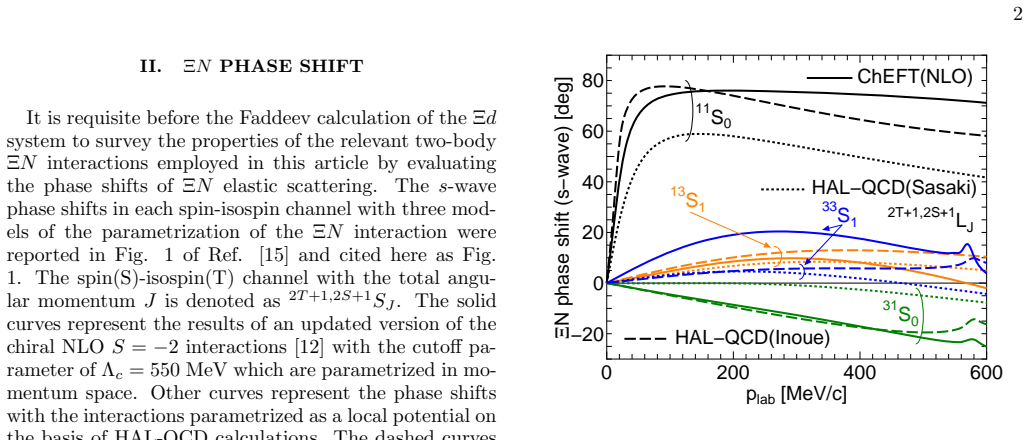
The spin(S)-isospin(T) channel with the total angu- lar momentumJis denoted as 2T+1,2S+1 SJ. The solid curves represent the results of an updated version of the chiral NLOS=−2 interactions [12] with the cutoff pa- rameter of Λc = 550 MeV which are parametrized in mo- mentum space. Other curves represent the phase shifts with the interactions parametrized ...
-
[2]
(dashed) and the other is with the fitting parameters for t/a= 12 by Sasakiet al.[14] (dotted). mentumJ= 1/2 and 3/2 channels, employing the three ΞNinteractions: the chiral NLO, Inoue and Sasaki po- tentials. The low-energy behavior of the phase shifts in- dicates that no ΞN Nbound state is expected in both J= 1/2 and 3/2. The absence of the bound state ...
-
[3]
It should be noted thatC(q 0) is simply denoted byC(q) in the sub- sequent figures
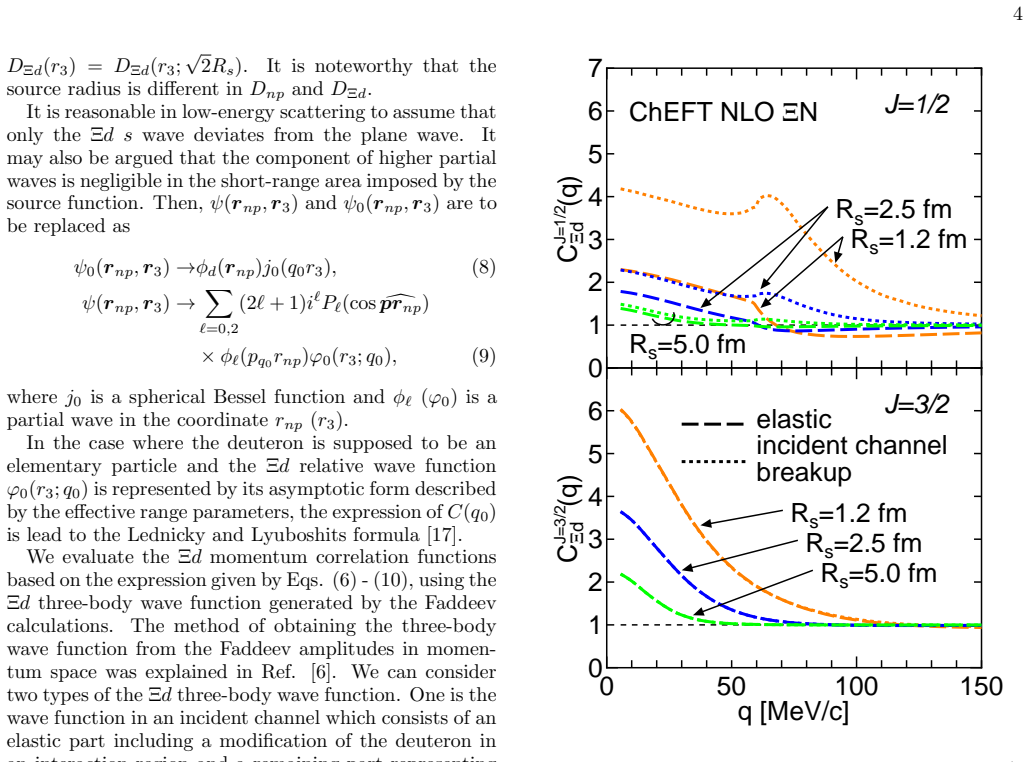
together with the chiral N4LO+ N Ninteraction [18], using the incident channel Ξdwave functions. It should be noted thatC(q 0) is simply denoted byC(q) in the sub- sequent figures. The cutoff scale is 550 MeV for both the 5 ΞNandN Ninteractions. Three representative source radius are selected for the calculations;R s = 1.2, 2.5, and 5.0 fm, respectively. ...
-
[4]
present in theJ= 3/2 correlation functions due to the absence of the coupling to the 1S0 N Nstate
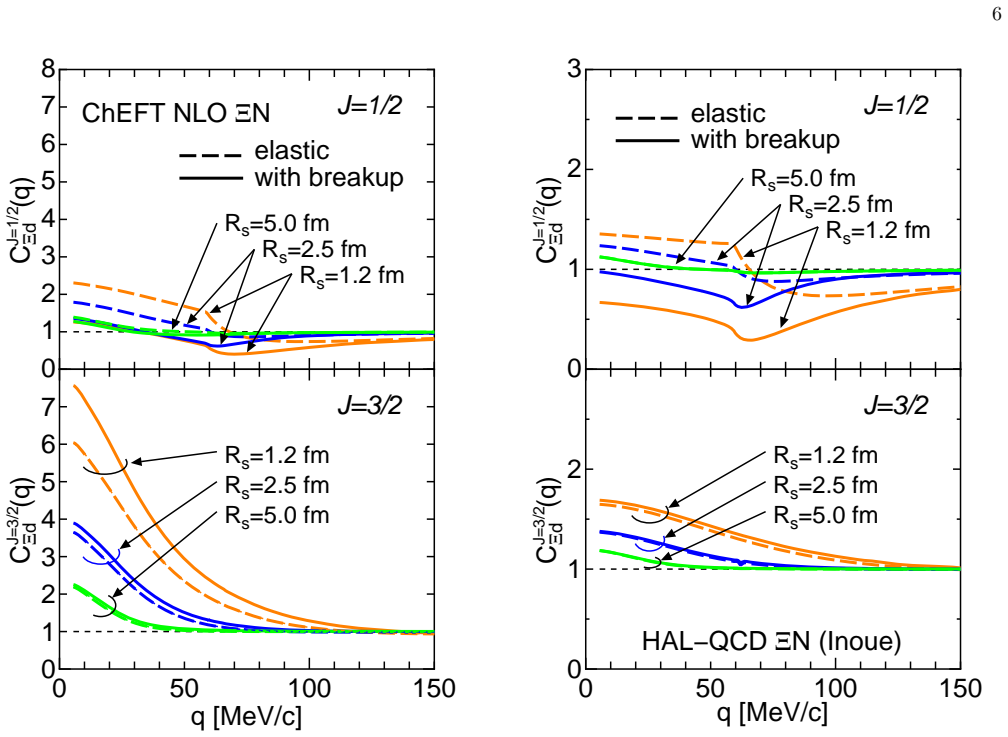
and the AV18 [19]N Ninteraction. present in theJ= 3/2 correlation functions due to the absence of the coupling to the 1S0 N Nstate. As demonstrated Figs. 4 and 5, the remaining two HAL-QCD potentials yield qualitatively similar results. Fig. 4 is for the Inoue potential, and Fig. 5 is for the Sasaki potential. Because these HAL-QCD potentials are parametr...
-
[5]
and the AV18 [19]N Ninteraction. 6 0 50 100 15 00 1 2 3 4 5 6 7 0 1 2 3 4 5 6 7 8 q [MeV/c] Rs=1.2 fm Rs=2.5 fm Rs=5.0 fm J=1/2 CΞd (q)J=1/2 elastic with breakup Rs=1.2 fm Rs=2.5 fm Rs=5.0 fm CΞd (q)J=3/2 J=3/2 ChEFT NLO ΞN FIG. 6: Ξdmomentum correlation functions in theJ= 1/2 and 3/2 channels for three choices of the source radiusR s = 1.2, 2.5, and 5.0 ...
-
[6]
and the AV18 [19]N Ninteraction. stantial interference to decrease the correlation function, which becomes smaller than the elastic one. Given that the experimental data is initially taken as a sum of theJ= 1/2 and 3/2 states, it is use- ful to show the total-spin averaged correlation function C av(q) = (C J=1/2 + 2CJ=3/2)/3, which is given in Fig
-
[7]
The depression below 1, as shown in the J= 1/2 correlation functions in Figs
These results show a considerable dependence of the theoretical correlation function on the three ΞNinterac- tions employed. The depression below 1, as shown in the J= 1/2 correlation functions in Figs. 6 - 8, is masked in the average quantity. VI. SUMMAR Y The understanding of the baryon-baryon interactions in a strangeness S=-2 sector remains in its nas...
-
[8]
and the AV18 [19]N Ninteraction. ergies in nuclei. The recent development of measuring hyperon-proton and hyperon-deuteron correlation func- tions in heavy-ion collision experiments has been shown to provide reliable sources of information on baryon- baryon interactions. These correlation functions are gov- erned by the two-body and three-body wave functi...
-
[9]
T. Nanamuraet al., Measurement of differential cross sections for Σ +pelastic scattering in the momentum range 0.44−0.80 GeV/c, Prog. Theor. Exp. Phys.2022, 093D01 (2022)
work page 2022
-
[10]
S. Acharyaet al., First Observation of an Attractive In- teraction between a Proton and a Cascade Baryon, Phys. Rev. Lett.123, 112002 (2019)
work page 2019
-
[11]
S. Acharyaet al.(ALICE Collaboration), Exploring the NΛ-NΣ coupled system with high precision correlation, Phy. Lett.B 833, 137272 (2022). 9
work page 2022
- [12]
-
[13]
M. Kohno and H. Kamada, Faddeev calculations of low- energy Λ-deuteron scattering and momentum correlation function, Phys. Rev. C110, 044005 (2024)
work page 2024
-
[14]
M. Kohno and H. Kamada, Λ-deuteron momentum cor- relation functions incorporating deuteron breakup con- tributions in Faddeev formulation, Phys. Rev. C112, 044005 (2025)
work page 2025
-
[15]
Nakazawaet al., The first evidence of a deeply bound state of Ξ- 14N system, Prog
K. Nakazawaet al., The first evidence of a deeply bound state of Ξ- 14N system, Prog. Theor. Exp. Phys.2015, 033D02 (2015)
work page 2015
-
[16]
Hayakawaet al., Observation of Coulomb-Assisted Nuclear Bound State of Ξ−-14N System, Phys
S.H. Hayakawaet al., Observation of Coulomb-Assisted Nuclear Bound State of Ξ−-14N System, Phys. Lev. Lett. 126, 062501 (2021)
work page 2021
-
[17]
Yoshimotoet al., First observation of a nuclear s-state of a Ξ hypernucleus, 12 Ξ C, Prog
K. Yoshimotoet al., First observation of a nuclear s-state of a Ξ hypernucleus, 12 Ξ C, Prog. Theor. Exp. Phys.2021, 073D02 (2021)
work page 2021
-
[18]
Y. Ichikawaet al., Missing-Mass Measurement of the 12C (K −, K+) Reaction at 1.8 GeV/cwith the Superconduct- ing Kaon Spectrometer, Prog. Theor. Exp. Phys.2024, 091D01 (2024)
work page 2024
-
[19]
J. Haidenbauer, U.-G. Meißner, and S. Petschauer, StrangenessS=−2 baryon-baryon interaction at next- to-leading order in chiral effective field theory, Nucl. Phys. A954, 273 (2016)
work page 2016
-
[20]
J. Haidenbauer and U.-G. Meißner, In-medium proper- ties of a ΞNinteraction derived from chiral effective field theory, Eur. Phys. J. A55, 23 (2019)
work page 2019
-
[21]
Inoue and for HAL QCD Collaboration, Strange nu- clear physics from QCD on lattice, AIP Conf
T. Inoue and for HAL QCD Collaboration, Strange nu- clear physics from QCD on lattice, AIP Conf. Proc.2130, 020002 (2019)
work page 2019
-
[22]
Sasakiet al., ΛΛ andNΞ interactions from lattice QCD near the physical point, Nucl
K. Sasakiet al., ΛΛ andNΞ interactions from lattice QCD near the physical point, Nucl. PhysA 998, 121737 (2020)
work page 2020
-
[23]
M. Kohno and K. Miyagawa, Ξ hypernuclear states pre- dicted by next-to-leading-order chiral baryon-baryon in- teractions, Prog. Theor. Phys.2021,103D4 (2021)
work page 2021
-
[24]
Mr´ owczy´ nski, Production of light nuclei at colliders- coalescence vs
S. Mr´ owczy´ nski, Production of light nuclei at colliders- coalescence vs. thermal model, Eur. Phys. J. Spec. Top. 229, 3559 (2020)
work page 2020
-
[25]
R. Lednicky and V. L. Lyuboshits, Final state interaction effect on pairing correlations between particles with small relative momenta, Sov. J. Nucl. Phys.35, 770 (1982) [Yad. Fiz.35, 1316 (1981)]
work page 1982
-
[26]
P. Reinert, and H. Krebs, and E. Epelbaum, Semilocal momentum-space regularized chiral two-nucleon poten- tials up to fifth order, Eur. Phys. J.A 54, 86 (2018)
work page 2018
-
[27]
R. B. Wiringa, V. G. J. Stoks, and R. Schiavilla, Accu- rate nucleon-nucleon potential with charge-independence breaking, Phys. Rev. C51, 38 (1995)
work page 1995
-
[28]
K. Miyagawa and M. Kohno, A realistic approach to the ΞN Nbound-state problem based on Faddeev equation, Few-Body Syst.62, 65 (2021)
work page 2021
-
[29]
W. Gl¨ ockle, H. Wita la, D. H¨ uber, H. Kamada, and J. Go- lak, The three-nucleon continuum: Achievement, chal- lenges and application, Phys. Rep.274, 107 (1996)
work page 1996
discussion (0)
Sign in with ORCID, Apple, or X to comment. Anyone can read and Pith papers without signing in.