Recognition: 2 theorem links
· Lean TheoremA Distributed Switching Protocol for Quantum Networks
Pith reviewed 2026-05-11 01:14 UTC · model grok-4.3
The pith
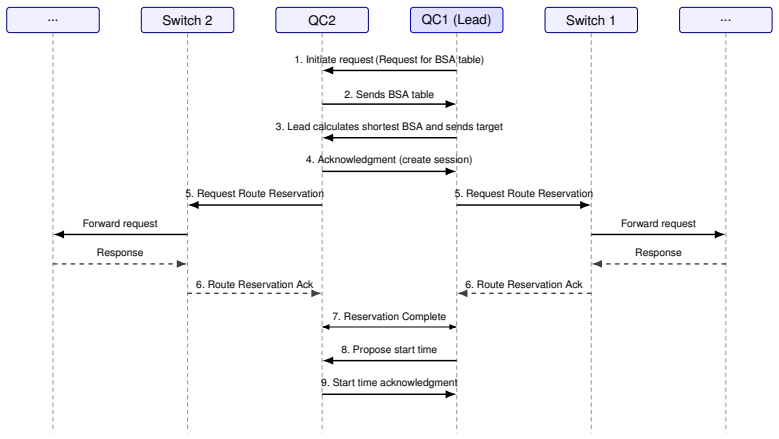
Two end nodes cooperatively select the lowest-cost shared Bell State Analyzer and reserve paths to establish entanglement links in a quantum network.
A machine-rendered reading of the paper's core claim, the machinery that carries it, and where it could break.
Core claim
The protocol enables link establishment between two end nodes by cooperatively selecting a target BSA node with the lowest path cost and independently reserving each path in the network through bi-path reservations, all within a photonic synchronization domain for unbuffered multidrop quantum networks.
What carries the argument
The cooperative BSA selection combined with distributed bi-path reservations, which allows resource sharing without central coordination or buffering.
If this is right
- High success rates for link establishment can be maintained in multidrop networks.
- Shared BSAs become feasible, reducing the need for dedicated analyzers per link.
- Performance stability under higher network loads supports scalable operation.
- Distributed decision-making eliminates single points of failure in resource allocation.
Where Pith is reading between the lines
- This approach could lower hardware costs for large quantum networks by maximizing BSA utilization.
- It opens the way for automated management in entanglement distribution without requiring quantum memories.
- Future work might test how the protocol handles photon loss rates beyond the simulation assumptions.
Load-bearing premise
The simulation of photon routing, switching delays, and traffic patterns accurately reflects real-world quantum network behavior.
What would settle it
Running the protocol on a physical quantum network and measuring link establishment success rates that are substantially lower than the simulated high rates under similar load conditions.
Figures




read the original abstract
With the advent of the construction and deployment of entanglement-based quantum networks, the efficient use of network resources will become a critical challenge for the scalable operation of such a system. Recently, architectures that incorporate memoryless optical switches have gained attention for forwarding entangled photons. By leveraging these architectures, costly resources such as high efficiency Bell State Analyzers (BSAs) can be shared across the network. Nevertheless, the introduction of switching substantially complicates the process of multiplexing and resource allocation compared to an individual link. In this work, we propose a switching protocol for unbuffered, multidrop quantum networks in a photonic synchronization domain that establishes a link between two end nodes using a shared BSA in the switched network. To achieve this, two end nodes cooperatively select the target BSA node with the lowest path cost and independently reserve each path within the network. Bi-path reservations are performed to allocate resources in a distributed manner. The proposed protocol is evaluated through simulation on Q-Fly network topologies under varying traffic conditions. The results demonstrate high link establishment success with stable performance even under increased network load. These capabilities which are driven by our proposed protocol are an essential way to realize large-scale, managed, and automated quantum networks.
Editorial analysis
A structured set of objections, weighed in public.
Referee Report
Summary. The manuscript proposes a distributed switching protocol for unbuffered multidrop quantum networks in a photonic synchronization domain. Two end nodes cooperatively select the lowest-cost shared BSA node and independently perform bi-path reservations to allocate resources without central control. The protocol is evaluated exclusively via discrete-event simulations on Q-Fly topologies under varying traffic loads, with the central claim being high link-establishment success rates that remain stable as network load increases.
Significance. If the simulation results are shown to be robust, the protocol would provide a concrete mechanism for sharing expensive BSAs across switched quantum networks, directly addressing a scalability bottleneck in entanglement distribution. The distributed, memoryless design is a positive contribution that avoids single points of failure. The use of reproducible simulation on standard topologies is a strength, though the absence of explicit modeling details for quantum-channel effects reduces the immediate applicability to physical systems.
major comments (2)
- [§4 and §5] §4 (Simulation Model) and §5 (Performance Evaluation): the discrete-event simulator is described without equations or parameter tables for photon loss, timing jitter, BSA inefficiency, or distributed synchronization errors. These effects are load-bearing for the headline claim of stable performance under increased load; their omission or idealization means the reported success rates cannot yet be taken as evidence for physical quantum networks.
- [§5.2] §5.2 (Traffic and Topology Parameters): no explicit description is given of the traffic model (e.g., Poisson rates, session durations), exact Q-Fly topology sizes, or the baseline protocols used for comparison. Without these, the generality of the “high link establishment success” result and its stability claim cannot be verified or reproduced.
minor comments (2)
- [§3] Notation for path cost and reservation messages is introduced without a consolidated table; a single reference table would improve readability.
- [§5] Figure captions for the simulation results do not state the number of independent runs or confidence intervals; adding these would strengthen the presentation.
Simulated Author's Rebuttal
We thank the referee for the constructive and detailed review of our manuscript. We have addressed each major comment below and will incorporate the suggested clarifications and additions in the revised version to improve reproducibility and strengthen the presentation of the simulation results.
read point-by-point responses
-
Referee: [§4 and §5] §4 (Simulation Model) and §5 (Performance Evaluation): the discrete-event simulator is described without equations or parameter tables for photon loss, timing jitter, BSA inefficiency, or distributed synchronization errors. These effects are load-bearing for the headline claim of stable performance under increased load; their omission or idealization means the reported success rates cannot yet be taken as evidence for physical quantum networks.
Authors: We agree that the current description of the discrete-event simulator in §4 and §5 lacks sufficient technical detail on the modeled physical effects. In the revised manuscript we will expand §4 with the governing equations for photon loss, timing jitter, BSA inefficiency, and distributed synchronization errors, together with a comprehensive parameter table listing all numerical values used in the simulations. This will make explicit the assumptions underlying the reported link-establishment success rates and allow readers to evaluate their applicability to physical systems. revision: yes
-
Referee: [§5.2] §5.2 (Traffic and Topology Parameters): no explicit description is given of the traffic model (e.g., Poisson rates, session durations), exact Q-Fly topology sizes, or the baseline protocols used for comparison. Without these, the generality of the “high link establishment success” result and its stability claim cannot be verified or reproduced.
Authors: We acknowledge the need for greater specificity in §5.2. The revised manuscript will include an explicit traffic model (Poisson arrival process with stated rates and session-duration distributions), the precise node counts and link configurations of each Q-Fly topology employed, and a clear description of the baseline protocols against which our distributed switching protocol is compared. These additions will enable independent reproduction and assessment of the stability claims under varying loads. revision: yes
Circularity Check
No circularity: protocol design and simulation evaluation are independent
full rationale
The paper proposes an original distributed switching protocol for unbuffered multidrop quantum networks and assesses its performance exclusively via discrete-event simulation on Q-Fly topologies under varying traffic loads. Link-establishment success rates and stability metrics are generated outputs of the simulator rather than being algebraically equivalent to the protocol rules or fitted parameters by construction. No self-citations, uniqueness theorems, or ansatzes are invoked to justify the central claims; the simulation model operates as an external benchmark. This satisfies the default expectation of a self-contained design paper with no load-bearing reductions to its own inputs.
Axiom & Free-Parameter Ledger
axioms (2)
- domain assumption Memoryless optical switches can forward entangled photons between nodes while sharing a BSA.
- domain assumption End nodes can independently compute and reserve paths to a chosen BSA without central coordination.
Lean theorems connected to this paper
-
IndisputableMonolith/Foundation/RealityFromDistinction.leanreality_from_one_distinction unclear?
unclearRelation between the paper passage and the cited Recognition theorem.
The proposed protocol is evaluated through simulation on Q-Fly network topologies under varying traffic conditions. The results demonstrate high link establishment success with stable performance even under increased network load.
-
IndisputableMonolith/Cost/FunctionalEquation.leanwashburn_uniqueness_aczel unclear?
unclearRelation between the paper passage and the cited Recognition theorem.
Bi-path reservations are performed to allocate resources in a distributed manner.
What do these tags mean?
- matches
- The paper's claim is directly supported by a theorem in the formal canon.
- supports
- The theorem supports part of the paper's argument, but the paper may add assumptions or extra steps.
- extends
- The paper goes beyond the formal theorem; the theorem is a base layer rather than the whole result.
- uses
- The paper appears to rely on the theorem as machinery.
- contradicts
- The paper's claim conflicts with a theorem or certificate in the canon.
- unclear
- Pith found a possible connection, but the passage is too broad, indirect, or ambiguous to say the theorem truly supports the claim.
Reference graph
Works this paper leans on
-
[1]
R. Van Meter,Quantum Networking. John Wiley & Sons, 2014, doi:10.1002/9781118648919
-
[2]
J. Kn ¨orzer, X. Liu, B. F. Schiffer, and J. Tura, “Distributed quantum information processing: A review of recent progress,”arXiv preprint arXiv:2510.15630, 2025, doi:10.48550/arXiv.2510.15630
-
[3]
Private quantum computation: an introduction to blind quantum computing and related protocols,
J. F. Fitzsimons, “Private quantum computation: an introduction to blind quantum computing and related protocols,”npj Quantum Information, vol. 3, no. 1, p. 23, 2017, doi:10.1038/s41534-017-0025-3
-
[4]
arXiv:2310.12780 Lei Song, Yuan Feng, and Lijun Zhang
S. Singh, M. Doosti, N. Mathur, M. Delavar, A. Mantri, H. Ollivier, and E. Kashefi, “Towards a unified quantum protocol framework: Classifica- tion, implementation, and use cases,”arXiv preprint arXiv:2310.12780, 2023, doi:10.48550/arXiv.2310.12780
-
[5]
Path selection for quantum repeater networks,
R. Van Meter, T. Satoh, T. D. Ladd, W. J. Munro, and K. Nemoto, “Path selection for quantum repeater networks,”Networking Science, vol. 3, no. 1, pp. 82–95, 2013, doi:10.1007/s13119-013-0026-2
-
[6]
Entanglement routing in quantum networks: A comprehensive survey,
A. Abane, M. Cubeddu, V . S. Mai, and A. Battou, “Entanglement routing in quantum networks: A comprehensive survey,”IEEE Transactions on Quantum Engineering, 2025, doi:10.1109/TQE.2025.3541123
-
[7]
Multiplexing schemes for quantum repeater networks,
L. Aparicio and R. V . Meter, “Multiplexing schemes for quantum repeater networks,” inQuantum Communications and Quantum Imaging IX, R. E. Meyers, Y . Shih, and K. S. Deacon, Eds., vol. 8163, International Society for Optics and Photonics. SPIE, 2011, p. 816308, doi:10.1117/12.893272
-
[8]
Request scheduling in quantum networks,
C. Cicconetti, M. Conti, and A. Passarella, “Request scheduling in quantum networks,”IEEE Transactions on Quantum Engineering, vol. 2, pp. 2–17, 2021
work page 2021
-
[9]
Design and analysis of communication protocols for quantum repeater networks,
C. Jones, D. Kim, M. T. Rakher, P. G. Kwiat, and T. D. Ladd, “Design and analysis of communication protocols for quantum repeater networks,”New Journal of Physics, vol. 18, no. 8, p. 083015, 2016, doi:10.1088/1367-2630/18/8/083015
-
[10]
Remote-entanglement protocols for stationary qubits with photonic interfaces,
H. K. Beukers, M. Pasini, H. Choi, D. Englund, R. Hanson, and J. Borregaard, “Remote-entanglement protocols for stationary qubits with photonic interfaces,”PRX Quantum, vol. 5, p. 010202, Mar 2024, doi:10.1103/PRXQuantum.5.010202
-
[11]
K. S. Soon, M. Hajdu ˇsek, S. Nagayama, N. Benchasattabuse, K. Ter- amoto, R. Satoh, and R. Van Meter, “An implementation and analysis of a practical quantum link architecture utilizing entangled photon sources,” in2024 International Conference on Quantum Communica- tions, Networking, and Computing (QCNC). IEEE, 2024, pp. 25–32, doi:10.1109/QCNC62729.2024.00014
-
[12]
doi:10.1038/s41586-024-08404-x
D. Main, P. Drmota, D. Nadlinger, E. Ainley, A. Agrawal, B. Nichol, R. Srinivas, G. Araneda, and D. Lucas, “Distributed quantum com- puting across an optical network link,”Nature, pp. 1–6, 2025, doi:10.1038/s41586-024-08404-x
-
[13]
Reconfigurable quantum local area network over deployed fiber,
M. Alshowkanet al., “Reconfigurable quantum local area network over deployed fiber,”PRX Quantum, vol. 2, no. 4, p. 040304, 2021, doi:10.1103/PRXQuantum.2.040304
-
[14]
Quant- net: A testbed for quantum networking research over deployed fiber,
I. Monga, E. Saglamyurek, E. Kissel, H. Haffner, and W. Wu, “Quant- net: A testbed for quantum networking research over deployed fiber,” in Proceedings of the 1st Workshop on Quantum Networks and Distributed Quantum Computing, 2023, pp. 31–37, doi:10.1145/3610251.3610561
-
[15]
A. Taherkhani, K. Teramoto, A. Todd, R. Van Meter, and S. Na- gayama, “A scalable framework for automation of quantum network experiments,” in2024 IEEE International Conference on Quantum Computing and Engineering (QCE), vol. 02, 2024, pp. 624–625, doi:10.1109/QCE60285.2024.10436
-
[16]
M. Koyama, C. Yun, A. Taherkhani, N. Benchasattabuse, B. O. Sane, M. Hajdu ˇsek, S. Nagayama, and R. Van Meter, “Optimal switching networks for paired-egress bell state analyzer pools,” in2024 IEEE International Conference on Quantum Computing and Engineering (QCE), vol. 1. IEEE, 2024, pp. 1897–1907, doi:10.1109/QCE60285.2024.00219
-
[17]
On-demand resource allocation for a quantum network hub,
S. Gauthier, T. Vasantam, and G. Vardoyan, “On-demand resource allocation for a quantum network hub,”IEEE Transactions on Quantum Engineering, 2025, doi:10.1109/TQE.2025.3641834
-
[18]
Switching networks for pairwise-entanglement distribution,
R. J. Drost, T. J. Moore, and M. Brodsky, “Switching networks for pairwise-entanglement distribution,”Journal of Optical Com- munications and Networking, vol. 8, no. 5, pp. 331–342, 2016, doi:10.1364/JOCN.8.000331
-
[19]
A link layer protocol for quantum networks,
A. Dahlberget al., “A link layer protocol for quantum networks,” inProceedings of the ACM Special Interest Group on Data Communication, ser. SIGCOMM ’19. New York, NY , USA: Association for Computing Machinery, 2019, p. 159–173, doi:10.1145/3341302.3342070
-
[20]
Embedding learning in hybrid quantum-classical neural networks,
R. Van Meter, R. Satoh, N. Benchasattabuse, K. Teramoto, T. Matsuo, M. Hajdu ˇsek, T. Satoh, S. Nagayama, and S. Suzuki, “A quantum internet architecture,” in2022 IEEE International Conference on Quan- tum Computing and Engineering (QCE). IEEE, 2022, pp. 341–352, doi:10.1109/QCE53715.2022.00055
-
[21]
Y . Mori, T. Sasaki, R. Ikuta, K. Teramoto, H. Ohno, M. Hajdu ˇsek, R. Van Meter, and S. Nagayama, “Scalable timing coordination of bell state analyzers in quantum networks,” in2024 IEEE International Conference on Quantum Computing and Engineering (QCE), vol. 1. IEEE, 2024, pp. 1890–1896, doi:10.1109/QCE60285.2024.00218
-
[22]
Q-Fly: An Optical Interconnect for Modular Quantum Computers,
D. Sakumaet al., “Q–Fly: An optical interconnect for modu- lar quantum computers,”arXiv preprint arXiv:2412.09299, 2024, doi:10.48550/arXiv.2412.09299
-
[23]
Quantum data center infrastructures: A scalable architectural design perspective,
H. Shapourian, E. Kaur, T. Sewell, J. Zhao, M. Kilzer, R. Kompella, and R. Nejabati, “Quantum data center infrastructures: A scalable ar- chitectural design perspective,”arXiv preprint arXiv:2501.05598, 2025, doi:10.48550/arXiv.2501.05598
-
[24]
M. Hajdu ˇsek and R. Van Meter, “Quantum communications,”arXiv preprint arXiv:2311.02367, 2023, doi:10.48550/arXiv.2311.02367
-
[25]
Accelerating large-scale linear algebra using variational quantum imaginary time evolution,
A. Taherkhani, A. Todd, K. Teramoto, R. Van Meter, and S. Na- gayama, “Automatic configuration protocols for optical quantum net- works,” in2025 IEEE International Conference on Quantum Comput- ing and Engineering (QCE), vol. 1. IEEE, 2025, pp. 1263–1273, doi:10.1109/QCE65121.2025.00141
-
[26]
Numerische Mathematik , author =
E. Dijkstra, “Two problems in connection with graphs,”Numer. Math, vol. 1, pp. 269–271, 1959, doi:10.1007/BF01386390
discussion (0)
Sign in with ORCID, Apple, or X to comment. Anyone can read and Pith papers without signing in.