Recognition: no theorem link
Over-the-Air Beamforming Design for Full-Duplex Cell-Free Massive MIMO Systems
Pith reviewed 2026-05-11 02:09 UTC · model grok-4.3
The pith
Distributed over-the-air beamforming with pilot projection enables effective full-duplex operation in cell-free massive MIMO systems.
A machine-rendered reading of the paper's core claim, the machinery that carries it, and where it could break.
Core claim
The authors show that by introducing a pilot-domain projection of the received signals at the UEs to suppress UE-to-UE pilot leakage and employing best-response updates at the UEs within an alternating optimization framework, a fully distributed beamforming design based on iterative UL and DL pilot signaling under a joint UL and DL sum MSE criterion can achieve accurate cross-term reconstruction at the APs and improved performance in FD cell-free massive MIMO systems.
What carries the argument
The pilot-domain projection of received signals at the UEs combined with best-response updates in an alternating optimization framework for joint UL/DL beamforming under sum MSE criterion.
If this is right
- The joint criterion accounts for all major interference components in FD operation.
- The projection enables accurate cross-term reconstruction despite simultaneous pilot transmissions.
- Best-response updates improve convergence under strong interference.
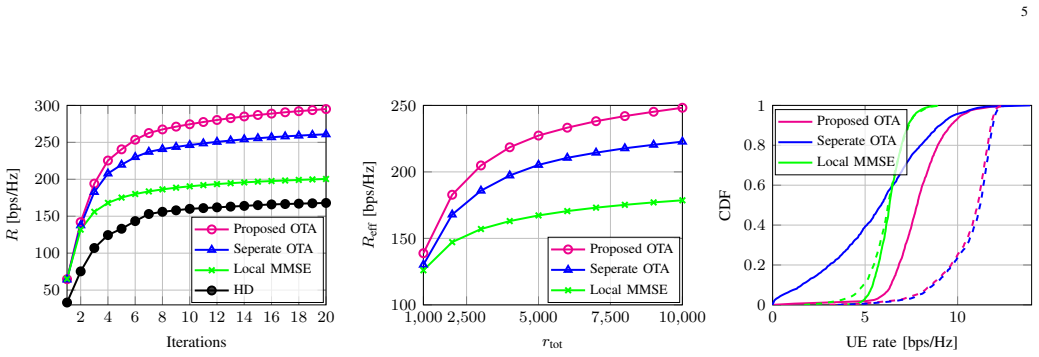
- Overall, higher effective sum rates are achieved, with gains most pronounced for strong interferers.
Where Pith is reading between the lines
- Extending this to networks with mobile users could require adaptive projection methods.
- The distributed nature suggests scalability benefits over centralized alternatives in very large deployments.
- Hardware experiments with actual full-duplex APs would validate the modeled interference suppression.
Load-bearing premise
The pilot-domain projection at the UEs sufficiently suppresses UE-to-UE pilot leakage to allow accurate reconstruction of cross terms at the APs.
What would settle it
A measurement or simulation showing that the sum rate does not improve or convergence slows under strong UE-to-UE interference when using the proposed projection and best-response updates compared to baseline distributed schemes.
Figures
read the original abstract
We study a full-duplex (FD) cell-free massive MIMO system where distributed access points (APs) operate in FD mode while user equipments (UEs) remain half-duplex. Although simultaneous uplink (UL) and downlink (DL) transmissions improve spectral efficiency, they introduce residual self-interference, AP-to-AP coupling, and UE-to-UE cross-link interference. Building on prior over-the-air distributed beamforming frameworks, we develop a fully distributed beamforming design based on iterative UL and DL pilot signaling under a joint UL and DL sum mean-square error criterion that explicitly accounts for these interference components. In FD operation, simultaneous UL and DL pilot transmissions cause UE-to-UE pilot leakage, which contaminates the reconstruction of the cross terms required for AP-specific beamforming design. To mitigate this effect, we introduce a pilot-domain projection of the received signals at the UEs, which suppresses the interference component and enables accurate cross-term reconstruction at the APs. In addition, best-response updates at the UEs are employed within the alternating optimization framework to improve convergence under strong UE-to-UE interference. Numerical results demonstrate faster convergence and higher effective sum rate, with particularly significant gains for strongly interfering UEs, compared with both separate UL and DL distributed OTA beamforming training schemes and designs based solely on local channel state information.
Editorial analysis
A structured set of objections, weighed in public.
Referee Report
Summary. The paper proposes a fully distributed over-the-air beamforming design for full-duplex cell-free massive MIMO systems with APs in FD mode and half-duplex UEs. It develops an iterative algorithm using simultaneous UL and DL pilot signaling under a joint UL/DL sum mean-square error criterion that accounts for residual self-interference, AP-to-AP coupling, and UE-to-UE cross-link interference. A pilot-domain projection is introduced at the UEs to suppress UE-to-UE pilot leakage and enable accurate cross-term reconstruction at the APs, combined with best-response updates at the UEs to improve convergence. Numerical results claim faster convergence and higher effective sum rates, with notable gains under strong UE-to-UE interference, relative to separate UL/DL OTA schemes and local CSI designs.
Significance. If the projection step reliably suppresses leakage without introducing significant residual bias and the iterative best-response updates converge as claimed, the work would advance practical distributed beamforming for FD cell-free systems by enabling low-overhead, interference-aware designs that scale with distributed APs. The explicit joint MSE formulation and handling of strong interference scenarios address key limitations in existing OTA frameworks, potentially improving spectral efficiency in dense deployments. The numerical improvements in sum rate and convergence speed are promising for the strong-interference regime highlighted in the abstract.
major comments (2)
- [Abstract] Abstract: The central claim that the pilot-domain projection 'suppresses the interference component and enables accurate cross-term reconstruction at the APs' is load-bearing for the joint UL/DL sum-MSE beamformer, yet no analytic bound on the residual norm after projection (or resulting MSE degradation) is provided. If the projection matrix is formed from imperfect local estimates or if leakage channels are not perfectly orthogonal to the subspace, nonzero residual UE-to-UE pilot leakage directly biases the cross terms used in AP best-response updates; this risk is especially acute in the strong-interference regime where the method is claimed to be most useful.
- [Numerical results] Numerical results section: The reported gains in effective sum rate and convergence lack Monte Carlo run counts, error bars, or explicit parameter settings (e.g., interference strength levels, pilot lengths) for the 'strongly interfering UEs' case. Without these, it is impossible to assess whether the observed improvements over baselines are statistically robust or sensitive to the projection residual.
minor comments (2)
- [Section describing the projection] The notation for the projection matrix and the effective pilot observation after projection should be defined explicitly with an equation reference to avoid ambiguity in how the suppression is implemented.
- [Alternating optimization framework] Clarify whether the best-response updates at the UEs are performed with perfect knowledge of the projected signals or under the same estimation errors as the APs.
Simulated Author's Rebuttal
We thank the referee for the thorough review and constructive comments on our manuscript. We address each major comment point by point below and have revised the manuscript to strengthen the presentation where feasible.
read point-by-point responses
-
Referee: [Abstract] The central claim that the pilot-domain projection 'suppresses the interference component and enables accurate cross-term reconstruction at the APs' is load-bearing for the joint UL/DL sum-MSE beamformer, yet no analytic bound on the residual norm after projection (or resulting MSE degradation) is provided. If the projection matrix is formed from imperfect local estimates or if leakage channels are not perfectly orthogonal to the subspace, nonzero residual UE-to-UE pilot leakage directly biases the cross terms used in AP best-response updates; this risk is especially acute in the strong-interference regime where the method is claimed to be most useful.
Authors: We agree that an analytic bound on the residual norm after projection would provide stronger theoretical grounding for the claim, particularly under imperfect local CSI. Deriving a tight, closed-form bound is challenging because the projection matrix depends on noisy local estimates of the UE-to-UE channels and the leakage subspace is not guaranteed to be perfectly orthogonal in finite dimensions. The manuscript instead relies on the geometric interpretation of the projection (onto the orthogonal complement of the estimated interference directions) together with the alternating optimization structure. In the revised version we have added a brief discussion of the residual bias under imperfect CSI and included additional numerical results that quantify the residual norm and its impact on the reconstructed cross terms across a range of interference strengths. These changes clarify the operating regime without overstating the guarantees. revision: partial
-
Referee: [Numerical results] The reported gains in effective sum rate and convergence lack Monte Carlo run counts, error bars, or explicit parameter settings (e.g., interference strength levels, pilot lengths) for the 'strongly interfering UEs' case. Without these, it is impossible to assess whether the observed improvements over baselines are statistically robust or sensitive to the projection residual.
Authors: We acknowledge that the original numerical section omitted several details required for reproducibility and statistical assessment. In the revised manuscript we now explicitly state that all curves are averaged over 1000 independent Monte Carlo realizations, include error bars showing one standard deviation, and provide the precise parameter values used for the strong-interference scenario (UE-to-UE channel gain set to 0 dB, pilot length of 8 symbols, and the specific AP/UE counts). These additions confirm that the reported gains in sum rate and convergence speed remain consistent and are not artifacts of a single realization or hidden parameter choice. revision: yes
Circularity Check
Iterative OTA beamforming design derives directly from system model and pilot observations without reduction to inputs
full rationale
The paper presents a new iterative distributed beamforming algorithm using UL/DL pilot signaling and a pilot-domain projection at UEs to handle interference in FD cell-free massive MIMO. The updates follow from the joint UL/DL sum-MSE criterion and the defined system model (residual SI, AP-to-AP, UE-to-UE terms). No equations reduce a claimed prediction or result to a fitted parameter or prior self-result by construction. The projection is introduced as a mitigation technique, not derived tautologically. Self-citation to prior OTA frameworks is present but not load-bearing for the central FD-specific contributions. The derivation chain remains self-contained against the stated model and observations.
Axiom & Free-Parameter Ledger
axioms (2)
- domain assumption Distributed APs operate in full-duplex while UEs remain half-duplex, with residual self-interference, AP-to-AP coupling, and UE-to-UE cross-link interference present.
- domain assumption Iterative UL and DL pilot signaling can be used to reconstruct cross terms needed for beamforming.
Reference graph
Works this paper leans on
-
[1]
Cell-free massive MIMO versus small cells,
H. Q. Ngo, A. Ashikhmin, H. Yang, E. G. Larsson, and T. L. Marzetta, “Cell-free massive MIMO versus small cells,”IEEE Trans. Wireless Commun., vol. 16, no. 3, pp. 1834–1850, Mar. 2017
work page 2017
-
[2]
Performance of cell-free massive MIMO systems with MMSE and LSFD receivers,
E. Nayebi, A. Ashikhmin, T. L. Marzetta, H. Yang, and B. D. Rao, “Performance of cell-free massive MIMO systems with MMSE and LSFD receivers,” inProc. Asilomar Conf. Signals, Syst., and Comput. (ASILOMAR), Nov. 2017, pp. 203–207
work page 2017
-
[3]
Ubiquitous cell-free massive MIMO communications,
G. Interdonato, E. Björnson, H. Q. Ngo, P. Frenger, and E. G. Larsson, “Ubiquitous cell-free massive MIMO communications,”EURASIP J. Wireless Commun. Netw., vol. 2019, no. 197, Aug. 2019
work page 2019
-
[4]
Making cell-free massive MIMO competitive with MMSE processing and centralized implementation,
E. Björnson and L. Sanguinetti, “Making cell-free massive MIMO competitive with MMSE processing and centralized implementation,” IEEE Trans. Wireless Commun., vol. 19, no. 1, pp. 77–90, Jan. 2020
work page 2020
-
[5]
Scalable synchronization and reciprocity calibration for distributed multiuser MIMO,
R. Rogalin, O. Y . Bursalioglu, H. Papadopoulos, G. Caire, A. F. Molisch, A. Michaloliakos, V . Balan, and K. Psounis, “Scalable synchronization and reciprocity calibration for distributed multiuser MIMO,”IEEE Trans. Wireless Commun., vol. 13, no. 4, pp. 1815–1831, Apr. 2014
work page 2014
-
[6]
Distributed precoding design via over-the-air signaling for cell-free massive MIMO,
I. Atzeni, B. Gouda, and A. Tölli, “Distributed precoding design via over-the-air signaling for cell-free massive MIMO,”IEEE Trans. Wireless Commun., vol. 20, no. 2, pp. 1201–1216, Feb. 2021
work page 2021
-
[7]
Pilot-aided distributed multi-group multicast precoding design for cell-free massive MIMO,
B. Gouda, I. Atzeni, and A. Tölli, “Pilot-aided distributed multi-group multicast precoding design for cell-free massive MIMO,”IEEE Trans. Wireless Commun., vol. 23, no. 8, pp. 9282–9298, Aug. 2024
work page 2024
-
[8]
Distributed joint receiver design for cell-free massive MIMO with fast convergence,
B. Gouda and A. Tölli, “Distributed joint receiver design for cell-free massive MIMO with fast convergence,” inProc. IEEE Int. Conf. Commun. (ICC), Jun. 2021, pp. 1–6
work page 2021
-
[9]
Q. Shi, M. Razaviyayn, Z.-Q. Luo, and C. He, “An iteratively weighted MMSE approach to distributed sum-utility maximization for a MIMO interfering broadcast channel,”IEEE Trans. Signal Process., vol. 59, no. 9, pp. 4331–4340, Sep. 2011
work page 2011
-
[10]
In-band full-duplex wireless: Challenges and opportunities,
A. Sabharwal, P. Schniter, D. Guo, D. W. Bliss, S. Rangarajan, and R. Wichman, “In-band full-duplex wireless: Challenges and opportunities,” IEEE J. Sel. Areas Commun., vol. 32, no. 9, pp. 1637–1652, Sep. 2014
work page 2014
-
[11]
D. Bharadia, E. McMilin, and S. Katti, “Full duplex radios,” inProc. ACM SIGCOMM, ser. SIGCOMM ’13. New York, NY , USA: Association for Computing Machinery, 2013, pp. 375–386
work page 2013
-
[12]
Passive self-interference suppression for full-duplex infrastructure nodes,
E. Everett, A. Sahai, and A. Sabharwal, “Passive self-interference suppression for full-duplex infrastructure nodes,”IEEE Trans. Wireless Commun., vol. 13, no. 2, pp. 680–694, Feb. 2014
work page 2014
-
[13]
Bi-directional beamformer training for dynamic TDD networks,
P. Jayasinghe, A. Tölli, J. Kaleva, and M. Latva-aho, “Bi-directional beamformer training for dynamic TDD networks,”IEEE Trans. Signal Process., vol. 66, no. 23, pp. 6252–6267, Dec. 2018
work page 2018
-
[14]
Prospective multiple antenna technologies for beyond 5G,
J. Zhang, E. Björnson, M. Matthaiou, D. J. Love, D. W. K. Ng, and H. Yang, “Prospective multiple antenna technologies for beyond 5G,” IEEE J. Sel. Areas Commun., vol. 38, no. 8, pp. 1637–1660, Aug. 2020
work page 2020
-
[15]
A. Chowdhury, R. Chopra, and C. R. Murthy, “Can dynamic TDD enabled half-duplex cell-free massive MIMO outperform full-duplex cellular massive MIMO?”IEEE Trans. Commun., vol. 70, no. 7, pp. 4867–4883, Jul. 2022
work page 2022
-
[16]
Combined DL-UL distributed beamforming design for cell-free massive MIMO,
B. Gouda, A. Arvola, I. Atzeni, and A. Tölli, “Combined DL-UL distributed beamforming design for cell-free massive MIMO,”IEEE Wireless Commun. Lett., vol. 13, no. 6, pp. 1621–1625, Jun. 2024
work page 2024
-
[17]
A unified convergence analysis of block successive minimization methods for nonsmooth optimization,
M. Razaviyayn, M. Hong, and Z.-Q. Luo, “A unified convergence analysis of block successive minimization methods for nonsmooth optimization,” SIAM Journal on Optimization, vol. 23, no. 2, pp. 1126–1153, 2013
work page 2013
discussion (0)
Sign in with ORCID, Apple, or X to comment. Anyone can read and Pith papers without signing in.