Recognition: 2 theorem links
· Lean TheoremRabi-coupling-induced three-component quantum droplet in ultracold Bose gases
Pith reviewed 2026-05-11 02:02 UTC · model grok-4.3
The pith
Rabi coupling enables three-component quantum droplets even with only one attractive interspecies interaction.
A machine-rendered reading of the paper's core claim, the machinery that carries it, and where it could break.
Core claim
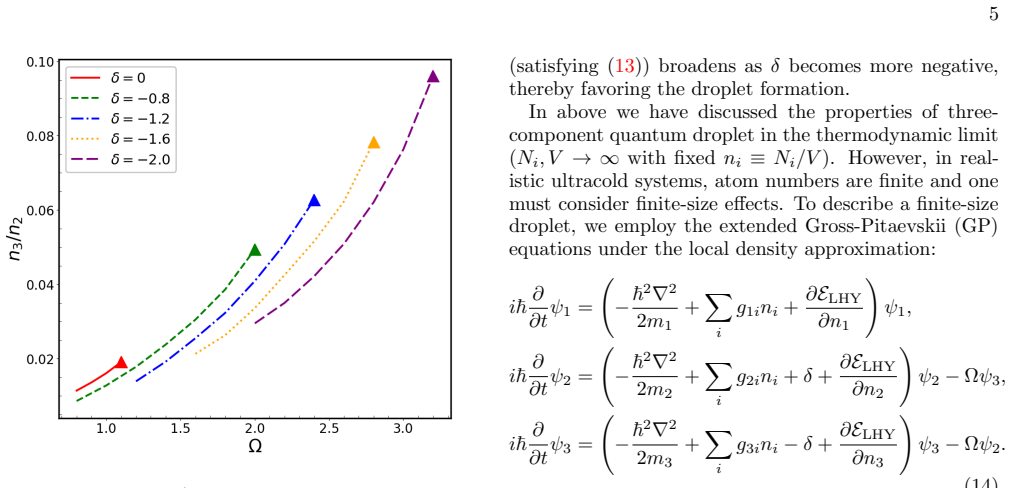
The authors show that Rabi coupling between one component of a binary quantum droplet and a third species creates a stable three-component droplet. The third component's population increases with Rabi coupling strength, but this introduces destabilizing repulsive interactions that are mitigated by a finite detuning between the Rabi-coupled components. Thermodynamic stability and dynamical simulations confirm this in realistic Na-Rb systems.
What carries the argument
The Rabi coupling term added to the extended Gross-Pitaevskii equations, which acts as a bridge allowing the third component to join the self-bound binary droplet formed by the attractive interspecies interaction.
If this is right
- Stronger Rabi coupling increases the fraction of the third component in the droplet.
- Finite detuning between the Rabi-coupled states prevents destabilization from added repulsive interactions.
- This provides a general method to stabilize multi-component droplets by linking additional components to binary droplets via single-particle fields.
- The mechanism is demonstrated to work in Na-Rb mixtures through both analysis and numerical simulations.
Where Pith is reading between the lines
- This could enable experimental creation of droplets with more components by applying multiple Rabi couplings in sequence.
- The dependence on detuning might allow fine-tuning of droplet composition in lab settings.
- Similar single-particle field techniques could apply to other multi-component quantum many-body systems.
- Testing in different atomic species mixtures would verify the generality of the route.
Load-bearing premise
The extended Gross-Pitaevskii equations with Rabi coupling terms accurately model the stability and dynamics of the three-component droplet in Na-Rb mixtures, including effects of finite detuning.
What would settle it
An experiment in Na-Rb mixtures where applying Rabi coupling fails to incorporate a stable fraction of the third component into the droplet, or where the droplet disperses without sufficient detuning, would falsify the proposed mechanism.
Figures



read the original abstract
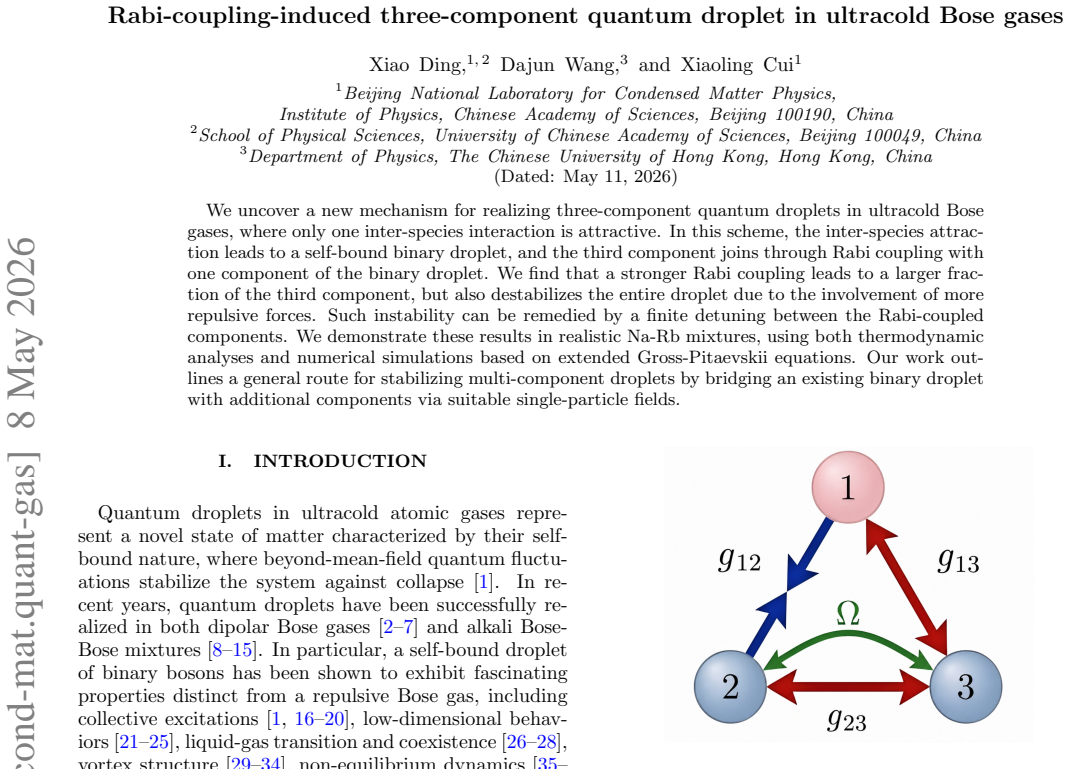
We uncover a new mechanism for realizing three-component quantum droplets in ultracold Bose gases, where only one inter-species interaction is attractive. In this scheme, the inter-species attraction leads to a self-bound binary droplet, and the third component joins through Rabi coupling with one component of the binary droplet. We find that a stronger Rabi coupling leads to a larger fraction of the third component, but also destabilizes the entire droplet due to the involvement of more repulsive forces. Such instability can be remedied by a finite detuning between the Rabi-coupled components. We demonstrate these results in realistic Na-Rb mixtures, using both thermodynamic analyses and numerical simulations based on extended Gross-Pitaevskii equations. Our work outlines a general route for stabilizing multi-component droplets by bridging an existing binary droplet with additional components via suitable single-particle fields.
Editorial analysis
A structured set of objections, weighed in public.
Referee Report
Summary. The manuscript proposes a mechanism for realizing stable three-component quantum droplets in ultracold Bose gases with only one attractive interspecies interaction: a self-bound binary droplet is formed by the attractive pair, the third component is attached via Rabi coupling to one of the binary components, and finite detuning is introduced to counteract the destabilization that accompanies stronger Rabi coupling. The results are illustrated for realistic Na-Rb parameters through thermodynamic analysis of the energy functional and numerical simulations of the extended Gross-Pitaevskii equations.
Significance. If the central claims are substantiated, the work supplies a concrete, experimentally accessible route for extending binary quantum droplets to three (and potentially more) components by means of single-particle Rabi fields and detuning. This could broaden the range of stable multi-component droplet states beyond the narrow window of attractive interactions required in purely interaction-driven schemes.
major comments (2)
- [Extended GPE formulation and thermodynamic analysis (near Eq. for energy functional)] The central stability analysis rests on grafting the standard two-component Lee-Huang-Yang (LHY) correction directly onto the three-component extended GPE that includes coherent Rabi terms and detuning. Because the Rabi coupling mixes the spinor components and shifts the Bogoliubov excitation spectrum, the infrared divergence that generates the LHY term is altered; no derivation or numerical validation of the modified fluctuation integral is provided for the Na-Rb parameters employed.
- [Numerical simulations and stability diagrams] The claim that finite detuning restores stability for stronger Rabi coupling is supported only by numerical solutions of the extended GPE; no systematic error analysis or comparison against a modified LHY expression is given to show that the reported stability boundaries remain quantitatively reliable once the Rabi-induced change in the fluctuation spectrum is accounted for.
minor comments (2)
- [Introduction and model section] Notation for the three-component order parameter and the Rabi matrix should be introduced once in a dedicated subsection rather than piecemeal in the text.
- [Parameter choice for Na-Rb] The abstract states that 'only one inter-species interaction is attractive,' but the main text should explicitly list the three scattering lengths used for Na-Rb and confirm which pair provides the sole attraction.
Simulated Author's Rebuttal
We thank the referee for the careful reading and constructive comments on our manuscript. The points raised concerning the application of the Lee-Huang-Yang correction in the Rabi-coupled three-component system are important, and we address them point by point below, proposing targeted revisions to improve clarity and transparency.
read point-by-point responses
-
Referee: The central stability analysis rests on grafting the standard two-component Lee-Huang-Yang (LHY) correction directly onto the three-component extended GPE that includes coherent Rabi terms and detuning. Because the Rabi coupling mixes the spinor components and shifts the Bogoliubov excitation spectrum, the infrared divergence that generates the LHY term is altered; no derivation or numerical validation of the modified fluctuation integral is provided for the Na-Rb parameters employed.
Authors: We acknowledge that Rabi coupling mixes the components and modifies the Bogoliubov spectrum relative to the pure two-component case. In our thermodynamic analysis we apply the standard two-component LHY correction to the attractive binary subsystem while treating the Rabi-coupled third component through the mean-field and detuning terms; this is an approximation whose validity holds when the Rabi strength remains moderate compared with the interaction scales, as is true for the Na-Rb parameters we consider. The extended-GPE simulations, which evolve the full spinor dynamics including Rabi terms, provide independent dynamical confirmation of the stability boundaries obtained from the energy functional. In the revised manuscript we will insert a dedicated paragraph discussing the regime of applicability of the standard LHY term, the conditions under which the approximation remains quantitatively reliable, and the fact that a complete re-derivation of the fluctuation integral in the Rabi-mixed basis lies beyond the present scope. revision: partial
-
Referee: The claim that finite detuning restores stability for stronger Rabi coupling is supported only by numerical solutions of the extended GPE; no systematic error analysis or comparison against a modified LHY expression is given to show that the reported stability boundaries remain quantitatively reliable once the Rabi-induced change in the fluctuation spectrum is accounted for.
Authors: Stability restoration by finite detuning is obtained from both minimization of the energy functional and direct numerical integration of the extended GPE. To strengthen the quantitative assessment we will add, in the revised version, a systematic sensitivity analysis in which the LHY coefficient is varied by ±20 % around its nominal value; the resulting stability diagrams remain qualitatively unchanged. We will also report a direct comparison between the droplet radii and total energies extracted from the time-dependent simulations and those obtained by energy minimization, thereby providing an internal consistency check on the reliability of the reported boundaries. revision: yes
Circularity Check
No circularity: standard extended GPE + LHY applied to Rabi-extended system
full rationale
The derivation begins from the established extended Gross-Pitaevskii framework (mean-field plus Lee-Huang-Yang correction) for binary quantum droplets and augments it with explicit Rabi-coupling and detuning terms as independent single-particle fields. Thermodynamic stability and numerical simulations are performed directly on these equations for Na-Rb parameters; no parameter is fitted to the three-component droplet properties themselves, and no load-bearing step reduces to a self-citation or redefinition of the target result. The LHY term is imported as the conventional two-component form without modification claimed or derived in the paper, but this is an external modeling assumption rather than a circular reduction.
Axiom & Free-Parameter Ledger
free parameters (2)
- Rabi coupling strength
- Detuning
axioms (1)
- domain assumption Extended Gross-Pitaevskii equations accurately model the Rabi-coupled three-component system
Lean theorems connected to this paper
-
IndisputableMonolith/Cost/FunctionalEquation.leanwashburn_uniqueness_aczel unclearWe demonstrate these results in realistic Na-Rb mixtures, using both thermodynamic analyses and numerical simulations based on extended Gross-Pitaevskii equations.
-
IndisputableMonolith/Foundation/AlexanderDuality.leanalexander_duality_circle_linking unclearthree-component quantum droplets in ultracold Bose gases
Reference graph
Works this paper leans on
-
[1]
D. S. Petrov,Quantum Mechanical Stabilization of a Col- lapsing Bose-Bose Mixture, Phys. Rev. Lett.115, 155302 (2015)
work page 2015
-
[2]
I. Ferrier-Barbut, H. Kadau, M. Schmitt, M. Wenzel, T. Pfau,Observation of Quantum Droplets in a Strongly Dipolar Bose Gas, Phys. Rev. Lett.116, 215301 (2016)
work page 2016
-
[3]
M. Schmitt, M. Wenzel, F. B¨ ottcher, I. Ferrier-Barbut, T. Pfau,Self-bound droplets of a dilute magnetic quantum liquid, Nature539, 259 (2016)
work page 2016
- [4]
- [5]
-
[6]
F. B¨ ottcher, J. N. Schmidt, M. Wenzel, J. Hertkorn, M. Guo, T. Langen, T. Pfau,Transient Supersolid Properties in an Array of Dipolar Quantum Droplets, Phys. Rev. X 9, 011051 (2019)
work page 2019
- [7]
-
[8]
C. R. Cabrera, L. Tanzi, J. Sanz, B. Naylor, P. Thomas, P. Cheiney, L. Tarruell,Quantum liquid droplets in a mixture of Bose-Einstein condensates, Science359, 301 (2018)
work page 2018
-
[9]
P. Cheiney, C. R. Cabrera, J. Sanz, B. Naylor, L. Tanzi, L. Tarruell,Bright Soliton to Quantum Droplet Transi- tion in a Mixture of Bose-Einstein Condensates, Phys. Rev. Lett.120, 135301 (2018)
work page 2018
-
[10]
G. Semeghini, G. Ferioli, L. Masi, C. Mazzinghi, L. Wol- swijk, F. Minardi, M. Modugno, G. Modugno, M. Ingus- cio, M. Fattori,Self-Bound Quantum Droplets of Atomic Mixtures in Free Space, Phys. Rev. Lett.120, 235301 (2018). 7
work page 2018
-
[11]
C. D’Errico, A. Burchianti, M. Prevedelli, L. Salasnich, F. Ancilotto, M. Modugno, F. Minardi, C. Fort,Observa- tion of quantum droplets in a heteronuclear bosonic mix- ture, Phys. Rev. Res.1, 033155 (2019)
work page 2019
-
[12]
A. Burchianti, C. D’Errico, M. Prevedelli, L. Salasnich, F. Ancilotto, M. Modugno, F. Minardi, C. Fort,A Dual- Species Bose-Einstein Condensate with Attractive Inter- species Interactions, Condens. Matter5, 21 (2020)
work page 2020
-
[13]
G. Ferioli, G. Semeghini, S. Terradas-Brians´ o, L. Masi, M. Fattori, and M. Modugno,Dynamical formation of quantum droplets in a 39Kmixture, Phys. Rev. Research 2, 013269 (2020)
work page 2020
-
[14]
Z. Guo, F. Jia, L. Li, Y. Ma, J. M. Hutson, X. Cui, D. Wang,Lee-Huang-Yang effects in the ultracold mixture of 23Na and 87Rb with attractive interspecies interactions, Phys. Rev. Res.3, 033247 (2021)
work page 2021
-
[15]
L. Cavicchioli, C. Fort, F. Ancilotto, M. Modugno, F. Mi- nardi, and A. Burchianti,Dynamical Formation of Mul- tiple Quantum Droplets in a Bose-Bose Mixture, Phys. Rev. Lett.134, 093401 (2025)
work page 2025
-
[16]
M. Tylutki, G. E. Astrakharchik, B. A. Malomed, and D. S. Petrov,Collective Excitations of a One-Dimensional Quantum Droplet, Phys. Rev. A101, 051601(R) (2020)
work page 2020
-
[17]
H. Hu and X.-J. Liu,Collective excitations of a spherical ultradilute quantum droplet, Phys. Rev. A102, 053303 (2020)
work page 2020
-
[18]
P. St¨ urmer, M. Nilsson Tengstrand, R. Sachdeva, and S. M. Reimann,Breathing mode in two-dimensional binary self-bound Bose-gas droplets, Phys. Rev. A103, 053302 (2021)
work page 2021
-
[19]
E. Orignac, S. De Palo, L. Salasnich, and R. Citro, Breathing mode of a quantum droplet in a quasi-one- dimensional dipolar Bose gas, Phys. Rev. A109, 043316 (2024)
work page 2024
-
[20]
Y. Fei, X. Du, X.-L. Chen, and Y. Zhang,Collective ex- citations in two-dimensional harmonically trapped quan- tum droplets, Phys. Rev. A109, 053309 (2024)
work page 2024
-
[21]
D. S. Petrov and G. E. Astrakharchik,Ultradilute Low- Dimensional Liquids, Phys. Rev. Lett.117, 100401 (2016)
work page 2016
-
[22]
L. Parisi and S. Giorgini,Quantum droplets in one- dimensional Bose mixtures: A quantum Monte Carlo study, Phys. Rev. A102, 023318 (2020)
work page 2020
-
[23]
X. Du, Y. Fei, X.-L. Chen, and Y. Zhang,Ground- state properties and Bogoliubov modes of a harmonically trapped one-dimensional quantum droplet, Phys. Rev. A 108, 033312 (2023)
work page 2023
- [24]
-
[25]
J. C. Pelayo, G. Bougas, T. Fogarty, T. Busch, and S. I. Mistakidis,Phases and dynamics of quantum droplets in the crossover to two-dimensions, SciPost Phys.18, 129 (2025)
work page 2025
- [26]
-
[27]
L. He, H. Li, W. Yi, and Z.-Q. Yu,Quantum Criticality of Liquid-Gas Transition in a Binary Bose Mixture, Phys. Rev. Lett.130, 193001 (2023)
work page 2023
- [28]
-
[29]
Y. Li, Z. Chen, Z. Luo, C. Huang, H. Tan, W. Pang, B. A. Malomed,Two-dimensional vortex quantum droplets, Phys. Rev. A98, 063602 (2018)
work page 2018
- [30]
-
[31]
M. N. Tengstrand, P. St¨ urmer, E. Karabulut, S. M. Reimann,Rotating binary Bose-Einstein condensates and vortex clusters in quantum droplets, Phys. Rev. Lett. 123, 160405 (2019)
work page 2019
-
[32]
M. Caldara, F. Ancilotto,Vortices in quantum droplets of heteronuclear Bose mixtures, Phys. Rev. A105, 063328 (2022)
work page 2022
-
[33]
Q. Gu, X. Cui,Self-bound Vortex Lattice in a Rapidly Rotating Quantum Droplet, Phys. Rev. A108, 063302 (2023)
work page 2023
-
[34]
T. A. Yoˇgurt, U. Tanyeri, A. Kele¸ s, M.¨O. Oktel,Vortex lattices in strongly confined quantum droplets, Phys. Rev. A108, 033315 (2023)
work page 2023
-
[35]
G. E. Astrakharchik, B. A. Malomed,Dynamics of one- dimensional quantum droplets, Phys. Rev. A98, 013631 (2018)
work page 2018
-
[36]
G. Ferioli, G. Semeghini, L. Masi, G. Giusti, G. Mod- ugno,M. Inguscio, A. Gallem´ ı, A. Recati, M. Fattori,Col- lisions of Self-Bound Quantum Droplets, Phys. Rev. Lett. 122, 090401 (2019)
work page 2019
-
[37]
V. Cikojevi´ c ,L. Vranjeˇ s Marki´ c, M. Pi , M. Barranco, F. Ancilotto, J. Boronat,Dynamics of equilibration and collisions in ultradilute quantum droplets, Phys. Rev. Res. 3, 043139 (2021)
work page 2021
-
[38]
C. Fort, M. Modugno,Self-evaporation dynamics of quantum droplets in a 41K-87Rb mixture, Appl. Sci.11, 866 (2021)
work page 2021
- [39]
-
[40]
I. A. Englezos, S. I. Mistakidis, and P. Schmelcher,Corre- lated dynamics of collective droplet excitations in a one- dimensional harmonic trap, Phys. Rev. A107, 023320 (2023)
work page 2023
-
[41]
Y. Li, Z. Luo, Y. Liu, Z. Chen, C. Huang, S. Fu, H. Tan, and B. A. Malomed,Two-dimensional solitons and quantum droplets supported by competing self- and cross- interactions in spin-orbit-coupled condensates, New J. Phys.19, 113043 (2017)
work page 2017
-
[42]
Cui,Spin-orbit-coupling-induced quantum droplet in ultracold Bose-Fermi mixtures, Phys
X. Cui,Spin-orbit-coupling-induced quantum droplet in ultracold Bose-Fermi mixtures, Phys. Rev. A98, 023630 (2018)
work page 2018
-
[43]
J. S´ anchez-Baena, J. Boronat, and F. Mazzanti,Super- solid striped droplets in a Raman spin-orbit-coupled sys- tem, Phys. Rev. A102, 053308 (2020)
work page 2020
-
[44]
Y. Xiong and L. Yin,Self-Bound Quantum Droplet with Internal Stripe Structure in One-Dimensional Spin- Orbit-Coupled Bose Gas, Chin. Phys. Lett.38, 070301 (2021)
work page 2021
-
[45]
L. Lavoine, A. Hammond, A. Recati, D. S. Petrov, and T. Bourdel,Beyond-Mean-Field Effects in Rabi-Coupled Two-Component Bose-Einstein Condensate, Phys. Rev. Lett.127, 203402 (2021)
work page 2021
-
[46]
T. A. Yo˘ gurt, A. Kele¸ s, and M.¨O. Oktel,Polarized Rabi- coupled and spinor boson droplets, Phys. Rev. A107, 023322 (2023). 8
work page 2023
- [47]
-
[48]
Y. Ma, C. Peng, and X. Cui,Borromean Droplet in Three-Component Ultracold Bose Gases, Phys. Rev. Lett. 127, 043002 (2021)
work page 2021
- [49]
- [50]
-
[51]
I. A. Englezos, P. Schmelcher, and S. I. Mistakidis,Multi- component one-dimensional quantum droplets across the mean-field stability regime, SciPost Phys.19, 133 (2025)
work page 2025
- [52]
-
[53]
Z. Guo, F. Jia, B. Zhu, L. Li, J. M. Hutson, D. Wang, Improved characterization of Feshbach resonances and in- teraction potentials between 23Naand 87Rbatoms, Phys. Rev. A105, 023313 (2022)
work page 2022
-
[54]
X. Ding, D. Wang and X. Cui,Data for Rabi- coupling-induced three-component quantum droplet in ul- tracold Bose gases,https://doi.org/10.5281/zenodo. 19795275
discussion (0)
Sign in with ORCID, Apple, or X to comment. Anyone can read and Pith papers without signing in.