Recognition: no theorem link
Revisiting Ferroelectricity Beyond Polar Space Groups
Pith reviewed 2026-05-11 02:16 UTC · model grok-4.3
The pith
Nonpolar crystals can possess nonzero formal polarization and exhibit quantized polarization changes along symmetry-preserving adiabatic paths.
A machine-rendered reading of the paper's core claim, the machinery that carries it, and where it could break.
Core claim
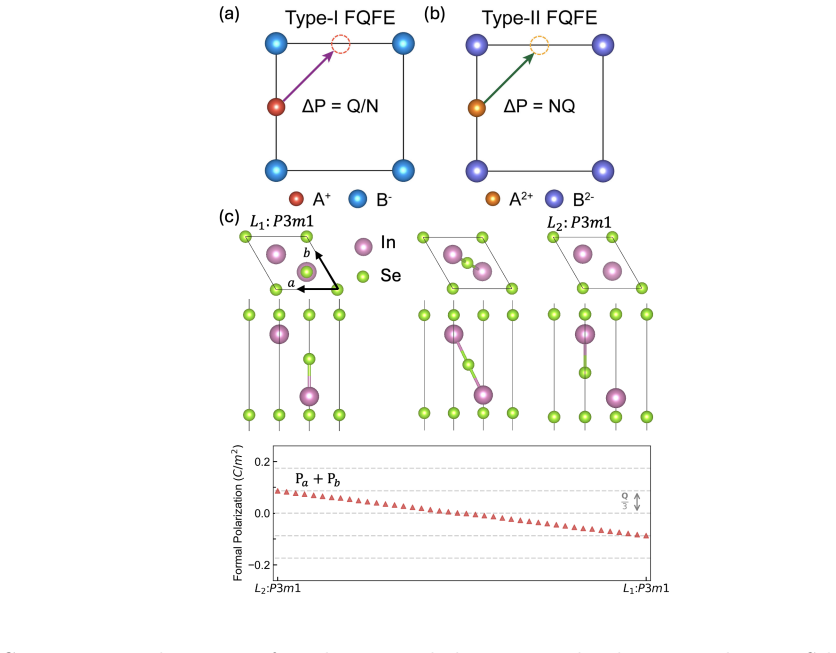
Formal polarization in insulating periodic crystals is multivalued and defined modulo the polarization quantum. Nonpolar crystals may therefore carry nonzero formal polarization, and adiabatic paths connecting symmetry-equivalent structures produce quantized polarization changes without symmetry violation. The symmetry of this multivalued quantity obeys a generalized Neumann principle. Large polarization changes driven by long-range ion migration in fractional quantum ferroelectrics and ionic-conductor ferroelectrics follow directly from the topological definition of oxidation state, which ties ionic transport to quantized charge transfer and polarization shift.
What carries the argument
The multivalued formal polarization, defined modulo a polarization quantum and governed by a generalized Neumann principle, together with the topological definition of oxidation state that connects ion migration to quantized polarization change.
If this is right
- Nonpolar crystals can support switchable formal polarization through quantized changes along symmetry-preserving paths.
- Ion migration produces large polarization shifts that are naturally quantified by the topological oxidation state.
- Physical accessibility of these states depends on the details of switching pathways, boundary conditions, and domain-wall dynamics.
- The most promising functionality arises from discontinuities in formal polarization that create and stabilize charged interfaces and domain walls.
Where Pith is reading between the lines
- Material design could focus on engineering ion-migration pathways to achieve desired quantized polarization states in nonpolar hosts.
- Domain walls arising from formal-polarization discontinuities may enable new device concepts that exploit local charge accumulation rather than bulk remanent polarization.
- The generalized Neumann principle offers a symmetry-based tool for screening additional nonpolar compounds that could host similar behavior once adiabatic paths are identified.
Load-bearing premise
Adiabatic paths exist that connect symmetry-equivalent structures, and the topological oxidation-state definition maps directly onto observable polarization changes without extra constraints from defects or boundaries.
What would settle it
Direct measurement of a polarization hysteresis loop in a nonpolar crystal such as α-In₂Se₃ that shows discrete quantized jumps under controlled ion migration while the overall crystal symmetry remains unbroken.
Figures




read the original abstract
Ferroelectricity, a hallmark of spontaneous inversion-symmetry breaking, has been a central concept in condensed matter physics and functional materials research, yet recent discoveries are revealing that switchable polarization can emerge in forms far richer than allowed by the conventional symmetry-based paradigm. Fractional quantum ferroelectricity and ionic-conductor ferroelectricity challenge the long-standing association of ferroelectricity exclusively with polar space groups. In this Review, we reconcile these emerging phenomena within the Berry-phase modern theory of polarization. We emphasize that polarization in insulating periodic crystals is not a single-valued vector, but a multivalued lattice quantity defined modulo a polarization quantum. Consequently, nonpolar crystals may possess nonzero formal polarization, and adiabatic paths connecting symmetry-equivalent structures can produce quantized changes in polarization without violating symmetry principles. The symmetry of this multivalued formal polarization is governed by a generalized Neumann principle. We further show that the large polarization changes induced by long-range ion migration in both fractional quantum ferroelectrics and ionic-conductor ferroelectrics can be naturally understood through the topological definition of oxidation state, which links ionic transport to quantized charge transfer and polarization change. We discuss the physical accessibility of these unconventional polarization states, highlighting the roles of switching pathways, boundary conditions, and domain-wall dynamics, particularly in systems such as $\alpha$-In$_2$Se$_3$. Finally, we suggest that the most promising functionality of these materials may lie not in conventional bulk ferroelectric switching, but in the creation and control of charged interfaces and domain walls arising from discontinuities in formal polarization.
Editorial analysis
A structured set of objections, weighed in public.
Referee Report
Summary. This review reconciles recent observations of switchable polarization in non-polar space groups—fractional quantum ferroelectricity and ionic-conductor ferroelectricity—with the Berry-phase modern theory of polarization. It argues that formal polarization is a multivalued lattice quantity defined modulo a quantum, permitting nonzero values in nonpolar crystals and quantized changes along adiabatic paths connecting symmetry-equivalent structures. The large polarization shifts from long-range ion migration are attributed to the topological definition of oxidation state. The manuscript discusses physical accessibility via switching pathways, boundary conditions, and domain-wall dynamics (with emphasis on α-In2Se3) and proposes that the primary functionality arises from discontinuities in formal polarization at charged interfaces and domain walls rather than conventional bulk switching.
Significance. If the arguments hold, the work is significant for supplying a parameter-free conceptual unification of unconventional ferroelectricity with established polarization theory. It explicitly credits the multivalued Berry-phase polarization and topological oxidation states for explaining quantized changes without introducing new fitted entities, and it correctly identifies the generalized Neumann principle as governing the symmetry of the multivalued polarization. This framework could redirect materials searches toward interface and domain-wall engineering in ionic conductors and related systems.
major comments (1)
- [Discussion of physical accessibility of these unconventional polarization states, with reference to α-In2Se3] The central claim that quantized polarization changes in ionic-conductor ferroelectrics can be attributed to the Berry-phase formalism along adiabatic paths is load-bearing. The manuscript invokes the existence of continuous, fully gapped paths connecting symmetry-equivalent structures (particularly for α-In2Se3) but does not demonstrate or cite explicit evidence—such as band-gap calculations along the migration coordinate—that such insulating paths exist. In real ionic conductors, long-range ion migration typically involves mobile defects or partial conductivity that closes the electronic gap, rendering the Berry-phase definition inapplicable without additional assumptions about defect-free dynamics.
minor comments (2)
- [Abstract] The abstract introduces the 'generalized Neumann principle' without a one-sentence definition or citation; a brief parenthetical clarification would improve accessibility for readers outside the immediate subfield.
- [Abstract] Several sentences in the abstract and early paragraphs are compound and could be split to improve readability without altering technical content.
Simulated Author's Rebuttal
We thank the referee for their insightful and constructive review of our manuscript. The concern regarding the physical accessibility of unconventional polarization states, specifically the requirement for continuous fully gapped adiabatic paths in systems such as α-In2Se3, is a substantive point that merits careful clarification. We address it point by point below.
read point-by-point responses
-
Referee: The central claim that quantized polarization changes in ionic-conductor ferroelectrics can be attributed to the Berry-phase formalism along adiabatic paths is load-bearing. The manuscript invokes the existence of continuous, fully gapped paths connecting symmetry-equivalent structures (particularly for α-In2Se3) but does not demonstrate or cite explicit evidence—such as band-gap calculations along the migration coordinate—that such insulating paths exist. In real ionic conductors, long-range ion migration typically involves mobile defects or partial conductivity that closes the electronic gap, rendering the Berry-phase definition inapplicable without additional assumptions about defect-free dynamics.
Authors: We agree that the Berry-phase formalism requires the system to remain insulating along any adiabatic path for the polarization to be well-defined, and that this assumption is central to attributing quantized changes to the multivalued formal polarization. The manuscript discusses physical accessibility via switching pathways, boundary conditions, and domain-wall dynamics (with emphasis on α-In2Se3) precisely to identify regimes where such paths can exist without gap closure. We acknowledge that the current text does not include or cite explicit band-gap calculations along the ion-migration coordinate. In the revised version we will expand the relevant section to cite existing first-principles studies on α-In2Se3 that track the electronic structure during In-ion displacements and ferroelectric switching, where the gap is shown to remain open under the relevant conditions. We will also add a brief discussion of the role of defects, noting that while mobile defects can induce local metallicity in real ionic conductors, the topological oxidation-state argument and the resulting polarization quantum still apply to the defect-free or low-defect portions of the material, consistent with experimental reports of switchable polarization. This revision will make the assumptions explicit and supported by literature without altering the core framework. revision: yes
Circularity Check
Minor self-citation present but not load-bearing; derivation draws from established Berry-phase and topological oxidation-state literature
full rationale
The paper's central reconciliation of fractional quantum ferroelectricity and ionic-conductor ferroelectricity with multivalued formal polarization and the generalized Neumann principle rests on the standard Berry-phase modern theory of polarization (King-Smith/Vanderbilt) and the topological definition of oxidation state. These are imported from prior independent literature rather than defined circularly within the manuscript. No equations reduce a claimed prediction to a fitted input by construction, no uniqueness theorem is smuggled via self-citation, and no ansatz is renamed as a new result. Any self-citations to the authors' prior work on related topics are peripheral and do not carry the core argument; the derivation chain remains self-contained against external benchmarks.
Axiom & Free-Parameter Ledger
axioms (2)
- domain assumption Polarization in insulating periodic crystals is a multivalued lattice quantity defined modulo a polarization quantum.
- domain assumption The symmetry of this multivalued formal polarization is governed by a generalized Neumann principle.
Reference graph
Works this paper leans on
-
[1]
Valasek, Piezoelectric and allied phenomena in rochelle salt, Phys
J. Valasek, Piezoelectric and allied phenomena in rochelle salt, Phys. Rev.17, 475 (1921)
work page 1921
-
[2]
M. E. Lines and A. M. Glass,Principles and Applications of Ferroelectrics and Related Mate- rials(Clarendon Press, Oxford, 1977)
work page 1977
-
[3]
F. E. Neumann,Vorlesungen ¨ uber die Theorie der Elastizit¨ at der festen K¨ orper und des Licht¨ athers, edited by O. E. M. Leipzig and B. G. Teubner-Verlag (1885)
-
[4]
V. L. Ginzburg, Zh. Eksp. Teor. Fiz.15, 739 (1945)
work page 1945
-
[5]
J. Junquera and P. Ghosez, Critical thickness for ferroelectricity in perovskite ultrathin films, Nature422, 506 (2003)
work page 2003
-
[6]
R. E. Cohen, Origin of ferroelectricity in perovskite oxides, Nature358, 136 (1992)
work page 1992
-
[7]
S. Saha, T. P. Sinha, and A. Mookerjee, Electronic structure, chemical bonding, and optical properties of paraelectric BaTiO 3, Phys. Rev. B62, 8828 (2000)
work page 2000
-
[8]
J. Ji, G. Yu, C. Xu, and H. J. Xiang, Fractional quantum ferroelectricity, Nat. Commun.15, 135 (2024)
work page 2024
-
[9]
G. Yu, J. Ji, Y. Chen, C. Xu, and H. J. Xiang, Symmetry strategy for rapid discovery of 20 abundant fractional quantum ferroelectrics, Phys. Rev. Lett.134, 016801 (2025)
work page 2025
-
[10]
X. Wang and M. Wu, Quantized ferroelectricity in multivalent ion conductors with non-polar point groups, Mater. Horiz.11, 3885–3891 (2024)
work page 2024
-
[11]
R. D. King-Smith and D. Vanderbilt, Theory of polarization of crystalline solids, Phys. Rev. B47, 1651 (1993)
work page 1993
-
[12]
Resta, Theory of the electric polarization in crystals, Ferroelectrics136, 51–55 (1992)
R. Resta, Theory of the electric polarization in crystals, Ferroelectrics136, 51–55 (1992)
work page 1992
-
[13]
Resta, Macroscopic polarization in crystalline dielectrics: the geometric phase approach, Rev
R. Resta, Macroscopic polarization in crystalline dielectrics: the geometric phase approach, Rev. Mod. Phys.66, 899 (1994)
work page 1994
-
[14]
N. A. Spaldin, A beginner's guide to the modern theory of polarization, J. Solid State Chem. 195, 2 (2012)
work page 2012
-
[15]
D. Vanderbilt,Berry Phases in Electronic Structure Theory: Electric Polarization, Orbital Magnetization and Topological Insulators(Cambridge University Press, 2018)
work page 2018
-
[16]
G. Jin, H. Pang, Y. Ji, Z. Dai, and L. He, Pyatb: An efficient python package for electronic structure calculations using ab initio tight-binding model, Comput. Phys. Commun.291, 108844 (2023)
work page 2023
-
[17]
Q.-S. Huang and S.-H. Wei, Revisiting the theory of crystal polarization: The downside of employing the periodic boundary conditions, Chin. Phys. Lett.43, 020701 (2026)
work page 2026
-
[18]
D. Vanderbilt and R. D. King-Smith, Electric polarization as a bulk quantity and its relation to surface charge, Phys. Rev. B48, 4442 (1993)
work page 1993
-
[19]
K. N. Kudin, R. Car, and R. Resta, Longitudinal polarizability of long polymeric chains: Quasi-one-dimensional electrostatics as the origin of slow convergence, J. Chem. Phys.122, 134907 (2005)
work page 2005
- [20]
-
[21]
H. Pang and L. He, Generalized neumann’s principle as a unified framework for fractional quantum and conventional ferroelectricity, Phys. Rev. Lett.135, 116402 (2025)
work page 2025
-
[22]
F. Bernardini, V. Fiorentini, and D. Vanderbilt, Spontaneous polarization and piezoelectric constants of III-V nitrides, Phys. Rev. B56, R10024–R10027 (1997)
work page 1997
-
[23]
F. Bernardini, V. Fiorentini, and D. Vanderbilt, Accurate calculation of polarization-related quantities in semiconductors, Phys. Rev. B63, 193201 (2001)
work page 2001
-
[24]
F. Bechstedt, U. Grossner, and J. Furthm¨ uller, Dynamics and polarization of group-III nitride 21 lattices: A first-principles study, Phys. Rev. B62, 8003–8011 (2000)
work page 2000
-
[25]
C. E. Dreyer, A. Janotti, C. G. van de Walle, and D. Vanderbilt, Correct implementation of polarization constants in wurtzite materials and impact on III-nitrides, Phys. Rev. X6, 021038 (2016)
work page 2016
-
[26]
S. Fichtner, N. Wolff, F. Lofink, L. Kienle, and B. Wagner, AlScN: A III-V semiconductor based ferroelectric, J. Appl. Phys.125, 114103 (2019)
work page 2019
-
[27]
P. Hohenberg and W. Kohn, Inhomogeneous electron gas, Phys. Rev.136, B864 (1964)
work page 1964
-
[28]
W. Kohn and L. J. Sham, Self-consistent equations including exchange and correlation effects, Phys. Rev.140, A1133 (1965)
work page 1965
-
[29]
G. Henkelman, B. P. Uberuaga, and H. J´ onsson, A climbing image nudged elastic band method for finding saddle points and minimum energy paths, J. Chem. Phys.113, 9901 (2000)
work page 2000
-
[30]
G. Henkelman and H. J´ onsson, Improved tangent estimate in the nudged elastic band method for finding minimum energy paths and saddle points, J. Chem. Phys.113, 9978–9985 (2000)
work page 2000
- [31]
-
[32]
M. V. Stern, Y. Waschitz, W. Cao, I. Nevo, K. Watanabe, T. Taniguchi, E. Sela, M. Urbakh, O. Hod, and M. B. Shalom, Interfacial ferroelectricity by van der waals sliding, Science372, 1462 (2021)
work page 2021
- [33]
- [34]
-
[35]
C. Ke, F. Liu, and S. Liu, Superlubric motion of wavelike domain walls in sliding ferroelectrics, Phys. Rev. Lett.135, 046201 (2025)
work page 2025
-
[36]
M. H. Lente and J. A. Eiras, 90°domain reorientation and domain wall rearrangement in lead zirconate titanate ceramics characterized by transient current and hysteresis loop measure- ments, J. Appl. Phys.89, 5093 (2001)
work page 2001
-
[37]
P. Ghosez and K. M. Rabe, Microscopic model of ferroelectricity in stress-free PbTiO 3 ultra- thin films, Appl. Phys. Lett.76, 2767 (2000)
work page 2000
-
[38]
K.-J. Range and R. Leeb, Preparation and crystal structure of the high pressure phase Tm2S3- 22 II, Z. Naturforsch. B31, 311–314 (1976)
work page 1976
-
[39]
G. A. Jeffrey and M. Vlasse, Crystal structures of the red, yellow, and orange forms of mercuric iodide, Inorg. Chem.6, 396–399 (1967)
work page 1967
-
[40]
D. Schwarzenbach, H. Birkedal, M. Hostettler, and P. Fischer, Neutron diffraction investigation of the temperature dependence of crystal structure and thermal motions of red HgI 2, Acta Cryst. B63, 828–835 (2007)
work page 2007
- [41]
-
[42]
Y. Gao, M. Wu, and X. C. Zeng, Phase transitions and ferroelasticity–multiferroicity in bulk and two-dimensional silver and copper monohalides, Nanoscale Horiz.4, 1106–1112 (2019)
work page 2019
- [43]
-
[44]
W. Ding, J. Zhu, Z. Wang, Y. Gao, D. Xiao, Y. Gu, Z. Zhang, and W. Zhu, Prediction of intrinsic two-dimensional ferroelectrics in In 2Se3 and other III 2-VI3 van der waals materials, Nat. Commun.8, 14956 (2017)
work page 2017
-
[45]
M. Soleimani and M. Pourfath, Ferroelectricity and phase transitions in In 2Se3 van der waals material, Nanoscale12, 22688–22697 (2020)
work page 2020
-
[46]
Y. Zhou, D. Wu, Y. Zhu, Y. Cho, Q. He, X. Yang, K. Herrera, Z. Chu, Y. Han, M. C. Downer, H. Peng, and K. Lai, Out-of-plane piezoelectricity and ferroelectricity in layered α-In2Se3 nanoflakes, Nano Lett.17, 5508 (2017)
work page 2017
-
[47]
C. Cui, W.-J. Hu, X. Yan, C. Addiego, W. Gao, Y. Wang, Z. Wang, L. Li, Y. Cheng, P. Li, X. Zhang, H. N. Alshareef, T. Wu, W. Zhu, X. Pan, and L.-J. Li, Intercorrelated in-plane and out-of-plane ferroelectricity in ultrathin two-dimensional layered semiconductor In 2Se3, Nano Lett.18, 1253 (2018)
work page 2018
-
[48]
F. Xue, W. Hu, K.-C. Lee, L.-S. Lu, J. Zhang, H.-L. Tang, A. Han, W.-T. Hsu, S. Tu, W.-H. Chang, C.-H. Lien, J.-H. He, Z. Zhang, L.-J. Li, and X. Zhang, Room-temperature ferroelectricity in hexagonally layeredα-In 2Se3 nanoflakes down to the monolayer limit, Adv. Funct. Mater.28, 1803738 (2018)
work page 2018
-
[49]
F. Xue, J. Zhang, W. Hu, W.-T. Hsu, A. Han, S.-F. Leung, J.-K. Huang, Y. Wan, S. Liu, J. Zhang, J.-H. He, W.-H. Chang, Z. L. Wang, X. Zhang, and L.-J. Li, Multidirection piezo- electricity in mono- and multilayered hexagonalα-In 2Se3, ACS Nano12, 4976 (2018). 23
work page 2018
-
[50]
J. Xiao, H. Zhu, Y. Wang, W. Feng, Y. Hu, A. Dasgupta, Y. Han, Y. Wang, D. A. Muller, L. W. Martin, P. Hu, and X. Zhang, Intrinsic two-dimensional ferroelectricity with dipole locking, Phys. Rev. Lett.120, 227601 (2018)
work page 2018
-
[51]
F. Xue, X. He, J. R. D. Retamal, A. Han, J. Zhang, Z. Liu, J. Huang, W. Hu, V. Tung, J. He, L. Li, and X. Zhang, Gate-tunable and multidirection-switchable memristive phenomena in a van der waals ferroelectric, Adv. Mater.31, 1901300 (2019)
work page 2019
-
[52]
Y. Li, C. Chen, W. Li, X. Mao, H. Liu, J. Xiang, A. Nie, Z. Liu, W. Zhu, and H. Zeng, Orthogonal electric control of the out-of-plane field-effect in 2D ferroelectric In 2Se3, Adv. Electron. Mater.6, 2000061 (2020)
work page 2020
-
[53]
L. Wang, X. Wang, Y. Zhang, R. Li, T. Ma, K. Leng, Z. Chen, I. Abdelwahab, and K. P. Loh, Exploring ferroelectric switching In2Se3 for neuromorphic computing, Adv. Funct. Mater.30, 2004609 (2020)
work page 2020
-
[54]
L. Bai, C. Ke, Z. Luo, T. Zhu, L. You, and S. Liu, Intrinsic ferroelectric switching in two- dimensionalα-In 2Se3, ACS Nano18, 26103 (2024)
work page 2024
-
[55]
J. Lu, R. Luo, J. Zhou, M. Hao, C. Chai, T. Ying, Y. Gao, S. Jin, and X. Chen, High, multiple, and nonvolatile polarizations in organic–inorganic hybrid [(CH 3)3(CH2CH2Cl)N]2InCl5·H2O for memcapacitor, J. Am. Chem. Soc.146, 281–288 (2023)
work page 2023
- [56]
-
[57]
J. Yanagisawa, T. Aoyama, K. Fujii, M. Yashima, Y. Inaguma, A. Kuwabara, K. Shitara, B. Le Ouay, S. Hayami, M. Ohba, and R. Ohtani, Strongly enhanced polarization in a ferro- electric crystal by conduction-proton flow, J. Am. Chem. Soc.146, 1476–1483 (2024)
work page 2024
-
[58]
X. Wang, Y. Ren, and M. Wu, Unconventional ferroelectricity with quantized polarizations in ionic conductors: High-throughput screening, J. Phys. Chem. Lett.13, 9552–9557 (2022)
work page 2022
-
[59]
Y. Ren, S. Dong, and M. Wu, Unusual ferroelectricity of trans-unitcell ion-displacement and multiferroic soliton in sodium and potassium hydroxides, ACS Appl. Mater. Interfaces10, 35361–35366 (2018)
work page 2018
-
[60]
D. A. Bandurin, A. V. Tyurnina, G. L. Yu, A. Mishchenko, V. Z´ olyomi, S. V. Morozov, R. K. Kumar, R. V. Gorbachev, Z. R. Kudrynskyi, S. Pezzini, Z. D. Kovalyuk, U. Zeitler, K. S. Novoselov, A. Patan` e, L. Eaves, I. V. Grigorieva, V. I. Fal’ko, A. K. Geim, and Y. Cao, High electron mobility, quantum hall effect and anomalous optical response in atomicall...
work page 2016
-
[61]
L. Gao, G. Bian, Y. Yang, B. Zhang, X. Wu, and K. Wu, Na 4SnS4 and Na4SnSe4 exhibiting multifunctional physicochemical performances as potential infrared nonlinear optical crystals and sodium ion conductors, New J. Chem.45, 12362–12366 (2021)
work page 2021
- [62]
- [63]
-
[64]
S. Wan, Y. Li, W. Li, X. Mao, C. Wang, C. Chen, J. Dong, A. Nie, J. Xiang, Z. Liu, W. Zhu, and H. Zeng, Nonvolatile ferroelectric memory effect in ultrathinα-In2Se3, Adv. Funct. Mater. 29, 1808606 (2019)
work page 2019
-
[65]
V. Garcia and M. Bibes, Ferroelectric tunnel junctions for information storage and processing, Nat. Commun.5, 4289 (2014)
work page 2014
-
[66]
F. Xue, X. He, Y. Ma, D. Zheng, C. Zhang, L.-J. Li, J.-H. He, B. Yu, and X. Zhang, Unraveling the origin of ferroelectric resistance switching through the interfacial engineering of layered ferroelectric-metal junctions, Nat. Commun12, 7291 (2021)
work page 2021
- [67]
-
[68]
J. Yang, J. Zhou, J. Lu, Z. Luo, J. Yang, and L. Shen, Giant tunnelling electroresistance through 2D sliding ferroelectric materials, Mater. Horiz.9, 1422 (2022)
work page 2022
-
[69]
Y. Wang, X. Liu, J. D. Burton, S. S. Jaswal, and E. Y. Tsymbal, Ferroelectric instability under screened coulomb interactions, Phys. Rev. Lett.109, 247601 (2012)
work page 2012
- [70]
-
[71]
Y. Lin, Y. Shao, J. Dai, T. Li, Y. Liu, X. Dai, X. Xiao, Y. Deng, A. Gruverman, X. C. Zeng, and J. Huang, Metallic surface doping of metal halide perovskites, Nat. Commun.12, 7 (2021)
work page 2021
-
[72]
M. Stengel and D. Vanderbilt, Berry-phase theory of polar discontinuities at oxide-oxide in- terfaces, Phys. Rev. B80, 241103(R) (2009). 25
work page 2009
-
[73]
H. Pang and L. He, Quantized polarization redefines polar interfaces (2025), arXiv:2511.18697
- [74]
- [75]
-
[76]
M. Onen, N. Emond, B. Wang, D. Zhang, F. M. Ross, J. Li, B. Yildiz, and J. A. del Alamo, Nanosecond protonic programmable resistors for analog deep learning, Science377, 539 (2022)
work page 2022
-
[77]
L. Ma, J. Wu, T. Zhu, Y. Huang, Q. Lu, and S. Liu, Ultrahigh oxygen ion mobility in ferroelectric hafnia, Phys. Rev. Lett.131, 256801 (2023). 26 FIG. 1. Multivalued formal polarization in a two-dimensional crystal of classical point charges. (a) Unit cell A: the unit cell is chosen so that the anion (green) is paired with the cation (orange) to its northe...
work page 2023
discussion (0)
Sign in with ORCID, Apple, or X to comment. Anyone can read and Pith papers without signing in.