Recognition: 2 theorem links
· Lean TheoremCharacterization of a Two-Channel Optical and Near-infrared Transition Edge Sensor System for Rare-Event Searches
Pith reviewed 2026-05-11 02:13 UTC · model grok-4.3
The pith
A two-channel tungsten transition edge sensor system reaches 86 percent detection efficiency and sub-6 millihertz dark counts for 1064 nm photons.
A machine-rendered reading of the paper's core claim, the machinery that carries it, and where it could break.
Core claim
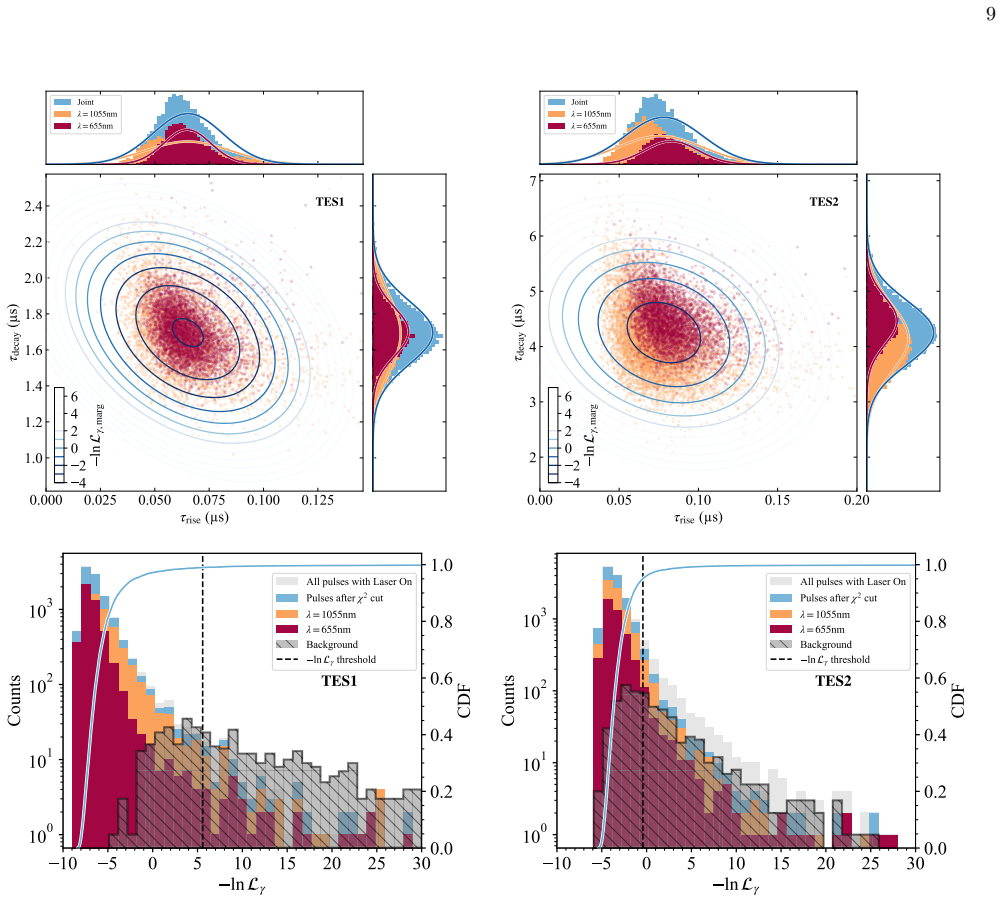
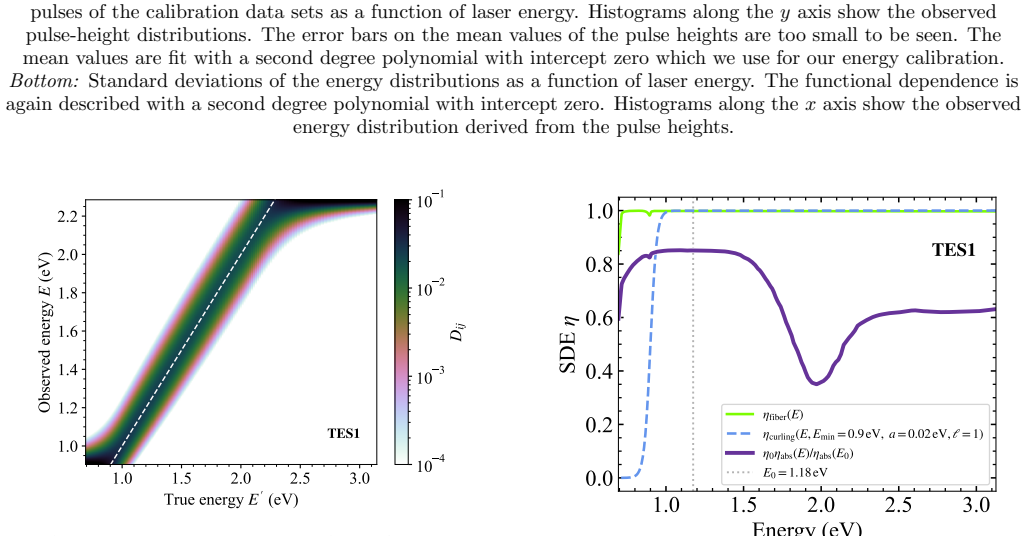
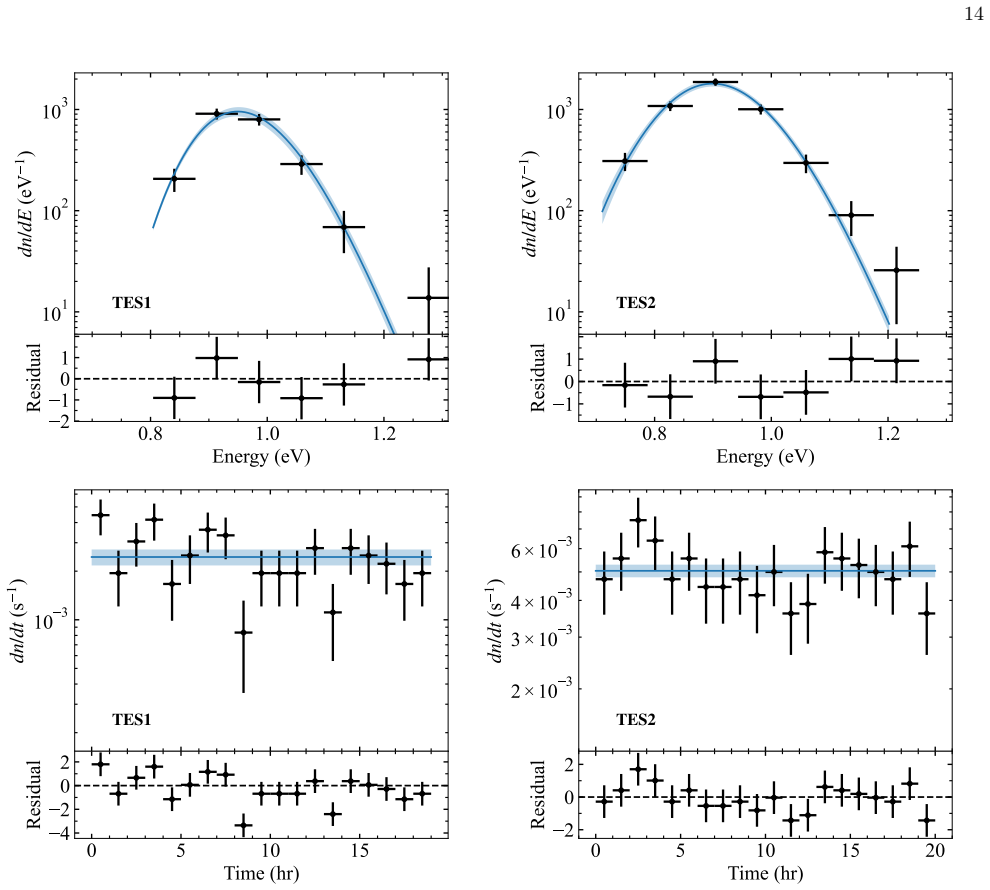
The two-channel TES module achieves a system detection efficiency of (86±1) percent, an energy resolution better than 7 percent, and a photon-like dark-count rate below 6 mHz when read out through an optical fiber. An unbinned likelihood analysis finds this background compatible with blackbody radiation from the laboratory. The energy-resolving capability allows the detection of pure 1064 nm signals at rates greater than or equal to 2.7 times 10 to the minus 5 Hz (corresponding to powers of 5 times 10 to the minus 24 W) within 20 days at 5 sigma .
What carries the argument
The two-channel tungsten transition edge sensor module, which resolves photon energy while delivering high quantum efficiency and low dark counts at 1064 nm.
If this is right
- Monochromatic 1064 nm signals become detectable at rates above 2.7 times 10 to the minus 5 Hz within 20 days of live time at 5 sigma .
- The same detectors are suitable for axion and axion-like-particle searches in ALPS II or axion interferometers.
- The energy-resolution information can be used to distinguish signal photons from the thermal background in any rare-event TES application.
- The demonstrated methodologies extend directly to other optical or near-infrared rare-event searches that employ transition edge sensors.
Where Pith is reading between the lines
- If additional backgrounds appear only in the full optical chain, the quoted sensitivity would degrade unless shielding or filtering is added.
- The same two-channel architecture could be retuned for other wavelengths by changing the TES film thickness or bias point.
- Energy-resolved counting may allow subtraction of non-monochromatic backgrounds that a simple rate measurement would miss.
Load-bearing premise
The laboratory dark-count rate stays representative once the module is inserted into a complete experimental apparatus containing additional optics and cryogenics.
What would settle it
A measured dark-count rate well above 6 mHz once the sensors are integrated into the full ALPS II optical path, or the inability to register a calibrated 1064 nm signal at the stated rate after 20 days, would falsify the performance claims.
Figures




read the original abstract
Transition edge sensors (TESs) are superconducting energy-resolving microcalorimeters that have demonstrated low background rates as well as quantum efficiencies close to unity for photons at optical and near-infrared wavelengths. This makes these detectors well suited for rare-event searches. We report on the comprehensive characterization of a two-channel detector module consisting of two tungsten TESs optimized for the detection of photons with a wavelength of 1064nm. The devices achieve a system detection efficiency of $(86\pm1)$%, an energy resolution better than 7%, and a background dark-count rate of photon-like events below 6mHz when coupled to an optical fiber. Using an unbinned likelihood framework, we find the dark count rate to be compatible with blackbody radiation from the room-temperature laboratory environment. Thanks to the energy resolution of the TESs, we show that it is possible to detect monochromatic signals at 1064nm with photon rates $\geqslant 2.7_{-0.6}^{+0.8} \times10^{-5}$Hz, which corresponds to a power of $\geqslant(5.0_{-1.1}^{+1.4})\times10^{-24}$W, within 20 days of measurement time at the 5$\sigma$ confidence level. This makes our detectors well suited for searches for hypothetical axions and axion-like particles with experiments such as the Any Light Particle Search II (ALPS II) or axion interferometers. The developed methodologies are not only applicable to axion searches, but are also relevant for rare-event searches with TESs in general.
Editorial analysis
A structured set of objections, weighed in public.
Referee Report
Summary. The paper characterizes a two-channel tungsten TES detector module optimized for 1064 nm photons. It reports a system detection efficiency of (86±1)%, energy resolution better than 7%, and a background dark-count rate of photon-like events below 6 mHz when coupled to an optical fiber. An unbinned likelihood analysis finds the dark counts compatible with room-temperature blackbody radiation. The work projects that monochromatic signals at 1064 nm with rates ≥2.7_{-0.6}^{+0.8}×10^{-5} Hz (power ≥(5.0_{-1.1}^{+1.4})×10^{-24} W) can be detected at 5σ in 20 days, positioning the system for axion searches in ALPS II.
Significance. If the reported performance metrics hold, the work demonstrates that TES detectors can achieve the combination of near-unity efficiency, sub-7% resolution, and sub-6 mHz background needed for rare-event optical searches. The direct measurements and unbinned likelihood framework for background modeling and sensitivity projection are strengths that provide a reproducible basis for projecting detection limits in axion-like particle experiments.
major comments (1)
- The 5σ sensitivity projection (abstract and associated analysis) that signals at rates ≥2.7×10^{-5} Hz are detectable in 20 days rests on the measured dark-count rate (<6 mHz, modeled as room-temperature blackbody) remaining dominant. The manuscript provides no ray-tracing, temperature map, or aperture calculation for the ALPS II regeneration cavity and optical path to confirm that additional backgrounds from warm windows, scattered light, or cavity leakage will not exceed this threshold. This assumption is load-bearing for the claim of suitability for ALPS II.
minor comments (2)
- The abstract states the efficiency, resolution, and dark-count values with uncertainties but does not reference the specific section or figure where the unbinned likelihood fit results and error propagation are shown; adding this cross-reference would improve traceability.
- Notation for the asymmetric uncertainties on the projected rate and power (e.g., 2.7_{-0.6}^{+0.8}) is clear in the abstract but should be defined explicitly in the methods section for readers unfamiliar with the likelihood framework.
Simulated Author's Rebuttal
We thank the referee for the positive assessment of our work and the opportunity to address the major comment. We respond point by point below.
read point-by-point responses
-
Referee: The 5σ sensitivity projection (abstract and associated analysis) that signals at rates ≥2.7×10^{-5} Hz are detectable in 20 days rests on the measured dark-count rate (<6 mHz, modeled as room-temperature blackbody) remaining dominant. The manuscript provides no ray-tracing, temperature map, or aperture calculation for the ALPS II regeneration cavity and optical path to confirm that additional backgrounds from warm windows, scattered light, or cavity leakage will not exceed this threshold. This assumption is load-bearing for the claim of suitability for ALPS II.
Authors: We agree that the sensitivity projection assumes the laboratory-measured dark-count rate remains representative. This manuscript is a detector characterization study reporting the TES module performance (efficiency, resolution, and background) when coupled to an optical fiber in a controlled environment. The 5σ projection illustrates the detector's potential for rare-event searches based on these metrics. We do not provide ray-tracing, temperature maps, or aperture calculations for the ALPS II regeneration cavity because those pertain to the full experimental integration and optical path design, which lie outside the scope of this work. To address the concern, we will add an explicit statement in the discussion section clarifying that the projection assumes no significant additional backgrounds from the ALPS II optical path and that such backgrounds must be evaluated separately as part of the experiment's integration studies. revision: yes
Circularity Check
No circularity: sensitivity projection is a standard forward statistical calculation from measured background rate and resolution.
full rationale
The paper's core results are direct experimental measurements (system efficiency 86±1%, energy resolution <7%, dark-count rate <6 mHz) obtained from lab fiber-coupled data. The unbinned likelihood analysis is used only to demonstrate compatibility of the observed counts with a room-temperature blackbody model; this is a consistency check, not an input that is later renamed as a prediction. The 5σ sensitivity claim (≥2.7×10^{-5} Hz monochromatic signal detectable in 20 days) is computed from the measured background rate, the energy-resolving capability, and standard Poisson or likelihood statistics for signal-on-background detection. No equation reduces the projected rate to a fitted parameter by construction, no self-citation supplies a load-bearing uniqueness theorem or ansatz, and no known empirical pattern is merely relabeled. The assumption that the lab dark-count rate will hold in the ALPS II setup is an external-validity question, not a circularity in the derivation chain itself.
Axiom & Free-Parameter Ledger
free parameters (1)
- dark count rate upper limit
axioms (1)
- domain assumption Observed dark counts are compatible with blackbody radiation from the room-temperature laboratory environment.
Lean theorems connected to this paper
-
IndisputableMonolith/Foundation/AbsoluteFloorClosure.leanreality_from_one_distinction unclearTransition edge sensors (TESs) are superconducting energy-resolving microcalorimeters... system detection efficiency of (86±1)%, an energy resolution better than 7%
Reference graph
Works this paper leans on
-
[1]
K. D. Irwin and G. C. Hilton, Transition-Edge Sensors, in Cryogenic Particle Detection, Vol. 99, edited by C. Enss (2005) p. 63
work page 2005
-
[2]
M. De Lucia, P. D. Bo, E. Di Giorgi, T. Lari, C. Puglia, and F. Paolucci, Transition Edge Sensors: Physics and Applications, Instruments8, 47 (2024), arXiv:2411.01968 [physics.ins-det]
-
[3]
D. Fukuda and T. Kikuchi, Single and few-photon detec- tion using superconducting transition edge sensors, Prog. Opt.69, 135 (2024). 18
work page 2024
-
[4]
A. E. Lita, D. V. Reddy, V. B. Verma, R. P. Mirin, and S. W. Nam, Development of Superconducting Single- Photon and Photon-Number Resolving Detectors for Quantum Applications, Journal of Lightwave Technology 40, 7578 (2022)
work page 2022
-
[5]
A. E. Lita, A. J. Miller, and S. W. Nam, Counting near- infrared single-photons with 95% efficiency, Optics Ex- press16, 3032 (2008)
work page 2008
-
[6]
K. Hattori, T. Konno, Y. Miura, S. Takasu, and D. Fukuda, An optical transition-edge sensor with high energy resolution, Superconductor Science Technology 35, 095002 (2022), arXiv:2204.01903 [physics.ins-det]
- [7]
-
[8]
L. S. Madsen, F. Laudenbach, M. F. Askarani, F. Rortais, T. Vincent, J. F. F. Bulmer, F. M. Miatto, L. Neuhaus, L. G. Helt, M. J. Collins, and et al., Quantum computa- tional advantage with a programmable photonic proces- sor, Nature606, 75 (2022)
work page 2022
-
[9]
P. Li, J. Zhong, W. Zhang, Z. Wang, K. Zhou, W. Miao, Y. Ren, J. Li, Q. Yao, and S. Shi, Multi-color photon detection with a single superconducting transition-edge sensor, Nuclear Instruments and Methods in Physics Re- search A1054, 168408 (2023)
work page 2023
-
[10]
K. Niwa, T. Numata, K. Hattori, and D. Fukuda, Few- photon color imaging using energy-dispersive supercon- ducting transition-edge sensor spectrometry, Scientific Reports7, 45660 (2017)
work page 2017
-
[11]
K. Niwa, K. Hattori, and D. Fukuda, Few-photon spec- tral confocal microscopy for cell imaging using super- conducting transition edge sensor, Frontiers in Bioengi- neering and Biotechnology9, 10.3389/fbioe.2021.789709 (2021)
- [12]
-
[13]
J. N. Ullom and D. A. Bennett, Review of supercon- ducting transition-edge sensors for x-ray and gamma-ray spectroscopy, Superconductor Science Technology28, 084003 (2015)
work page 2015
-
[14]
G. Angloher, S. Banik, G. Benato, A. Bento, A. Bertolini, R. Breier, C. Bucci, J. Burkhart, L. Canonica, A. D’Addabbo, and et al., DoubleTES detectors to inves- tigate the CRESST low energy background: results from above-ground prototypes, European Physical Journal C 84, 1001 (2024), arXiv:2404.02607 [physics.ins-det]
-
[15]
R. K. Romani, Y.-Y. Chang, R. Mahapatra, M. Platt, M. Reed, I. Rydstrom, B. Sadoulet, B. Serfass, and M. Pyle, A transition edge sensor operated in coincidence with a high sensitivity athermal phonon sensor for pho- ton coupled rare event searches, Applied Physics Letters 125, 232601 (2024), arXiv:2408.11158 [physics.ins-det]
-
[16]
R. B¨ ahre, B. D¨ obrich, J. Dreyling-Eschweiler, S. Ghaz- aryan, R. Hodajerdi, D. Horns, F. Januschek, E.-A. Kn- abbe, A. Lindner, D. Notz, and et al., Any light particle search II — Technical Design Report, Journal of Instru- mentation8(9), T09001, arXiv:1302.5647 [physics.ins- det]
-
[17]
J. Dreyling-Eschweiler, N. Bastidon, B. D¨ obrich, D. Horns, F. Januschek, and A. Lindner, Characteriza- tion, 1064 nm photon signals and background events of a tungsten TES detector for the ALPS experiment, Jour- nal of Modern Optics62, 1132 (2015), arXiv:1502.07878 [physics.ins-det]
- [18]
-
[19]
A. Arzaet al., The COSMIC WISPers White Paper: The physics case for Weakly Interacting Slim Particles, arXiv e-prints , arXiv:2603.03433 (2026), arXiv:2603.03433 [hep-ph]
-
[20]
R. D. Peccei and H. R. Quinn, Constraints imposed by CP conservation in the presence of pseudoparticles, PRD 16, 1791 (1977)
work page 1977
-
[21]
Weinberg, A new light boson?, PRL40, 223 (1978)
S. Weinberg, A new light boson?, PRL40, 223 (1978)
work page 1978
-
[22]
Wilczek, Problem of strong P and T invariance in the presence of instantons, PRL40, 279 (1978)
F. Wilczek, Problem of strong P and T invariance in the presence of instantons, PRL40, 279 (1978)
work page 1978
-
[23]
L. F. Abbott and P. Sikivie, A cosmological bound on the invisible axion, Physics Letters B120, 133 (1983)
work page 1983
-
[24]
M. Dine and W. Fischler, The not-so-harmless axion, Physics Letters B120, 137 (1983)
work page 1983
- [25]
-
[26]
T. Kozlowski, L.-W. Wei, A. D. Spector, A. Hallal, H. Fr¨ adrich, D. C. Brotherton, I. Oceano, A. Ejlli, H. Grote, H. Hollis, and et al., Design and performance of the ALPS II regeneration cavity, Optics Express33, 11153 (2025), arXiv:2408.13218 [physics.optics]
- [27]
-
[28]
W. DeRocco and A. Hook, Axion interferometry, PRD 98, 035021 (2018), arXiv:1802.07273 [hep-ph]
-
[29]
Optical Ring Cavity Search for Axion Dark Matter,
I. Obata, T. Fujita, and Y. Michimura, Optical Ring Cavity Search for Axion Dark Matter, PRL121, 161301 (2018), arXiv:1805.11753 [astro-ph.CO]
- [30]
-
[31]
Quantum-enhanced interferometry for axion searches,
D. Martynov and H. Miao, Quantum-enhanced inter- ferometry for axion searches, PRD101, 095034 (2020), arXiv:1911.00429 [physics.ins-det]
-
[32]
D. Rosenberg, A. E. Lita, A. J. Miller, and S. W. Nam, Noise-free high-efficiency photon-number-resolving detectors, Phys. Rev. A71, 061803 (2005), arXiv:quant- ph/0506175
-
[33]
A. J. Miller, A. E. Lita, B. Calkins, I. Vayshenker, S. M. Gruber, and S. W. Nam, Compact cryogenic self-aligning fiber-to-detector coupling with losses below one percent, Optics Express19, 9102 (2011)
work page 2011
-
[34]
R. Shah, K.-S. Isleif, F. Januschek, A. Lindner, and M. Schott, Characterising a Single-Photon Detector for ALPS II, Journal of Low Temperature Physics 10.1007/s10909-022-02720-0 (2022)
- [35]
-
[36]
E. Rivasto, K.-S. Isleif, F. Januschek, A. Lindner, M. Meyer, G. Othman, J. A. Rubiera Gimeno, and C. Schwemmbauer, Binary classification of signal and background triggers of a transition edge sensor using con- volutional neural networks, Scientific Reports16, 3389 (2026)
work page 2026
-
[37]
T. Gerrits, A. Migdall, J. C. Bienfang, J. Lehman, S. W. Nam, J. Splett, I. Vayshenker, and J. Wang, Calibration of free-space and fiber-coupled single-photon detectors, Metrologia57, 015002 (2020), arXiv:1906.02258 [quant- ph]
-
[38]
V. T. Jordanov and G. F. Knoll, Digital synthesis of pulse shapes in real time for high resolution radiation spec- troscopy, Nuclear Instruments and Methods in Physics Research A345, 337 (1994)
work page 1994
-
[39]
D. Fukuda, G. Fujii, T. Numata, K. Amemiya, A. Yoshizawa, H. Tsuchida, H. Fujino, H. Ishii, T. Itatani, S. Inoue, and et al., Titanium-based transition-edge photon number resolving detector with 98% detection efficiency with index-matched small-gap fiber coupling, Optics Express19, 870 (2011)
work page 2011
-
[40]
M. Schmidt, M. von Helversen, M. L´ opez, F. Gericke, E. Schlottmann, T. Heindel, S. K¨ uck, S. Reitzenstein, and J. Beyer, Photon-number-resolving transition-edge sensors for the metrology of quantum light sources, Jour- nal of Low Temperature Physics193, 1243–1250 (2018)
work page 2018
-
[41]
M. Endo, T. Nomura, T. Sonoyama, K. Takahashi, S. Takasu, D. Fukuda, T. Kashiwazaki, A. Inoue, T. Umeki, R. Nehra, and et al., High-Rate Four Pho- ton Subtraction from Squeezed Vacuum: Preparing Cat State for Optical Quantum Computation, arXiv e-prints , arXiv:2502.08952 (2025), arXiv:2502.08952 [quant-ph]
-
[42]
J. A. Rubiera Gimeno, F. Januschek, K.-S. Isleif, A. Lind- ner, M. Meyer, G. Othman, C. Schwemmbauer, and R. Shah, A TES system for ALPS II - Status and Prospects, PoSEPS-HEP2023, 567 (2023)
work page 2023
-
[43]
F. James and M. Roos, Minuit: A System for Function Minimization and Analysis of the Parameter Errors and Correlations, Comput. Phys. Commun.10, 343 (1975)
work page 1975
-
[44]
H. Dembinski, P. Ongmongkolkul, C. Deil, H. Schreiner, M. Feickert, C. Burr, J. Watson, F. Rost, A. Pearce, L. Geiger, A. Abdelmotteleb, A. Desai, B. M. Wiede- mann, C. Gohlke, J. Sanders, J. Drotleff, J. Eschle, L. Neste, M. E. Gorelli, M. Baak, M. Eliachevitch, and O. Zapata, scikit-hep/iminuit (2025)
work page 2025
-
[45]
M. Meyer, K. Isleif, F. Januschek, A. Lindner, G. Oth- man, J. A. Rubiera Gimeno, C. Schwemmbauer, M. Schott, and R. Shah (ALPS), A First Application of Machine and Deep Learning for Background Rejection in the ALPS II TES Detector, Annalen Phys.536, 2200545 (2024), arXiv:2304.08406 [hep-ex]
-
[46]
L. Manentiet al., Dark counts in optical supercon- ducting transition-edge sensors for rare-event searches, Phys. Rev. Applied22, 024051 (2024), arXiv:2402.03073 [physics.ins-det]
-
[47]
C. Schwemmbauer, G. D. Hadas, Y. Hochberg, K.-S. Isleif, F. Januschek, B. V. Lehmann, A. Lindner, A. E. Lita, M. Meyer, G. Othman, and et al., First direct search for light dark matter interactions in a transition- edge sensor, arXiv e-prints , arXiv:2506.18982 (2025), arXiv:2506.18982 [physics.ins-det]
- [48]
-
[49]
J. Dreyling-Eschweiler,A superconducting mi- crocalorimeter for low-flux detection of near-infrared single photons, Ph.D. thesis, U. Hamburg, Dept. Phys. (2014)
work page 2014
-
[50]
M. A. Arshad, A. Hartung, and M. J¨ ager, A stimulated Stokes Raman scattering-based approach for continuous wave supercontinuum generation in optical fibers, Laser Physics Letters16, 035108 (2019)
work page 2019
-
[51]
R. J. Barlow, Extended maximum likelihood, Nucl. In- strum. Meth. A297, 496 (1990)
work page 1990
-
[52]
S. S. Wilks, The Large-Sample Distribution of the Like- lihood Ratio for Testing Composite Hypotheses, Annals Math. Statist.9, 60 (1938)
work page 1938
- [53]
- [54]
- [55]
- [56]
-
[57]
A. Lamas-Linares, B. Calkins, N. A. Tomlin, T. Ger- rits, A. E. Lita, J. Beyer, R. P. Mirin, and S. Woo Nam, Nanosecond-scale timing jitter for single photon detec- tion in transition edge sensors, Applied Physics Letters 102, 231117 (2013), arXiv:1209.5721 [quant-ph]
-
[58]
R. Kobayashi, K. Hattori, S. Inoue, and D. Fukuda, De- velopment of a Fast Response Titanium-Gold Bilayer Op- tical TES With an Optical Fiber Self-Alignment Struc- ture, IEEE Transactions on Applied Superconductivity 29, TASC.2019 (2019)
work page 2019
-
[59]
A. E. Lita, A. J. Miller, and S. Nam, Energy Collec- tion Efficiency of Tungsten Transition-Edge Sensors in the Near-Infrared, Journal of Low Temperature Physics 151, 125 (2008)
work page 2008
-
[60]
H. Shibata, K. Shimizu, H. Takesue, and Y. Tokura, Ul- timate low system dark-count rate for superconducting nanowire single-photon detector, Optics Letters40, 3428 (2015)
work page 2015
-
[61]
J. B. Barton, S. K. Chanda, S. A. Locknar, and G. E. Carver, Interference filters deposited on optical fiber tips, inOptifab 2021, Society of Photo-Optical Instrumen- tation Engineers (SPIE) Conference Series, Vol. 11889, edited by J. DeGroote Nelson and B. L. Unger (2021) p. 118890I. 20 Appendix A: Calibration factors for photo diodes Both PDs have two p...
work page 2021
-
[62]
The HP4Pro spectrometer measured a central wavelength compatible with this value
with a nominal wavelength of (1064±0.5) nm. The HP4Pro spectrometer measured a central wavelength compatible with this value. However, the NIRQuest spectrometer was offset by +3.4 nm with respect to the HP4Pro value and we have corrected for this offset in all subsequent measurements. The measured optical power 10 In our notation, the attenuation factorsA...
discussion (0)
Sign in with ORCID, Apple, or X to comment. Anyone can read and Pith papers without signing in.