Recognition: no theorem link
Geometry-Aided Channel Deduction: A Robust Channel Acquisition Framework Utilizing Coarse Scenario Prompt
Pith reviewed 2026-05-11 02:01 UTC · model grok-4.3
The pith
Coarse geometric information enables accurate full channel recovery from sparse pilots via pseudo-channel fusion.
A machine-rendered reading of the paper's core claim, the machinery that carries it, and where it could break.
Core claim
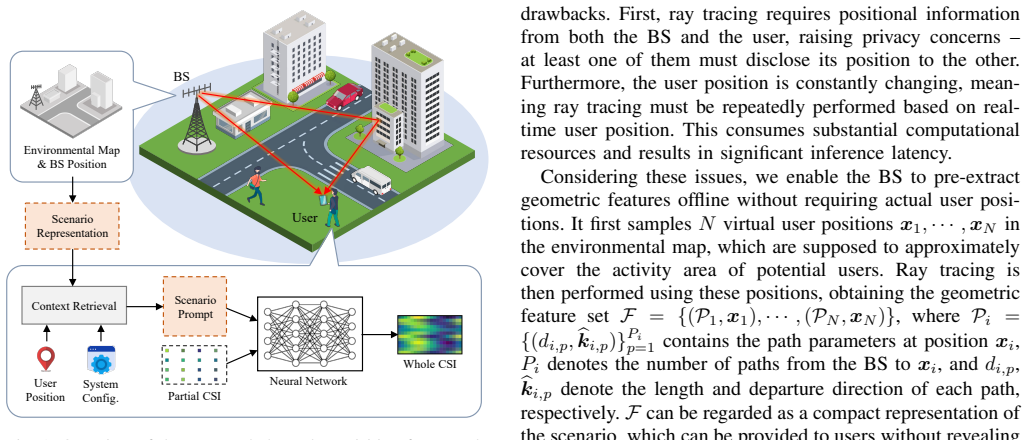
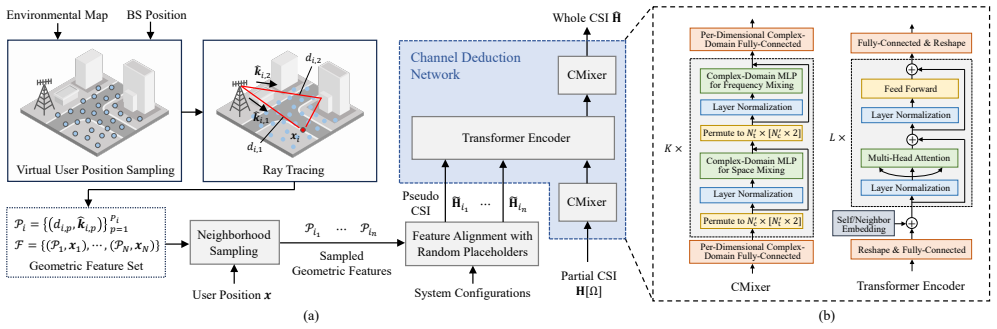
Geometry-aided channel deduction retrieves approximate geometric features by neighborhood searching in a pre-extracted set, converts them into pseudo channels through feature alignment, and fuses these with the partial pilot-based estimate in a neural network to generate the complete channel state information.
What carries the argument
Pseudo-channel generation from coarse scenario geometry using ray tracing, neighborhood search, and a priori feature alignment to provide supplementary features for neural network fusion.
If this is right
- Leading accuracy in channel acquisition is achieved under sparse pilot conditions.
- The method generalizes to new scenarios and dynamic environments.
- Robust performance is maintained despite user position errors and non-ideal environmental information.
Where Pith is reading between the lines
- Deploying this could lower pilot overhead in mobile networks, improving spectral efficiency and reducing latency.
- The fusion approach might apply to other estimation tasks where geometric priors can supplement incomplete measurements.
- Periodic map updates from mobile users could iteratively refine the pre-extracted feature set over time.
Load-bearing premise
The pseudo-channels produced from coarse geometric data through ray tracing and search provide features that are aligned and complementary enough for the neural network to accurately reconstruct the full channel from partial pilots.
What would settle it
A controlled experiment where the actual propagation environment differs substantially from the ray-tracing predictions based on the coarse map, such that the method's accuracy falls below that of standard least-squares estimation using the same number of pilots.
Figures


read the original abstract
Channel state information (CSI) is critical for multi-input multi-output (MIMO) orthogonal frequency division multiplexing (OFDM) system. Pilot-based channel estimation methods suffer from high pilot overhead and low channel acquisition quality, while pilot-free approaches typically impose impractical demands on positional or environmental information precision. This paper proposes geometry-aided channel deduction (GCD), which leverages readily available geometric information to assist channel acquisition. The environmental map and base station position together constitute the scenario geometry, which can provide geometric channel features through ray tracing. To obtain the complete channel, the user first retrieves approximate geometric features by performing neighborhood searching within a pre-extracted geometric feature set, and then converts them into pseudo channels through a priori designed feature alignment. These pseudo channels serve as contextual prompt, providing supplementary channel features beyond those derived from pilot-based estimate. Finally, a neural network fuses these pseudo channels with partial estimate to generate the complete channel. Comprehensive experiments validate the superiority of our method, which achieves the leading accuracy in channel acquisition under sparse pilot conditions, demonstrates strong generalization capabilities in new scenarios and dynamic environments, and exhibits robust resilience against user position errors and non-ideal environmental information.
Editorial analysis
A structured set of objections, weighed in public.
Referee Report
Summary. The paper proposes Geometry-Aided Channel Deduction (GCD) for MIMO-OFDM CSI acquisition. Coarse geometry (environmental map plus BS position) is used for ray tracing to extract features; neighborhood search in a pre-extracted set yields approximate features that are aligned into pseudo-channels. These serve as prompts that a neural network fuses with a partial pilot-based estimate to recover the full channel. The authors claim leading accuracy under sparse pilots, strong generalization to new/dynamic scenarios, and robustness to position errors and non-ideal geometry, supported by comprehensive experiments.
Significance. If the performance and robustness claims hold under detailed scrutiny, the work would provide a practical hybrid geometric-data-driven route to lower pilot overhead in MIMO systems, exploiting readily available coarse maps without requiring high-precision positioning or exhaustive environmental data.
major comments (2)
- [Abstract] Abstract and experimental evaluation: the central claims of 'leading accuracy', 'strong generalization', and 'robust resilience' rest entirely on unspecified experiments. No baselines, channel models, datasets, training details, error bars, or statistical significance tests are described, preventing verification that the NN fusion actually benefits from the pseudo-channels rather than being harmed by model mismatch.
- [Proposed Method] Framework description (ray-tracing and pseudo-channel generation): the load-bearing assumption that neighborhood search plus a priori alignment produces pseudo-channels whose multipath parameters are close enough to reality for reliable NN fusion is not accompanied by any mismatch analysis or sensitivity study. Unmodeled effects such as diffuse scattering or material losses could render the geometric prompt unhelpful or adversarial, directly undermining the robustness claims to position errors and non-ideal maps.
minor comments (1)
- [Abstract] The abstract introduces several terms ('a priori designed feature alignment', 'pre-extracted geometric feature set') without even a one-sentence definition; a short parenthetical clarification would improve immediate readability.
Simulated Author's Rebuttal
We thank the referee for the detailed and insightful review. The comments correctly identify areas where additional clarity on experiments and mismatch sensitivity would strengthen the manuscript. We address each point below and have revised the paper to incorporate the requested details and analysis.
read point-by-point responses
-
Referee: [Abstract] Abstract and experimental evaluation: the central claims of 'leading accuracy', 'strong generalization', and 'robust resilience' rest entirely on unspecified experiments. No baselines, channel models, datasets, training details, error bars, or statistical significance tests are described, preventing verification that the NN fusion actually benefits from the pseudo-channels rather than being harmed by model mismatch.
Authors: We agree that the original abstract and experimental description lacked the necessary specifics, which limits independent assessment of the claims. In the revised manuscript we have expanded the abstract to reference the experimental configurations, datasets, and baselines used. Section IV has been substantially enlarged to include full training details, error bars computed over multiple runs, and statistical significance testing. We have also added ablation experiments that isolate the effect of the pseudo-channel prompts and show that their inclusion improves performance over the partial pilot estimate alone. revision: yes
-
Referee: [Proposed Method] Framework description (ray-tracing and pseudo-channel generation): the load-bearing assumption that neighborhood search plus a priori alignment produces pseudo-channels whose multipath parameters are close enough to reality for reliable NN fusion is not accompanied by any mismatch analysis or sensitivity study. Unmodeled effects such as diffuse scattering or material losses could render the geometric prompt unhelpful or adversarial, directly undermining the robustness claims to position errors and non-ideal maps.
Authors: We accept that the original submission did not contain a dedicated mismatch or sensitivity analysis, leaving the robustness claims insufficiently supported. We have added a new subsection that quantifies feature mismatch under simulated diffuse scattering and material-loss variations, reports the resulting errors in extracted multipath parameters, and evaluates end-to-end CSI accuracy. The results indicate that the neural-network fusion continues to outperform baselines for moderate mismatch levels; we now discuss the observed degradation thresholds in the revised text. revision: yes
Circularity Check
No circularity: method relies on external geometric inputs and NN training without self-referential reductions
full rationale
The paper presents a framework (GCD) that takes readily available scenario geometry (map + BS position), applies ray tracing to extract features, performs neighborhood search in a pre-extracted set, applies a priori feature alignment to create pseudo-channels, and fuses them via neural network with sparse pilot estimates. No equations, derivations, or self-citations are shown that reduce any claimed performance metric to fitted parameters or prior results by construction. The central claims rest on external inputs and data-driven training rather than tautological re-labeling of inputs as outputs. This is the common case of a self-contained empirical method whose validity is tested against benchmarks outside the derivation itself.
Axiom & Free-Parameter Ledger
Reference graph
Works this paper leans on
-
[1]
Channel mapping based on in- terleaved learning with complex-domain MLP-mixer,
Z. Chen, Z. Zhang, Z. Yang, et al., “Channel mapping based on in- terleaved learning with complex-domain MLP-mixer,”IEEE Wireless Commun. Lett., vol. 13, no. 5, pp. 1369–1373, 2024
work page 2024
-
[2]
Accurate channel prediction based on transformer: Making mobility negligible,
H. Jiang, M. Cui, D. W. K. Ng, et al., “Accurate channel prediction based on transformer: Making mobility negligible,”IEEE J. Sel. Areas Commun., vol. 40, no. 9, pp. 2717–2732, 2022
work page 2022
-
[3]
Z. Xiao, Z. Zhang, C. Huang, et al., “C-GRBFnet: A physics-inspired generative deep neural network for channel representation and predic- tion,”IEEE J. Sel. Areas Commun., vol. 40, no. 8, pp. 2282–2299, 2022
work page 2022
-
[4]
Model-based learning for multi-antenna multi-frequency location-to-channel mapping,
B. Chatelier, V . Corlay, M. Crussiere, et al., “Model-based learning for multi-antenna multi-frequency location-to-channel mapping,”IEEE J. Sel. Top. Signal Process., 2025
work page 2025
-
[5]
Learning radio en- vironments by differentiable ray tracing,
J. Hoydis, F. A. Aoudia, S. Cammerer, et al., “Learning radio en- vironments by differentiable ray tracing,”IEEE Trans. Mach. Learn. Commun. Netw., vol. 2, pp. 1527–1539, 2024
work page 2024
-
[6]
Spatial channel deduction: Acquiring channel from approximate position and coarse estimate,
Z. Chen, Z. Zhang, Z. Xing, et al., “Spatial channel deduction: Acquiring channel from approximate position and coarse estimate,” inIEEE Int. Symp. Person. Indoor Mobile Radio Commun. (PIMRC), 2025, pp. 1–6
work page 2025
-
[7]
Z. Chen, Z. Zhang, Z. Yang, et al., “Channel deduction: A new learn- ing framework to acquire channel from outdated samples and coarse estimate,”IEEE J. Sel. Areas Commun., vol. 43, no. 3, pp. 944–958, 2025
work page 2025
-
[8]
Y . Cai, J. Zhang, L. Yu, et al., “Digital twin channel-aided CSI prediction: An environment-based subspace extraction approach for achieving low overhead and high robustness,”arXiv preprint arXiv:2508.05142, 2025
-
[9]
Can wireless environment informa- tion decrease pilot overhead: A channel prediction example,
L. Shi, J. Zhang, L. Yu, et al., “Can wireless environment informa- tion decrease pilot overhead: A channel prediction example,”IEEE Wireless Commun. Lett., vol. 14, no. 3, pp. 861–865, 2025
work page 2025
-
[10]
Z. Chen, Z. Zhang, Z. Xing, et al., “Analogical learning for cross- scenario generalization: Framework and application to intelligent localization,”arXiv preprint arXiv:2504.08811, 2025
-
[11]
Retrieval-Augmented Generation for Large Language Models: A Survey
Y . Gao, Y . Xiong, X. Gao, et al., “Retrieval-augmented generation for large language models: A survey,”arXiv preprint arXiv:2312.10997, 2023
work page internal anchor Pith review Pith/arXiv arXiv 2023
-
[12]
Towards wireless native big AI model: The mission and approach differ from large language model,
Z. Chen, Z. Zhang, C. Liu, et al., “Towards wireless native big AI model: The mission and approach differ from large language model,” Sci. China Inf. Sci., vol. 68, no. 7, p. 170 303, 2025
work page 2025
discussion (0)
Sign in with ORCID, Apple, or X to comment. Anyone can read and Pith papers without signing in.