Recognition: 2 theorem links
· Lean TheoremPoint-gap topology of damped magnon excitations in skyrmion strings
Pith reviewed 2026-05-11 01:56 UTC · model grok-4.3
The pith
Damped magnons in skyrmion strings exhibit point-gap topology that produces the non-Hermitian skin effect even without nonlocal damping.
A machine-rendered reading of the paper's core claim, the machinery that carries it, and where it could break.
Core claim
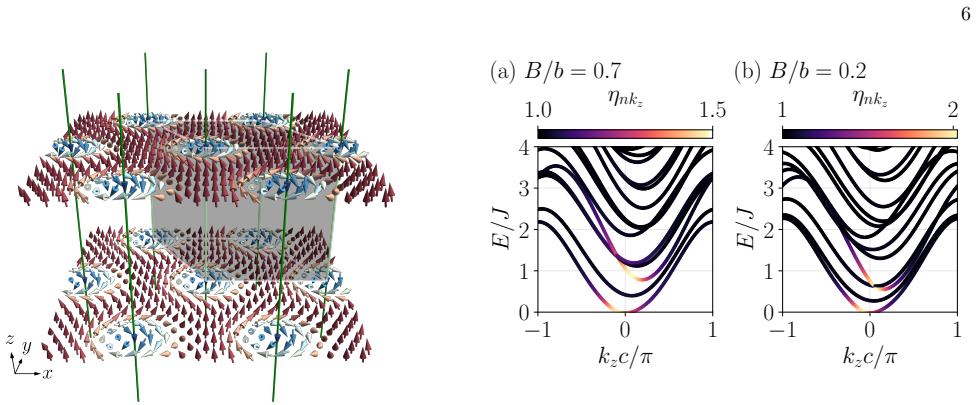
By incorporating the spin-wave theory and perturbation theory for the Landau-Lifshitz-Gilbert equation including nonlocal damping terms, we analytically evaluate the spectral winding number for point gaps, which indicates the existence of the non-Hermitian skin effect. We find that the NHSE can occur even in the absence of nonlocal damping. In the presence of nonlocal damping along one direction, we show that the winding number for an energy band with a unique minimum is determined from the sign of the wave number at the band minimum. We demonstrate these results using a model that hosts a skyrmion-string lattice as a steady state and further investigate spin-wave propagation dynamics.
What carries the argument
The spectral winding number of point gaps in the complex magnon energy bands under local and nonlocal Gilbert damping, which diagnoses the non-Hermitian skin effect.
If this is right
- The non-Hermitian skin effect appears in magnon systems that contain only local Gilbert damping.
- Unidirectional nonlocal damping fixes the winding number of a band solely by the sign of the wave number at its energy minimum.
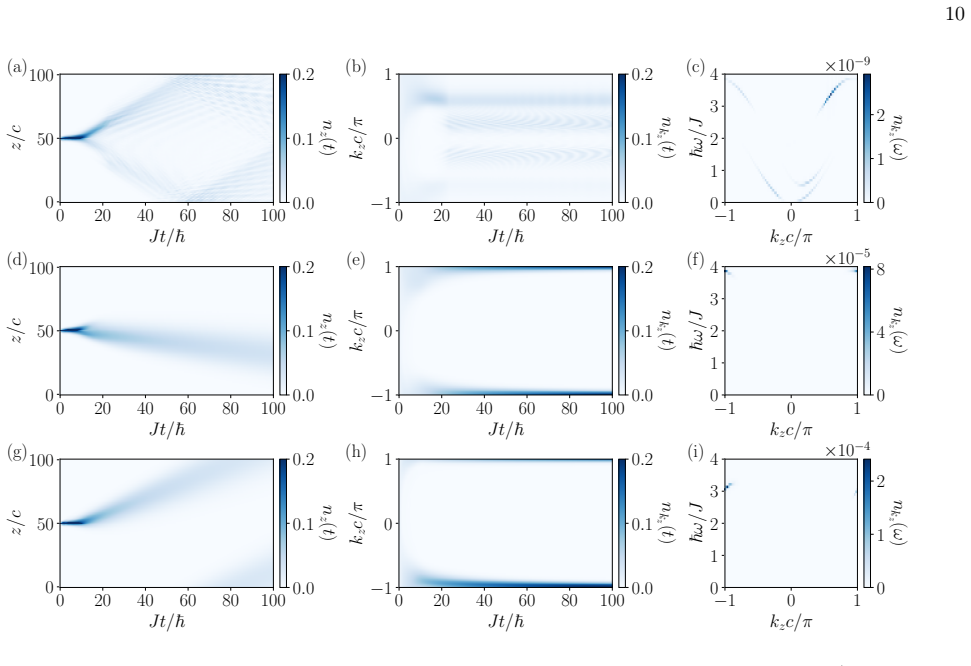
- Spin-wave propagation direction changes sharply from band to band according to the presence or absence of local and nonlocal damping.
- The topological winding numbers correctly predict the observed asymmetry in magnon transport under different damping conditions.
Where Pith is reading between the lines
- Damping parameters could be engineered to select preferred propagation directions for magnons in skyrmion-based devices.
- Analogous point-gap topology may govern damped excitations in other periodic spin textures or bosonic lattices.
- Edge-resolved spectroscopy on finite skyrmion-string samples would provide a direct test of the predicted skin-mode localization.
Load-bearing premise
The skyrmion-string lattice remains a stable steady state of the system so that perturbation theory on the damped Landau-Lifshitz-Gilbert equation correctly describes the finite-lifetime magnon modes.
What would settle it
Direct observation that spin-wave packets launched in a skyrmion-string sample with unidirectional nonlocal damping do not reverse propagation direction when crossing a band minimum whose wave number changes sign would falsify the winding-number rule.
Figures


read the original abstract
We theoretically study the non-Hermitian topology of magnons with finite lifetimes due to Gilbert damping. By incorporating the spin-wave theory and perturbation theory for the Landau-Lifshitz-Gilbert equation including nonlocal damping terms, we analytically evaluate the spectral winding number for point gaps, which indicates the existence of the non-Hermitian skin effect (NHSE). We find that the NHSE can occur even in the absence of nonlocal damping. In the presence of nonlocal damping along one direction, we show that the winding number for an energy band with a unique minimum is determined from the sign of the wave number at the band minimum. We demonstrate these results using a model that hosts a skyrmion-string lattice as a steady state. We further investigate spin-wave propagation dynamics excited by a magnetic-field pulse and show that the propagation direction changes drastically from band to band depending on the presence of local and nonlocal damping, consistent with the nontrivial winding numbers.
Editorial analysis
A structured set of objections, weighed in public.
Referee Report
Summary. The manuscript theoretically studies non-Hermitian topology of finite-lifetime magnons arising from Gilbert damping in skyrmion strings. Combining spin-wave theory with perturbation theory on the Landau-Lifshitz-Gilbert equation that includes nonlocal damping terms, the authors analytically compute the spectral winding number of point gaps to establish the non-Hermitian skin effect (NHSE). They report that the NHSE appears even in the absence of nonlocal damping and that, when nonlocal damping acts along one direction, the winding number of a band possessing a unique minimum is fixed by the sign of the wave number at that minimum. These analytic results are illustrated in a model that supports a skyrmion-string lattice as a steady state, and they are further supported by numerical simulations of spin-wave propagation excited by a magnetic-field pulse, which show damping-dependent direction reversal consistent with the computed winding numbers.
Significance. If the central claims hold, the work meaningfully extends non-Hermitian topology into the magnonics domain by showing that ordinary Gilbert damping alone can generate point-gap topology and skin effects. The explicit relation between winding number and the sign of k at a band minimum supplies a simple, falsifiable diagnostic that could guide both theory and experiment. The analytic evaluation together with the concrete skyrmion-string demonstration and the pulse-propagation numerics constitute clear strengths that make the predictions testable in existing magnon platforms.
major comments (3)
- [Model definition and steady-state verification] The perturbation treatment of the LLG equation around the skyrmion-string background assumes that the lattice remains an exact steady state once the chosen local and nonlocal damping terms are included. No explicit substitution of the background configuration into the full damped LLG equation is shown to confirm that the damping contributions identically vanish or balance, which is required before linearization can be trusted for the subsequent winding-number calculation.
- [Perturbation theory and spectral winding number] Both the claim of NHSE without nonlocal damping and the rule that the winding number equals the sign of k at the band minimum rest on the first-order perturbative spectrum. No quantitative error estimate, validity window in damping strength or magnon amplitude, or side-by-side comparison with direct numerical integration of the nonlinear LLG dynamics is provided; such checks are necessary to establish that the extracted point-gap topology survives at the finite lifetimes considered.
- [Spin-wave propagation dynamics] The numerical pulse-propagation results are stated to be consistent with the analytic winding numbers, yet no quantitative metrics (extracted group velocities, decay lengths, or skin-localization lengths) are reported that would allow a direct, falsifiable comparison between the simulated dynamics and the predicted non-Hermitian spectrum.
minor comments (2)
- [Notation and damping terms] The notation distinguishing the local Gilbert damping term from the nonlocal damping tensor should be introduced with explicit component-wise equations early in the methods section to avoid ambiguity when the winding-number formulas are derived.
- [Figures] Figure captions for the dispersion and propagation plots would benefit from explicit labels indicating the location of each band minimum and the sign of the associated winding number, facilitating immediate visual verification of the analytic claims.
Simulated Author's Rebuttal
We thank the referee for the thorough review and constructive suggestions. We address each major comment below and will incorporate revisions to strengthen the manuscript.
read point-by-point responses
-
Referee: [Model definition and steady-state verification] The perturbation treatment of the LLG equation around the skyrmion-string background assumes that the lattice remains an exact steady state once the chosen local and nonlocal damping terms are included. No explicit substitution of the background configuration into the full damped LLG equation is shown to confirm that the damping contributions identically vanish or balance, which is required before linearization can be trusted for the subsequent winding-number calculation.
Authors: We acknowledge that an explicit verification was omitted. The model is constructed such that the skyrmion-string lattice is an exact steady state of the undamped LLG equation, and the damping terms (local and nonlocal) are added as perturbations that vanish identically on the static background by symmetry. In the revised manuscript we will add an explicit substitution of the background magnetization into the full damped LLG equation, demonstrating that all damping contributions cancel, thereby rigorously justifying the linearization step. revision: yes
-
Referee: [Perturbation theory and spectral winding number] Both the claim of NHSE without nonlocal damping and the rule that the winding number equals the sign of k at the band minimum rest on the first-order perturbative spectrum. No quantitative error estimate, validity window in damping strength or magnon amplitude, or side-by-side comparison with direct numerical integration of the nonlinear LLG dynamics is provided; such checks are necessary to establish that the extracted point-gap topology survives at the finite lifetimes considered.
Authors: We agree that additional validation of the perturbative spectrum is desirable. The first-order correction in the Gilbert damping α is controlled by the small-α expansion standard in magnonics; the leading error is O(α²) and vanishes in the experimentally relevant limit α ≪ 1. In the revision we will (i) state the validity window explicitly, (ii) supply a quantitative error bound derived from the perturbation series, and (iii) present a direct numerical comparison of the perturbative eigenvalues with the spectrum obtained by exact diagonalization of the linearized damped LLG operator for representative α values. Full nonlinear LLG integration lies outside the linear spin-wave regime that defines the point-gap topology under study; we will add a brief remark clarifying this scope limitation while noting that the linear approximation is the appropriate framework for the reported winding numbers. revision: partial
-
Referee: [Spin-wave propagation dynamics] The numerical pulse-propagation results are stated to be consistent with the analytic winding numbers, yet no quantitative metrics (extracted group velocities, decay lengths, or skin-localization lengths) are reported that would allow a direct, falsifiable comparison between the simulated dynamics and the predicted non-Hermitian spectrum.
Authors: We accept that quantitative metrics would improve the falsifiability of the comparison. In the revised manuscript we will extract and tabulate group velocities, exponential decay lengths, and (where relevant) skin-localization lengths from the pulse-propagation simulations. These numbers will be placed alongside the analytic predictions obtained from the winding numbers and the non-Hermitian dispersion, enabling a direct, quantitative test of consistency. revision: yes
Circularity Check
No circularity: results follow from standard spin-wave and LLG perturbation theory
full rationale
The derivation applies established spin-wave theory and perturbative linearization to the LLG equation with damping terms to compute spectral winding numbers analytically for a skyrmion-string lattice model. No parameters are fitted to data within the paper and then relabeled as predictions; the winding numbers and NHSE claims emerge directly from the linearized non-Hermitian spectrum without self-definitional loops or load-bearing self-citations. The skyrmion lattice is posited as a steady state by construction of the model, but this is an input assumption rather than a derived output that feeds back into the topology calculation. All steps remain independent of the target results and rest on external, standard methods.
Axiom & Free-Parameter Ledger
Lean theorems connected to this paper
-
IndisputableMonolith/Cost/FunctionalEquation.leanwashburn_uniqueness_aczel unclear?
unclearRelation between the paper passage and the cited Recognition theorem.
We find that the NHSE can occur even in the absence of nonlocal damping... winding number... determined from the sign of the wave number at the band minimum.
-
IndisputableMonolith/Foundation/AlphaCoordinateFixation.leanalpha_pin_under_high_calibration unclear?
unclearRelation between the paper passage and the cited Recognition theorem.
Using the nondegenerate perturbation theory, we show that the presence of damping gives rise to an imaginary part in the magnon eigenenergy.
What do these tags mean?
- matches
- The paper's claim is directly supported by a theorem in the formal canon.
- supports
- The theorem supports part of the paper's argument, but the paper may add assumptions or extra steps.
- extends
- The paper goes beyond the formal theorem; the theorem is a base layer rather than the whole result.
- uses
- The paper appears to rely on the theorem as machinery.
- contradicts
- The paper's claim conflicts with a theorem or certificate in the canon.
- unclear
- Pith found a possible connection, but the passage is too broad, indirect, or ambiguous to say the theorem truly supports the claim.
Reference graph
Works this paper leans on
-
[1]
By linearizing Eq. (1) with respect toψ r, we obtain the following non-Hermitian Bogoliubov-de Gennes (BdG) equation: iℏ ∂ ∂t ψ ψ∗ =H τ (α) ψ ψ∗ ,(4) whereψ := (ψ r)denotes a vector whose components are labeled by the site indexrand Hτ (α) := (τ z +iA) −1H= (1 +iA τ )−1H(0) τ (5) is the non-Hermitian BdG Hamiltonian withτx,y,z being the Pauli matrices act...
- [2]
-
[3]
E. J. Bergholtz, J. C. Budich, and F. K. Kunst, Ex- ceptional topology of non-Hermitian systems, Rev. Mod. Phys.93, 015005 (2021)
work page 2021
-
[4]
N. Okuma and M. Sato, Non-Hermitian Topological Phe- nomena: A Review, Annu. Rev. Condens. Matter Phys. 14, 83 (2023)
work page 2023
-
[5]
Z. Gong, Y. Ashida, K. Kawabata, K. Takasan, S. Hi- gashikawa, and M. Ueda, Topological Phases of Non- Hermitian Systems, Phys. Rev. X8, 031079 (2018)
work page 2018
-
[6]
K. Kawabata, K. Shiozaki, M. Ueda, and M. Sato, Sym- metry and Topology in Non-Hermitian Physics, Phys. Rev. X9, 041015 (2019)
work page 2019
- [7]
- [8]
- [9]
-
[10]
L. Xiao, T. Deng, K. Wang, G. Zhu, Z. Wang, W. Yi, and P. Xue, Non-Hermitian bulk–boundary correspondence in quantum dynamics, Nat. Phys.16, 761 (2020)
work page 2020
-
[11]
S. Weidemann, M. Kremer, T. Helbig, T. Hofmann, A. Stegmaier, M. Greiter, R. Thomale, and A. Szameit, Topological funneling of light, Science368, 311 (2020)
work page 2020
-
[12]
M. Brandenbourger, X. Locsin, E. Lerner, and C. Coulais, Non-reciprocal robotic metamaterials, Nat. Commun.10, 4608 (2019)
work page 2019
- [13]
-
[14]
Y. Chen, X. Li, C. Scheibner, V. Vitelli, and G. Huang, Realization of active metamaterials with odd micropolar elasticity, Nat. Commun.12, 5935 (2021)
work page 2021
- [15]
- [16]
- [17]
-
[18]
R. Shindou, R. Matsumoto, S. Murakami, and J.-i. Ohe, Topological chiral magnonic edge mode in a magnonic crystal, Phys. Rev. B87, 174427 (2013)
work page 2013
-
[19]
H. M. Hurst and B. Flebus, Non-Hermitian physics in magnetic systems, J. Appl. Phys.132, 220902 (2022)
work page 2022
-
[20]
T. Yu, J. Zou, B. Zeng, J. Rao, and K. Xia, Non- Hermitian topological magnonics, Phys. Rep.1062, 1 (2024)
work page 2024
-
[21]
X. Li, M. A. Begaowe, S. Zhang, and B. Flebus, Non- Hermitian and Liouvillian skin effects in magnetic sys- tems, Phys. Rev. B112, 134416 (2025)
work page 2025
- [22]
-
[23]
J. S. Harms, H. Y. Yuan, and R. A. Duine, Antimagnon- ics, AIP Adv.14, 025303 (2024)
work page 2024
-
[24]
Y. Wang, J. Wang, R. Ma, and J. Xiao, Connection be- tween spin-wave polarization and dissipation, Phys. Rev. B111, 134431 (2025)
work page 2025
-
[25]
Gilbert, A phenomenological theory of damping in ferromagnetic materials, IEEE Trans
T. Gilbert, A phenomenological theory of damping in ferromagnetic materials, IEEE Trans. Magn.40, 3443 (2004)
work page 2004
- [26]
-
[27]
D. Thonig and J. Henk, Gilbert damping tensor within the breathing Fermi surface model: anisotropy and non- locality, New J. Phys.16, 013032 (2014)
work page 2014
- [28]
-
[29]
Z. Lu, I. P. Miranda, S. Streib, M. Pereiro, E. Sjöqvist, O. Eriksson, A. Bergman, D. Thonig, and A. Delin, In- fluence of nonlocal damping on magnon properties of fer- romagnets, Phys. Rev. B108, 014433 (2023)
work page 2023
-
[30]
F. Reyes-Osorio and B. K. Nikolić, Nonlocal damping of spin waves in a magnetic insulator induced by normal, heavy, or altermagnetic metallic overlayer: A Schwinger- Keldysh field theory approach, Phys. Rev. B110, 214432 (2024)
work page 2024
-
[31]
K. Deng and B. Flebus, Non-Hermitian skin effect in magnetic systems, Phys. Rev. B105, L180406 (2022). 12
work page 2022
-
[32]
S. Seki, M. Garst, J. Waizner, R. Takagi, N. D. Khanh, Y. Okamura, K. Kondou, F. Kagawa, Y. Otani, and Y. Tokura, Propagation dynamics of spin excitations along skyrmion strings, Nat. Commun.11, 256 (2020)
work page 2020
-
[33]
S. Brinker, M. dos Santos Dias, and S. Lounis, Gen- eralization of the Landau–Lifshitz–Gilbert equation by multi-body contributions to Gilbert damping for non- collinear magnets, J. Phys. Condens. Matter34, 285802 (2022)
work page 2022
-
[34]
132 (Springer, Berlin, Heidel- berg, 1995)
T.Kato,Perturbation Theory for Linear Operators,Clas- sics in Mathematics, Vol. 132 (Springer, Berlin, Heidel- berg, 1995)
work page 1995
- [35]
-
[36]
S. Okumura, V. P. Kravchuk, and M. Garst, Instability of Magnetic Skyrmion Strings Induced by Longitudinal Spin Currents, Phys. Rev. Lett.131, 066702 (2023)
work page 2023
- [37]
-
[38]
O. Petrova and O. Tchernyshyov, Spin waves in a skyrmion crystal, Phys. Rev. B84, 214433 (2011)
work page 2011
-
[39]
Mochizuki, Spin-Wave Modes and Their Intense Ex- citation Effects in Skyrmion Crystals, Phys
M. Mochizuki, Spin-Wave Modes and Their Intense Ex- citation Effects in Skyrmion Crystals, Phys. Rev. Lett. 108, 017601 (2012)
work page 2012
-
[40]
T. Bessho and M. Sato, Nielsen-Ninomiya Theorem with Bulk Topology: Duality in Floquet and Non-Hermitian Systems, Phys. Rev. Lett.127, 196404 (2021)
work page 2021
- [41]
discussion (0)
Sign in with ORCID, Apple, or X to comment. Anyone can read and Pith papers without signing in.