Recognition: no theorem link
LoBoFit: Flexible Garment Refitting via Local Bone Mapping Blending
Pith reviewed 2026-05-11 02:13 UTC · model grok-4.3
The pith
Representing garments as blends of local bone mappings allows robust refitting while preserving fine details and wrinkles.
A machine-rendered reading of the paper's core claim, the machinery that carries it, and where it could break.
Core claim
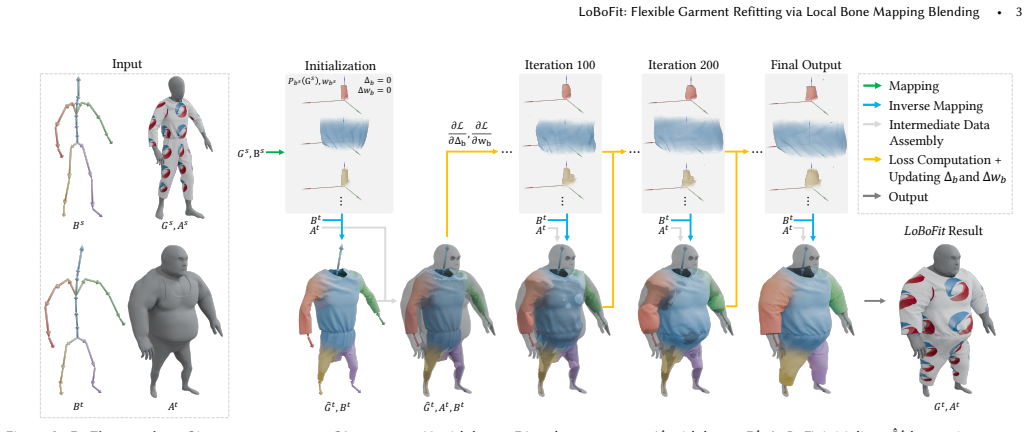
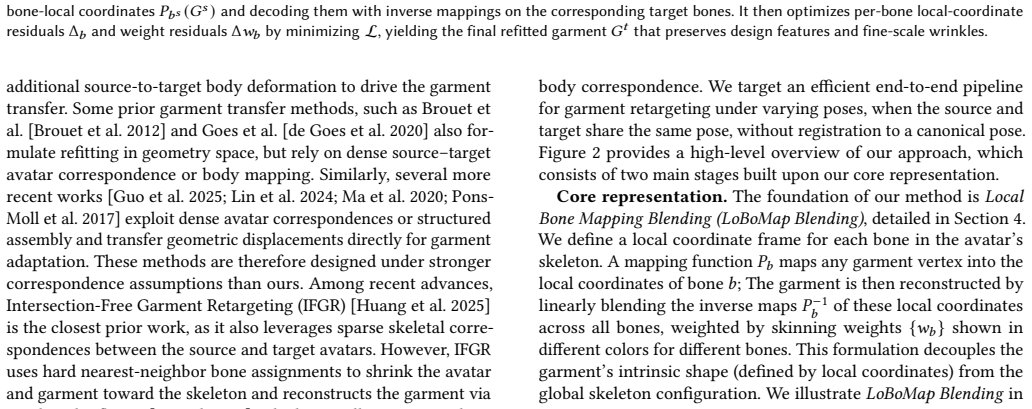
LoBoFit is built upon a novel Local Bone Mapping Blending (LoBoMap Blending) representation. Instead of manipulating global vertex positions, LoBoMap Blending expresses garment geometry as a linear blend of its mappings into local bone coordinate frames. This representation is highly expressive and flexible: local bone mappings yield a pose-robust initialization and a well-conditioned parameterization, while blending weights smooth the optimization landscape and broaden the space of plausible solutions for stable convergence with fine-scale detail preservation. The subsequent refinement efficiently resolves collisions and preserves details by optimizing localized residuals, effectively decom
What carries the argument
LoBoMap Blending, which expresses garment geometry as a linear blend of its mappings into local bone coordinate frames to deliver pose-robust initialization and a well-conditioned parameterization that supports stable convergence.
If this is right
- High-resolution single- and multi-layer garments can be refitted across avatars with large shape and topological differences.
- Intricate wrinkles and the intended fit style are faithfully preserved during the process.
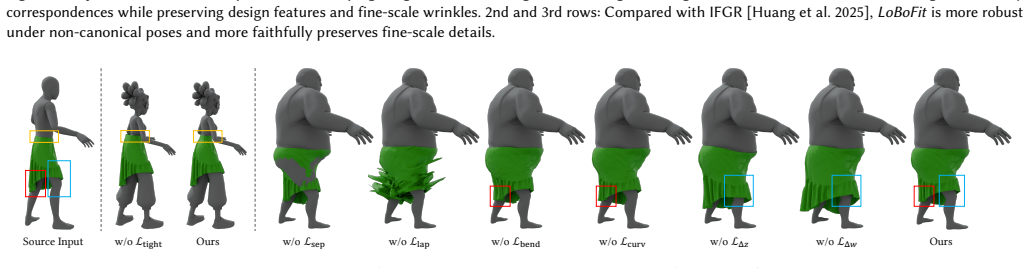
- The approach outperforms prior methods in both robustness to variation and final output quality.
- Complex global deformations are broken into manageable localized subproblems that converge more reliably.
Where Pith is reading between the lines
- The same local-frame blending idea might reduce optimization difficulty in other surface deformation tasks such as character rigging or soft-body simulation.
- If the representation proves stable, it could serve as a better initialization for data-driven refitting networks trained on limited pose data.
- Real-time garment adaptation pipelines might become feasible if the improved conditioning cuts the number of optimization iterations needed.
Load-bearing premise
That expressing the garment via local bone mappings and blending weights will always produce a sufficiently broad yet well-conditioned space of solutions so that localized residual optimization can resolve collisions without losing intended wrinkles or design features.
What would settle it
Running the method on a high-resolution multi-layer garment transferred between avatars with large shape and topological differences and checking whether specific fine-scale wrinkle patterns disappear or self-collisions remain unresolved would test whether the claim holds.
Figures





read the original abstract
Garment refitting, the task of adapting a garment from a source to a target avatar, must preserve the original design features and fine-scale wrinkles, a challenge exacerbated by significant shape variations and varying poses without registration to a shared canonical pose. Existing methods struggle to balance robustness, efficiency, and fidelity of detail: physics-based simulation is costly, data-driven approaches lack generalizability, and geometry optimization in the full vertex space is often ill-conditioned and prone to local minima with unsatisfactory quality. We identify that a fundamental limitation lies in the representation: deforming garments directly in global coordinates couples vertices non-locally, creating a complex and poorly-structured optimization landscape. Therefore, we introduce LoBoFit, a robust refitting method built upon a novel Local Bone Mapping Blending (LoBoMap Blending) representation. Instead of manipulating global vertex positions, LoBoMap Blending expresses garment geometry as a linear blend of its mappings into local bone coordinate frames. This representation is highly expressive and flexible: local bone mappings yield a pose-robust initialization and a well-conditioned parameterization, while blending weights smooth the optimization landscape and broaden the space of plausible solutions for stable convergence with fine-scale detail preservation. The subsequent refinement efficiently resolves collisions and preserves details by optimizing localized residuals, effectively decomposing the complex global deformation into manageable subproblems. Our experiments demonstrate that LoBoFit reliably refits high-resolution, single- and multi-layer garments across avatars with large shape and topological differences, while faithfully preserving intricate wrinkles and the intended fit style, outperforming state-of-the-art methods in robustness and output quality.
Editorial analysis
A structured set of objections, weighed in public.
Referee Report
Summary. The paper claims to solve garment refitting across large shape and pose variations while preserving design features and fine-scale wrinkles. It identifies global-coordinate optimization as ill-conditioned and proposes LoBoFit, built on a novel Local Bone Mapping Blending (LoBoMap Blending) representation that expresses garment vertices as a linear combination of per-bone local-frame mappings plus blending weights. This is said to yield pose-robust initialization, a well-conditioned parameterization, and a broadened solution space; a subsequent localized residual optimization then resolves collisions. Experiments are reported to demonstrate reliable refitting of high-resolution single- and multi-layer garments on avatars with large topological differences, faithful wrinkle preservation, and superior robustness/quality versus state-of-the-art methods.
Significance. If the LoBoMap Blending representation truly produces a parameterization whose basin is both wide and detail-preserving, the work would advance garment adaptation pipelines by offering an efficient, generalizable alternative to costly physics simulation and limited data-driven methods. The explicit decomposition of global deformation into local mappings plus residuals is a conceptually clean contribution that could influence other non-rigid registration tasks. The reported experiments on challenging high-resolution and multi-layer cases provide concrete evidence of practical utility.
major comments (2)
- [Abstract] Abstract: The load-bearing claim that 'blending weights smooth the optimization landscape and broaden the space of plausible solutions for stable convergence with fine-scale detail preservation' is asserted without derivation, bounds, or analysis showing that the linear blend spans the required non-rigid deformations. It remains unclear whether the combination inherently attenuates high-frequency wrinkles (a common risk with skinning-style blends) before the residual stage can recover them.
- [Method] Method (LoBoMap Blending formulation): No explicit equations or conditioning analysis are referenced to demonstrate that the local-frame mappings plus blending weights produce a well-conditioned landscape whose basin is sufficiently broad for arbitrary shape variations; without such support or an ablation quantifying detail preservation (e.g., wrinkle frequency spectra before/after blending), the subsequent localized residual optimization's ability to restore intended features cannot be verified.
minor comments (2)
- [Abstract] The abstract states that LoBoFit 'outperforms state-of-the-art methods in robustness and output quality' yet provides no quantitative metrics, specific baselines, or dataset details; adding these (or referencing the corresponding tables/figures) would make the experimental claims easier to evaluate.
- Consider including an early schematic diagram of the local bone mapping and blending process to clarify the novel representation for readers unfamiliar with the coordinate-frame construction.
Simulated Author's Rebuttal
We thank the referee for the constructive and detailed feedback on our manuscript. We have prepared point-by-point responses to the major comments below and revised the manuscript to incorporate additional analysis and ablations where appropriate.
read point-by-point responses
-
Referee: [Abstract] Abstract: The load-bearing claim that 'blending weights smooth the optimization landscape and broaden the space of plausible solutions for stable convergence with fine-scale detail preservation' is asserted without derivation, bounds, or analysis showing that the linear blend spans the required non-rigid deformations. It remains unclear whether the combination inherently attenuates high-frequency wrinkles (a common risk with skinning-style blends) before the residual stage can recover them.
Authors: The abstract summarizes the core properties of the LoBoMap Blending representation, whose full formulation and motivation appear in Section 3. The representation decomposes garment vertices into per-bone local-frame mappings blended by proximity-based weights; this structure separates coarse pose- and shape-driven deformation from fine-scale residuals. We agree that the abstract claim would benefit from supporting analysis and have therefore added a concise derivation in the revised manuscript showing that the linear combination spans the necessary non-rigid deformations while the localized residual stage recovers high-frequency content. We have also inserted an ablation that compares wrinkle frequency spectra before and after blending to confirm that attenuation does not occur. revision: yes
-
Referee: [Method] Method (LoBoMap Blending formulation): No explicit equations or conditioning analysis are referenced to demonstrate that the local-frame mappings plus blending weights produce a well-conditioned landscape whose basin is sufficiently broad for arbitrary shape variations; without such support or an ablation quantifying detail preservation (e.g., wrinkle frequency spectra before/after blending), the subsequent localized residual optimization's ability to restore intended features cannot be verified.
Authors: Section 3.2 already states the explicit vertex expression v = sum_i w_i * T_i(v_local,i) together with the definition of the local transformations T_i and blending weights w_i. We nevertheless acknowledge that an explicit conditioning argument and quantitative ablation were not included. In the revision we have added a short conditioning analysis (Jacobian norm and condition-number bounds) that shows the localized parameterization yields a better-conditioned landscape than global-coordinate optimization. We have further included an ablation study reporting wrinkle frequency spectra before/after the blending stage, confirming that high-frequency detail is retained and that the subsequent residual optimization restores any minor discrepancies. These additions directly support the breadth of the solution basin observed in our large-variation experiments. revision: yes
Circularity Check
No circularity detected; derivation is self-contained
full rationale
The paper introduces LoBoMap Blending as a novel representation expressing garment geometry via linear combination of per-bone local-frame mappings plus blending weights. This is presented as an original parameterization choice to improve conditioning over global coordinates, followed by independent localized residual optimization. No equations reduce a claimed prediction or property to a fitted input by construction, no load-bearing self-citations justify uniqueness or ansatzes, and no renaming of known results occurs. The central claims rest on the explicit definition of the new representation rather than circular reduction to prior quantities.
Axiom & Free-Parameter Ledger
axioms (1)
- domain assumption Garment geometry can be expressed as a linear blend of local mappings to bone coordinate frames without losing expressiveness for fine-scale wrinkles.
invented entities (1)
-
Local Bone Mapping Blending (LoBoMap Blending)
no independent evidence
Reference graph
Works this paper leans on
-
[1]
Visualization and mathematics III , pages=
Discrete differential-geometry operators for triangulated 2-manifolds , author=. Visualization and mathematics III , pages=. 2003 , publisher=
work page 2003
-
[2]
International Conference on Learning Representations , year =
Decoupled Weight Decay Regularization , author =. International Conference on Learning Representations , year =
-
[3]
SIGGRAPH Asia 2024 Conference Papers , pages=
Neural Garment Dynamic Super-Resolution , author=. SIGGRAPH Asia 2024 Conference Papers , pages=
work page 2024
-
[4]
ACM Transactions on Graphics , volume=
Design preserving garment transfer , author=. ACM Transactions on Graphics , volume=
-
[5]
Proceedings of the IEEE/CVF conference on computer vision and pattern recognition , pages=
Smplicit: Topology-aware generative model for clothed people , author=. Proceedings of the IEEE/CVF conference on computer vision and pattern recognition , pages=
-
[6]
ACM SIGGRAPH 2024 Conference Papers , pages=
Layga: Layered gaussian avatars for animatable clothing transfer , author=. ACM SIGGRAPH 2024 Conference Papers , pages=
work page 2024
-
[7]
ACM Transactions on Graphics (ToG) , volume=
ClothCap: Seamless 4D clothing capture and retargeting , author=. ACM Transactions on Graphics (ToG) , volume=. 2017 , publisher=
work page 2017
-
[8]
Proceedings of the IEEE/CVF international conference on computer vision , pages=
Ag3d: Learning to generate 3d avatars from 2d image collections , author=. Proceedings of the IEEE/CVF international conference on computer vision , pages=
- [9]
-
[10]
Proceedings of the IEEE/CVF Conference on Computer Vision and Pattern Recognition , pages=
Inverse simulation: Reconstructing dynamic geometry of clothed humans via optimal control , author=. Proceedings of the IEEE/CVF Conference on Computer Vision and Pattern Recognition , pages=
-
[11]
Proceedings of the IEEE/CVF Conference on Computer Vision and Pattern Recognition , pages=
Diffavatar: Simulation-ready garment optimization with differentiable simulation , author=. Proceedings of the IEEE/CVF Conference on Computer Vision and Pattern Recognition , pages=
-
[12]
European Conference on Computer Vision , pages=
Physavatar: Learning the physics of dressed 3d avatars from visual observations , author=. European Conference on Computer Vision , pages=. 2024 , organization=
work page 2024
-
[13]
ACM Transactions on Graphics (TOG) , volume=
Rule-free sewing pattern adjustment with precision and efficiency , author=. ACM Transactions on Graphics (TOG) , volume=. 2018 , publisher=
work page 2018
-
[14]
Computer Graphics Forum , volume=
Designing personalized garments with body movement , author=. Computer Graphics Forum , volume=. 2023 , organization=
work page 2023
-
[15]
Proceedings of the ACM on Computer Graphics and Interactive Techniques , volume=
Dress anyone: Automatic physically-based garment pattern refitting , author=. Proceedings of the ACM on Computer Graphics and Interactive Techniques , volume=. 2025 , publisher=
work page 2025
-
[16]
Sumner, Robert W. and Popovi\'. Deformation transfer for triangle meshes , year =. ACM Trans. Graph. , month = aug, pages =
-
[17]
ACM Transactions on Graphics (TOG) , volume=
DRAPE: DRessing Any PErson , author=. ACM Transactions on Graphics (TOG) , volume=. 2012 , publisher=
work page 2012
-
[18]
DeepWrinkles: Accurate and Realistic Clothing Modeling , author=. Proc. European Conference on Computer Vision (ECCV) , pages=. 2018 , publisher=
work page 2018
-
[19]
TailorNet: Predicting Clothing in 3D as a Function of Human Pose, Shape and Garment Style , author=. Proc. IEEE/CVF International Conference on Computer Vision (ICCV) , pages=. 2021 , organization=
work page 2021
-
[20]
ACM Transactions on Graphics (TOG) , volume=
GarmageNet: A Multimodal Generative Framework for Sewing Pattern Design and Generic Garment Modeling , author=. ACM Transactions on Graphics (TOG) , volume=. 2025 , publisher=
work page 2025
-
[21]
ACM Transactions on Graphics (TOG) , volume=
Dresscode: Autoregressively sewing and generating garments from text guidance , author=. ACM Transactions on Graphics (TOG) , volume=. 2024 , publisher=
work page 2024
-
[22]
ACM Transactions on Graphics (TOG) , volume =
GarmentCodeData: A Large-Scale Corpus of Parametric Sewing Patterns for Machine Learning , author =. ACM Transactions on Graphics (TOG) , volume =. 2024 , publisher =
work page 2024
-
[23]
Geometry Images , author =. Proceedings of the 29th Annual Conference on Computer Graphics and Interactive Techniques (SIGGRAPH) , pages =. 2002 , publisher =
work page 2002
-
[24]
ACM SIGGRAPH Asia 2013 , pages =
Folding and Crumpling Adaptive Sheets , author =. ACM SIGGRAPH Asia 2013 , pages =. 2013 , doi =
work page 2013
-
[25]
Layered Garment Retargeting with Stretch Compensation , author =. Computer Graphics Forum (Proc. Pacific Graphics) , volume =. 2020 , doi =
work page 2020
-
[26]
Advances in Neural Information Processing Systems , volume=
ULNeF: Untangled layered neural fields for mix-and-match virtual try-on , author=. Advances in Neural Information Processing Systems , volume=
-
[27]
Advances in Neural Information Processing Systems , volume=
Isp: Multi-layered garment draping with implicit sewing patterns , author=. Advances in Neural Information Processing Systems , volume=
-
[28]
Proceedings of the fourth symposium on digital production , pages=
Delta Mush: smoothing deformations while preserving detail , author=. Proceedings of the fourth symposium on digital production , pages=
- [29]
-
[30]
Intersection-free Garment Retargeting , author=. Proceedings of the Special Interest Group on Computer Graphics and Interactive Techniques Conference Conference Papers , pages=
- [31]
-
[32]
ACM Transactions on Graphics (TOG) , volume=
Slippage-preserving reshaping of human-made 3D content , author=. ACM Transactions on Graphics (TOG) , volume=. 2023 , publisher=
work page 2023
- [33]
-
[34]
Proceedings of the 2008 ACM SIGGRAPH/Eurographics Symposium on Computer Animation , pages=
DrivenShape: a data-driven approach for shape deformation , author=. Proceedings of the 2008 ACM SIGGRAPH/Eurographics Symposium on Computer Animation , pages=. 2008 , publisher=
work page 2008
-
[35]
ACM Transactions on Graphics (TOG) , volume=
Sensitivity-optimized rigging for example-based real-time clothing synthesis , author=. ACM Transactions on Graphics (TOG) , volume=. 2014 , publisher=
work page 2014
-
[36]
Computer Graphics Forum , volume=
Learning-based animation of clothing for virtual try-on , author=. Computer Graphics Forum , volume=. 2019 , publisher=
work page 2019
-
[37]
ACM Transactions on Graphics (TOG) , volume=
Learning an intrinsic garment space for interactive authoring of garment animation , author=. ACM Transactions on Graphics (TOG) , volume=. 2019 , publisher=
work page 2019
-
[38]
Proceedings of the IEEE/CVF Conference on Computer Vision and Pattern Recognition (CVPR) , pages=
SNUG: Self-supervised neural dynamic garments , author=. Proceedings of the IEEE/CVF Conference on Computer Vision and Pattern Recognition (CVPR) , pages=
-
[39]
Proceedings of the 2004 Eurographics/ACM SIGGRAPH Symposium on Geometry Processing , pages=
Laplacian surface editing , author=. Proceedings of the 2004 Eurographics/ACM SIGGRAPH Symposium on Geometry Processing , pages=. 2004 , publisher=
work page 2004
-
[40]
Proceedings of the IEEE/CVF Conference on Computer Vision and Pattern Recognition , pages=
Registering explicit to implicit: Towards high-fidelity garment mesh reconstruction from single images , author=. Proceedings of the IEEE/CVF Conference on Computer Vision and Pattern Recognition , pages=
-
[41]
ACM SIGGRAPH 2024 Conference Papers , articleno=
ContourCraft: Learning to resolve intersections in neural multi-garment simulations , author=. ACM SIGGRAPH 2024 Conference Papers , articleno=. 2024 , publisher=
work page 2024
-
[42]
Proceedings of the IEEE/CVF Conference on Computer Vision and Pattern Recognition (CVPR) , pages=
Learning to dress 3D people in generative clothing , author=. Proceedings of the IEEE/CVF Conference on Computer Vision and Pattern Recognition (CVPR) , pages=
-
[43]
Proceedings of the IEEE/CVF Conference on Computer Vision and Pattern Recognition (CVPR) , pages=
HOOD: Hierarchical graphs for generalized modelling of clothing dynamics , author=. Proceedings of the IEEE/CVF Conference on Computer Vision and Pattern Recognition (CVPR) , pages=
-
[44]
ACM Transactions on Graphics (TOG) , volume=
Motion guided deep dynamic 3d garments , author=. ACM Transactions on Graphics (TOG) , volume=. 2022 , publisher=
work page 2022
-
[45]
Computer Graphics Forum , volume=
Digital garment alteration , author=. Computer Graphics Forum , volume=. 2024 , organization=
work page 2024
-
[46]
Special Interest Group on Computer Graphics and Interactive Techniques Conference Talks , pages=
Garment refitting for digital characters , author=. Special Interest Group on Computer Graphics and Interactive Techniques Conference Talks , pages=
-
[47]
Proceedings of the SIGGRAPH Asia 2025 Conference Papers , pages=
Progressive Outfit Assembly and Instantaneous Pose Transfer , author=. Proceedings of the SIGGRAPH Asia 2025 Conference Papers , pages=
work page 2025
discussion (0)
Sign in with ORCID, Apple, or X to comment. Anyone can read and Pith papers without signing in.