Recognition: no theorem link
VNN-LIB 2.0: Rigorous Foundations for Neural Network Verification
Pith reviewed 2026-05-11 02:07 UTC · model grok-4.3
The pith
VNN-LIB 2.0 uses a network theory abstraction to supply precise syntax, type systems, and semantics for neural network verification queries independent of external model formats.
A machine-rendered reading of the paper's core claim, the machinery that carries it, and where it could break.
Core claim
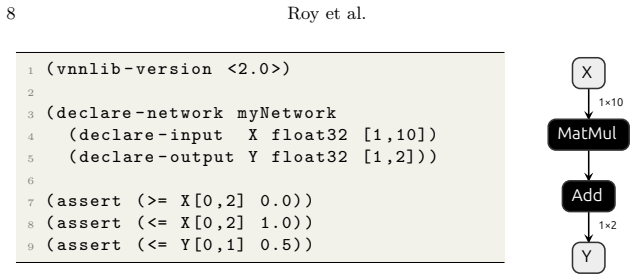
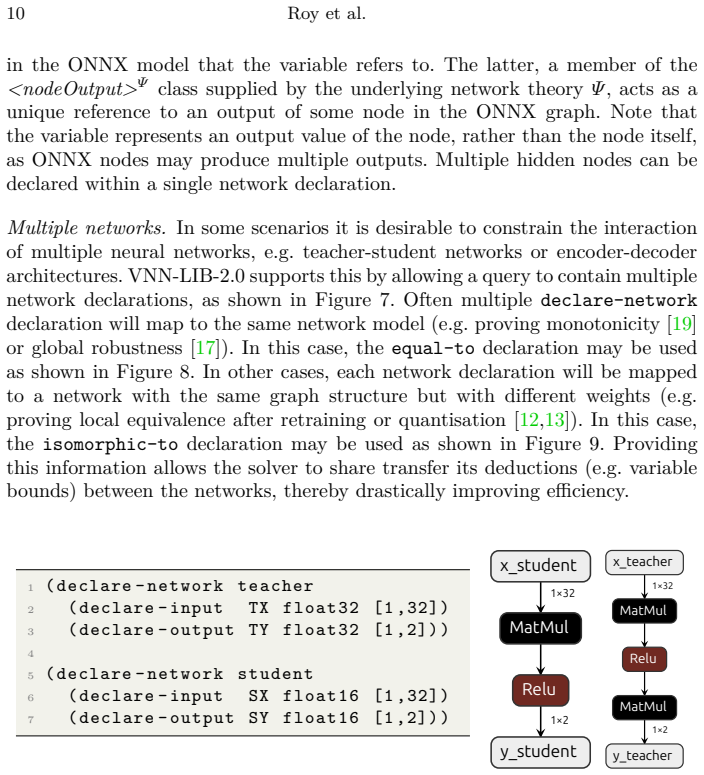
The central claim is that a network theory abstraction characterises the minimal semantic interface required from a neural network model format. This interface enables VNN-LIB to be defined independently of any specific version of external model representations while preserving compatibility as those representations evolve. Building on the abstraction, the paper supplies a formal syntax for an expressive query language, a type system for that language over the numeric domains provided by the network theory, and a formal semantics for the queries, all of which are mechanized to guarantee consistency.
What carries the argument
The network theory, an abstract characterisation of the minimal semantic interface required from any neural network model format, which decouples the verification query language from concrete model implementations.
If this is right
- Verification queries acquire fixed, self-contained semantics that do not change with updates to external model formats.
- The query language supports greater expressivity while remaining type-safe with respect to the numeric domains of the network theory.
- Compatibility with new or revised model representations is maintained without introducing soundness gaps in the verification process.
- Mechanization of the syntax, type system, and semantics ensures that the definitions contain no internal contradictions.
Where Pith is reading between the lines
- Verification tools built on this standard could remain stable even as underlying model formats continue to change.
- The same abstraction pattern could be reused for other verification or certification standards that must interface with rapidly evolving external data representations.
- Developers could test the abstraction by attempting to encode existing neural network models and queries strictly within the network theory boundaries and checking for completeness.
- keywords:[
- neural network verification
- formal semantics
- type system
- query language
Load-bearing premise
The network theory abstraction is sufficient to capture every necessary semantic detail of neural network models while preserving full expressivity and soundness when interfacing with external formats.
What would settle it
An observation that a real neural network model exhibits observable behaviors or constraints that cannot be expressed through the network theory interface without either omitting information or producing unsound verification outcomes would falsify the claim.
Figures






read the original abstract
Neural network verification is an active and rapidly maturing research area, with a growing ecosystem of solvers and tools. The VNN-LIB standard was introduced to support interoperability in this ecosystem, but Version~1.0 has several serious short-comings as a formal foundation: it lacks a precise syntax, semantics, and type system, offers limited expressivity, and relies on externally defined ONNX models whose semantics are informal and constantly evolving. The latter distinguishes VNN-LIB from established standards such as SMT-LIB, where queries are self-contained and have fixed semantics. In this paper we address these challenges by developing the theoretical foundations of VNN-LIB~2.0. Our key contribution is the introduction of the notion of a \emph{network theory}, which abstractly characterises the minimal semantic interface required from a neural network model format. This abstraction enables VNN-LIB to be defined independently of any specific ONNX version while remaining compatible with evolving model representations. Building on this foundation, we present a formal syntax for a more expressive query language, a type system for it over the numeric domains provided by the network theory, and finally a formal semantics. To ensure internal consistency, the standard is mechanised in the Agda theorem prover. VNN-LIB~2.0 therefore provides robust and rigorous foundations for trustworthy neural network verification.
Editorial analysis
A structured set of objections, weighed in public.
Referee Report
Summary. The paper introduces VNN-LIB 2.0 by defining a network theory as an abstract minimal semantic interface for neural network models. This enables a self-contained formal syntax for an expressive query language, a type system over numeric domains supplied by the network theory, formal semantics, and full mechanization in Agda. The development directly targets the shortcomings of VNN-LIB 1.0 (imprecise syntax/semantics, limited expressivity, and dependence on informal, evolving ONNX semantics) and aims to deliver rigorous, trustworthy foundations for neural network verification.
Significance. If the network theory abstraction succeeds in capturing required semantics while preserving compatibility, the work would establish a self-contained standard comparable to SMT-LIB, substantially improving interoperability and soundness guarantees across verification tools. The Agda mechanization supplies independent, machine-checked evidence of internal consistency for the syntax, type system, and semantics, which is a notable strength.
major comments (2)
- [§3] §3 (Network Theory definition): the claim that the abstraction is sufficient to capture all necessary semantic details of neural network models (including those required for full ONNX compatibility) is load-bearing for the central contribution, yet the paper provides only high-level interface requirements without a concrete mapping or expressivity proof for representative ONNX operators.
- [§5] §5 (Semantics and mechanization): while the Agda development demonstrates consistency of the core definitions, the paper does not state which edge cases (e.g., non-standard numeric domains, higher-order network constructs, or partial functions) are covered by the mechanized theorems versus left as informal assumptions.
minor comments (3)
- [Abstract and §1] The abstract and introduction repeatedly contrast VNN-LIB with SMT-LIB; a short table summarizing the corresponding features (self-contained queries, fixed semantics, etc.) would improve clarity.
- [§4] Notation for the numeric domains supplied by the network theory is introduced without an explicit summary table; adding one would aid readers when following the type-system rules.
- [§4 and §5] A few forward references to later mechanization lemmas appear before the relevant definitions are fully stated; reordering or adding brief forward pointers would reduce reader effort.
Simulated Author's Rebuttal
We thank the referee for their careful reading, positive assessment of the contribution, and recommendation for minor revision. We address each major comment below.
read point-by-point responses
-
Referee: [§3] §3 (Network Theory definition): the claim that the abstraction is sufficient to capture all necessary semantic details of neural network models (including those required for full ONNX compatibility) is load-bearing for the central contribution, yet the paper provides only high-level interface requirements without a concrete mapping or expressivity proof for representative ONNX operators.
Authors: The network theory is intentionally defined as a minimal abstract interface that characterises the semantic requirements any concrete model format must satisfy, thereby decoupling VNN-LIB from the informal and evolving semantics of ONNX. The formal syntax, type system, and semantics are then built parametrically over this interface, and the Agda mechanisation establishes their internal consistency. We agree, however, that an explicit illustration of how representative ONNX operators are captured would strengthen the load-bearing claim. In the revised manuscript we will add an appendix that supplies concrete mappings for a representative set of ONNX operators (e.g., Gemm, Conv, Relu, and element-wise arithmetic) together with a brief discussion of how their semantics are expressed through the network-theory interface. revision: yes
-
Referee: [§5] §5 (Semantics and mechanization): while the Agda development demonstrates consistency of the core definitions, the paper does not state which edge cases (e.g., non-standard numeric domains, higher-order network constructs, or partial functions) are covered by the mechanized theorems versus left as informal assumptions.
Authors: We appreciate the request for greater precision regarding the scope of the mechanisation. The Agda development covers the syntax, typing rules, and denotational semantics for the core query language over the standard numeric domains (reals, integers, and finite-precision floating-point) and first-order network constructs supplied by the network theory. Non-standard numeric domains, higher-order network constructs, and partial functions fall outside this fragment and are treated as informal assumptions, as already indicated in the paper’s limitations discussion. In the revision we will add a short subsection (or table) in §5 that explicitly enumerates the mechanised cases and the informal assumptions that remain. revision: yes
Circularity Check
No significant circularity
full rationale
The paper introduces a network theory as an abstract minimal semantic interface for neural network models, then defines a formal syntax, type system, and semantics on top of it, with the full development mechanized in Agda. This chain is purely definitional and foundational: the abstraction enables independence from evolving ONNX while the mechanization supplies independent evidence of internal consistency. No equations reduce to prior inputs by construction, no parameters are fitted then relabeled as predictions, and no load-bearing claims rest on self-citations or uniqueness theorems imported from the authors' prior work. The contribution addresses VNN-LIB 1.0 shortcomings through new definitions rather than circular derivation.
Axiom & Free-Parameter Ledger
axioms (1)
- standard math Standard mathematical foundations of syntax, semantics, and type theory
invented entities (1)
-
Network theory
no independent evidence
Reference graph
Works this paper leans on
-
[1]
Ansel, J., Yang, E., He, H., Gimelshein, N., Jain, A., Voznesensky, M., Bao, B., Bell, P., et al.: PyTorch 2: Faster Machine Learning Through Dynamic Python Bytecode Transformation and Graph Compilation. In: 29th International Confer- ence on Architectural Support for Programming Languages and Operating Systems (ASPLOS ’24). ACM (Apr 2024).https://doi.org...
-
[2]
In: International Conference on Computer Aided Verification
Athavale, A., Bartocci, E., Christakis, M., Maffei, M., Nickovic, D., Weissenbacher, G.: Verifying global two-safety properties in neural networks with confidence. In: International Conference on Computer Aided Verification. pp. 329–351. Springer (2024).https://doi.org/10.1007/978-3-031-65630-9_17
-
[3]
In: Proceedings of the 8th International Workshop on Satisfiability Modulo Theories (Edinburgh, UK)
Barrett, C., Stump, A., Tinelli, C., et al.: The SMT-LIB standard: Version 2.0. In: Proceedings of the 8th International Workshop on Satisfiability Modulo Theories (Edinburgh, UK). vol. 13, p. 14 (2010)
work page 2010
-
[4]
First Three Years of the International Verification of Neural Networks Competition (
Brix, C., Müller, M.N., Bak, S., Johnson, T.T., Liu, C.: First three years of the international verification of neural networks competition (VNN-COMP). Interna- tional Journal on Software Tools for Technology Transfer25(3), 329–339 (2023). https://doi.org/10.1007/s10009-023-00703-4
-
[5]
In: European Symposium on Programming
Cordeiro, L.C., Daggitt, M.L., Girard-Satabin, J., Isac, O., Johnson, T.T., Katz, G., Komendantskaya, E., Lemesle, A., Manino, E., Šinkarovs, A., et al.: Neural net- work verification is a programming language challenge. In: European Symposium on Programming. pp. 206–235. Springer (2025)
work page 2025
-
[6]
Journal of Open Source Software10(116), 9241 (2025).https://doi
Daggitt, M.L., Allais, G., McKinna, J., Abel, A., Doorn, V., Wood, J., Norell, U., Kidney, D.O., Meshveliani, S., Stucki, S., et al.: The Agda standard library: Version 2.0. Journal of Open Source Software10(116), 9241 (2025).https://doi. org/10.21105/joss.09241
-
[7]
Daggitt, M.L., Kokke, W., Atkey, R., Komendantskaya, E., Slusarz, N., Arnaboldi, L.: Vehicle: Bridging the Embedding Gap in the Verification of Neuro-Symbolic Programs. In: International Conference on Formal Structures for Computation and Deduction (FSCD 2025). vol. 337, pp. 2:1–2:20. Dagstuhl, Germany (2025). https://doi.org/10.4230/LIPIcs.FSCD.2025.2 VN...
-
[8]
Demarchi, S., Guidotti, D., Pulina, L., Tacchella, A., Narodytska, N., Amir, G., Katz, G., Isac, O.: Supporting Standardization of Neural Networks Verification with VNNLIB and CoCoNet. In: FoMLAS@ CAV. pp. 47–58 (2023)
work page 2023
-
[9]
developers, O.R.: ONNX Runtime.https://onnxruntime.ai/(2021)
work page 2021
-
[10]
In: International Sympo- sium on AI Verification
Elboher, Y.Y., Isac, O., Katz, G., Ladner, T., Wu, H.: Abstraction-based proof production in formal verification of neural networks. In: International Sympo- sium on AI Verification. pp. 203–220. Springer (2025).https://doi.org/10.1007/ 978-3-031-99991-8_10
work page 2025
-
[11]
Girard-Satabin, J., Alberti, M., Bobot, F., Chihani, Z., Lemesle, A.: CAISAR: A platform for Characterizing Artificial Intelligence Safety and Robustness. In: AISafety. CEUR-Workshop Proceedings, Vienne, Austria (Jul 2022),https:// hal.archives-ouvertes.fr/hal-03687211
work page 2022
-
[12]
In: Proceedings of the AAAI conference on Artificial Intelligence
Henzinger, T.A., Lechner, M., Žikelić, Ð.: Scalable verification of quantized neural networks. In: Proceedings of the AAAI conference on Artificial Intelligence. vol. 35, pp. 3787–3795 (2021)
work page 2021
-
[13]
Huang, P., Wu, H., Yang, Y., Daukantas, I., Wu, M., Zhang, Y., Barrett, C.: Towards efficient verification of quantized neural networks. In: Proceedings of the AAAIConferenceonArtificialIntelligence.vol.38,pp.21152–21160(2024).https: //doi.org/10.1609/aaai.v38i19.30108
-
[14]
In: Proceedings of the 22nd ACM International Conference on Hybrid Systems: Computation and Control
Ivanov, R., Weimer, J., Alur, R., Pappas, G.J., Lee, I.: Verisig: verifying safety properties of hybrid systems with neural network controllers. In: Proceedings of the 22nd ACM International Conference on Hybrid Systems: Computation and Control. pp. 169–178 (2019).https://doi.org/10.1145/3302504.3311806
-
[15]
In: International Static Analysis Symposium
Jia, K., Rinard, M.: Exploiting verified neural networks via floatingpoint numerical error. In: International Static Analysis Symposium. pp. 191–205. Springer (2021). https://doi.org/10.1007/978-3-030-88806-0_9
-
[16]
Allerton Conference on Communication, Control, and Computing (2025)
Johnson, T.T.: Is neural network verification useful and what is next? In: 2025 61st Allerton Conference on Communication, Control, and Computing Proceedings. Allerton Conference on Communication, Control, and Computing (2025)
work page 2025
-
[17]
Pro- ceedings of the ACM on Programming Languages8(OOPSLA), 1010–1039 (2024)
Kabaha, A., Cohen, D.D.: Verification of neural networks’ global robustness. Pro- ceedings of the ACM on Programming Languages8(OOPSLA), 1010–1039 (2024). https://doi.org/10.1145/3649847
-
[18]
arXiv preprint arXiv:2512.19007 (2025)
Kaulen, K., Ladner, T., Bak, S., Brix, C., Duong, H., Flinkow, T., Johnson, T.T., Koller, L., Manino, E., Nguyen, T.H., et al.: The 6th International Verifica- tion of Neural Networks Competition (VNN-COMP 2025): Summary and Results. arXiv:2512.19007 (2025).https://doi.org/10.48550/arXiv.2512.19007
-
[19]
Ad- vances in Neural Information Processing Systems33, 15427–15438 (2020)
Liu, X., Han, X., Zhang, N., Liu, Q.: Certified monotonic neural networks. Ad- vances in Neural Information Processing Systems33, 15427–15438 (2020)
work page 2020
-
[20]
Lopez, D.M., Choi, S.W., Tran, H.D., Johnson, T.T.: NNV 2.0: The neural network verification tool. In: International Conference on Computer Aided Verification. pp. 397–412. Springer (2023).https://doi.org/10.1007/978-3-031-37703-7_19
-
[21]
Proceedings of the ACM on Programming Languages6(POPL), 1–33 (2022)
Müller, M.N., Makarchuk, G., Singh, G., Püschel, M., Vechev, M.: PRIMA: gen- eral and precise neural network certification via scalable convex hull approxima- tions. Proceedings of the ACM on Programming Languages6(POPL), 1–33 (2022). https://doi.org/10.1145/3498704
-
[22]
In: Proceedings of the 4th international workshop on Types in language design and implementation
Norell, U.: Dependently typed programming in Agda. In: Proceedings of the 4th international workshop on Types in language design and implementation. pp. 1–2 (2009).https://doi.org/10.1145/1481861.1481862
-
[23]
In: Proceedings of the ACM/IEEE 42nd International Conference on 22 Roy et al
Paulsen, B., Wang, J., Wang, C.: Reludiff: Differential verification of deep neural networks. In: Proceedings of the ACM/IEEE 42nd International Conference on 22 Roy et al. Software Engineering. pp. 714–726 (2020).https://doi.org/10.1145/3377811. 3380337
-
[24]
Shriver, D., Elbaum, S., Dwyer, M.B.: DNNV: A Framework for Deep Neural Network Verification. In: Silva, A., Leino, K.R.M. (eds.) Computer Aided Ver- ification. pp. 137–150. Springer International Publishing, Cham (2021).https: //doi.org/10.1007/978-3-030-81685-8_6
-
[25]
In: Globerson, A., Mackey, L., Fan, A., Zhang, C., Bel- grave, D., Tomczak, J., Paquet, U
Teuber, S., Mitsch, S., Platzer, A.: Provably safe neural network controllers via differential dynamic logic. In: Globerson, A., Mackey, L., Fan, A., Zhang, C., Bel- grave, D., Tomczak, J., Paquet, U. (eds.) Advances in Neural Information Process- ing Systems. Curran Associates, Inc. (2024).https://doi.org/10.5555/3737916. 3737967
-
[26]
Advances in Neural Information Processing Systems34(2021).https://doi.org/10.5555/3540261.3542550
Wang, S., Zhang, H., Xu, K., Lin, X., Jana, S., Hsieh, C.J., Kolter, J.Z.: Beta- CROWN: Efficient bound propagation with per-neuron split constraints for com- plete and incomplete neural network verification. Advances in Neural Information Processing Systems34(2021).https://doi.org/10.5555/3540261.3542550
-
[27]
Wang, Y.: Survey on deep multi-modal data analytics: Collaboration, rivalry, and fusion. ACM Transactions on Multimedia Computing, Communications, and Ap- plications (TOMM)17(1s), 1–25 (2021).https://doi.org/10.1145/3408317
-
[28]
In: International Conference on Computer Aided Verification
Wu, H., Isac, O., Zeljić, A., Tagomori, T., Daggitt, M., Kokke, W., Refaeli, I., Amir, G., Julian, K., Bassan, S., et al.: Marabou 2.0: a versatile formal analyzer of neural networks. In: International Conference on Computer Aided Verification. pp. 249–264. Springer (2024).https://doi.org/10.1007/978-3-031-65630-9_13
discussion (0)
Sign in with ORCID, Apple, or X to comment. Anyone can read and Pith papers without signing in.