Recognition: no theorem link
NEXT Simulation Dataset for AI Summer School UC Irvine 2026
Pith reviewed 2026-05-11 03:11 UTC · model grok-4.3
The pith
The NEXT collaboration releases a dataset of simulated 0νββ signals and 214Bi backgrounds in high-pressure xenon gas for AI training.
A machine-rendered reading of the paper's core claim, the machinery that carries it, and where it could break.
Core claim
The paper establishes that a new public dataset of Monte Carlo simulated 0νββ and 214Bi events in high-pressure xenon gas has been created to closely replicate the detector response of the NEXT experiment, providing ready-to-use training samples for AI algorithms focused on background rejection in rare-event searches.
What carries the argument
The simulated dataset of 0νββ decay and 214Bi background events modeled in high-pressure xenon gas to match NEXT detector characteristics.
If this is right
- Students at the summer school can train and test AI classifiers for signal-background separation on realistic examples.
- The dataset enables standardized evaluation of machine learning performance in 0νββ searches before application to real data.
- It lowers the barrier for exploring AI techniques in xenon-based rare-event experiments by providing accessible training material.
- Models developed on this data could support improved background rejection strategies that tighten limits on neutrino mass.
Where Pith is reading between the lines
- If the simulations prove faithful, AI models trained here could be fine-tuned on real NEXT data with limited additional calibration.
- The public release format may encourage similar dataset contributions from other 0νββ experiments to advance community AI methods.
- Extending the dataset with varied xenon pressures or additional background isotopes would test the generalization of any trained models.
Load-bearing premise
The Monte Carlo simulations must accurately reproduce the detector response, energy resolution, tracking, and background processes of the real NEXT experiment.
What would settle it
Direct comparison of the simulated energy spectra, event topologies, or rate distributions against data from actual NEXT calibration runs that reveals large systematic mismatches.
Figures

read the original abstract
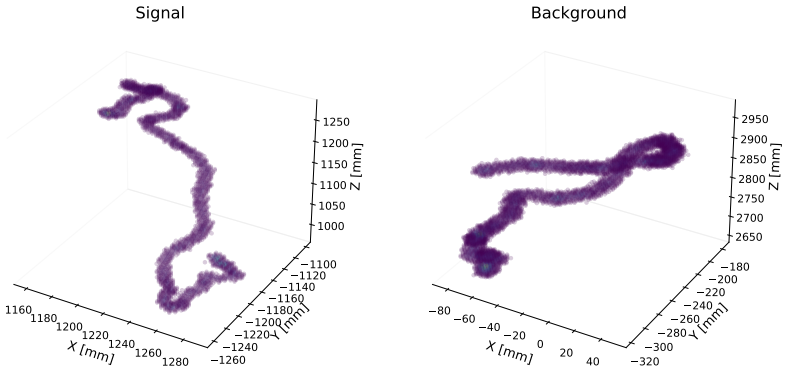
This document details the dataset release of simulated $0\nu\beta\beta$ and background events originating from the decay of $^{214}$Bi in high-pressure xenon gas, describing events similar to those produced in the NEXT detector. This release is part of the Neutrinoless Double Beta Decay ($0\nu\beta\beta$) AI Summer School held on June 20-21 2026 at the University of California, Irvine.
Editorial analysis
A structured set of objections, weighed in public.
Referee Report
Summary. The manuscript announces the release of a simulated dataset of 0νββ signal events and 214Bi background events generated in high-pressure xenon gas, with events described as similar to those expected in the NEXT detector. The release is positioned as educational material for the 0νββ AI Summer School at UC Irvine scheduled for June 20-21 2026.
Significance. Open release of simulation datasets for AI/ML training in rare-event searches is a useful contribution to the field, as it can lower barriers for students and early-career researchers working on background discrimination techniques relevant to next-generation 0νββ experiments. The educational framing adds modest value, though the overall impact remains limited by the absence of quantitative validation or usage documentation.
minor comments (3)
- The abstract and text provide no information on dataset size, file formats, energy ranges, or access method (e.g., repository URL or DOI). Adding a short table or dedicated section summarizing these practical details would improve usability for the intended summer-school audience.
- No description is given of the Monte Carlo framework, gas parameters (pressure, drift field), or detector response model used to generate the events. Even a brief statement citing the relevant NEXT simulation references would clarify the scope of the 'similar to NEXT' claim.
- The manuscript contains no references to prior NEXT detector or simulation papers. Including 1-2 key citations would help place the dataset in context for readers unfamiliar with the experiment.
Simulated Author's Rebuttal
We thank the referee for their review and for recommending minor revision. We address the noted limitation regarding documentation below.
read point-by-point responses
-
Referee: the overall impact remains limited by the absence of quantitative validation or usage documentation.
Authors: We agree that usage documentation would increase the dataset's value for the intended educational audience. In the revised manuscript we will add a dedicated usage section that includes download instructions, file formats, example Python code for loading events, and basic summary statistics (e.g., energy spectra and topology distributions) that allow users to verify the signal and background samples. Because the paper is a data-release note rather than a physics analysis, we do not provide full detector-response validation; the added statistics are intended only to help summer-school participants begin working with the data. revision: yes
Circularity Check
No circularity: dataset release note with no derivations
full rationale
This manuscript is a straightforward dataset release announcement for simulated 0νββ and 214Bi background events in high-pressure xenon gas, intended for an AI summer school. It contains no equations, no predictions, no fitted parameters, no modeling derivations, and no self-citations of load-bearing results. The central claim is simply that the dataset is being made available and that the events are described as similar to those in the NEXT detector; this is a descriptive statement of purpose with no internal reasoning chain that could reduce to its own inputs by construction. The document is self-contained against external benchmarks as a data availability note.
Axiom & Free-Parameter Ledger
Reference graph
Works this paper leans on
-
[1]
Agostinelli, S. and others. GEANT4: A Simulation toolkit. Nucl. Instrum. Meth. A. 2003. doi:10.1016/S0168-9002(03)01368-8
-
[2]
Simón, A. and others , title = ". Journal of High Energy Physics , volume =. 2021 , doi =
work page 2021
-
[3]
Open Science Data Federation. 2015 , bdsk-url-1 =. doi:10.21231/0KVZ-VE57 , publisher =
-
[4]
OSPool. 2006 , bdsk-url-1 =. doi:10.21231/906P-4D78 , publisher =
-
[5]
Pordes, Ruth and Petravick, Don and Kramer, Bill and Olson, Doug and Livny, Miron and Roy, Alain and Avery, Paul and Blackburn, Kent and Wenaus, Torre and W. The open science grid. J. Phys. Conf. Ser. , doi =. 2007 , bdsk-url-1 =
work page 2007
-
[6]
The pilot way to grid resources using glideinWMS
Sfiligoi, Igor and Bradley, Daniel C and Holzman, Burt and Mhashilkar, Parag and Padhi, Sanjay and Wurthwein, Frank , booktitle =. The pilot way to grid resources using glideinWMS. 2009 , bdsk-url-1 =. doi:10.1109/CSIE.2009.950 , pages =
- [7]
-
[8]
S. Agostinelli et al. GEANT4: A Simulation toolkit . Nucl. Instrum. Meth. A , 506:250--303, 2003
work page 2003
-
[9]
A. Simón et al. Boosting background suppression in the NEXT experiment through Richardson--Lucy deconvolution . Journal of High Energy Physics , 2021(7):146, 2021
work page 2021
- [10]
-
[11]
Ruth Pordes, Don Petravick, Bill Kramer, Doug Olson, Miron Livny, Alain Roy, Paul Avery, Kent Blackburn, Torre Wenaus, Frank W \"u rthwein, Ian Foster, Rob Gardner, Mike Wilde, Alan Blatecky, John McGee, and Rob Quick. The open science grid . In J. Phys. Conf. Ser. , volume 78 of 78 , page 012057, 2007
work page 2007
-
[12]
The pilot way to grid resources using glideinWMS
Igor Sfiligoi, Daniel C Bradley, Burt Holzman, Parag Mhashilkar, Sanjay Padhi, and Frank Wurthwein. The pilot way to grid resources using glideinWMS . In 2009 WRI World Congress on Computer Science and Information Engineering , volume 2 of 2 , pages 428--432, 2009
work page 2009
discussion (0)
Sign in with ORCID, Apple, or X to comment. Anyone can read and Pith papers without signing in.