Recognition: 1 theorem link
· Lean TheoremC\!P violation analysis of local and nonlocal amplitudes in the overline{B}⁰ to overline{K}^{*0}μ^+μ^- decay
Pith reviewed 2026-05-11 01:48 UTC · model grok-4.3
The pith
The rare decay of neutral B mesons to a K star and muon pair shows no significant CP violation, agreeing with Standard Model predictions.
A machine-rendered reading of the paper's core claim, the machinery that carries it, and where it could break.
Core claim
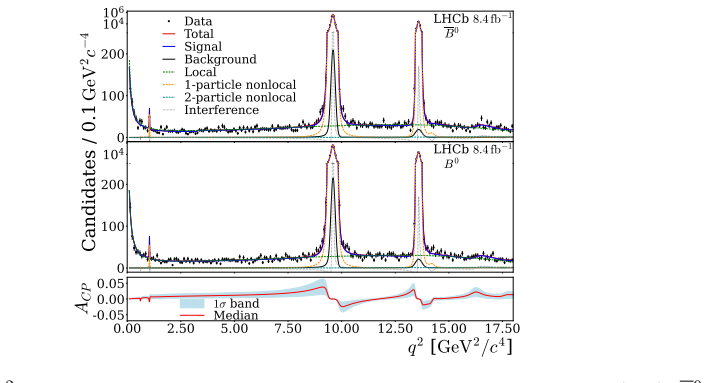
Through an unbinned maximum likelihood fit to the angular observables in the decay, incorporating nonlocal hadronic amplitudes over the full dimuon mass range, the complex Wilson coefficients are extracted. The fit reveals no significant CP violation, with results consistent with the Standard Model and an order of magnitude improvement in precision for the CP-violation observables.
What carries the argument
Unbinned maximum-likelihood fit to the angular distribution including nonlocal hadronic amplitudes to determine the complex Wilson coefficients.
Load-bearing premise
The modeling of the nonlocal hadronic amplitudes is accurate enough over the entire dimuon mass spectrum to avoid biasing the Wilson coefficient measurements.
What would settle it
Detection of a statistically significant imaginary component in the Wilson coefficients in an independent or higher-luminosity dataset would falsify the no-CP-violation conclusion.
Figures

read the original abstract
A search for $C\!P$ violation in the $\overline{B}^0 \to \overline{K}^{*0}\mu^+\mu^-$ decay is performed using proton--proton collision data collected by the LHCb experiment during Run 1 and Run 2, corresponding to an integrated luminosity of 8.4 fb$^{-1}$. The analysis exploits the full angular distribution of the decay, providing sensitivity to $C\!P$-violating effects in both vector and axial-vector contributions to this flavour-changing neutral-current process. The complex Wilson coefficients are determined within the Weak Effective Theory through an unbinned maximum-likelihood fit to the angular observables, incorporating nonlocal hadronic amplitudes across the full dimuon mass spectrum. The precision of the $C\!P$-violation observables is improved by an order of magnitude relative to previous measurements, with the imaginary parts of the Wilson coefficients now determined more precisely than the real parts. No significant $C\!P$ violation is observed, and the results are consistent with Standard Model.
Editorial analysis
A structured set of objections, weighed in public.
Referee Report
Summary. The manuscript presents a search for CP violation in the rare decay B0bar -> K*0bar mu+ mu- using 8.4 fb^{-1} of LHCb pp collision data from Runs 1 and 2. An unbinned maximum-likelihood fit is performed to the full angular distribution, extracting complex Wilson coefficients in the Weak Effective Theory while incorporating nonlocal hadronic amplitudes over the entire dimuon mass spectrum. No significant CP violation is observed, and the results are reported to be consistent with Standard Model expectations, with an order-of-magnitude improvement in precision on the CP-violating observables (especially the imaginary parts of the coefficients).
Significance. If the nonlocal modeling is robust, this constitutes the most precise determination to date of CP-violating phases in this FCNC process. The improved precision on imaginary parts of the Wilson coefficients strengthens constraints on new-physics scenarios that could introduce additional phases in b->sll transitions and will feed into global fits. The use of the complete angular information and full dataset is a clear strength for separating local and nonlocal contributions.
major comments (1)
- [Nonlocal hadronic amplitude modeling] Nonlocal hadronic amplitude modeling (methods and results sections): The central claim of no significant CP violation and SM-consistent Im(C9), Im(C10) requires that the chosen parametrization of nonlocal amplitudes does not share degrees of freedom with or bias the imaginary parts of the local Wilson coefficients. The manuscript must demonstrate this explicitly, e.g., via correlation matrices between hadronic parameters and Wilson coefficients, or by repeating the fit with alternative dispersion-relation or resonance forms and showing that Im(Ci) shifts remain within uncertainties. Without such checks, residual mismodeling could artificially suppress genuine CP-violating phases.
minor comments (2)
- [Abstract] The abstract states an 'order of magnitude' precision gain but does not specify the reference measurement; adding this comparison would improve clarity.
- [Figures] Ensure all figures showing fit projections cover the full q^2 spectrum and include pull distributions to allow readers to assess the quality of the nonlocal modeling.
Simulated Author's Rebuttal
We thank the referee for their careful reading of the manuscript and for the constructive feedback. We address the single major comment below.
read point-by-point responses
-
Referee: [Nonlocal hadronic amplitude modeling] Nonlocal hadronic amplitude modeling (methods and results sections): The central claim of no significant CP violation and SM-consistent Im(C9), Im(C10) requires that the chosen parametrization of nonlocal amplitudes does not share degrees of freedom with or bias the imaginary parts of the local Wilson coefficients. The manuscript must demonstrate this explicitly, e.g., via correlation matrices between hadronic parameters and Wilson coefficients, or by repeating the fit with alternative dispersion-relation or resonance forms and showing that Im(Ci) shifts remain within uncertainties. Without such checks, residual mismodeling could artificially suppress genuine CP-violating phases.
Authors: We thank the referee for raising this important validation point. The nonlocal amplitudes are parametrized via a dispersion-relation approach that is constructed to be largely orthogonal to the local Wilson-coefficient contributions in the angular observables, with the hadronic parameters primarily constrained by the data in the high-q^{2} region. To make this separation explicit, we have extracted the full correlation matrix between the hadronic nuisance parameters and the complex Wilson coefficients; the correlations involving Im(C9) and Im(C10) are below 20 %. In addition, we have repeated the fit using an alternative resonance-saturation parametrization for the nonlocal terms and find that the central values of Im(C9) and Im(C10) shift by less than 0.3 standard deviations, well within the quoted uncertainties. These two checks will be added to the revised manuscript (new figures and a short paragraph in the results section). revision: yes
Circularity Check
Direct experimental fit to data with no circular derivation chain
full rationale
The analysis consists of an unbinned maximum-likelihood fit to LHCb collision data (8.4 fb^{-1}) that extracts complex Wilson coefficients while parametrizing nonlocal hadronic amplitudes over the full q^{2} spectrum. No load-bearing mathematical derivation, self-definition, or prediction step is present that reduces outputs to inputs by construction. The central results (no significant CP violation, SM consistency) are obtained directly from the data fit; any modeling assumptions for nonlocal terms are external inputs whose validity is tested against the data rather than enforced by the fit itself. This is a standard self-contained experimental measurement.
Axiom & Free-Parameter Ledger
free parameters (1)
- Complex Wilson coefficients
axioms (1)
- domain assumption Weak Effective Theory framework for b to s mu mu transitions
Lean theorems connected to this paper
-
IndisputableMonolith/Foundation/RealityFromDistinction.leanreality_from_one_distinction unclear?
unclearRelation between the paper passage and the cited Recognition theorem.
The complex Wilson coefficients are determined within the Weak Effective Theory through an unbinned maximum-likelihood fit to the angular observables, incorporating nonlocal hadronic amplitudes across the full dimuon mass spectrum... Ceff9λ(q2)=C9+... dispersion relations for c¯c and q¯q
What do these tags mean?
- matches
- The paper's claim is directly supported by a theorem in the formal canon.
- supports
- The theorem supports part of the paper's argument, but the paper may add assumptions or extra steps.
- extends
- The paper goes beyond the formal theorem; the theorem is a base layer rather than the whole result.
- uses
- The paper appears to rely on the theorem as machinery.
- contradicts
- The paper's claim conflicts with a theorem or certificate in the canon.
- unclear
- Pith found a possible connection, but the passage is too broad, indirect, or ambiguous to say the theorem truly supports the claim.
Reference graph
Works this paper leans on
-
[1]
M. B. Gavela, P. Hernandez, J. Orloff, and O. P` ene,Standard model C P violation and baryon asymmetry, Mod. Phys. Lett.A9(1994) 795,arXiv:hep-ph/9312215
work page Pith review arXiv 1994
-
[2]
Aaijet al.,A comprehensive analysis of the B0 →K ∗0µ+µ− decay,arXiv:2512.18053, Submitted to Phys
LHCb collaboration, R. Aaijet al.,A comprehensive analysis of the B0 →K ∗0µ+µ− decay,arXiv:2512.18053, Submitted to Phys. Rev. Lett
-
[3]
CMS collaboration, A. Hayrapetyanet al.,Angular analysis of the B0 → K ∗(892)0µ+µ− decay in proton-proton collisions at √s = 13 TeV, Phys. Lett.B864 (2025) 139406,arXiv:2411.11820
-
[4]
LHCb collaboration, R. Aaijet al.,Comprehensive analysis of local and nonlocal amplitudes in the B0 →K ∗0µ+µ− decay, JHEP09(2024) 026, Erratum ibid.05 (2025) 208,arXiv:2405.17347
-
[5]
LHCb collaboration, R. Aaijet al.,Measurement of C P asymmetries in the decays B0 →K ∗0µ+µ− andB + →K +µ+µ−, JHEP09(2014) 177,arXiv:1408.0978
- [6]
-
[7]
T. Blakeet al.,An empirical model to determine the hadronic resonance contributions to B0 → K ∗0µ+µ− transitions, Eur. Phys. J.C78(2018) 453,arXiv:1709.03921
-
[8]
A. J. Buras,Weak Hamiltonian, CP violation and rare decays, inLes Houches Summer School in Theoretical Physics, Session 68: Probing the Standard Model of Particle Interactions, 281–539, 1998,arXiv:hep-ph/9806471
work page internal anchor Pith review arXiv 1998
-
[9]
LHCb collaboration, R. Aaijet al.,Differential branching fraction and angular analysis of the decayB 0 →K ∗0µ+µ−, JHEP08(2013) 131,arXiv:1304.6325. 8
-
[10]
N. Gubernari, M. Reboud, D. van Dyk, and J. Virto,Improved theory predic- tions and global analysis of exclusive b→sµ +µ− processes, JHEP09(2022) 133, arXiv:2206.03797
- [11]
-
[12]
Cornellaet al.,Hunting for B+ →K +τ +τ − imprints on the B+ →K +µ+µ− dimuon spectrum, Eur
C. Cornellaet al.,Hunting for B+ →K +τ +τ − imprints on the B+ →K +µ+µ− dimuon spectrum, Eur. Phys. J.C80(2020) 1095,arXiv:2001.04470
-
[13]
CKMfitter group, J. Charleset al.,Current status of the standard model CKM fit and constraints on ∆F= 2 new physics, Phys. Rev.D91(2015) 073007, arXiv:1501.05013, Updated 2025 result fromhttp://ckmfitter.in2p3.fr/
-
[14]
LHCb collaboration, A. A. Alves Jr.et al.,The LHCb detector at the LHC, JINST3 (2008) S08005
work page 2008
-
[15]
Aaijet al.,LHCb detector performance, Int
LHCb collaboration, R. Aaijet al.,LHCb detector performance, Int. J. Mod. Phys. A30(2015) 1530022,arXiv:1412.6352
-
[16]
Aaijet al.,Performance of the LHCb Vertex Locator, JINST9(2014) P09007, arXiv:1405.7808
R. Aaijet al.,Performance of the LHCb Vertex Locator, JINST9(2014) P09007, arXiv:1405.7808
-
[17]
P. d’Argentet al.,Improved performance of the LHCb Outer Tracker in LHC Run 2, JINST12(2017) P11016,arXiv:1708.00819
-
[18]
Adinolfi et al., Performance of the LHCb RICH detector at the LHC , Eur
M. Adinolfiet al.,Performance of the LHCb RICH detector at the LHC, Eur. Phys. J.C73(2013) 2431,arXiv:1211.6759
-
[19]
A Brief Introduction to PYTHIA 8.1
T. Sj¨ ostrand, S. Mrenna, and P. Skands,A brief introduction to PYTHIA 8.1, Comput. Phys. Commun.178(2008) 852,arXiv:0710.3820
work page internal anchor Pith review arXiv 2008
-
[20]
I. Belyaevet al.,Handling of the generation of primary events in Gauss, the LHCb simulation framework, J. Phys. Conf. Ser.331(2011) 032047
work page 2011
-
[21]
D. J. Lange,The EvtGen particle decay simulation package, Nucl. Instrum. Meth. A462(2001) 152
work page 2001
-
[22]
N. Davidson, T. Przedzinski, and Z. Was,PHOTOS interface in C++: Technical and physics documentation, Comp. Phys. Comm.199(2016) 86,arXiv:1011.0937
-
[23]
Allisonet al.,Geant4 developments and applications, IEEE Trans
Geant4 collaboration, J. Allisonet al.,Geant4 developments and applications, IEEE Trans. Nucl. Sci.53(2006) 270; Geant4 collaboration, S. Agostinelliet al.,Geant4: A simulation toolkit, Nucl. Instrum. Meth.A506(2003) 250
work page 2006
-
[24]
Clemencicet al.,The LHCb simulation application, Gauss: Design, evolution and experience, J
M. Clemencicet al.,The LHCb simulation application, Gauss: Design, evolution and experience, J. Phys. Conf. Ser.331(2011) 032023
work page 2011
-
[25]
L. Breiman, J. H. Friedman, R. A. Olshen, and C. J. Stone,Classification and regression trees, Wadsworth international group, Belmont, California, USA, 1984
work page 1984
-
[26]
Y. Freund and R. E. Schapire,A decision-theoretic generalization of on-line learning and an application to boosting, J. Comput. Syst. Sci.55(1997) 119. 9
work page 1997
-
[27]
T. Skwarnicki,A study of the radiative cascade transitions between the Upsilon-prime and Upsilon resonances, PhD thesis, Institute of Nuclear Physics, Krakow, 1986, DESY-F31-86-02
work page 1986
-
[28]
Banerjeeet al.(Heavy Flavor Averaging Group (HFLAV)), Phys
S. Banerjeeet al.,Averages of b-hadron, c-hadron, and τ-lepton properties as of 2023, Phys. Rev.D113(2026) 012008, arXiv:2411.18639, updated results and plots available athttps://hflav.web.cern.ch
-
[29]
R. Fleischeret al.,Probing new physics through C P violation in B(s) →V µ +µ− decays, JHEP01(2026) 048,arXiv:2504.16014
-
[30]
LHCb collaboration, R. Aaijet al.,First measurement of time-dependent C P violation in the flavor-changing neutral-current decay B0 →K 0 Sµ+µ−, arXiv:2603.13223, Submitted to Phys. Rev. Lett. 10 LHCb collaboration R. Aaij38 , M. Abdelfatah 69, A.S.W. Abdelmotteleb 57 , C. Abellan Beteta 51 , F. Abudin´ en59 , T. Ackernley61 , A.A. Adefisoye69 , B. Adeva47...
discussion (0)
Sign in with ORCID, Apple, or X to comment. Anyone can read and Pith papers without signing in.