Recognition: 2 theorem links
· Lean TheoremEvidence for the decay B⁰_stoφη'
Pith reviewed 2026-05-11 02:24 UTC · model grok-4.3
The pith
Evidence is found for the decay of the neutral strange B meson into a phi and an eta-prime meson at 3.5 sigma significance.
A machine-rendered reading of the paper's core claim, the machinery that carries it, and where it could break.
Core claim
Using proton-proton collision data, evidence is found for the decay B^0_s to phi eta-prime with 3.5 sigma significance. The branching ratio relative to B^0_s to phi phi is measured to be R = (3.56 ± 0.79 ± 0.18 ± 0.06) × 10^{-2}. This corresponds to an absolute branching fraction B(B^0_s to phi eta-prime) = (0.66 ± 0.15 ± 0.03 ± 0.02) × 10^{-6}, where the uncertainties are statistical, systematic, and from external inputs respectively.
What carries the argument
The relative branching fraction R extracted from an invariant-mass fit to selected B candidate decays, normalized to the reference channel B_s^0 to phi phi.
If this is right
- The measured branching fraction provides a new experimental input for testing theoretical calculations of non-leptonic B_s decays.
- This decay channel can be used in future studies to compare the rate of eta-prime production against predictions from QCD models.
- The result constrains the size of possible contributions from penguin amplitudes or other mechanisms in the decay amplitude.
- Larger future datasets can reduce the uncertainty on this branching fraction and enable searches for CP violation or other asymmetries in the same final state.
Where Pith is reading between the lines
- The observation opens the possibility of measuring the lifetime or mixing parameters of the B_s^0 in this specific decay mode with higher statistics.
- Comparison of this rate to the related B_s^0 to phi eta decay could test isospin or SU(3) flavor symmetry relations in the final state.
- If the measured value deviates from updated Standard Model predictions, it would motivate targeted searches for new physics in b to s transitions.
Load-bearing premise
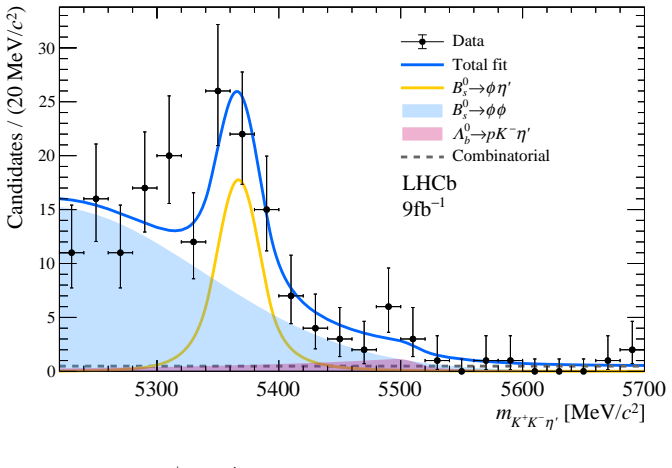
The parametric shapes used for the signal peak and the various background components in the invariant mass fit correctly describe the observed data without large unaccounted contributions from other B decays.
What would settle it
An independent re-analysis of the same or larger dataset that finds the fitted signal yield in the B_s^0 to phi eta-prime mass window consistent with zero would falsify the 3.5 sigma evidence claim.
Figures


read the original abstract
Using a dataset corresponding to an integrated luminosity of $9 \,\textrm{fb}^{-1}$ collected in proton-proton collisions between 2011 and 2018 by the LHCb experiment, evidence is found for the decay $B^0_s\to\phi\eta'$ with $3.5 \sigma$ significance. The branching ratio relative to the $B^0_s\to\phi\phi$ decay is determined to be $R=(3.56 \pm 0.79\pm 0.18\pm 0.06)\times10^{-2}$. This corresponds to a branching fraction, $B(B^0_s\to\phi\eta')=(0.66 \pm 0.15 \pm 0.03 \pm 0.02) \times 10^{-6}$ where, in both cases, the first uncertainty is statistical, the second systematic, and the third due to external branching fractions.
Editorial analysis
A structured set of objections, weighed in public.
Referee Report
Summary. The manuscript reports evidence at 3.5σ significance for the decay B_s^0 → ϕη' in a dataset of 9 fb^{-1} collected by LHCb in pp collisions from 2011–2018. The branching ratio relative to the normalization channel B_s^0 → ϕϕ is measured as R = (3.56 ± 0.79 ± 0.18 ± 0.06) × 10^{-2}, corresponding to an absolute branching fraction B(B_s^0 → ϕη') = (0.66 ± 0.15 ± 0.03 ± 0.02) × 10^{-6}, with uncertainties statistical, systematic, and from external inputs, respectively.
Significance. If the result holds, it provides the first evidence for this decay mode, adding a new measurement in the B_s sector that can test theoretical predictions involving penguin amplitudes and η' mixing. Normalizing to the well-measured B_s^0 → ϕϕ mode is a strength that reduces absolute efficiency uncertainties. The moderate significance is consistent with a rare decay and does not undermine the claim provided the fit procedure is robust.
major comments (1)
- [Invariant mass fit] The central 3.5σ significance is extracted from an unbinned maximum-likelihood fit to the B-candidate invariant mass; the weakest assumption is that the chosen parametric shapes for signal (typically Crystal Ball or Gaussian) and background (exponential or polynomial) accurately describe the data without significant unaccounted peaking backgrounds from other B decays. More explicit validation of fit stability, including pull distributions and alternative background models, is needed to confirm the yield is not biased.
minor comments (2)
- [Abstract] The abstract clearly states the result but could briefly note the fit model and efficiency ratio determination for improved readability.
- [Systematic uncertainties] A dedicated table or section breaking down the systematic uncertainties (currently quoted as a single ±0.18 term) would allow readers to assess their individual contributions more precisely.
Simulated Author's Rebuttal
We thank the referee for the positive assessment of our manuscript and the recommendation for minor revision. We address the single major comment on the invariant mass fit validation in the point-by-point response below.
read point-by-point responses
-
Referee: The central 3.5σ significance is extracted from an unbinned maximum-likelihood fit to the B-candidate invariant mass; the weakest assumption is that the chosen parametric shapes for signal (typically Crystal Ball or Gaussian) and background (exponential or polynomial) accurately describe the data without significant unaccounted peaking backgrounds from other B decays. More explicit validation of fit stability, including pull distributions and alternative background models, is needed to confirm the yield is not biased.
Authors: We thank the referee for this constructive comment. In the analysis, the signal is modeled with a Crystal Ball function whose parameters are determined from simulation, and the combinatorial background with an exponential function. The manuscript already reports the fit results and the 3.5σ significance obtained from the likelihood ratio test. To strengthen the validation as suggested, we will add in the revised version: (i) pull distributions from the fit and from pseudo-experiments, (ii) results using an alternative background model (second-order polynomial), and (iii) a dedicated study of possible peaking backgrounds from other B decays (such as B^0 → ϕη or B_s^0 → ϕη) showing their contribution is negligible within the selected mass window. These will be included either in the main text or as supplementary material to demonstrate that the extracted yield is robust and unbiased. revision: yes
Circularity Check
No significant circularity: direct experimental measurement
full rationale
The paper reports a standard LHCb branching-fraction measurement. Event yields for the signal mode B_s^0 → ϕη' and the normalization mode B_s^0 → ϕϕ are extracted from unbinned maximum-likelihood fits to the invariant-mass distribution. The relative branching ratio is obtained from the yield ratio after correction by the ratio of selection efficiencies (determined from simulation and data-driven methods). The absolute branching fraction is then scaled by the external world-average value of B(B_s^0 → ϕϕ). No equation or step reduces the reported result to a fitted parameter by construction, no ansatz is smuggled via self-citation, and no uniqueness theorem or self-referential definition is invoked. The analysis chain is externally falsifiable and relies on independent inputs (data, simulation, external branching fractions).
Axiom & Free-Parameter Ledger
free parameters (2)
- signal and background yields in mass fit
- efficiency ratio between signal and normalization channels
axioms (2)
- domain assumption The invariant-mass distributions of signal and background are adequately described by the chosen parametric forms
- domain assumption External branching fraction of B_s^0 to phi phi is known to sufficient precision
Lean theorems connected to this paper
-
IndisputableMonolith/Cost/FunctionalEquation.leanwashburn_uniqueness_aczel unclear?
unclearRelation between the paper passage and the cited Recognition theorem.
The baseline model used to describe the B0s → ϕη′ decay mode is a double-sided Crystal Ball (DSCB) function... combinatorial background is modelled using an exponential function.
-
IndisputableMonolith/Foundation/RealityFromDistinction.leanreality_from_one_distinction unclear?
unclearRelation between the paper passage and the cited Recognition theorem.
R ≡ B(B0s → ϕη′)/B(B0s → ϕϕ) = Nϕη′ · B(ϕ→K+K−) / (Nϕϕ · B(η′→ρ0γ) · ϵϕϕ/ϵϕη′)
What do these tags mean?
- matches
- The paper's claim is directly supported by a theorem in the formal canon.
- supports
- The theorem supports part of the paper's argument, but the paper may add assumptions or extra steps.
- extends
- The paper goes beyond the formal theorem; the theorem is a base layer rather than the whole result.
- uses
- The paper appears to rely on the theorem as machinery.
- contradicts
- The paper's claim conflicts with a theorem or certificate in the canon.
- unclear
- Pith found a possible connection, but the passage is too broad, indirect, or ambiguous to say the theorem truly supports the claim.
Reference graph
Works this paper leans on
-
[1]
M. Kobayashi and T. Maskawa, C P-violation in the renormalizable theory of weak interaction, Prog. Theor. Phys.49(1973) 652
work page 1973
-
[2]
A. Aliet al.,Charmless nonleptonic Bs decays to P P, P V and V V final states in the pQCD approach, Phys. Rev.D76(2007) 074018,arXiv:hep-ph/0703162
-
[3]
Wanget al.,Charmless two-body Bs →V P decays in soft collinear effective theory, Phys
W. Wanget al.,Charmless two-body Bs →V P decays in soft collinear effective theory, Phys. Rev.D78(2008) 034011,arXiv:0801.3123
-
[4]
H.-Y. Cheng and C.-K. Chua,QCD factorization for charmless hadronic Bs decays revisited, Phys. Rev.D80(2009) 114026,arXiv:0910.5237
-
[5]
M. Beneke and M. Neubert,QCD factorization for B→P P and B→P V decays, Nucl. Phys.B675(2003) 333,arXiv:hep-ph/0308039
-
[6]
X.-f. Chen, D.-q. Guo, and Z.-j. Xiao, Bs → (ρ, ω, ϕ)η′ decays in the perturbative QCD approach,arXiv:hep-ph/0701146
-
[7]
H.-Y. Cheng, C.-W. Chiang, and A.-L. Kuo,Updating B→P P, V P decays in the framework of flavor symmetry, Phys. Rev.D91(2015) 014011,arXiv:1409.5026
-
[8]
S.-H. Zhou, Q.-A. Zhang, W.-R. Lyu, and C.-D. L¨ u,Analysis of charmless two-body B decays in factorization assisted topological amplitude approach, Eur. Phys. J.C77 (2017) 125,arXiv:1608.02819
-
[9]
Aaijet al.,Search for the B0 s →η ′ϕ decay, JHEP05(2017) 158,arXiv:1612.08110
LHCb collaboration, R. Aaijet al.,Search for the B0 s →η ′ϕ decay, JHEP05(2017) 158,arXiv:1612.08110
-
[10]
LHCb collaboration, A. A. Alves Jr.et al.,The LHCb detector at the LHC, JINST3 (2008) S08005
work page 2008
-
[11]
Aaijet al.,LHCb detector performance, Int
LHCb collaboration, R. Aaijet al.,LHCb detector performance, Int. J. Mod. Phys. A30(2015) 1530022,arXiv:1412.6352
-
[12]
LHCb collaboration,LHCb magnet: Technical Design Report, CERN-LHCC-2000- 007, 2000
work page 2000
-
[13]
LHCb collaboration, R. Aaijet al.,Momentum scale calibration of the LHCb spec- trometer, JINST19(2024) P02008,arXiv:2312.01772
-
[14]
Aaijet al.,The LHCb trigger and its performance in 2011, JINST8(2013) P04022, arXiv:1211.3055
R. Aaijet al.,The LHCb trigger and its performance in 2011, JINST8(2013) P04022, arXiv:1211.3055
-
[15]
R. Aaijet al.,Design and performance of the LHCb trigger and full real-time recon- struction in Run 2 of the LHC, JINST14(2019) P04013,arXiv:1812.10790
- [16]
-
[17]
Likhomanenkoet al.,LHCb topological trigger reoptimization, J
T. Likhomanenkoet al.,LHCb topological trigger reoptimization, J. Phys. Conf. Ser. 664(2015) 082025,arXiv:1510.00572. 9
-
[18]
N. Grieseret al.,The LHCb stripping project: Sustainable legacy data processing for high-energy physics, Comput. Softw. Big. Sci.9(2025) 21,arXiv:2509.05294
-
[19]
A Brief Introduction to PYTHIA 8.1
T. Sj¨ ostrand, S. Mrenna, and P. Skands,A brief introduction to PYTHIA 8.1, Comput. Phys. Commun.178(2008) 852, arXiv:0710.3820; T. Sj¨ ostrand, S. Mrenna, and P. Skands,PYTHIA 6.4 physics and manual, JHEP05(2006) 026, arXiv:hep-ph/0603175
work page internal anchor Pith review arXiv 2008
-
[20]
I. Belyaevet al.,Handling of the generation of primary events in Gauss, the LHCb simulation framework, J. Phys. Conf. Ser.331(2011) 032047
work page 2011
-
[21]
D. J. Lange,The EvtGen particle decay simulation package, Nucl. Instrum. Meth. A462(2001) 152
work page 2001
-
[22]
N. Davidson, T. Przedzinski, and Z. Was,PHOTOS interface in C++: Technical and physics documentation, Comput. Phys. Commun.199(2016) 86, arXiv:1011.0937
-
[23]
Allisonet al.,Geant4 developments and applications, IEEE Trans
Geant4 collaboration, J. Allisonet al.,Geant4 developments and applications, IEEE Trans. Nucl. Sci.53(2006) 270; Geant4 collaboration, S. Agostinelliet al.,Geant4: A simulation toolkit, Nucl. Instrum. Meth.A506(2003) 250
work page 2006
-
[24]
Clemencicet al.,The LHCb simulation application, Gauss: Design, evolution and experience, J
M. Clemencicet al.,The LHCb simulation application, Gauss: Design, evolution and experience, J. Phys. Conf. Ser.331(2011) 032023
work page 2011
- [25]
-
[26]
Navaset al.,Review of particle physics, Phys
Particle Data Group, S. Navaset al.,Review of particle physics, Phys. Rev.D110 (2024) 030001
work page 2024
- [27]
-
[28]
T. Chen and C. Guestrin,XGBoost: A scalable tree boosting system, inProceedings of the 22nd ACM SIGKDD International Conference on Knowledge Discovery and Data Mining, KDD ’16, (New York, NY, USA), 785–794, ACM, 2016
work page 2016
-
[29]
LHCb collaboration, R. Aaijet al.,Measurement of the B± production asymmetry and the C P asymmetry in B± →J/ ψK± decays, Phys. Rev.D95(2017) 052005, arXiv:1701.05501
-
[30]
Sensitivity of searches for new signals and its optimization
G. Punzi,Sensitivity of searches for new signals and its optimization, eConfC030908 (2003) MODT002,arXiv:physics/0308063
work page Pith review arXiv 2003
-
[31]
T. Skwarnicki,A study of the radiative cascade transitions between the Upsilon-prime and Upsilon resonances, PhD thesis, Institute of Nuclear Physics, Krakow, 1986, DESY-F31-86-02
work page 1986
-
[32]
T. Williams,First observation of the charmless beauty decay Λ0 b →pK −η′, PhD thesis, University of Birmingham, Birmingham, United Kingdom, 2018. 10
work page 2018
- [33]
-
[34]
Theodossiou,Financial data and the skewed generalized T distribution, Manag
P. Theodossiou,Financial data and the skewed generalized T distribution, Manag. Sci.44(1998) 1650
work page 1998
-
[35]
Aaijet al.,Search for the decay B0 →ϕϕ , JHEP12(2025) 26,arXiv:2507.20945
LHCb collaboration, R. Aaijet al.,Search for the decay B0 →ϕϕ , JHEP12(2025) 26,arXiv:2507.20945
-
[36]
S. S. Wilks,The large-sample distribution of the likelihood ratio for testing composite hypotheses, Ann. Math. Stat.9(1938) 60
work page 1938
-
[37]
S. Tolk, J. Albrecht, F. Dettori, and A. Pellegrino,Data driven trigger efficiency determination at LHCb, LHCb-PUB-2014-039, 2014
work page 2014
-
[38]
Anderliniet al.,The PIDCalib package, LHCb-PUB-2016-021, 2016
L. Anderliniet al.,The PIDCalib package, LHCb-PUB-2016-021, 2016
work page 2016
-
[39]
Fave,Estimation of the material budget of the Inner Tracker, LHCb-2008-054, CERN-LHCb-2008-054, 2008
LHCb collaboration, V. Fave,Estimation of the material budget of the Inner Tracker, LHCb-2008-054, CERN-LHCb-2008-054, 2008
work page 2008
-
[40]
Banerjeeet al.(Heavy Flavor Averaging Group (HFLAV)), Phys
Heavy Flavor Averaging Group, S. Banerjeeet al.,Averages of b-hadron, c-hadron, and τ-lepton properties as of 2023, Phys. Rev.D113(2026) 012008, arXiv:2411.18639. 11 LHCb collaboration R. Aaij38 , M. Abdelfatah 69, A.S.W. Abdelmotteleb 57 , C. Abellan Beteta 51 , F. Abudin´ en59 , T. Ackernley61 , A.A. Adefisoye69 , B. Adeva47 , M. Adinolfi 55 , P. Adlars...
discussion (0)
Sign in with ORCID, Apple, or X to comment. Anyone can read and Pith papers without signing in.