Recognition: 2 theorem links
· Lean TheoremOptimisation of TES design for the CRESST experiment
Pith reviewed 2026-05-11 01:58 UTC · model grok-4.3
The pith
Optimizing phonon collector design in tungsten TES sensors improves signal-to-noise performance for the CRESST dark matter detectors.
A machine-rendered reading of the paper's core claim, the machinery that carries it, and where it could break.
Core claim
The authors show that systematic variation of phonon collector thickness, dimensions, and composition in W-TES devices yields a clear rise in signal-to-noise ratio, allowing the CRESST detectors to maintain or improve their low energy thresholds while establishing updated performance benchmarks for the sensors.
What carries the argument
Phonon collectors on tungsten transition edge sensors, whose geometry and material composition control the collection of phonons generated by particle interactions and thereby set the detector's energy threshold and noise level.
If this is right
- The experiment can maintain energy thresholds at or below 10 eV while operating with the improved sensors.
- CRESST can extend its dark matter search down to masses around 70 MeV/c² or lower.
- New reference values are set for signal-to-noise performance of tungsten TES devices in similar cryogenic setups.
- Detector response improves overall through more efficient phonon collection without added noise channels.
Where Pith is reading between the lines
- If the gains hold in the complete array, CRESST could tighten limits on sub-GeV dark matter more rapidly than with previous sensor generations.
- The same collector design principles might transfer to other TES-based low-threshold experiments searching for neutrinos or rare events.
- Further scaling of the optimized geometry could reduce the number of channels needed for a given target mass while keeping sensitivity.
Load-bearing premise
That performance improvements measured on individual optimized sensors in laboratory conditions will carry over unchanged when those sensors are installed in the full cryogenic detector array.
What would settle it
A full-array run of CRESST with the new TES designs that shows no reduction in energy threshold or no net gain in signal-to-noise ratio relative to prior sensors.
Figures


read the original abstract
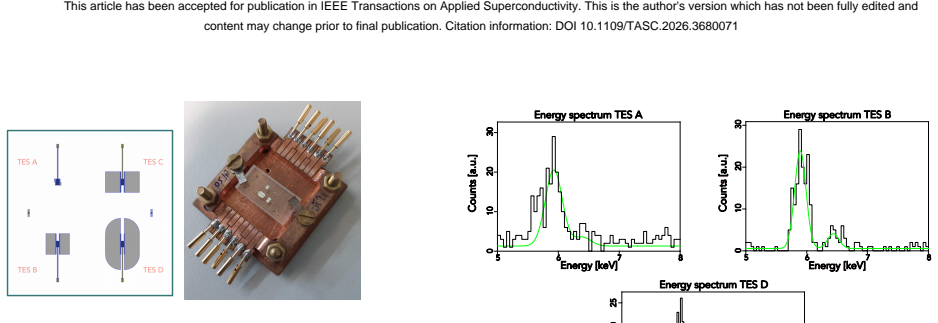
The CRESST experiment aims at the direct detection of sub-GeV dark matter particles via elastic scattering off nuclei in different target crystals at cryogenic temperatures. The advancement in W-TES sensors allowed the CRESST detectors to reach energy thresholds of 10 eV and lower, opening the way to the exploration of dark matter masses as low as 70 MeV/c2. This work presents optimisation studies of W-TESs aimed at further improving the signal-to-noise ratio and overall detector performance. In particular, we investigate the thickness, dimensions and material composition of phonon collectors and assess their impact on detector response. The results demonstrate a significant performance enhancement and establish new benchmarks for the sensors used within CRESST.
Editorial analysis
A structured set of objections, weighed in public.
Referee Report
Summary. The manuscript reports optimization studies of tungsten transition-edge sensors (W-TES) for the CRESST dark matter experiment. It investigates the impact of phonon collector thickness, dimensions, and material composition on detector response, concluding that these changes yield significant signal-to-noise ratio improvements and establish new performance benchmarks for CRESST sensors.
Significance. If validated in the full cryogenic setup, the optimizations could further reduce CRESST energy thresholds below 10 eV, extending sensitivity to dark matter masses below 70 MeV/c². The work directly supports cryogenic detector development for rare-event searches.
major comments (2)
- Abstract: The assertion of 'significant performance enhancement' and 'new benchmarks' lacks any quantitative support such as SNR values, baseline comparisons, error bars, or statistical details, making the central claim impossible to verify from the presented information.
- §3–4: Results are shown for isolated laboratory TES tests of phonon collector variations; no data are provided on the same devices operated within a complete CRESST cryogenic module, where untested noise channels (microphonics, altered thermalization, or 10 mK stability shifts) could eliminate the reported net gains.
minor comments (1)
- The abstract would be strengthened by including at least one specific quantitative metric (e.g., SNR improvement factor) to support the enhancement claim.
Simulated Author's Rebuttal
We thank the referee for the constructive review and positive assessment of the significance of our work on W-TES optimization for CRESST. We address each major comment below and have made revisions to strengthen the manuscript.
read point-by-point responses
-
Referee: Abstract: The assertion of 'significant performance enhancement' and 'new benchmarks' lacks any quantitative support such as SNR values, baseline comparisons, error bars, or statistical details, making the central claim impossible to verify from the presented information.
Authors: We agree that the abstract would be strengthened by including quantitative details. The revised abstract now explicitly references the measured SNR improvements (with associated uncertainties and baseline comparisons to prior CRESST sensors) that are reported in Sections 3 and 4, allowing readers to verify the claims directly from the presented data. revision: yes
-
Referee: §3–4: Results are shown for isolated laboratory TES tests of phonon collector variations; no data are provided on the same devices operated within a complete CRESST cryogenic module, where untested noise channels (microphonics, altered thermalization, or 10 mK stability shifts) could eliminate the reported net gains.
Authors: The manuscript focuses on controlled laboratory characterization of the TES sensors to isolate the effects of phonon collector parameters on intrinsic detector response. These tests were performed under conditions that replicate the relevant cryogenic thermal environment. We argue that the reported SNR gains are intrinsic to the optimized collector design and independent of the additional noise sources mentioned, which would affect all sensor variants similarly. We have added a dedicated paragraph in the conclusions discussing the need for full-module integration tests and our plans to perform them in upcoming CRESST runs. This study is scoped to the sensor optimization phase rather than end-to-end module validation. revision: partial
Circularity Check
No circularity: experimental optimization with direct measurements
full rationale
The manuscript reports laboratory measurements of TES response as a function of phonon collector thickness, geometry and composition. No equations, first-principles derivations, fitted parameters subsequently called predictions, or self-citation chains are invoked to generate the reported performance gains; the results are presented as empirical outcomes from the described test devices. Because the central claims rest on measured data rather than any closed theoretical loop, the work is self-contained and exhibits no reduction of outputs to inputs by construction.
Axiom & Free-Parameter Ledger
Lean theorems connected to this paper
-
IndisputableMonolith/Cost/FunctionalEquationwashburn_uniqueness_aczel unclear?
unclearRelation between the paper passage and the cited Recognition theorem.
we investigate the thickness, dimensions and material composition of phonon collectors and assess their impact on detector response
-
IndisputableMonolith/Foundation/RealityFromDistinctionreality_from_one_distinction unclear?
unclearRelation between the paper passage and the cited Recognition theorem.
The results demonstrate a significant performance enhancement and establish new benchmarks for the sensors used within CRESST
What do these tags mean?
- matches
- The paper's claim is directly supported by a theorem in the formal canon.
- supports
- The theorem supports part of the paper's argument, but the paper may add assumptions or extra steps.
- extends
- The paper goes beyond the formal theorem; the theorem is a base layer rather than the whole result.
- uses
- The paper appears to rely on the theorem as machinery.
- contradicts
- The paper's claim conflicts with a theorem or certificate in the canon.
- unclear
- Pith found a possible connection, but the passage is too broad, indirect, or ambiguous to say the theorem truly supports the claim.
Reference graph
Works this paper leans on
-
[1]
Angloher et al., Probing low WIMP masses with the next generation of CRESST detector (2015)
CRESST Collaboration, G. Angloher et al., Probing low WIMP masses with the next generation of CRESST detector (2015)
work page 2015
-
[2]
Abdelhameed et al., First results from the CRESST-III low-mass dark matter program, Phys
CRESST Collaboration, A.H. Abdelhameed et al., First results from the CRESST-III low-mass dark matter program, Phys. Rev. D100(10), 102002 (2019)
work page 2019
-
[3]
Angloher et al., High-dimensional bayesian likelihood normalisation for CRESST’s background model, J
CRESST Collaboration, G. Angloher et al., High-dimensional bayesian likelihood normalisation for CRESST’s background model, J. Instrum. 19(11), P11013 (2024). https://dx.doi.org/10.1088/1748-0221/19/11/ P11013
-
[4]
Angloher et al., Towards an automated data cleaning with deep learning in CRESST, Eur
CRESST Collaboration, G. Angloher et al., Towards an automated data cleaning with deep learning in CRESST, Eur. Phys. J. Plus. 138(1), 100 (2023). https://doi.org/10.1140/epjp/s13360-023-03674-2
-
[5]
Angloher et al., Detector development for the cresst experiment, J
CRESST Collaboration, G. Angloher et al., Detector development for the cresst experiment, J. Low Temp. Phys. 216(1), 393 (2024). https: //doi.org/10.1007/s10909-024-03154-6
-
[6]
CRESST Collaboration, G. Angloher et al., First observation of single photons in a CRESST detector and new dark matter exclusion limits, Phys. Rev. D 110, 083038 (2024). https://link.aps.org/doi/10.1103/ PhysRevD.110.083038
work page 2024
-
[7]
F. Pr ¨obst et al., Model for cryogenic particle detectors with supercon- ducting phase transition thermometers, J. Low Temp. Phys. 100(1), 69 (1995)
work page 1995
-
[8]
M. W ¨ustrich, Improving particle discrimination and achieving a 4 π-veto detector concept for the CRESST experiment. Ph.D. thesis, Technische Universit¨at M ¨unchen (2020)
work page 2020
-
[9]
J.F.M. Rothe, Low-threshold cryogenic detectors for low-mass dark matter search and coherent neutrino scattering. Ph.D. thesis, Technische Universit¨at M ¨unchen (2021)
work page 2021
-
[10]
Tanzke, Low-threshold detectors for low-mass direct dark matter search with CRESST-III
A. Tanzke, Low-threshold detectors for low-mass direct dark matter search with CRESST-III. Ph.D. thesis, Technische Universit ¨at M ¨unchen (2017)
work page 2017
-
[11]
K.D. Irwin et al., A quasiparticle-trap-assisted transition-edge sensor for phonon-mediated particle detection, Rev. Sci. Instrum. 66(11), 5322 (1995). https://doi.org/10.1063/1.1146105
-
[12]
K. Irwin G. Hilton, Transition-Edge Sensors (Springer Berlin Heidel- berg, Berlin, Heidelberg, 2005), pp. 63–150. DOI 10.1007/10933596 3. https://doi.org/10.1007/10933596 3
-
[13]
K.D. Irwin, An application of electrothermal feedback for high resolu- tion cryogenic particle detection, Appl. Phys. Lett. 66(15), 1998 (1995). https://doi.org/10.1063/1.113674
-
[14]
Bandler et al., Design of transition edge sensor microcalorime- ters for optimal performance, Nucl
S. Bandler et al., Design of transition edge sensor microcalorime- ters for optimal performance, Nucl. Instrum. Methods Phys. Res. A 520(1), 285 (2004). https://www.sciencedirect.com/science/article/pii/ S0168900203031437
work page 2004
-
[15]
Cabrera, Design considerations for tes and qet sensors, Nucl
B. Cabrera, Design considerations for tes and qet sensors, Nucl. Instrum. Methods Phys. Res. A 444(1), 304 (2000). https://www.sciencedirect. com/science/article/pii/S0168900299014023
work page 2000
-
[16]
J. Yen et al., Quasiparticle transport in thick aluminum films coupled to tungsten transition edge sensors, J. Low Temp. Phys. 184 (2016)
work page 2016
-
[17]
R. Holm W. Meissner, Messungen mit Hilfe von flssigem Helium. XIII, Eur. Phys. J. A. (1932). https://api.semanticscholar.org/CorpusID: 126976182 This article has been accepted for publication in IEEE Transactions on Applied Superconductivity. This is the author's version which has not been fully edited and content may change prior to final publication. Ci...
discussion (0)
Sign in with ORCID, Apple, or X to comment. Anyone can read and Pith papers without signing in.