Recognition: no theorem link
Nonreciprocal McKean-Vlasov Equations: From Stationary Instabilities to Travelling Waves
Pith reviewed 2026-05-11 02:19 UTC · model grok-4.3
The pith
Spatially modulated nonreciprocity in two-species particle systems generates travelling waves through Hopf bifurcations even under weak asymmetry.
A machine-rendered reading of the paper's core claim, the machinery that carries it, and where it could break.
Core claim
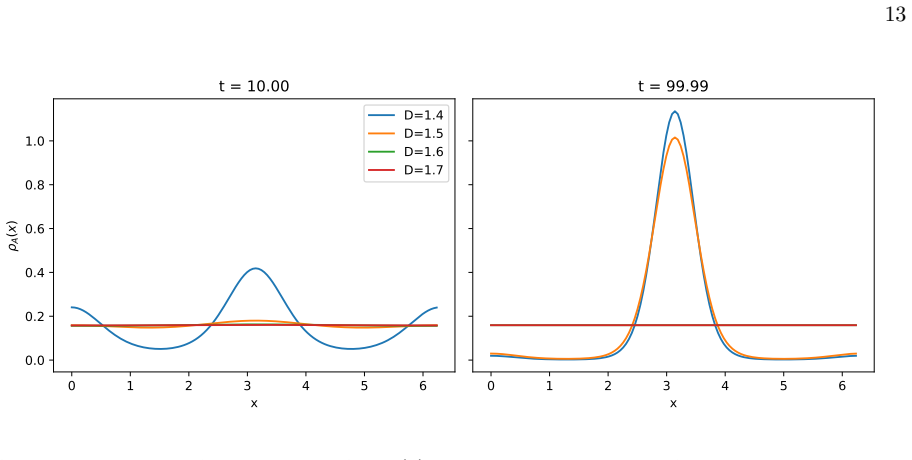
In the two-species nonreciprocal McKean-Vlasov model, the structure of nonreciprocity controls the instability type: spatially uniform weak nonreciprocity produces only stationary patterns by shifting the critical diffusion threshold, while spatially modulated nonreciprocity induces Hopf bifurcations that give rise to standing and travelling wave states, even without strong nonreciprocity or explicit microscopic run-and-chase rules.
What carries the argument
The two-species nonreciprocal McKean-Vlasov equation, analyzed through linear stability to detect Hopf bifurcations when nonreciprocity is spatially modulated.
Load-bearing premise
The mean-field closure remains valid for stochastic particle dynamics when the interactions are both nonreciprocal and spatially modulated.
What would settle it
Full stochastic Langevin simulations at the same parameters where the mean-field model predicts travelling waves would falsify the claim if they instead produce only stationary clusters or decay back to the homogeneous state.
Figures


read the original abstract
Nonreciprocal interactions, in which action-reaction symmetry is broken, provide a powerful route to collective dynamics that cannot be captured by equilibrium free-energy minimisation. Here, we introduce and analyse a two-species nonreciprocal McKean-Vlasov equation derived from an underlying system of interacting stochastic particles. Combining linear stability analysis, weakly nonlinear arguments, pseudo-spectral simulations, and Langevin particle dynamics, we show that the structure of nonreciprocity controls the onset and nature of collective order. For spatially uniform weak nonreciprocity, asymmetry shifts the critical diffusion threshold but produces only stationary instabilities, indicating that uniform imbalance alone is insufficient to generate sustained time-dependent motion. In contrast, spatially modulated nonreciprocity fundamentally enriches the dynamics: depending on its symmetry and coupling to the interaction potential, the homogeneous state can lose stability through Hopf bifurcations, giving rise to standing and travelling wave states. We identify both subcritical and supercritical Hopf transitions, relate the selected patterns to Landau saturation coefficients, and show that travelling waves can emerge even in the weak-nonreciprocity regime without explicit microscopic run-and-chase rules. Direct Langevin simulations confirm that these oscillatory and travelling states persist at the particle level and are not artefacts of the continuum mean-field description. Our results establish nonreciprocal McKean-Vlasov equations as a minimal framework for understanding how spatially structured asymmetric interactions generate self-organized motion, dynamical phase transitions, and nonequilibrium collective order.
Editorial analysis
A structured set of objections, weighed in public.
Referee Report
Summary. The manuscript introduces a two-species nonreciprocal McKean-Vlasov equation derived from an underlying system of interacting stochastic particles. Combining linear stability analysis, weakly nonlinear arguments, pseudo-spectral simulations of the PDE, and direct Langevin particle dynamics, it shows that spatially modulated nonreciprocity can induce Hopf bifurcations leading to standing and travelling waves (including in the weak-nonreciprocity regime without explicit run-and-chase rules), while uniform nonreciprocity only shifts thresholds for stationary instabilities. The structure of nonreciprocity is shown to control the onset and nature of collective order.
Significance. If the mean-field limit holds under the stated conditions, the work provides a minimal continuum framework for nonequilibrium collective dynamics arising from asymmetric interactions with spatial structure. The multi-method consistency (analytic, PDE numerics, and particle simulations) is a positive feature, and the result that travelling waves emerge without microscopic run-and-chase mechanisms is potentially impactful for active-matter and nonreciprocal systems.
major comments (1)
- [Derivation of the McKean-Vlasov limit] Derivation of the McKean-Vlasov limit (section introducing the continuum equation from the particle system): The central claim that travelling waves are not continuum artefacts requires that the PDE accurately represents the large-N limit of the stochastic particle system when interactions are both nonreciprocal and spatially modulated. Standard propagation-of-chaos arguments rely on uniform Lipschitz bounds or reciprocity for Wasserstein contraction; the manuscript should state the precise assumptions under which the limit is justified here or supply quantitative error bounds between particle trajectories and PDE solutions, as the abstract invokes Langevin confirmation without explicit comparison metrics.
Simulated Author's Rebuttal
We thank the referee for their careful reading and constructive feedback on our manuscript. We address the single major comment point by point below, with a commitment to revise the text where appropriate while remaining honest about the scope of our analysis.
read point-by-point responses
-
Referee: [Derivation of the McKean-Vlasov limit] Derivation of the McKean-Vlasov limit (section introducing the continuum equation from the particle system): The central claim that travelling waves are not continuum artefacts requires that the PDE accurately represents the large-N limit of the stochastic particle system when interactions are both nonreciprocal and spatially modulated. Standard propagation-of-chaos arguments rely on uniform Lipschitz bounds or reciprocity for Wasserstein contraction; the manuscript should state the precise assumptions under which the limit is justified here or supply quantitative error bounds between particle trajectories and PDE solutions, as the abstract invokes Langevin confirmation without explicit comparison metrics.
Authors: We appreciate the referee's emphasis on this foundational issue. The derivation in the manuscript follows the standard formal limit for McKean-Vlasov equations from N-particle Langevin dynamics with the specified interaction kernels (smooth, bounded, and Lipschitz-continuous potentials, as defined in the model section). Existing mathematical results on propagation of chaos for nonreciprocal McKean-Vlasov systems apply under precisely these conditions of bounded Lipschitz kernels, without requiring reciprocity; we will add an explicit paragraph in the derivation section stating these assumptions and citing the relevant literature on mean-field limits for asymmetric interactions. We do not derive new quantitative error bounds (e.g., Wasserstein distances or explicit convergence rates), as this would require a separate, technically involved analysis outside the paper's scope. However, to strengthen the empirical support, we will revise the numerical section to include direct quantitative comparisons—such as L2 differences in density profiles and discrepancies in the collective order parameters—between the PDE solutions and ensemble-averaged particle trajectories for representative parameter values. These additions will make the agreement between continuum and microscopic descriptions more transparent without altering the core claims. revision: partial
Circularity Check
No circularity detected; derivation from particles to PDE and wave emergence are independently supported
full rationale
The paper begins with an explicit underlying stochastic particle system, derives the nonreciprocal McKean-Vlasov PDE, performs linear stability and weakly nonlinear analysis to identify Hopf bifurcations and travelling waves, and validates via both pseudo-spectral continuum simulations and direct Langevin particle dynamics. No step equates a claimed prediction to a fitted input by construction, invokes self-citation for uniqueness or load-bearing premises, or renames a known result. The mean-field limit and wave selection are tested against particle-level numerics, rendering the chain self-contained against external benchmarks.
Axiom & Free-Parameter Ledger
free parameters (2)
- nonreciprocity strength and modulation
- diffusion coefficients
axioms (2)
- domain assumption The continuum McKean-Vlasov equation is the correct mean-field limit of the underlying stochastic particle system even when interactions are nonreciprocal.
- domain assumption The interaction potentials and nonreciprocity functions are sufficiently smooth for the stability and bifurcation analyses to apply.
Reference graph
Works this paper leans on
-
[1]
C. Castellano, S. Fortunato, and V. Loreto, Statistical physics of social dynamics, Reviews of modern physics81, 591 (2009)
work page 2009
-
[2]
P. C. Bressloff,Stochastic processes in cell biology, Vol. 41 (Springer, 2014)
work page 2014
-
[3]
D. A. Dawson, Critical dynamics and fluctuations for a mean-field model of cooperative behavior, Journal of Statistical Physics31, 29 (1983)
work page 1983
-
[4]
J. A. Acebr´ on, L. L. Bonilla, C. J. P´ erez Vicente, F. Ritort, and R. Spigler, The kuramoto model: A simple paradigm for synchronization phenomena, Reviews of modern physics77, 137 (2005)
work page 2005
-
[5]
F. B. Rizzato, R. Pakter, and Y. Levin, Driven one-component plasmas, Physical Review E—Statistical, Nonlinear, and Soft Matter Physics80, 021109 (2009)
work page 2009
-
[6]
J. D. Murray, Spatial models and biomedical applications, Mathematical Biology (2003)
work page 2003
-
[7]
J. A. Carrillo, R. J. McCann, and C. Villani, Contractions in the 2-wasserstein length space and thermalization of granular media, Archive for Rational Mechanics and Analysis179, 217 (2006)
work page 2006
-
[8]
T. D. Frank,Nonlinear Fokker-Planck equations: fundamentals and applications(Springer, 2005)
work page 2005
-
[9]
Villani,Topics in optimal transportation, Vol
C. Villani,Topics in optimal transportation, Vol. 58 (American Mathematical Soc., 2021)
work page 2021
- [10]
-
[11]
H. Sakaguchi and Y. Kuramoto, A soluble active rotator model showing phase transitions via mutual entrainment, Progress of Theoretical Physics76, 576 (1986)
work page 1986
- [12]
-
[13]
D. Lynden-Bell, The stability and vibrations of a gas of stars, Monthly Notices of the Royal Astronom- ical Society124, 279 (1962)
work page 1962
-
[14]
M. Palmroth, U. Ganse, Y. Pfau-Kempf, M. Battarbee, L. Turc, T. Brito, M. Grandin, S. Hoilijoki, A. Sandroos, and S. von Alfthan, Vlasov methods in space physics and astrophysics: M. palmroth et al., Living reviews in computational astrophysics4, 1 (2018)
work page 2018
-
[15]
W. Hong, S. Hu, and W. Liu, Mckean–vlasov sde and spde with locally monotone coefficients, The Annals of Applied Probability34, 2136 (2024)
work page 2024
-
[16]
X. Zhang, Compound poisson particle approximation for mckean–vlasov sdes, IMA Journal of Numerical Analysis45, 3507 (2025). 26
work page 2025
-
[17]
Y.-L. Chou and T. Ihle, Active matter beyond mean-field: Ring-kinetic theory for self-propelled parti- cles, Physical Review E91, 022103 (2015)
work page 2015
- [18]
-
[19]
P. Pramanik, Construction of an optimal strategy: An analytic insight through path integral control driven by a mckean–vlasov opinion dynamics, Mathematics13, 2842 (2025)
work page 2025
-
[20]
M. Fruchart, R. Hanai, P. B. Littlewood, and V. Vitelli, Non-reciprocal phase transitions, Nature592, 363 (2021)
work page 2021
-
[21]
Z. You, A. Baskaran, and M. C. Marchetti, Nonreciprocity as a generic route to traveling states, Proceedings of the National Academy of Sciences117, 19767 (2020)
work page 2020
-
[22]
S. A. Loos, S. H. Klapp, and T. Martynec, Long-range order and directional defect propagation in the nonreciprocal xy model with vision cone interactions, Physical review letters130, 198301 (2023)
work page 2023
-
[23]
L. P. Dadhichi, J. Kethapelli, R. Chajwa, S. Ramaswamy, and A. Maitra, Nonmutual torques and the unimportance of motility for long-range order in two-dimensional flocks, Physical Review E101, 052601 (2020)
work page 2020
-
[24]
T. H. Tan, A. Mietke, J. Li, Y. Chen, H. Higinbotham, P. J. Foster, S. Gokhale, J. Dunkel, and N. Fakhri, Odd dynamics of living chiral crystals, Nature607, 287 (2022)
work page 2022
- [25]
-
[26]
R. Soto and R. Golestanian, Self-assembly of catalytically active colloidal molecules: tailoring activity through surface chemistry, Physical review letters112, 068301 (2014)
work page 2014
-
[27]
V. Ouazan-Reboul, J. Agudo-Canalejo, and R. Golestanian, Self-organization of primitive metabolic cycles due to non-reciprocal interactions, Nature Communications14, 4496 (2023)
work page 2023
-
[28]
S. Saha, J. Agudo-Canalejo, and R. Golestanian, Scalar active mixtures: The nonreciprocal cahn-hilliard model, Physical Review X10, 041009 (2020)
work page 2020
-
[29]
D. S. Seara, A. Piya, and A. P. Tabatabai, Non-reciprocal interactions spatially propagate fluctuations in a 2d ising model, Journal of Statistical Mechanics: Theory and Experiment2023, 043209 (2023)
work page 2023
-
[30]
Y. Avni, M. Fruchart, D. Martin, D. Seara, and V. Vitelli, Nonreciprocal ising model, Physical Review Letters134, 117103 (2025)
work page 2025
-
[31]
R. Arjun and A. A. Kumar, Kinetic random-field nonreciprocal ising model, Physical Review E113, 034101 (2026)
work page 2026
-
[32]
Y. Rouzaire, D. J. Pearce, I. Pagonabarraga, and D. Levis, Nonreciprocal interactions reshape topo- logical defect annihilation, Physical Review Letters134, 167101 (2025)
work page 2025
- [33]
-
[34]
M. Fruchart and V. Vitelli, Nonreciprocal many-body physics, arXiv preprint arXiv:2602.11111 (2026). 27
-
[35]
B. Bertoli, B. D. Goddard, and G. A. Pavliotis, Stability of stationary states for mean field models with multichromatic interaction potentials, IMA Journal of Applied Mathematics89, 833 (2024)
work page 2024
- [36]
-
[37]
C. Ho, L. Jutras-Dub´ e, M. L. Zhao, G. M¨ onke, I. Z. Kiss, P. Fran¸ cois, and A. Aulehla, Nonreciprocal synchronization in embryonic oscillator ensembles, Proceedings of the National Academy of Sciences 121, e2401604121 (2024)
work page 2024
-
[38]
A. V. Ivlev, J. Bartnick, M. Heinen, C.-R. Du, V. Nosenko, and H. L¨ owen, Statistical mechanics where newton’s third law is broken, Physical Review X5, 011035 (2015)
work page 2015
-
[39]
A. Dinelli, J. O’Byrne, A. Curatolo, Y. Zhao, P. Sollich, and J. Tailleur, Non-reciprocity across scales in active mixtures, Nature Communications14, 7035 (2023)
work page 2023
-
[40]
J. Bartnick, M. Heinen, A. V. Ivlev, and H. L¨ owen, Structural correlations in diffusiophoretic colloidal mixtures with nonreciprocal interactions, Journal of Physics: Condensed Matter28, 025102 (2016)
work page 2016
-
[41]
F. Bavaud, Equilibrium properties of the vlasov functional: the generalized poisson-boltzmann-emden equation, Reviews of modern physics63, 129 (1991)
work page 1991
-
[42]
M. K. Faluweki, J. Cammann, M. G. Mazza, and L. Goehring, Active spaghetti: collective organization in cyanobacteria, Physical review letters131, 158303 (2023)
work page 2023
-
[43]
K. J. Painter, T. Hillen, and J. R. Potts, Biological modeling with nonlocal advection–diffusion equa- tions, Mathematical models and methods in applied sciences34, 57 (2024)
work page 2024
-
[44]
P. Constantin, I. Kevrekidis, and E. Titi, Asymptotic states of a smoluchowski equation, Archive for Rational Mechanics and Analysis174, 365 (2004)
work page 2004
-
[45]
I. Fatkullin and V. Slastikov, Critical points of the onsager functional on a sphere, Nonlinearity18, 2565 (2005)
work page 2005
-
[46]
J. T. Stuart, On the non-linear mechanics of wave disturbances in stable and unstable parallel flows part 1. the basic behaviour in plane poiseuille flow, Journal of Fluid Mechanics9, 353 (1960)
work page 1960
-
[47]
K. Stewartson and J. Stuart, A non-linear instability theory for a wave system in plane poiseuille flow, Journal of Fluid Mechanics48, 529 (1971)
work page 1971
-
[48]
L. N. Trefethen,Spectral methods in MATLAB(SIAM, 2000)
work page 2000
-
[49]
J. P. Boyd,Chebyshev and Fourier spectral methods(Courier Corporation, 2001)
work page 2001
-
[50]
L. Q. Chen and J. Shen, Applications of semi-implicit fourier-spectral method to phase field equations, Computer Physics Communications108, 147 (1998)
work page 1998
-
[51]
G. Maruyama, Continuous markov processes and stochastic equations, Rendiconti del Circolo Matem- atico di Palermo4, 48 (1955)
work page 1955
-
[52]
D. J. Higham, An algorithmic introduction to numerical simulation of stochastic differential equations, SIAM review43, 525 (2001)
work page 2001
discussion (0)
Sign in with ORCID, Apple, or X to comment. Anyone can read and Pith papers without signing in.