Recognition: 2 theorem links
· Lean TheoremOptimal Recourse Summaries via Bi-Objective Decision Tree Learning
Pith reviewed 2026-05-11 02:13 UTC · model grok-4.3
The pith
SOGAR finds the complete Pareto front of recourse summaries by learning bi-objective decision trees that balance effectiveness against cost.
A machine-rendered reading of the paper's core claim, the machinery that carries it, and where it could break.
Core claim
SOGAR formulates recourse summary learning as an optimal decision tree learning problem with two objectives: maximizing recourse effectiveness, defined as the fraction of individuals who can reach a favorable classifier outcome, and minimizing recourse cost, defined as the total expense of the recommended feature changes. The algorithm returns the Pareto front of all non-dominated trees, each of which partitions the population and assigns a sparse vector of actions to every leaf. This produces globally consistent summaries that remain stable under different operating points on the effectiveness-cost curve.
What carries the argument
The bi-objective decision tree learner that enumerates the Pareto front of all non-dominated recourse summaries, where each tree defines an axis-parallel partition of the input space and each leaf holds a sparse actionable change vector.
If this is right
- Auditors can inspect every efficient trade-off between fixing classifier errors and limiting action expense without retraining.
- Summaries stay consistent because they come from one global optimization rather than post-hoc aggregation of individual recourses.
- Policy makers can choose any desired balance between effectiveness and cost after the summaries are computed.
- The resulting summaries outperform prior methods on both effectiveness and cost metrics across the tested datasets.
Where Pith is reading between the lines
- The same bi-objective tree approach could be reused for other group-level intervention problems such as targeted fairness repairs.
- If deeper trees prove necessary on some data, the method's interpretability advantage would shrink while computation would increase.
- Experiments on datasets with strong feature interactions would test whether the shallowness restriction leaves important population structure uncaptured.
Load-bearing premise
Shallow axis-parallel decision trees combined with sparse leaf actions can capture enough population structure to produce globally effective and stable recourse summaries.
What would settle it
Run SOGAR and a more expressive baseline on a dataset whose optimal subgroups require deep or oblique splits; if the baseline achieves strictly better effectiveness at the same cost level or covers subgroups that SOGAR misses, the claim does not hold.
Figures


read the original abstract
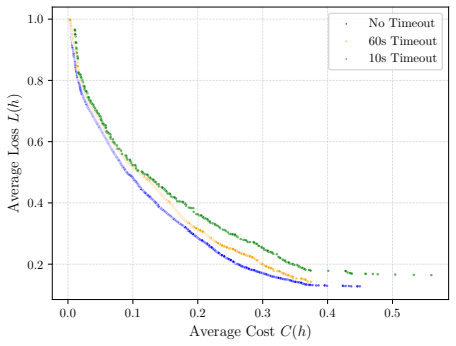
Actionable Recourse provides individuals with actions they can take to change an unfavorable classifier outcome. While useful at the instance level, it is ill-suited for global auditing and bias detection, since aggregating local actions is costly and often inconsistent. Recourse Summaries address this limitation by partitioning the population and assigning one shared action per subgroup, enabling comparison across subgroups. Designing summaries involves a fundamental trade-off between recourse effectiveness and recourse cost, which existing methods do not adequately address. We introduce Summaries of Optimal and Global Actionable Recourse (SOGAR), which formulates recourse summary learning as an optimal decision tree learning problem and finds the Pareto front -- the complete set of solutions where improving one objective necessarily worsens the other. SOGAR enables post-hoc selection of the desired trade-off without retraining. Using shallow axis-parallel decision trees and sparse leaf actions, SOGAR produces stable, low-cost, and effective recourse summaries that outperform existing approaches across effectiveness and cost metrics.
Editorial analysis
A structured set of objections, weighed in public.
Referee Report
Summary. The paper introduces Summaries of Optimal and Global Actionable Recourse (SOGAR), which formulates recourse summary learning as a bi-objective decision tree learning problem to find the Pareto front between effectiveness and cost. It uses shallow axis-parallel decision trees and sparse leaf actions to produce stable, low-cost, effective recourse summaries that allow post-hoc trade-off selection and outperform existing methods.
Significance. This work addresses the gap in global recourse by providing a method for generating summaries with explicit trade-off control. If the bi-objective optimization and the use of decision trees prove effective in experiments, it offers a practical tool for model auditing and bias detection. The post-hoc selection is a notable feature that avoids retraining for different trade-offs.
major comments (2)
- [Abstract and Introduction] The central claim of outperformance across effectiveness and cost metrics lacks supporting quantitative details in the provided abstract, and the full experimental validation needs to be checked for sufficient baselines and statistical significance to support the superiority assertion.
- [Method (bi-objective DT formulation)] The assumption that shallow axis-parallel decision trees with depth limits and sparsity constraints on leaf actions are sufficient to capture the necessary population partitions for globally effective recourse summaries is load-bearing; if the data requires capturing non-linear interactions or subgroup heterogeneity beyond what shallow trees can model, the learned Pareto front may not be optimal compared to more expressive models.
minor comments (2)
- [Notation] Ensure consistent use of symbols for effectiveness and cost objectives throughout the paper.
- [Experiments] Include details on the datasets used, number of runs, and exact baselines compared to allow reproducibility.
Simulated Author's Rebuttal
We thank the referee for the constructive feedback. We address each major comment below and indicate planned revisions.
read point-by-point responses
-
Referee: [Abstract and Introduction] The central claim of outperformance across effectiveness and cost metrics lacks supporting quantitative details in the provided abstract, and the full experimental validation needs to be checked for sufficient baselines and statistical significance to support the superiority assertion.
Authors: We agree that the abstract would be strengthened by including concrete quantitative results. In the revision we will add specific metrics (e.g., average effectiveness gains and cost reductions relative to baselines across the evaluated datasets). Our experiments already compare against multiple existing recourse-summary methods, report means and standard deviations over repeated runs, and include statistical significance testing (Wilcoxon signed-rank tests). We will make these aspects more prominent in the revised experimental section. revision: yes
-
Referee: [Method (bi-objective DT formulation)] The assumption that shallow axis-parallel decision trees with depth limits and sparsity constraints on leaf actions are sufficient to capture the necessary population partitions for globally effective recourse summaries is load-bearing; if the data requires capturing non-linear interactions or subgroup heterogeneity beyond what shallow trees can model, the learned Pareto front may not be optimal compared to more expressive models.
Authors: We deliberately restrict the model class to shallow axis-parallel trees to preserve interpretability, stability of the resulting partitions, and tractability of the bi-objective optimization. Experiments demonstrate that this class already yields Pareto fronts superior to prior methods on the target metrics. Nevertheless, we acknowledge that highly non-linear subgroup structure could exceed the capacity of shallow trees. We will add a limitations paragraph discussing this trade-off and outlining possible extensions (e.g., oblique trees) while retaining the current formulation as the core contribution. revision: partial
Circularity Check
No circularity: SOGAR introduces an independent bi-objective DT optimization for Pareto-front recourse summaries
full rationale
The paper formulates recourse summary learning as a bi-objective optimal decision tree problem that explicitly computes the Pareto front of effectiveness-cost trade-offs, enabling post-hoc selection. No equations, fitted parameters, or self-citations in the abstract or described method reduce the claimed Pareto front, stability, or outperformance to quantities defined by construction from the inputs. The use of shallow axis-parallel trees and sparse leaf actions is presented as an explicit modeling choice rather than a redefinition of the target quantities. The derivation chain is self-contained and does not rely on load-bearing self-citations or renaming of prior results; the optimization procedure stands as an independent contribution.
Axiom & Free-Parameter Ledger
Lean theorems connected to this paper
-
IndisputableMonolith/Foundation/AbsoluteFloorClosure.leanreality_from_one_distinction unclear?
unclearRelation between the paper passage and the cited Recognition theorem.
formulates recourse summary learning as a bi-objective optimal decision tree learning problem... STreeD framework... Pareto front of non-dominated summaries
-
IndisputableMonolith/Cost/FunctionalEquation.leanwashburn_uniqueness_aczel unclear?
unclearRelation between the paper passage and the cited Recognition theorem.
Using shallow axis-parallel decision trees and sparse leaf actions... Maximum Percentile Shift (MPS) cost
What do these tags mean?
- matches
- The paper's claim is directly supported by a theorem in the formal canon.
- supports
- The theorem supports part of the paper's argument, but the paper may add assumptions or extra steps.
- extends
- The paper goes beyond the formal theorem; the theorem is a base layer rather than the whole result.
- uses
- The paper appears to rely on the theorem as machinery.
- contradicts
- The paper's claim conflicts with a theorem or certificate in the canon.
- unclear
- Pith found a possible connection, but the passage is too broad, indirect, or ambiguous to say the theorem truly supports the claim.
Reference graph
Works this paper leans on
-
[1]
Strong optimal classification trees.arXiv preprint arXiv:2103.15965, 2021
Sina Aghaei, Andrés Gómez, and Phebe Vayanos. Strong optimal classification trees.arXiv preprint arXiv:2103.15965, 2021
-
[2]
Learning optimal decision trees using caching branch-and-bound search
Gaël Aglin, Siegfried Nijssen, and Pierre Schaus. Learning optimal decision trees using caching branch-and-bound search. InProceedings of the AAAI conference on artificial intelligence, volume 34, pages 3146–3153, 2020
work page 2020
-
[3]
Barry Becker and Ronny Kohavi. Adult. UCI Machine Learning Repository, 1996. DOI: https://doi.org/10.24432/C5XW20
-
[4]
Optimal classification trees.Machine Learning, 106(7):1039–1082, July 2017
Dimitris Bertsimas and Jack Dunn. Optimal classification trees.Machine Learning, 106(7):1039–1082, July 2017
work page 2017
-
[5]
Interpretable clustering via optimal trees.arXiv preprint arXiv:1812.00539, 2018
Dimitris Bertsimas, Agni Orfanoudaki, and Holly Wiberg. Interpretable clustering via optimal trees.arXiv preprint arXiv:1812.00539, 2018
-
[6]
Counterfactual metarules for local and global recourse.arXiv preprint arXiv:2405.18875, 2024
Tom Bewley, Salim I Amoukou, Saumitra Mishra, Daniele Magazzeni, and Manuela Veloso. Counterfactual metarules for local and global recourse.arXiv preprint arXiv:2405.18875, 2024
-
[7]
Classification and regression trees
L Breiman, JH Friedman, R Olshen, and CJ Stone. Classification and regression trees. 1984
work page 1984
-
[8]
Xgboost: A scalable tree boosting system
Tianqi Chen and Carlos Guestrin. Xgboost: A scalable tree boosting system. InProceedings of the 22nd ACM SIGKDD International Conference on Knowledge Discovery and Data Mining, KDD ’16, page 785–794, New York, NY , USA, 2016. Association for Computing Machinery
work page 2016
-
[9]
Yu-Liang Chou, Catarina Moreira, Peter Bruza, Chun Ouyang, and Joaquim Jorge. Counterfac- tuals and causability in explainable artificial intelligence: Theory, algorithms, and applications. Information Fusion, 81:59–83, May 2022
work page 2022
-
[10]
Emir Demirovi´c, Anna Lukina, Emmanuel Hebrard, Jeffrey Chan, James Bailey, Christopher Leckie, Kotagiri Ramamohanarao, and Peter J Stuckey. Murtree: Optimal decision trees via dynamic programming and search.Journal of Machine Learning Research, 23(26):1–47, 2022
work page 2022
-
[11]
A survey of methods for explaining black box models.ACM computing surveys (CSUR), 51(5):1–42, 2018
Riccardo Guidotti, Anna Monreale, Salvatore Ruggieri, Franco Turini, Fosca Giannotti, and Dino Pedreschi. A survey of methods for explaining black box models.ACM computing surveys (CSUR), 51(5):1–42, 2018
work page 2018
-
[12]
Hans Hofmann. Statlog - german credit data. UCI Machine Learning Repository, 1994. DOI: https://doi.org/10.24432/C5NC77
-
[13]
Optimal sparse decision trees.Advances in neural information processing systems, 32, 2019
Xiyang Hu, Cynthia Rudin, and Margo Seltzer. Optimal sparse decision trees.Advances in neural information processing systems, 32, 2019
work page 2019
-
[14]
Laurent Hyafil and Ronald L. Rivest. Constructing optimal binary decision trees is np-complete. Information Processing Letters, 5(1):15–17, 1976. 10
work page 1976
-
[15]
Counterfactual explanation trees: Transparent and consistent actionable recourse with decision trees
Kentaro Kanamori, Takuya Takagi, Ken Kobayashi, and Yuichi Ike. Counterfactual explanation trees: Transparent and consistent actionable recourse with decision trees. InInternational Conference on Artificial Intelligence and Statistics, pages 1846–1870. PMLR, 2022
work page 2022
-
[16]
Algorithmic recourse: from counterfactual explanations to interventions
Amir-Hossein Karimi, Bernhard Schölkopf, and Isabel Valera. Algorithmic recourse: from counterfactual explanations to interventions. InProceedings of the 2021 ACM Conference on Fairness, Accountability, and Transparency, FAccT ’21, page 353–362, New York, NY , USA, March 2021. Association for Computing Machinery
work page 2021
-
[17]
Glance: Global actions in a nutshell for counterfactual explainability, 2025
Loukas Kavouras, Eleni Psaroudaki, Konstantinos Tsopelas, Dimitrios Rontogiannis, Nikolaos Theologitis, Dimitris Sacharidis, Giorgos Giannopoulos, Dimitrios Tomaras, Kleopatra Markou, Dimitrios Gunopulos, Dimitris Fotakis, and Ioannis Emiris. Glance: Global actions in a nutshell for counterfactual explainability, 2025
work page 2025
-
[18]
Guolin Ke, Qi Meng, Thomas Finley, Taifeng Wang, Wei Chen, Weidong Ma, Qiwei Ye, and Tie-Yan Liu. Lightgbm: A highly efficient gradient boosting decision tree.Advances in neural information processing systems, 30, 2017
work page 2017
-
[19]
Globe-ce: A translation-based approach for global counterfactual explanations
Dan Ley, Saumitra Mishra, and Daniele Magazzeni. Globe-ce: A translation-based approach for global counterfactual explanations. (arXiv:2305.17021), December 2023. arXiv:2305.17021 [cs]
-
[20]
Generalized and scalable optimal sparse decision trees
Jimmy Lin, Chudi Zhong, Diane Hu, Cynthia Rudin, and Margo Seltzer. Generalized and scalable optimal sparse decision trees. (arXiv:2006.08690), November 2022. arXiv:2006.08690 [cs]
-
[21]
A Unified Approach to Interpreting Model Predictions
Scott Lundberg and Su-In Lee. A unified approach to interpreting model predictions. (arXiv:1705.07874), November 2017. arXiv:1705.07874 [cs]
work page Pith review arXiv 2017
-
[22]
Fast sparse decision tree optimization via reference ensembles
Hayden McTavish, Chudi Zhong, Reto Achermann, Ilias Karimalis, Jacques Chen, Cynthia Rudin, and Margo Seltzer. Fast sparse decision tree optimization via reference ensembles. In Proceedings of the AAAI conference on artificial intelligence, volume 36, pages 9604–9613, 2022
work page 2022
-
[23]
S. Moro, P. Rita, and P. Cortez. Bank marketing. UCI Machine Learning Repository, 2014. DOI: https://doi.org/10.24432/C5K306
-
[24]
Learning optimal decision trees with sat
Nina Narodytska, Alexey Ignatiev, Filipe Pereira, and Joao Marques-Silva. Learning optimal decision trees with sat. InInternational Joint Conference on Artificial Intelligence 2018, pages 1362–1368. Association for the Advancement of Artificial Intelligence (AAAI), 2018
work page 2018
-
[25]
Mining optimal decision trees from itemset lattices
Siegfried Nijssen and Elisa Fromont. Mining optimal decision trees from itemset lattices. In Proceedings of the 13th ACM SIGKDD international conference on Knowledge discovery and data mining, pages 530–539, 2007
work page 2007
-
[26]
5: Programs for Machine Learning
J Ross Quinlan.C4. 5: Programs for Machine Learning. Morgan Kaufmann, 1993
work page 1993
-
[27]
Kaivalya Rawal and Himabindu Lakkaraju. Beyond individualized recourse: Interpretable and interactive summaries of actionable recourses.Advances in Neural Information Processing Systems, 33:12187–12198, 2020
work page 2020
-
[28]
Marco Tulio Ribeiro, Sameer Singh, and Carlos Guestrin. " why should i trust you?" explaining the predictions of any classifier. InProceedings of the 22nd ACM SIGKDD international conference on knowledge discovery and data mining, pages 1135–1144, 2016
work page 2016
-
[29]
Cynthia Rudin. Stop explaining black box machine learning models for high stakes decisions and use interpretable models instead.Nature machine intelligence, 1(5):206–215, 2019
work page 2019
-
[30]
Ibm hr analytics employee attrition & performance dataset
Pavan Subhash. Ibm hr analytics employee attrition & performance dataset. https://www. kaggle.com/datasets/pavansubhasht/ibm-hr-analytics-attrition-dataset ,
-
[31]
Accessed: 2025-11-04
work page 2025
-
[32]
Actionable recourse in linear classification
Berk Ustun, Alexander Spangher, and Yang Liu. Actionable recourse in linear classification. In Proceedings of the Conference on Fairness, Accountability, and Transparency, FAT* ’19, page 10–19, New York, NY , USA, January 2019. Association for Computing Machinery. 11
work page 2019
-
[33]
Jacobus van der Linden, Mathijs de Weerdt, and Emir Demirovi´c. Necessary and sufficient con- ditions for optimal decision trees using dynamic programming.Advances in Neural Information Processing Systems, 36:9173–9212, 2023
work page 2023
-
[34]
Counterfactual explanations without opening the black box: Automated decisions and the gdpr, 2018
Sandra Wachter, Brent Mittelstadt, and Chris Russell. Counterfactual explanations without opening the black box: Automated decisions and the gdpr, 2018
work page 2018
-
[35]
Elizabeth Anne Watkins and Jiahao Chen. The four-fifths rule is not disparate impact: a woeful tale of epistemic trespassing in algorithmic fairness. InProceedings of the 2024 ACM Conference on Fairness, Accountability, and Transparency, pages 764–775, 2024
work page 2024
-
[36]
Rui Zhang, Rui Xin, Margo Seltzer, and Cynthia Rudin. Optimal sparse survival trees.Proceed- ings of machine learning research, 238:352, 2024. A Proof of Proposition 1 We prove Proposition 1 by showing that recourse summary tree optimization is aseparableoptimiza- tion task in the framework of [32]. By their Theorem 4.7 this guarantees that dynamic progra...
work page 2024
-
[37]
The larger minimum leaf size for Adult (500 vs. 50) is necessary to control the search space on a dataset with over 30,000 training instances and 161 binarised features. Ablations on depth, sparsity, and bins are reported in Appendix D. Table 3: SOGAR default hyperparameters for all main experiments. Parameter Value Max depthd3 Max nodesm7 Min leaf sizeℓ5...
-
[38]
to 0.57 (depth 2) while runtime drops from 1,235 s to 51 s, a 24× speed-up for a 9.6% quality degradation. Depth 2 still outperforms all baselines on the invalidity metric across every dataset and classifier combination, making it a practical default when compute is constrained. The solutions are also maximally interpretable, producing exactly four subgro...
discussion (0)
Sign in with ORCID, Apple, or X to comment. Anyone can read and Pith papers without signing in.