Recognition: 2 theorem links
· Lean TheoremNew Determinations of the Charm and Bottom Quark Masses Using QCD Quarkonium Sum Rules
Pith reviewed 2026-05-11 02:30 UTC · model grok-4.3
The pith
Applying the characteristic operator extension of the Principle of Maximum Conformality to QCD quarkonium sum rules eliminates renormalization ambiguities and yields precise charm and bottom quark masses.
A machine-rendered reading of the paper's core claim, the machinery that carries it, and where it could break.
Core claim
Using the CO-PMC approach on the O(α_s^3) pQCD corrections to M_n,q^{X,th}, the perturbative series becomes strictly conformal and independent of renormalization scheme and scale. Combined with Padé estimates for N4LO, this leads to m_c(m_c) = 1275.8 ± 0.4 MeV from M_{2,c}^P and m_b(m_b) = 4177.0 ± 7.2 MeV from M_{1,b}^V, both consistent with PDG averages within 1σ.
What carries the argument
The characteristic operator (CO) extension of PMC, which simultaneously fixes the effective coupling and quark mass by absorbing β_i and γ_i terms through renormalization group equations to generate a conformal perturbative expansion.
If this is right
- The extracted quark masses serve as improved inputs for calculations of quarkonium properties and heavy-flavor physics.
- Scale-independent results allow for more reliable comparisons between theory and experiment in sum-rule analyses.
- The Padé method provides a systematic way to estimate unknown higher-order perturbative contributions in similar processes.
- Application to other moments or channels could further refine the mass values or extract other parameters like decay constants.
Where Pith is reading between the lines
- If the CO-PMC procedure generalizes, it could be used to remove perturbative ambiguities in other QCD observables beyond sum rules.
- The close agreement with PDG suggests that non-perturbative contributions or experimental inputs now limit the precision rather than the perturbative series itself.
- Future lattice QCD calculations of the same correlators could test the consistency of the perturbative treatment independent of sum-rule assumptions.
Load-bearing premise
The characteristic operator extension of PMC produces a strictly scheme- and scale-independent conformal series, and Padé approximants accurately estimate the unknown N4LO terms without large uncontrolled errors.
What would settle it
A full N4LO calculation of the quarkonium correlation functions that differs substantially from the Padé predictions, or a new experimental determination of the charm or bottom quark mass lying outside the stated uncertainty ranges.
Figures



read the original abstract
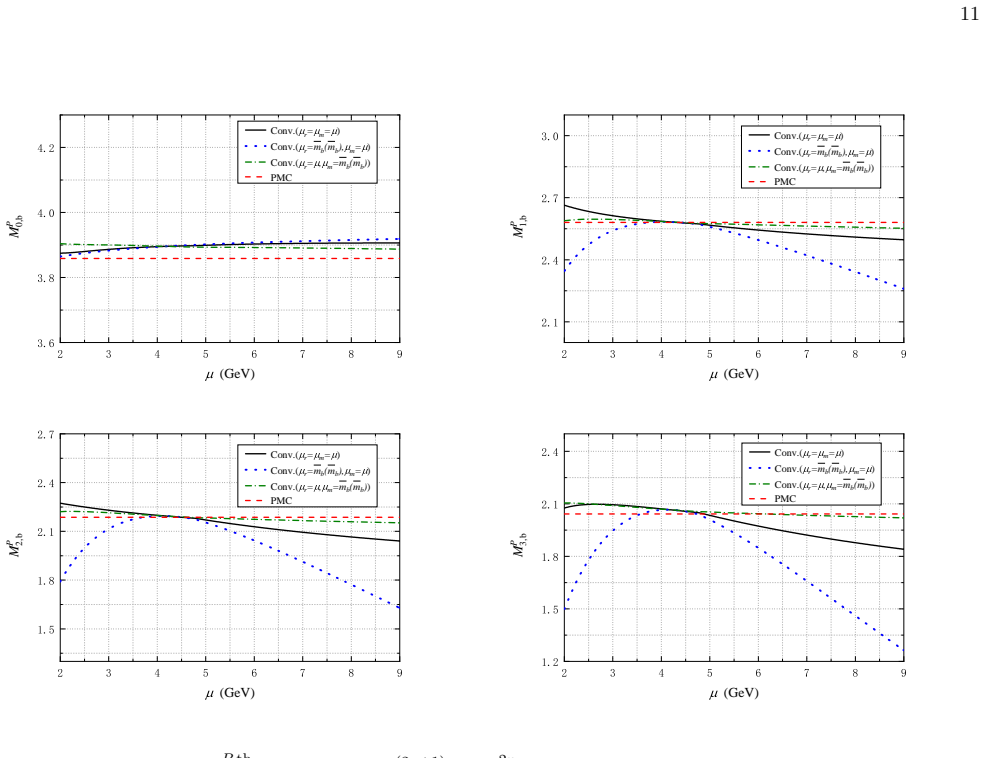
We reanalyze the perturbative QCD (pQCD) corrections to quarkonium QCD sum rules and extract the heavy quark masses $\overline{m}_{q}(\overline{m}_{q})$ ($q=c,b$). At present, the pQCD corrections to the correlation functions of two heavy-quark pseudoscalar and vector currents at zero momentum transfer, denoted as $M_{n,q}^{X,\rm th}$ ($X = P, V$), are calculated up to the $\mathcal{O}(\alpha_s^3)$ order. These corrections exhibit significant renormalization scheme and scale dependence, which introduces large theoretical uncertainties and deteriorates the precision of heavy quark mass determinations. In this work, we eliminate the renormalization scheme and scale ambiguities in the perturbative part of $M_{n,q}^{X,\rm th}$ by adopting the Principle of Maximum Conformality (PMC) within the characteristic operator (CO) approach. The CO approach, a novel extension of the standard PMC procedure, simultaneously determines the effective coupling $\alpha_s(Q_*)$ and the effective quark mass $\overline{m}_q(Q_*)$. It systematically absorbs the nonconformal $\{\beta_i\}$-terms and $\{\gamma_i\}$-terms via the renormalization group equations, yielding a strictly scheme- and scale-independent conformal perturbative series. Based on the improved PMC conformal series, we further provide reliable estimates for the unknown $\mathrm{N^4LO}$ contributions using the Pad\'e approximation method. The final predicted heavy quark masses in the $\overline{\mathrm{MS}}$ scheme read: $\overline{m}_c(\overline{m}_c)=1275.8\pm 0.4~\text{MeV}$, extracted from the second moment of the charmed pseudoscalar correlator $M_{2,c}^{P}$; and $\overline{m}_b(\overline{m}_b) = 4177.0 \pm 7.2~\text{MeV}$, extracted from the first moment of the bottom vector correlator $M_{1,b}^{V}$. Both results agree well with the PDG world averages with deviations smaller than $1\sigma$.
Editorial analysis
A structured set of objections, weighed in public.
Referee Report
Summary. The paper reanalyzes pQCD corrections to the two-point correlation functions of heavy-quark pseudoscalar and vector currents up to O(α_s^3) in quarkonium sum rules. It applies the Principle of Maximum Conformality (PMC) extended via the characteristic operator (CO) approach to absorb all β- and γ-dependent nonconformal terms, yielding a strictly scheme- and scale-independent conformal series. Unknown N4LO contributions are estimated via Padé approximants. The charm mass is extracted from the second moment of the pseudoscalar correlator as m_c(m_c)=1275.8±0.4 MeV and the bottom mass from the first moment of the vector correlator as m_b(m_b)=4177.0±7.2 MeV, both in the MS-bar scheme, with results agreeing with PDG averages to better than 1σ.
Significance. If the CO-PMC procedure produces a genuinely conformal series free of residual scale dependence and the Padé estimates prove accurate, the work would deliver high-precision heavy-quark mass determinations with substantially reduced theoretical uncertainties relative to conventional scale-variation analyses. The sub-MeV error on m_c and the close PDG agreement would represent a notable advance for QCD sum-rule phenomenology, provided the error budget is robust.
major comments (1)
- [Abstract] Abstract: The final results m_c(m_c)=1275.8±0.4 MeV and m_b(m_b)=4177.0±7.2 MeV are obtained only after replacing the unknown N4LO coefficient in the CO-PMC series by a Padé approximant. No cross-validation is reported (e.g., applying the same Padé procedure to predict the already-known N3LO coefficient and comparing it with its explicit value). Because QCD series are subject to renormalon-induced factorial growth, an untested Padé extrapolation can introduce an error comparable to or larger than the quoted 0.4 MeV uncertainty on m_c; this directly affects the claimed precision and must be addressed.
minor comments (1)
- [Abstract] The abstract refers to 'the second moment of the charmed pseudoscalar correlator M_{2,c}^P' and 'the first moment of the bottom vector correlator M_{1,b}^V' without stating the explicit definitions or the rationale for selecting these particular moments over others; a brief clarification would aid readability.
Simulated Author's Rebuttal
We thank the referee for the careful reading of our manuscript and the constructive comment. We address the major point raised below and outline the revisions we will make.
read point-by-point responses
-
Referee: [Abstract] Abstract: The final results m_c(m_c)=1275.8±0.4 MeV and m_b(m_b)=4177.0±7.2 MeV are obtained only after replacing the unknown N4LO coefficient in the CO-PMC series by a Padé approximant. No cross-validation is reported (e.g., applying the same Padé procedure to predict the already-known N3LO coefficient and comparing it with its explicit value). Because QCD series are subject to renormalon-induced factorial growth, an untested Padé extrapolation can introduce an error comparable to or larger than the quoted 0.4 MeV uncertainty on m_c; this directly affects the claimed precision and must be addressed.
Authors: We thank the referee for highlighting this issue. The CO-PMC procedure, through the characteristic operator approach, absorbs all β- and γ-dependent nonconformal terms into the effective coupling and mass scales, producing a strictly conformal perturbative series. Renormalon effects, which drive factorial growth in conventional QCD expansions, are associated with these nonconformal terms and are therefore eliminated; the remaining conformal series exhibits improved convergence properties that make Padé extrapolation more reliable than in the standard case. We acknowledge that an explicit cross-validation—applying the Padé approximant to predict the known N3LO coefficient from lower orders and comparing it to the exact value—was not reported in the original manuscript. We will add this validation (including quantitative comparison) to the revised version, together with a clearer explanation of how the spread among different Padé approximants is used to estimate the N4LO uncertainty and how it is incorporated into the final error budget. These additions will directly address the concern about the robustness of the quoted precision. revision: yes
Circularity Check
No circularity in the quark mass extraction via CO-PMC sum rules
full rationale
The paper reorganizes the known O(α_s^3) perturbative corrections to the quarkonium correlator moments using the CO extension of PMC, which by construction absorbs nonconformal β_i and γ_i terms via the RGE to produce a scale- and scheme-independent conformal series. It then applies Padé approximants to estimate the unknown N^4LO coefficient and extracts the MS-bar masses by matching the resulting theoretical moments M_n^th to experimental inputs. This matching step determines the mass values from external data rather than by internal definition or by renaming a fitted parameter as a prediction. No self-definitional reduction, fitted-input-called-prediction, or load-bearing self-citation chain is present; the central claim retains independent content from the data fit and the perturbative reorganization.
Axiom & Free-Parameter Ledger
Lean theorems connected to this paper
-
IndisputableMonolith/Cost/FunctionalEquation.leanwashburn_uniqueness_aczel unclear?
unclearRelation between the paper passage and the cited Recognition theorem.
we eliminate the renormalization scheme and scale ambiguities ... by adopting the Principle of Maximum Conformality (PMC) within the characteristic operator (CO) approach ... yielding a strictly scheme- and scale-independent conformal perturbative series
-
IndisputableMonolith/Foundation/AlphaCoordinateFixation.leanJ_uniquely_calibrated_via_higher_derivative unclear?
unclearRelation between the paper passage and the cited Recognition theorem.
Based on the improved PMC conformal series, we further provide reliable estimates for the unknown N4LO contributions using the Padé approximation method
What do these tags mean?
- matches
- The paper's claim is directly supported by a theorem in the formal canon.
- supports
- The theorem supports part of the paper's argument, but the paper may add assumptions or extra steps.
- extends
- The paper goes beyond the formal theorem; the theorem is a base layer rather than the whole result.
- uses
- The paper appears to rely on the theorem as machinery.
- contradicts
- The paper's claim conflicts with a theorem or certificate in the canon.
- unclear
- Pith found a possible connection, but the passage is too broad, indirect, or ambiguous to say the theorem truly supports the claim.
Reference graph
Works this paper leans on
-
[1]
Weinberg, Physica A96, no.1-2, 327-340 (1979)
S. Weinberg, Physica A96, no.1-2, 327-340 (1979)
work page 1979
- [2]
- [3]
- [4]
-
[5]
J. O. Andersen, Q. Yu and H. Zhou, Phys. Rev. D109, 034022 (2024)
work page 2024
- [6]
-
[7]
Aokiet al.[Flavour Lattice Averaging Group (FLAG)], Eur
Y. Aokiet al.[Flavour Lattice Averaging Group (FLAG)], Eur. Phys. J. C82, 869 (2022)
work page 2022
-
[8]
D. J. Gross and F. Wilczek, Phys. Rev. Lett.30, 1343- 1346 (1973)
work page 1973
-
[9]
H. D. Politzer, Phys. Rev. Lett.30, 1346-1349 (1973)
work page 1973
-
[10]
V. A. Novikov, L. B. Okun, M. A. Shifman, A. I. Vain- shtein, M. B. Voloshin and V. I. Zakharov, Phys. Rept. 41(1978), 1-133
work page 1978
-
[11]
L. J. Reinders, H. Rubinstein and S. Yazaki, Phys. Rept. 127, 1 (1985)
work page 1985
-
[12]
J. H. K¨ uhn and M. Steinhauser, Nucl. Phys. B619, 588-602 (2001) [erratum: Nucl. Phys. B640, 415-415 (2002)]
work page 2001
-
[13]
J. H. K¨ uhn, M. Steinhauser and C. Sturm, Nucl. Phys. B778, 192-215 (2007)
work page 2007
-
[14]
M. A. Shifman, A. I. Vainshtein and V. I. Zakharov, Nucl. Phys. B147(1979), 385-447
work page 1979
- [15]
- [16]
- [17]
-
[18]
C. McNeile, C. T. H. Davies, E. Follana, K. Hornbostel and G. P. Lepage, Phys. Rev. D82, 034512 (2010)
work page 2010
- [19]
- [20]
-
[21]
M. A. Shifman, A. I. Vainshtein and V. I. Zakharov, Nucl. Phys. B147(1979), 448-518
work page 1979
-
[22]
A. O. G. Kallen and A. Sabry, Kong. Dan. Vid. Sel. Mat. Fys. Med.29(1955)
work page 1955
-
[23]
K. G. Chetyrkin, J. H. Kuhn and M. Steinhauser, Phys. Lett. B371(1996), 93-98
work page 1996
-
[24]
K. G. Chetyrkin, J. H. Kuhn and M. Steinhauser, Nucl. Phys. B482(1996), 213-240
work page 1996
-
[25]
R. Boughezal, M. Czakon and T. Schutzmeier, Nucl. Phys. B Proc. Suppl.160(2006), 160-164
work page 2006
- [26]
- [27]
-
[28]
K. G. Chetyrkin, J. H. Kuhn and C. Sturm, Eur. Phys. J. C48(2006), 107-110
work page 2006
-
[29]
R. Boughezal, M. Czakon and T. Schutzmeier, Phys. Rev. D74(2006), 074006
work page 2006
- [30]
- [31]
- [32]
-
[33]
A. H. Hoang, V. Mateu and S. Mohammad Zebarjad, Nucl. Phys. B813(2009), 349-369
work page 2009
-
[34]
Y. Kiyo, A. Maier, P. Maierhofer and P. Marquard, Nucl. Phys. B823(2009), 269-287. 20
work page 2009
-
[35]
D. Greynat and S. Peris, Phys. Rev. D82(2010), 034030 [erratum: Phys. Rev. D82(2010), 119907]
work page 2010
- [36]
- [37]
- [38]
-
[39]
D. J. Gross and A. Neveu, Phys. Rev. D10, 3235 (1974)
work page 1974
-
[40]
B. E. Lautrup, Phys. Lett. B69, 109-111 (1977)
work page 1977
- [41]
- [42]
- [43]
- [44]
-
[45]
C. G. Callan, Jr., Phys. Rev. D2, 1541 (1970)
work page 1970
- [46]
- [47]
-
[48]
S. J. Brodsky and X. G. Wu, Phys. Rev. D85, 034038 (2012)
work page 2012
-
[49]
S. J. Brodsky and X. G. Wu, Phys. Rev. Lett.109, 042002 (2012)
work page 2012
- [50]
-
[51]
S. J. Brodsky, M. Mojaza and X. G. Wu, Phys. Rev. D 89, 014027 (2014)
work page 2014
-
[52]
X. G. Wu, Y. Ma, S. Q. Wang, H. B. Fu, H. H. Ma, S. J. Brodsky and M. Mojaza, Rep. Prog. Phys.78, 126201 (2015)
work page 2015
-
[53]
X. G. Wu, S. Q. Wang and S. J. Brodsky, Front. Phys. 11, 111201 (2016)
work page 2016
-
[54]
X. G. Wu, J. M. Shen, B. L. Du, X. D. Huang, S. Q. Wang and S. J. Brodsky, Prog. Part. Nucl. Phys. 108, 103706 (2019)
work page 2019
-
[55]
J. Yan, S. J. Brodsky, L. Di Giustino, P. G. Ratcliffe, S. Wang, S. Q. Wang, X. Wu and X. G. Wu, Symmetry 17, 411 (2025)
work page 2025
-
[56]
S. J. Brodsky and L. Di Giustino, Phys. Rev. D86, 085026 (2012)
work page 2012
-
[57]
X. C. Zheng, X. G. Wu, S. Q. Wang, J. M. Shen and Q. L. Zhang, JHEP10, 117 (2013)
work page 2013
-
[58]
J. M. Shen, X. G. Wu, B. L. Du and S. J. Brodsky, Phys. Rev. D95, 094006 (2017)
work page 2017
-
[59]
X. G. Wu, J. M. Shen, B. L. Du and S. J. Brodsky, Phys. Rev. D97, 094030 (2018)
work page 2018
-
[60]
J. M. Shen, B. H. Qin, J. Yan, S. Q. Wang and X. G. Wu, JHEP07, 109 (2023)
work page 2023
-
[61]
S. Q. Wang, C. Q. Luo, X. G. Wu, J. M. Shen and L. Di Giustino, JHEP09, 137 (2022)
work page 2022
-
[62]
Q. Yu, H. Zhou, X. D. Huang, J. M. Shen and X. G. Wu, Chin. Phys. Lett.39, 071201 (2022)
work page 2022
-
[63]
H. Y. Bi, X. G. Wu, Y. Ma, H. H. Ma, S. J. Brodsky and M. Mojaza, Phys. Lett. B748, 13-18 (2015)
work page 2015
-
[64]
S. Q. Wang, X. G. Wu, X. C. Zheng, G. Chen and J. M. Shen, J. Phys. G41, 075010 (2014)
work page 2014
-
[65]
Q. Yu, X. G. Wu, S. Q. Wang, X. D. Huang, J. M. Shen and J. Zeng, Chin. Phys. C43, 093102 (2019)
work page 2019
-
[66]
X. D. Huang, X. G. Wu, J. Zeng, Q. Yu, X. C. Zheng and S. Xu, Phys. Rev. D101, 114024 (2020)
work page 2020
-
[67]
X. D. Huang, X. G. Wu, X. C. Zheng, J. Yan, Z. F. Wu and H. H. Ma, Chin. Phys. C48, 053113 (2024)
work page 2024
-
[68]
S. Y. Ma, X. D. Huang, X. C. Zheng and X. G. Wu, Chin. Phys. Lett.41, 101201 (2024)
work page 2024
-
[69]
J. Yan, X. G. Wu, J. M. Shen, X. D. Huang and Z. F. Wu, JHEP04, 184 (2025)
work page 2025
-
[70]
B. L. Du, X. G. Wu, J. M. Shen and S. J. Brodsky, Eur. Phys. J. C79, 182 (2019)
work page 2019
-
[71]
J. M. Shen, Z. J. Zhou, S. Q. Wang, J. Yan, Z. F. Wu, X. G. Wu and S. J. Brodsky, Eur. Phys. J. C83, no.4, 326 (2023)
work page 2023
-
[72]
K. G. Chetyrkin, Phys. Lett. B404, 161-165 (1997)
work page 1997
-
[73]
J. A. M. Vermaseren, S. A. Larin and T. van Ritbergen, Phys. Lett. B405, 327-333 (1997)
work page 1997
-
[74]
K. G. Chetyrkin, Nucl. Phys. B710, 499 (2005)
work page 2005
- [75]
-
[76]
P. A. Baikov, K. G. Chetyrkin and J. H. K¨ uhn, JHEP 10, 076 (2014)
work page 2014
-
[77]
P. A. Baikov, K. G. Chetyrkin and J. H. K¨ uhn, Phys. Rev. Lett.118, no.8, 082002 (2017)
work page 2017
- [78]
-
[79]
B. L. Ioffe, Prog. Part. Nucl. Phys.56(2006), 232-277
work page 2006
- [80]
discussion (0)
Sign in with ORCID, Apple, or X to comment. Anyone can read and Pith papers without signing in.