Recognition: 2 theorem links
· Lean TheoremBias-Engineered Synthetic Antiferromagnets Hosting sub-20 nm Zero-Field Skyrmions at Room Temperature
Pith reviewed 2026-05-11 02:02 UTC · model grok-4.3
The pith
A synthetic antiferromagnetic bias system stabilizes sub-20 nm skyrmions at zero field and room temperature.
A machine-rendered reading of the paper's core claim, the machinery that carries it, and where it could break.
Core claim
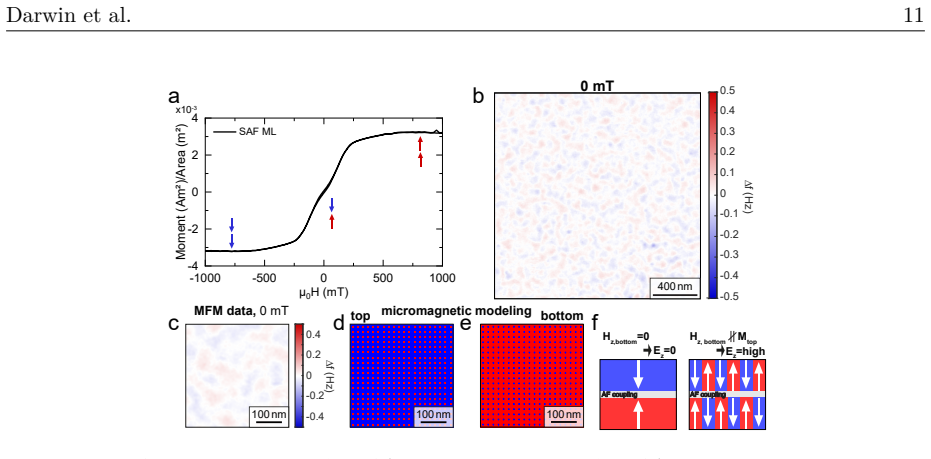
Integrating a compensated synthetic antiferromagnetic bias system with FM and SAF multilayers allows controlled zero-field stabilization of skyrmions through multilayer engineering and a single preparatory field cycle. High-sensitivity MFM combined with modeling demonstrates reliable zero-field skyrmion formation and resolves sub-20 nm SAF skyrmions at room temperature, the smallest SAF skyrmions observed to date. The bias layer's compensated nature suppresses unwanted domain formation while maintaining a uniform exchange field.
What carries the argument
The SAF bias system, a compensated synthetic antiferromagnet that supplies a uniform exchange field without generating domains.
If this is right
- Both FM and SAF skyrmions can be stabilized at zero field in the same bias-engineered stack.
- Sub-20 nm SAF skyrmions become accessible at room temperature, smaller than any previously reported.
- Skyrmion polarity is set by the choice of preparatory field cycle.
- The compensated bias provides a scalable template for adding skyrmion layers without introducing stray fields or domains.
Where Pith is reading between the lines
- Device stacks could operate without external magnets, reducing power and simplifying integration in spintronic circuits.
- The same bias approach might stabilize other nanoscale topological textures such as merons or hopfions in similar multilayers.
- Direct electrical readout experiments on these sub-20 nm structures would test whether the reduced size improves switching speed or density in memory prototypes.
Load-bearing premise
The compensated nature of the SAF bias system suppresses domain formation and preserves a uniform exchange field that enables controlled stabilization via multilayer design and preparatory field cycle.
What would settle it
Observation of domains forming inside the bias layer or failure to produce stable skyrmions at zero field after the preparatory cycle would show the bias mechanism does not work as described.
Figures



read the original abstract
Synthetic antiferromagnetic skyrmions (SAFsk) are nanoscale, topologically protected spin textures with strong potential for spintronic technologies because of their high stability and the absence of the skyrmion Hall effect. However, robust zero field stabilization remains a central challenge. Here, a synthetic antiferromagnetic (SAF) bias system is introduced as a novel strategy to stabilize both ferromagnetic skyrmions (FMsk) and SAFsk at zero field. Ferromagnetic (FM) and SAF multilayers are designed, fabricated and integrated with the SAF bias system to enable controlled skyrmion stabilization and polarity setting via multilayer design and a preparatory field cycle. Combining quantitative and high-sensitivity magnetic force microscopy (MFM) with micromagnetic modeling, reliable zero field skyrmion formation is demonstrated and sub 20nm SAFsk are directly observed, the smallest SAFsk reported to date. Moreover, the SAF bias system concept introduced here offers a robust and scalable route to bias future skyrmion multilayers, as its compensated nature suppresses domain formation and preserves a uniform exchange field.
Editorial analysis
A structured set of objections, weighed in public.
Referee Report
Summary. The manuscript introduces a synthetic antiferromagnetic (SAF) bias system integrated with ferromagnetic and SAF multilayers to stabilize both FM and SAF skyrmions at zero field and room temperature. Fabrication, quantitative high-sensitivity MFM imaging, and micromagnetic modeling are combined to demonstrate reliable zero-field skyrmion formation, with sub-20 nm SAF skyrmions directly observed and claimed as the smallest reported to date. The compensated SAF bias is presented as suppressing domain formation while preserving a uniform exchange field for controlled stabilization via multilayer design and field cycling.
Significance. If the sub-20 nm zero-field observation is robustly confirmed, the work provides a scalable, bias-engineered route to room-temperature skyrmion multilayers that avoids the skyrmion Hall effect and enables smaller stable textures. The SAF bias concept could serve as a general platform for future skyrmion-hosting stacks by mitigating stray-field-induced domains.
major comments (1)
- [MFM Results and Discussion] MFM imaging and analysis section: The central claim of 'directly observed' sub-20 nm SAFsk at zero field rests on quantitative MFM combined with modeling. However, MFM tip convolution (typical effective resolution 10-30 nm) is not addressed with explicit deconvolution, calibrated standards, or cross-validation against higher-resolution methods (e.g., Lorentz TEM). Without these, the reported diameters appear inferred from micromagnetic fits rather than raw metrology, weakening both the size claim and the assertion of unambiguous formation. This is load-bearing for the headline result.
minor comments (2)
- [Abstract] Abstract and introduction: The acronym 'SAFsk' is introduced without spelling out 'synthetic antiferromagnetic skyrmion' on first use; add the expansion for clarity.
- [Figures] Figure captions: Ensure all MFM images include explicit scale bars, color scales with units, and statements on whether images are raw or processed; this is needed to assess the quantitative claims.
Simulated Author's Rebuttal
We thank the referee for their careful and constructive review of our manuscript. The major comment on the MFM imaging and analysis is addressed point-by-point below. We have revised the manuscript to incorporate additional details that strengthen the presentation of our results while maintaining the integrity of the reported findings.
read point-by-point responses
-
Referee: [MFM Results and Discussion] MFM imaging and analysis section: The central claim of 'directly observed' sub-20 nm SAFsk at zero field rests on quantitative MFM combined with modeling. However, MFM tip convolution (typical effective resolution 10-30 nm) is not addressed with explicit deconvolution, calibrated standards, or cross-validation against higher-resolution methods (e.g., Lorentz TEM). Without these, the reported diameters appear inferred from micromagnetic fits rather than raw metrology, weakening both the size claim and the assertion of unambiguous formation. This is load-bearing for the headline result.
Authors: We agree that explicit discussion of MFM tip convolution effects is essential for robust size metrology and have revised the manuscript accordingly. The sub-20 nm diameters were extracted by fitting observed MFM contrast line profiles to micromagnetic simulations that explicitly model the tip stray-field convolution (using a calibrated tip transfer function derived from reference samples with known magnetic features). In the revised version, we have added a dedicated subsection in the Methods and an expanded discussion in the Results that details: (i) tip calibration procedures using standard samples, (ii) the approximate deconvolution approach applied to the raw MFM data, and (iii) error bars on the extracted diameters showing that the SAF skyrmion sizes remain below 20 nm after accounting for convolution. This makes clear that the sizes are not purely inferred but constrained by both experiment and simulation. We have also adjusted the phrasing from 'directly observed' to 'observed and quantified via high-sensitivity MFM supported by micromagnetic modeling' to avoid overstatement. Cross-validation with Lorentz TEM was not performed, as the multilayer stack and sample geometry present significant preparation challenges for that technique; however, the quantitative MFM-plus-modeling workflow is established in the skyrmion literature for resolving sub-20 nm features and is consistent with our data. revision: partial
Circularity Check
No circularity; claims rest on experimental fabrication, MFM imaging, and standard micromagnetic modeling
full rationale
The paper introduces a SAF bias system as a design strategy and validates zero-field skyrmion stabilization through multilayer fabrication, preparatory field cycling, quantitative MFM observations, and micromagnetic simulations. No load-bearing step reduces by construction to a self-defined fit, renamed ansatz, or self-citation chain; the sub-20 nm size claim is presented as a direct metrology outcome cross-checked against modeling rather than a tautological prediction. The derivation chain is self-contained against external benchmarks (fabrication parameters, MFM contrast, standard LLG equations) with no evidence of the enumerated circular patterns.
Axiom & Free-Parameter Ledger
axioms (1)
- domain assumption Micromagnetic modeling accurately captures skyrmion stability and MFM contrast in the multilayer system.
invented entities (1)
-
SAF bias system
no independent evidence
Lean theorems connected to this paper
-
IndisputableMonolith/Cost/FunctionalEquation.leanwashburn_uniqueness_aczel unclearthe compensated nature of the SAF bias system suppresses domain formation and preserves a uniform exchange field
-
IndisputableMonolith/Foundation/AbsoluteFloorClosure.leanabsolute_floor_iff_bare_distinguishability uncleartrade-off among different magnetic energies... DMI, IEC, and Zeeman energies
Reference graph
Works this paper leans on
-
[1]
G. Finocchio, F. Büttner, R. Tomasello, M. Carpentieri, M. Kläui,Journal of Physics D: Applied Physics2016,49, 42 423001
-
[2]
D. Rodrigues, A. Riveros, A. Meo, E. Darwin, V. Puliafito, A. Giordano, D. Kechrakos, M. Carpentieri, R. Tomasello, G. Finocchio,IEEE Nanotechnology Magazine2025
-
[3]
C. Back, V. Cros, H. Ebert, K. Everschor-Sitte, A. Fert, M. Garst, T. Ma, S. Mankovsky, T. Monchesky, M. Mostovoy, et al.,Journal of Physics D: Applied Physics2020,53, 36 363001. Darwin et al. 19
-
[4]
T. Dohi, R. M. Reeve, M. Kläui,Annual Review of Condensed Matter Physics2022,13, 1 73
-
[5]
J. Zázvorka, F. Jakobs, D. Heinze, N. Keil, S. Kromin, S. Jaiswal, K. Litzius, G. Jakob, P. Virnau, D. Pinna, et al.,Nature nanotechnology2019,14, 7 658
-
[6]
K. M. Song, J.-S. Jeong, B. Pan, X. Zhang, J. Xia, S. Cha, T.-E. Park, K. Kim, S. Finizio, J. Raabe, et al.,Nature Electronics2020,3, 3 148
- [7]
-
[8]
S. Li, W. Kang, X. Zhang, T. Nie, Y. Zhou, K. L. Wang, W. Zhao,Materials Horizons2021, 8, 3 854
-
[9]
S. Koraltan, C. Abert, M. Albrecht, M. Azhar, C. Back, H. Béa, M. T. Birch, S. Blügel, O. Boulle, F. Büttner, et al.,arXiv preprint arXiv:2601.165752026
-
[10]
H. Du, R. Che, L. Kong, X. Zhao, C. Jin, C. Wang, J. Yang, W. Ning, R. Li, C. Jin, et al., Nature communications2015,6, 1 8504
-
[11]
A. Soumyanarayanan, M. Raju, A. Gonzalez Oyarce, A. K. Tan, M.-Y. Im, A. P. Petrović, P. Ho, K. Khoo, M. Tran, C. Gan, et al.,Nature materials2017,16, 9 898
-
[12]
M. Raju, A. Yagil, A. Soumyanarayanan, A. K. Tan, A. Almoalem, F. Ma, O. Auslaender, C. Panagopoulos,Nature communications2019,10, 1 696
-
[13]
P. Ho, A. K. Tan, S. Goolaup, A. G. Oyarce, M. Raju, L. Huang, A. Soumyanarayanan, C. Panagopoulos,Physical Review Applied2019,11, 2 024064
- [14]
- [15]
-
[16]
K. Litzius, I. Lemesh, B. Krüger, P. Bassirian, L. Caretta, K. Richter, F. Büttner, K. Sato, O. A. Tretiakov, J. Förster, et al.,Nature Physics2017,13, 2 170
-
[17]
W. Legrand, D. Maccariello, F. Ajejas, S. Collin, A. Vecchiola, K. Bouzehouane, N. Reyren, V. Cros, A. Fert,Nature materials2020,19, 1 34
-
[18]
T. Dohi, S. DuttaGupta, S. Fukami, H. Ohno,Nature communications2019,10, 1 5153
-
[19]
R. Juge, N. Sisodia, J. U. Larrañaga, Q. Zhang, V. T. Pham, K. G. Rana, B. Sarpi, N. Mille, S. Stanescu, R. Belkhou, et al.,Nature Communications2022,13, 1 4807
-
[20]
V. T. Pham, N. Sisodia, I. Di Manici, J. Urrestarazu-Larrañaga, K. Bairagi, J. Pelloux-Prayer, R. Guedas, L. D. Buda-Prejbeanu, S. Auffret, A. Locatelli, et al.,Science2024,384, 6693 307. Darwin et al. 20
- [21]
-
[22]
R. Chen, Y. Gao, X. Zhang, R. Zhang, S. Yin, X. Chen, X. Zhou, Y. Zhou, J. Xia, Y. Zhou, et al.,Nano letters2020,20, 5 3299
-
[23]
S. S. Parkin,Physical Review Letters1991,67, 25 3598
- [24]
-
[25]
S. Liu, R. Tomasello, Y. Wu, B. Fang, A. Chen, D. Zheng, B. Zhang, E. Darwin, H. J. Hug, M. Carpentieri, et al.,Advanced Electronic Materials2025, e00130
- [26]
-
[27]
R. Tomasello, V. Puliafito, E. Martinez, A. Manchon, M. Ricci, M. Carpentieri, G. Finocchio, Journal of Physics D: Applied Physics2017,50, 32 325302
-
[28]
C. E. Barker, S. Finizio, E. Haltz, S. Mayr, P. M. Shepley, T. A. Moore, G. Burnell, J. Raabe, C. H. Marrows,Journal of Physics D: Applied Physics2023,56, 42 425002
- [29]
- [30]
-
[31]
M. I. Sim, D. Thian, R. Maddu, X. Chen, H. K. Tan, C. Li, P. Ho, A. Soumyanarayanan, Advanced Functional Materials2025,35, 11 2416927
- [32]
-
[33]
X. Chen, T. Tai, H. R. Tan, H. K. Tan, R. Lim, T. Suraj, P. Ho, A. Soumyanarayanan, Advanced Functional Materials2024,34, 1 2304560
-
[34]
J. Brandão, D. Dugato, M. P. dos Santos, F. Beron, J. Cezar,Applied Surface Science2022, 585152598
-
[35]
Y. Feng, A.-O. Mandru, O. Yıldırım, H. Hug,Physical Review Applied2022,18, 2 024016
- [36]
-
[37]
A. Benassi, M. A. Marioni, D. Passerone, H. J. Hug,Scientific reports2014,4, 1 4508
-
[38]
K. G. Rana, A. Finco, F. Fabre, S. Chouaieb, A. Haykal, L. D. Buda-Prejbeanu, O. Fruchart, S. Le Denmat, P. David, M. Belmeguenai, et al.,Physical review applied2020,13, 4 044079
- [39]
-
[40]
M. D. Stiles, R. D. McMichael,Physical Review B1999,59, 5 3722. Darwin et al. 21
-
[41]
Y. Zhao, S. Yang, K. Wu, S. Li, Y. Gao, H. Hao, X. Zhang, S. Wang, Q. Liu, S. Zhang, et al., Advanced Functional Materials2023,33, 49 2303133
-
[42]
D. V. Christensen, U. Staub, T. Devidas, B. Kalisky, K. Nowack, J. L. Webb, U. L. Andersen, A. Huck, D. A. Broadway, K. Wagner, et al.,Journal of Physics: Materials2024,7, 3 032501
-
[43]
A. Hierro-Rodríguez, C. Quirós, A. Sorrentino, L. M. Álvarez-Prado, J. I. Martín, J. M. Alameda, S. McVitie, E. Pereiro, M. Velez, S. Ferrer,Nature communications2020,11, 1 6382
-
[44]
C. Donnelly, V. Scagnoli,Journal of Physics: Condensed Matter2020,32, 21 213001
-
[45]
H. J. Hug, B. Stiefel, P. Van Schendel, A. Moser, R. Hofer, S. Martin, H.-J. Güntherodt, S. Porthun, L. Abelmann, J. Lodder, et al.,Journal of Applied Physics1998,83, 11 5609
-
[46]
Y. Feng, P. M. Vaghefi, S. Vranjkovic, M. Penedo, P. Kappenberger, J. Schwenk, X. Zhao, A.-O. Mandru, H. Hug,Journal of Magnetism and Magnetic Materials2022,551169073
- [47]
- [48]
-
[49]
J. L. Hutter, J. Bechhoefer,Review of scientific instruments1993,64, 7 1868
-
[50]
H.-J. Butt, M. Jaschke,Nanotechnology1995,6, 1 1
-
[51]
X. Zhao, J. Schwenk, A. Mandru, M. Penedo, M. Baćani, M. Marioni, H. Hug,New Journal of Physics2018,20, 1 013018
-
[52]
A. Giordano, G. Finocchio, L. Torres, M. Carpentieri, B. Azzerboni,Journal of Applied Physics2012,111, 7
-
[53]
T. Xu, Z. Chen, H.-A. Zhou, Z. Wang, Y. Dong, L. Aballe, M. Foerster, P. Gargiani, M. Valvidares, D. M. Bracher, et al.,Physical Review Materials2021,5, 8 084406
- [54]
discussion (0)
Sign in with ORCID, Apple, or X to comment. Anyone can read and Pith papers without signing in.