Recognition: 2 theorem links
· Lean TheoremTest-Beam Performance of the AstroPix Silicon Sensor for Imaging Calorimetry
Pith reviewed 2026-05-11 02:02 UTC · model grok-4.3
The pith
AstroPix-v3 silicon sensors capture electromagnetic shower development and discriminate it from hadronic activity in test beams.
A machine-rendered reading of the paper's core claim, the machinery that carries it, and where it could break.
Core claim
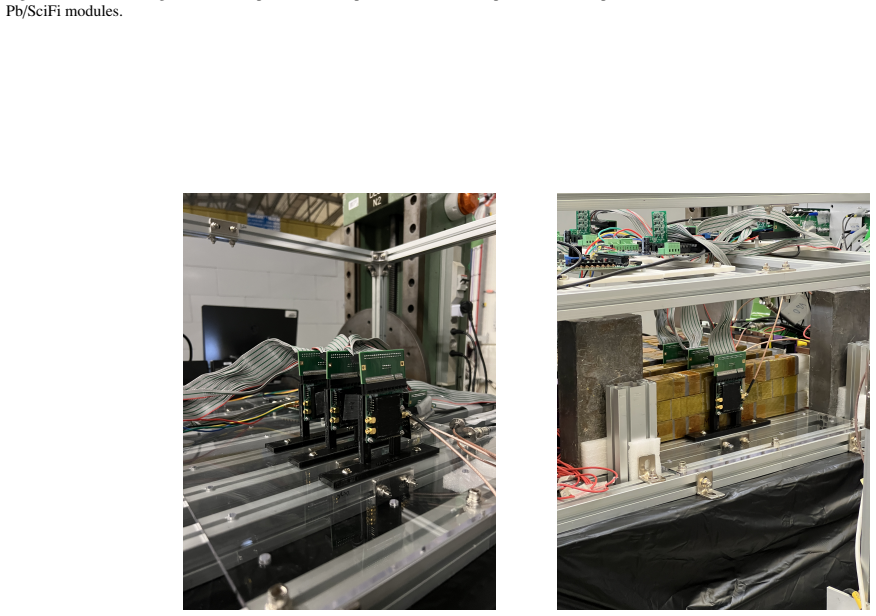
AstroPix-v3 sensors operated as tracking layers and as imaging layers between Pb/SciFi modules deliver stable performance with a maximum hit efficiency of 68 percent at -400 V under pion-dominated conditions. When combined with the calorimeter, electron-induced events produce significantly higher hit multiplicities and wider spatial distributions than pion-induced events, allowing clear separation of electromagnetic and hadronic showers through common-timestamp event synchronization.
What carries the argument
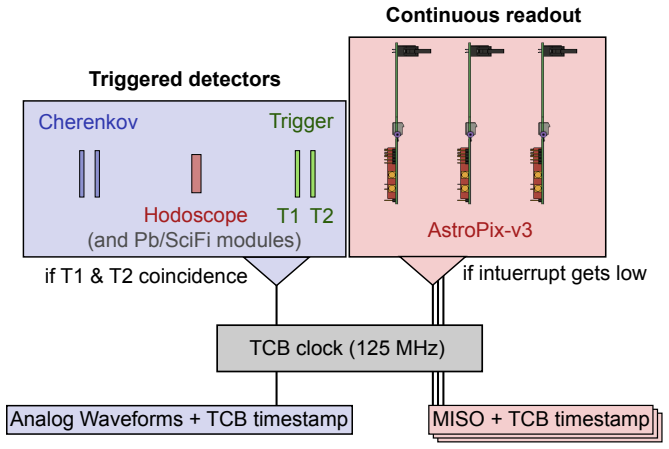
AstroPix-v3 high-voltage CMOS monolithic active pixel sensor used in continuous readout with timestamp-based synchronization to a trigger-based calorimeter readout.
If this is right
- The sensor can be inserted as an imaging layer inside the Barrel Imaging Calorimeter of the ePIC experiment at the Electron-Ion Collider.
- The same device remains a viable option for the imaging planes of future space-based gamma-ray missions.
- Timestamp synchronization allows pixel hits to be associated with calorimeter energy deposits for combined shower analysis.
- Cherenkov-based tagging confirms that hit multiplicity and spatial width provide electromagnetic versus hadronic discrimination.
Where Pith is reading between the lines
- Placing pixel layers inside a calorimeter could reduce reliance on separate tracking stations in future detector designs.
- Further bias-voltage scans or readout-threshold adjustments could raise efficiency above the observed 68 percent.
- Similar interleaved tests at higher beam energies would test whether the discrimination power holds for the multi-GeV to TeV regime typical of collider physics.
- The technology might be combined with other calorimeter media beyond Pb/SciFi to create hybrid imaging systems.
Load-bearing premise
The few-GeV electron and pion beams, including the Cherenkov particle identification, sufficiently match the particle species, energies, and backgrounds expected in the target collider and space instruments.
What would settle it
Measurement of hit efficiencies well below 68 percent or loss of shower-type discrimination when the same sensors are exposed to the actual particle fluxes and energies inside the ePIC Barrel Imaging Calorimeter or a space gamma-ray telescope.
Figures



read the original abstract
AstroPix is a high-voltage CMOS HVCMOS monolithic active pixel sensor MAPS developed for future space-based gamma-ray missions. It is also a candidate technology for the imaging layer of the Barrel Imaging Calorimeter BIC in the ePIC experiment at the future Electron-Ion Collider EIC. We report the first AstroPix test-beam results obtained at the KEK Photon Factory Advanced Ring PF-AR and the CERN Proton Synchrotron PS T10 beam line in 2025, using the third prototype AstroPix-v3. AstroPix-v3 sensors were operated as both standalone tracking layers and imaging layers interleaved with prototype lead/scintillating-fiber Pb/SciFi calorimeter modules, using electron and hadron beams in the few-GeV/c momentum range. Event synchronization between the continuous readout of AstroPix-v3 and the trigger-based readout of the Pb/SciFi calorimeter was achieved using a common timestamp. The AstroPix-v3 sensors exhibit stable performance, reaching a maximum hit efficiency of 68 percent at a bias voltage of -400 V under pion-dominated beam conditions. When combined with the Pb/SciFi calorimeter, the AstroPix layers successfully capture the development of electromagnetic showers. Using Cherenkov-based particle identification, electron-induced events exhibit significantly higher hit multiplicities and broader spatial distributions than pion-induced events, thereby providing clear discrimination between electromagnetic and hadronic showers. These results demonstrate that AstroPix-v3 provides effective, high-granularity imaging of shower development and is well suited as an imaging layer in future calorimeter systems for both collider and space-based experiments.
Editorial analysis
A structured set of objections, weighed in public.
Referee Report
Summary. The manuscript reports the first test-beam performance results for the AstroPix-v3 HVCMOS monolithic active pixel sensor at KEK PF-AR and CERN PS T10, using few-GeV/c electron and hadron beams. AstroPix-v3 was tested both standalone and as imaging layers interleaved with Pb/SciFi calorimeter modules, achieving a maximum hit efficiency of 68% at -400 V bias under pion-dominated conditions, successful imaging of electromagnetic shower development via timestamp synchronization, and clear electron-pion discrimination through higher hit multiplicities and broader spatial distributions in electron events identified by Cherenkov counters. The authors conclude that these results demonstrate AstroPix-v3's suitability as a high-granularity imaging layer for the ePIC Barrel Imaging Calorimeter and space-based gamma-ray missions.
Significance. If the reported performance metrics hold under scrutiny, the work provides a valuable experimental benchmark for AstroPix-v3 in a calorimeter context, including the first demonstration of interleaved operation with a prototype Pb/SciFi module and cross-system timestamp synchronization. This strengthens the case for the sensor in high-granularity imaging calorimetry applications, though the overall significance for the target ePIC and space environments depends on addressing the energy and background extrapolation.
major comments (2)
- [Abstract and Conclusions] Abstract and final paragraph of the manuscript: the central claim that AstroPix-v3 'provides effective, high-granularity imaging of shower development and is well suited as an imaging layer in future calorimeter systems for both collider and space-based experiments' rests on an untested extrapolation; the test-beam data are limited to few-GeV/c momenta with pion-dominated and Cherenkov-selected samples, with no scaling studies, Monte Carlo simulations bridging to tens-of-GeV ePIC conditions, photon-initiated showers, or space-specific backgrounds (cosmic rays, trapped radiation) provided to support the suitability conclusion.
- [Results (efficiency measurement)] Results on hit efficiency: the stated maximum hit efficiency of 68% at -400 V is presented without statistical uncertainties, the total number of reconstructed tracks used in the measurement, or the precise definition of efficiency (e.g., track-matching criteria and acceptance cuts), which is load-bearing for any quantitative assessment of sensor performance.
minor comments (2)
- [Abstract and Results] The abstract and results text describe 'significantly higher hit multiplicities and broader spatial distributions' for electrons versus pions but provide no quantitative separation metric (e.g., a cut efficiency, purity, or ROC curve); adding such numbers or referencing the relevant figure would improve clarity.
- [Experimental Setup] The beam conditions are described as 'few-GeV/c momentum range' and 'pion-dominated'; specifying the exact momentum settings, beam composition fractions, and any energy-dependent trends observed would aid reproducibility and context for the discrimination results.
Simulated Author's Rebuttal
We thank the referee for the careful and constructive review of our manuscript. We address each major comment below and have revised the manuscript to improve the presentation of results and to qualify our conclusions appropriately.
read point-by-point responses
-
Referee: [Abstract and Conclusions] Abstract and final paragraph of the manuscript: the central claim that AstroPix-v3 'provides effective, high-granularity imaging of shower development and is well suited as an imaging layer in future calorimeter systems for both collider and space-based experiments' rests on an untested extrapolation; the test-beam data are limited to few-GeV/c momenta with pion-dominated and Cherenkov-selected samples, with no scaling studies, Monte Carlo simulations bridging to tens-of-GeV ePIC conditions, photon-initiated showers, or space-specific backgrounds (cosmic rays, trapped radiation) provided to support the suitability conclusion.
Authors: We acknowledge that the test-beam campaign was performed at few-GeV/c momenta and that the manuscript does not contain scaling studies or Monte Carlo extrapolations to the higher energies and background conditions relevant for ePIC or space applications. The original claim was intended to reflect the demonstrated capabilities in shower imaging and particle discrimination rather than a fully validated extrapolation. In the revised manuscript we have modified the abstract and the final paragraph of the conclusions to state that the results constitute a proof-of-principle demonstration of AstroPix-v3 as an imaging layer, while explicitly noting that further studies at higher energies and with representative backgrounds are required to confirm performance in the target environments. revision: partial
-
Referee: [Results (efficiency measurement)] Results on hit efficiency: the stated maximum hit efficiency of 68% at -400 V is presented without statistical uncertainties, the total number of reconstructed tracks used in the measurement, or the precise definition of efficiency (e.g., track-matching criteria and acceptance cuts), which is load-bearing for any quantitative assessment of sensor performance.
Authors: We thank the referee for highlighting this omission. The efficiency value of 68% was obtained from a sample of approximately 1.2 × 10^5 reconstructed tracks in the pion-dominated beam. Efficiency is defined as the fraction of tracks for which at least one AstroPix hit lies within a 2-pixel matching window of the extrapolated track position, after applying acceptance cuts that require the track to have at least three hits in the telescope and to lie within the active area of the sensor. In the revised manuscript we have added the statistical uncertainty (68 ± 3%), the total track count, and a complete description of the matching criteria and acceptance cuts in the relevant Results subsection. revision: yes
Circularity Check
No circularity: pure experimental performance report with direct measurements
full rationale
This is an experimental test-beam paper reporting measured hit efficiencies, shower profiles, and particle discrimination from AstroPix-v3 sensors under few-GeV/c electron and pion beams at KEK and CERN. No derivations, fitted parameters, predictions, or equations appear in the text; all results are direct observations synchronized with calorimeter modules and Cherenkov PID. The suitability claims for ePIC BIC and space missions are stated extrapolations from the observed data rather than any self-referential chain or self-citation load-bearing step. No patterns from the enumerated circularity types are present.
Axiom & Free-Parameter Ledger
Lean theorems connected to this paper
-
IndisputableMonolith/Cost/FunctionalEquation.leanwashburn_uniqueness_aczel unclearAstroPix-v3 sensors exhibit stable performance, reaching a maximum hit efficiency of 68% at a bias voltage of -400 V under pion-dominated beam conditions... electron-induced events exhibit significantly higher hit multiplicities and broader spatial distributions than pion-induced events
-
IndisputableMonolith/Foundation/AlexanderDuality.leanalexander_duality_circle_linking unclearWhen combined with the Pb/SciFi calorimeter, the AstroPix layers successfully capture the development of electromagnetic showers
Reference graph
Works this paper leans on
-
[1]
I. Peric, A novel monolithic pixelated particle de- tector implemented in high-voltage CMOS technol- ogy, Nucl. Instrum. Meth. A 582 (2007) 876–885. doi:10.1016/j.nima.2007.07.115
-
[2]
A. L. Steinhebel, et al., AstroPix: novel monolithic ac- tive pixel silicon sensors for future gamma-ray telescopes, Proc. SPIE Int. Soc. Opt. Eng. 12181 (2022) 121816Y . arXiv:2209.02631, doi:10.1117/12.2630405
-
[3]
R. Caputo, A. L Steinhebel, H. Fleischhack, N. Striebig, M. Jadhav, Y . Suda, R. Luz, D. Violette, C. Kierans, H. Tajima, Y . Fukazawa, R. Leys, I. Peric, J. Metcalfe, M. Negro, J. S Perkins, Astropix: Cmos pixels in space, in: Proceedings of 10th International Workshop on Semi- conductor Pixel Detectors for Particles and Imaging — PoS(Pixel2022), Pixel20...
-
[4]
Y . Suda, R. Caputo, A. L. Steinhebel, H. Fleischhack, N. Striebig, M. Jadhav, R. Luz, D. Violette, C. Kier- ans, H. Tajima, Y . Fukazawa, R. Leys, I. Peric, J. Met- calfe, M. Negro, J. S. Perkins, Development of an HV- CMOS active pixel sensor “AstroPix" for all-sky medium- energy gamma-ray telescopes, PoS ICRC2023 (2023)
work page 2023
-
[5]
doi:10.22323/1.444.0644
-
[6]
A. L. Steinhebel, et al., AstroPix: A pixelated HVCMOS sensor for space-based gamma-ray measure- ment, Nucl. Instrum. Meth. A 1083 (2026) 171021. arXiv:2501.11698, doi:10.1016/j.nima.2025.171021
-
[7]
Y . Suda, et al., Performance evaluation of the high-voltage CMOS active pixel sensor AstroPix for gamma-ray space telescopes, Nucl. Instrum. Meth. A 1068 (2024) 169762. doi:10.1016/j.nima.2024.169762
-
[8]
Status and prospects of the PandaX-III experiment,
N. Striebig, et al., AstroPix4 — a novel HV-CMOS sen- sor developed for space based experiments, Journal of In- strumentation 19 (04) (2024) C04010. doi:10.1088/1748- 0221/19/04/C04010
-
[9]
Suda, et al., Evaluation of gamma-ray response of the AstroPix4 HV-CMOS active pixel sen- sor, Nucl
Y . Suda, et al., Evaluation of gamma-ray response of the AstroPix4 HV-CMOS active pixel sen- sor, Nucl. Instrum. Meth. A 1081 (2026) 170839. doi:10.1016/j.nima.2025.170839
-
[10]
Caputo, et al., All-sky Medium Energy Gamma-ray Observatory eXplorer mission concept, J
R. Caputo, et al., All-sky Medium Energy Gamma-ray Observatory eXplorer mission concept, J. Astron. Telesc. Instrum. Syst. 8 (4) (2022) 044003. arXiv:2208.04990, doi:10.1117/1.JATIS.8.4.044003
-
[11]
Peri ´c, et al., A high-voltage pixel sensor for the AT- LAS upgrade, Nucl
I. Peri ´c, et al., A high-voltage pixel sensor for the AT- LAS upgrade, Nucl. Instrum. Meth. A 924 (2019) 99–103. doi:10.1016/j.nima.2018.06.060
-
[12]
H. T. Klest, Calorimetry for the ePIC Experiment, PoS DIS2024 (2025) 276. arXiv:2408.11075, doi:10.22323/1.469.0276
-
[13]
R. Abdul Khalek, et al., Science Require- ments and Detector Concepts for the Electron- Ion Collider: EIC Yellow Report, Nucl. Phys. A 1026 (2022) 122447. arXiv:2103.05419, doi:10.1016/j.nuclphysa.2022.122447
-
[14]
950–952, https://doi.org/10.18429/JACoW- NAPAC2016-WEPOB24
C. Mitsuda, et al., Construction and beam commissioning of the GeV-range test beamline at KEK PF-AR, JACoW IPAC2023 (2023) MOPA180. doi:10.18429/JACoW- IPAC2023-MOPA180
-
[15]
P. Burdelski, et al., CERN Proton Synchrotron East Area Facility: Upgrades and renovation during Long Shutdown 2, V ol. 4/2021 of CERN Yellow Reports: Monographs, CERN, Geneva, 2021. doi:10.23731/CYRM-2021-004
-
[16]
M. van Dijk, A. Hayat, D. Banerjee, J. Bernhard, B. Gokturk, L. Nevay, J. Petersen, M. Schwinzerl, Particle production and identification for the T10 sec- ondary beamline of the CERN East Area, Nucl. In- strum. Meth. B 569 (2025) 165907. arXiv:2507.02567, doi:10.1016/j.nimb.2025.165907
-
[17]
Schimassek, Development and characterisation of integrated sensors for particle physics, Ph.D
R. Schimassek, Development and characterisation of integrated sensors for particle physics, Ph.D. the- sis, Karlsruher Institut für Technologie (KIT) (2021). doi:10.5445/IR/1000141412. 9
discussion (0)
Sign in with ORCID, Apple, or X to comment. Anyone can read and Pith papers without signing in.