Recognition: 2 theorem links
· Lean TheoremA Novel Framework for the Characterization of Continuous Electromagnetic Manifolds
Pith reviewed 2026-05-11 02:47 UTC · model grok-4.3
The pith
A framework characterizes continuous electromagnetic manifolds for arbitrary MIMO geometries by using a surface feeding function and quadrature on patches.
A machine-rendered reading of the paper's core claim, the machinery that carries it, and where it could break.
Core claim
By representing each mesh element as a 2D planar patch and computing its spatially averaged Green's function through Gauss-Legendre quadrature, the framework introduces a continuous feeding function w(p) in L2(S_T) as the infinite-dimensional limit of the N-port network. This construction yields an accurate description of the full electromagnetic manifold, incorporating near-field phase variations, polarization, and mutual coupling, while operating outside the N-dimensional subspace fixed by physical ports.
What carries the argument
The continuous feeding function w(p) in L2(S_T), which acts as the infinite-dimensional generalization of discrete port excitations and decouples the beamforming space from hardware constraints.
If this is right
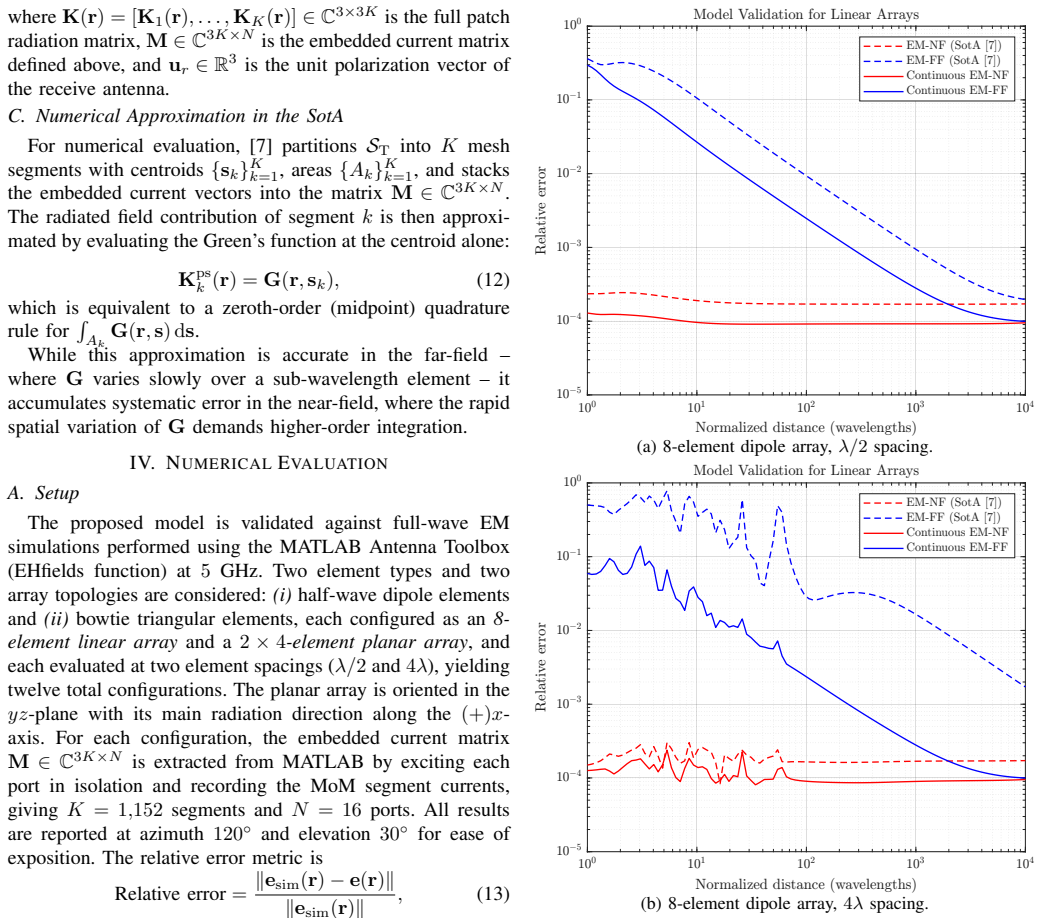
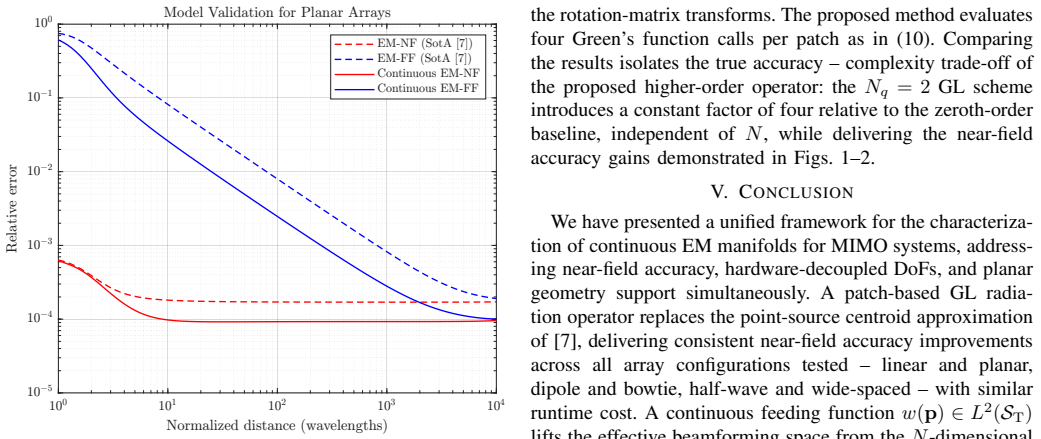
- Near-field modeling errors decrease for both linear and planar array geometries compared with point-source baselines.
- Beamforming can be performed in a subspace larger than the physical port count.
- The approach extends directly to arbitrary 2D array layouts without geometry-specific restrictions.
- Accuracy gains occur while keeping computational complexity comparable to existing methods.
Where Pith is reading between the lines
- Practical systems could first solve for the continuous optimum and then approximate it with a finite set of port excitations.
- The same continuous-surface representation may apply to metasurface or continuous-aperture antennas where current is defined over extended surfaces.
- Discretization rules that map the continuous solution back to limited hardware ports become a natural next design step.
Load-bearing premise
The infinite-dimensional continuous feeding function can be optimized and realized in practice, and Gauss-Legendre quadrature on 2D patches captures all relevant near-field variations without major trade-offs.
What would settle it
Full-wave simulation or measurement results for a non-planar or irregular array geometry in which the proposed model's near-field predictions match the true fields less accurately than the point-source baseline would falsify the claim of general improvement.
Figures

read the original abstract
A unified framework for the characterization of continuous electromagnetic (EM) manifolds for arbitrary multipleinput multiple-output (MIMO) system geometries is presented. The EM manifold refers to the set of all physically realizable radiated field vectors, parameterized by the array excitation, that encodes the full spatial structure of the antenna system including near-field phase variations, polarization, and mutual coupling. Building upon the discrete moment-matrix formulation, the proposed framework addresses three fundamental limitations simultaneously: (i) point-source near-field modeling errors in the radiation operator; (ii) confinement of the beamforming space to the $N$-dimensional subspace dictated by hardware port count; and (iii) restriction to linear (1D) array geometries. Each mesh element is modeled as a two-dimensional (2D) planar patch, whose spatially averaged Green's function is evaluated via Gauss-Legendre (GL) quadrature, yielding superior nearfield accuracy at negligible additional cost. A continuous feeding function $w(\mathbf{p})\in L^2(\mathcal{S}_\mathrm{T})$ is introduced as the infinite-dimensional limit of the $N$-port network, enabling optimization over a higher dimensional current subspace, decoupled from hardware constraints. Full-wave MATLAB Antenna Toolbox validation confirms near-field accuracy improvements over the state-of-the-art (SotA) baseline for both linear and planar array geometries, while maintaining reasonable computational complexity.
Editorial analysis
A structured set of objections, weighed in public.
Referee Report
Summary. The manuscript proposes a unified framework for the characterization of continuous electromagnetic (EM) manifolds in arbitrary MIMO antenna geometries. Building on the discrete moment-matrix formulation, it models mesh elements as 2D planar patches whose spatially averaged Green's functions are computed via Gauss-Legendre quadrature to reduce point-source near-field errors. A continuous feeding function w(p) ∈ L²(S_T) is introduced as the infinite-dimensional limit of the N-port network, enabling optimization over a higher-dimensional current subspace decoupled from hardware port count. The approach also extends to planar (2D) array geometries. Full-wave validation with the MATLAB Antenna Toolbox is reported to show improved near-field accuracy over the state-of-the-art baseline for both linear and planar arrays while maintaining reasonable computational cost.
Significance. If the continuous feeding function can be practically represented, optimized, and realized, the framework would offer a meaningful advance in array signal processing and antenna design by simultaneously improving near-field modeling fidelity and expanding the effective beamforming space beyond hardware-limited dimensions. The GL quadrature on 2D patches provides a concrete, low-overhead method for accuracy gains. However, the significance is currently limited by the absence of evidence that the continuous extension yields operational beamforming improvements or realizable excitations.
major comments (2)
- [Abstract] Abstract (continuous feeding function paragraph): The central claim that w(p) ∈ L²(S_T) enables optimization over a higher-dimensional current subspace decoupled from the N-port hardware constraints is load-bearing for the paper's novelty. No procedure is provided for representing w(p) (e.g., choice of basis functions in L²), optimizing it (e.g., functional gradient method or discretization), truncating it to finite dimensions, or verifying that the resulting fields lie outside the span of the original N discrete port vectors. Without these details, the decoupling remains formal rather than demonstrated.
- [Validation/results section] Validation/results section (MATLAB Antenna Toolbox experiments): The reported full-wave simulations confirm near-field accuracy improvements from the 2D GL quadrature for linear and planar arrays. This addresses only modeling accuracy of the radiation operator. No results are shown for beamforming performance gains, radiated-field dimensionality, or practical realizability of the continuous w(p) excitations with finite hardware, leaving the claims about limitations (ii) and (iii) unsupported by evidence.
minor comments (1)
- [Introduction] The notation S_T for the transmitting surface and the precise definition of the EM manifold should be introduced with an equation or diagram in the early sections to improve readability for readers unfamiliar with the discrete moment-matrix baseline.
Simulated Author's Rebuttal
We thank the referee for the constructive and detailed review of our manuscript. We address each major comment point by point below, acknowledging where additional clarification and evidence are needed, and describe the revisions we will implement.
read point-by-point responses
-
Referee: [Abstract] The central claim that w(p) ∈ L²(S_T) enables optimization over a higher-dimensional current subspace decoupled from the N-port hardware constraints is load-bearing for the paper's novelty. No procedure is provided for representing w(p) (e.g., choice of basis functions in L²), optimizing it (e.g., functional gradient method or discretization), truncating it to finite dimensions, or verifying that the resulting fields lie outside the span of the original N discrete port vectors. Without these details, the decoupling remains formal rather than demonstrated.
Authors: We agree that the abstract's emphasis on the continuous feeding function w(p) as enabling a higher-dimensional subspace requires supporting procedures to move beyond a formal statement. The manuscript introduces w(p) as the infinite-dimensional limit of the N-port network, but we acknowledge that explicit details on representation, optimization, truncation, and verification are insufficient. In the revised version, we will add a dedicated subsection specifying a basis expansion for w(p) (e.g., using orthogonal polynomials on the surface S_T), a practical discretization scheme for numerical optimization, and a verification approach via singular-value analysis of the radiation operator to demonstrate that the resulting fields extend beyond the original N-dimensional span. revision: yes
-
Referee: [Validation/results section] The reported full-wave simulations confirm near-field accuracy improvements from the 2D GL quadrature for linear and planar arrays. This addresses only modeling accuracy of the radiation operator. No results are shown for beamforming performance gains, radiated-field dimensionality, or practical realizability of the continuous w(p) excitations with finite hardware, leaving the claims about limitations (ii) and (iii) unsupported by evidence.
Authors: The validation experiments focus on confirming the near-field accuracy gains from the 2D patch modeling and Gauss-Legendre quadrature, which directly supports limitation (i). We concur that the manuscript does not yet provide direct evidence for beamforming performance improvements, increased radiated-field dimensionality, or realizability of continuous excitations, leaving aspects of limitations (ii) and (iii) without empirical support. We will revise the results section to include new simulations demonstrating beamforming gains with discretized w(p), an SVD-based analysis of the effective dimensionality of the EM manifold, and a discussion of practical approximation of continuous excitations using dense port arrays or reconfigurable surfaces. These additions will address the referee's concern while preserving the focus on modeling accuracy. revision: yes
Circularity Check
No significant circularity; extension via continuous limit and quadrature is independent of inputs
full rationale
The paper builds on the discrete moment-matrix formulation but introduces new modeling elements (2D patch discretization with Gauss-Legendre quadrature for the Green's function and the continuous w(p) in L^2(S_T) as an infinite-dimensional limit) without any quoted reduction where a claimed result equals a fitted parameter or prior input by construction. The decoupling from N-port constraints follows directly from the mathematical definition of the continuous feeding function rather than from any self-referential derivation or self-citation chain. Validation against full-wave MATLAB Antenna Toolbox simulations provides external confirmation of near-field accuracy improvements, keeping the central claims self-contained and falsifiable outside the fitted values.
Axiom & Free-Parameter Ledger
axioms (1)
- domain assumption The radiation operator can be modeled using Green's functions for planar patches.
invented entities (1)
-
Continuous feeding function w(p) ∈ L²(S_T)
no independent evidence
Lean theorems connected to this paper
-
IndisputableMonolith/Cost/FunctionalEquationwashburn_uniqueness_aczel unclearA continuous feeding function w(p)∈L²(S_T) is introduced as the infinite-dimensional limit of the N-port network, enabling optimization over a higher dimensional current subspace, decoupled from hardware constraints.
-
IndisputableMonolith/Foundation/AlexanderDualityalexander_duality_circle_linking unclearEach mesh element is modeled as a two-dimensional (2D) planar patch, whose spatially averaged Green’s function is evaluated via Gauss-Legendre (GL) quadrature
Reference graph
Works this paper leans on
-
[1]
Degrees of freedom in multiple-antenna channels: a signal space approach,
A. Poonet al., “Degrees of freedom in multiple-antenna channels: a signal space approach,”IEEE Transactions on Information Theory, vol. 51, no. 2, 2005
work page 2005
-
[2]
Optimal Beamforming for Multi- User Continuous Aperture Array (CAPA) Systems,
Z. Wang, C. Ouyang, and Y . Liu, “Optimal Beamforming for Multi- User Continuous Aperture Array (CAPA) Systems,”IEEE Transactions on Communications, vol. 73, no. 10, pp. 9207–9221, 2025
work page 2025
-
[3]
Analytical Framework for Effective Degrees of Freedom in Near-Field XL-MIMO,
Z. Wanget al., “Analytical Framework for Effective Degrees of Freedom in Near-Field XL-MIMO,”IEEE Transactions on Wireless Communica- tions, vol. 24, no. 4, pp. 3465–3482, 2025
work page 2025
-
[4]
Special Issue on Near-Field Signal Processing: Com- munications, Sensing, and Imaging,
A. M. Elbiret al., “Special Issue on Near-Field Signal Processing: Com- munications, Sensing, and Imaging,”IEEE Signal Processing Magazine, vol. 42, no. 1, pp. 16–18, 2025
work page 2025
-
[5]
S.-J. Yang, Y .-D. Kim, H.-W. Jo, and N.-H. Myung, “Alternative Method for Obtaining Antenna Current Green’s Function Based on Infinitesimal Dipole Modeling,”IEEE Transactions on Antennas and Propagation, vol. 67, no. 4, pp. 2583–2590, 2019
work page 2019
-
[6]
The Extended Manifold for Antenna Arrays,
B. Friedlander, “The Extended Manifold for Antenna Arrays,”IEEE Transactions on Signal Processing, vol. 68, pp. 493–502, 2020
work page 2020
-
[7]
Electromagnetic Manifold Char- acterization of Antenna Arrays,
M. R. Castellanos and R. W. Heath, “Electromagnetic Manifold Char- acterization of Antenna Arrays,”IEEE Transactions on Wireless Com- munications, vol. 24, no. 3, pp. 1772–1785, 2025
work page 2025
-
[8]
Elec- tromagnetic Effective Degree of Freedom of an MIMO System in Free Space,
S. S. A. Yuan, Z. He, X. Chen, C. Huang, and W. E. I. Sha, “Elec- tromagnetic Effective Degree of Freedom of an MIMO System in Free Space,”IEEE Antennas Wireless Propag. Lett., vol. 21, no. 3, Mar. 2022
work page 2022
-
[9]
Beamforming Optimization for Continuous Aperture Array (CAPA)-Based Communications,
Z. Wang, C. Ouyang, and Y . Liu, “Beamforming Optimization for Continuous Aperture Array (CAPA)-Based Communications,”IEEE Transactions on Wireless Communications, vol. 24, no. 6, 2025
work page 2025
-
[10]
Beamforming Design for Continuous Aperture Array (CAPA)- Based MIMO Systems,
——, “Beamforming Design for Continuous Aperture Array (CAPA)- Based MIMO Systems,”IEEE Transactions on Wireless Communica- tions, vol. 25, pp. 2167–2182, 2026
work page 2026
-
[11]
MoM antenna simulations, with Matlab: RWG basis functions,
S. Makarov, “MoM antenna simulations, with Matlab: RWG basis functions,”IEEE Antennas and Propagation Magazine, vol. 43, no. 5, pp. 100–107, 2001
work page 2001
-
[12]
Mutual coupling in MIMO wireless systems: a rigorous network theory analysis,
J. Wallace and M. Jensen, “Mutual coupling in MIMO wireless systems: a rigorous network theory analysis,”IEEE Transactions on Wireless Communications, vol. 3, no. 4, pp. 1317–1325, 2004
work page 2004
-
[13]
Optimal Antenna Currents for Q, Superdirectivity, and Radiation Patterns Using Convex Optimization,
M. Gustafsson and S. Nordebo, “Optimal Antenna Currents for Q, Superdirectivity, and Radiation Patterns Using Convex Optimization,” IEEE Transactions on Antennas and Propagation, vol. 61, no. 3, pp. 1109–1118, 2013
work page 2013
-
[14]
Optimal Currents on Arbitrarily Shaped Surfaces,
L. Jelinek and M. Capek, “Optimal Currents on Arbitrarily Shaped Surfaces,”IEEE Transactions on Antennas and Propagation, vol. 65, no. 1, pp. 329–341, 2017
work page 2017
discussion (0)
Sign in with ORCID, Apple, or X to comment. Anyone can read and Pith papers without signing in.