Recognition: no theorem link
Exploring the Potential of Ternary Blending for Two and Three-Junction RAINBOW Solar Cells
Pith reviewed 2026-05-11 03:31 UTC · model grok-4.3
The pith
Ternary blending in side-by-side RAINBOW solar cells raises efficiency from 12.9% in single-junction devices to 17.3% in three-junction devices.
A machine-rendered reading of the paper's core claim, the machinery that carries it, and where it could break.
Core claim
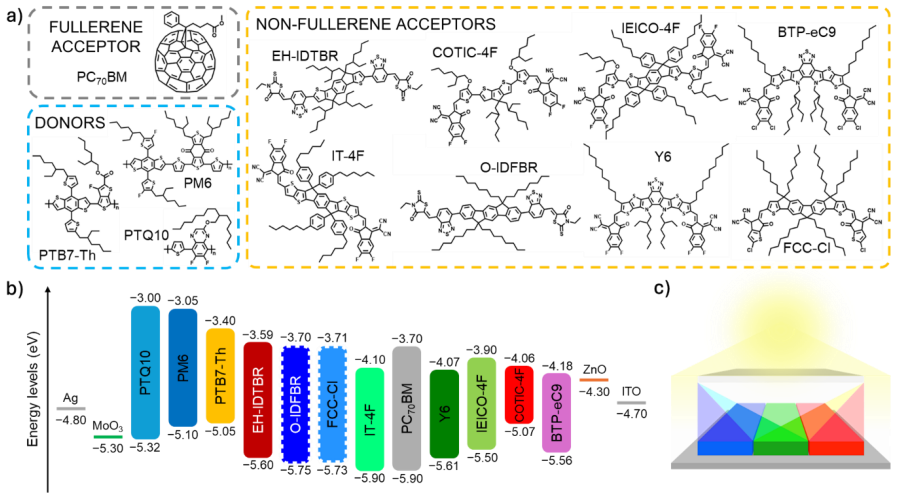
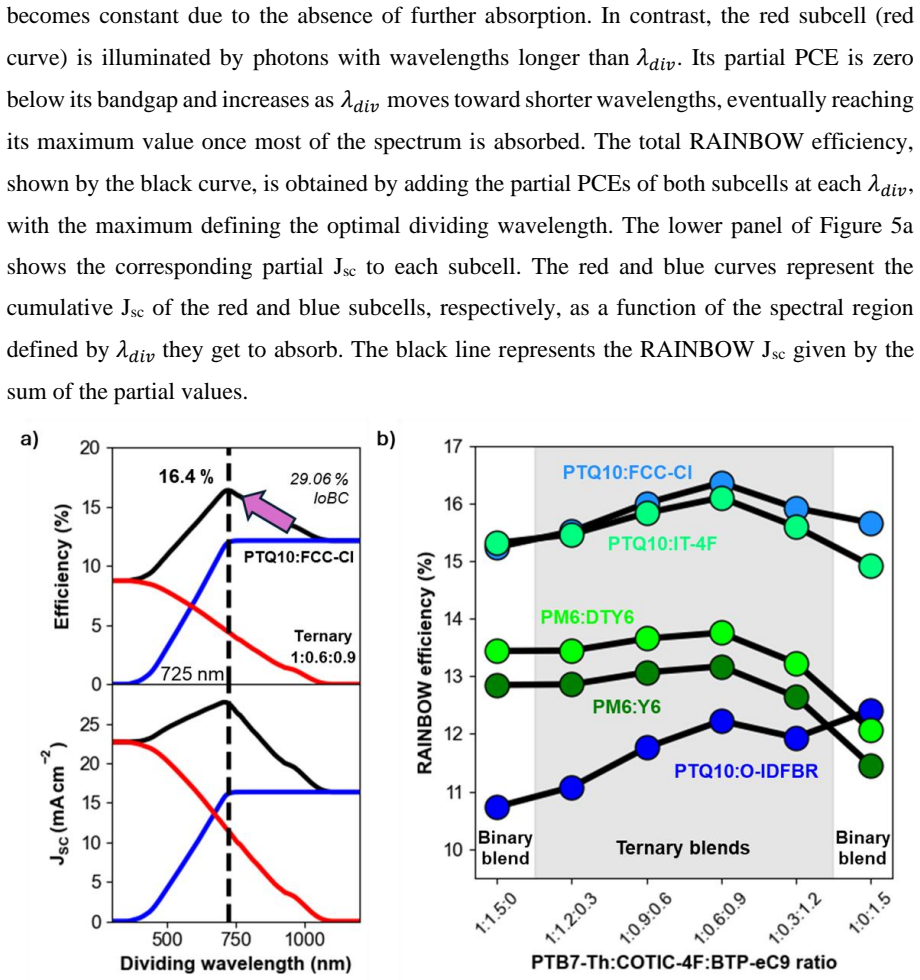
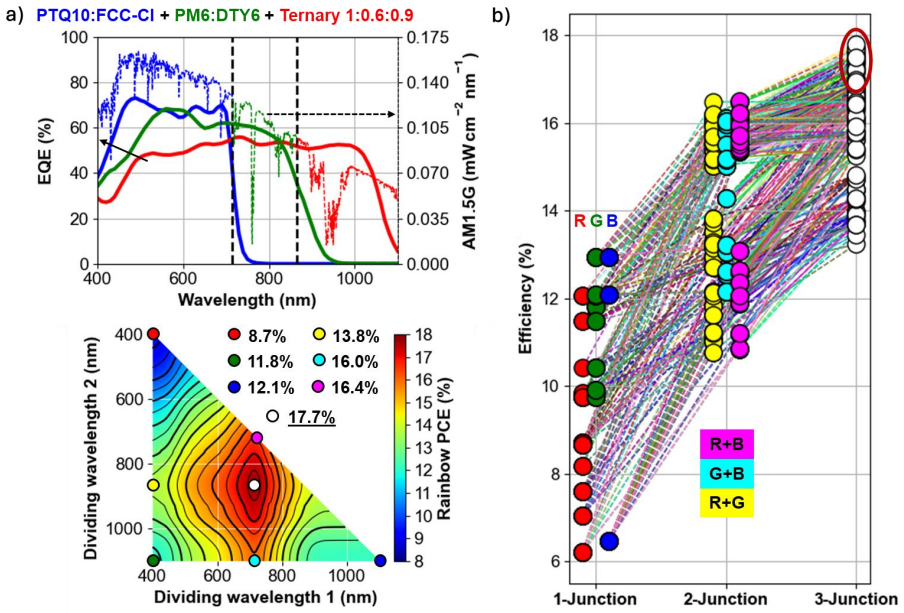
The RAINBOW architecture places subcells side-by-side and connects them externally for spectral splitting, avoiding vertical stack challenges. Among seven binaries and five ternaries tested, the PTB7-Th:COTIC-4F:BTP-eC9 ternary boosts performance as the red subcell when energy levels and morphology align. Device simulations select optimal two- and three-junction sets that include ternaries, and fabricated devices reach 15.9% efficiency for two junctions and 17.3% for three junctions, compared with 12.9% for single-junction cells. Detailed balance analysis indicates the geometry could reach much higher efficiencies once high-performance wide-bandgap materials between 2 and 2.5 eV become ready
What carries the argument
The RAINBOW geometry, a side-by-side spectral splitting design with externally connected subcells, which reduces fabrication complexity and removes current-matching constraints of vertical stacks.
If this is right
- Two-junction RAINBOW devices achieve 15.9% efficiency and 16.4% in simulations.
- Three-junction RAINBOW devices achieve 17.3% efficiency and 17.7% in simulations.
- Ternary blends tune Voc and increase PCE in the intended spectral region when morphology and energy levels align.
- Meniscus-guided blade coating produces working two- and three-junction RAINBOW devices at scale.
- Detailed balance limits show the geometry can exceed current efficiencies once wide-bandgap materials in the 2-2.5 eV range reach high performance.
Where Pith is reading between the lines
- Large-area OPV modules could become simpler to manufacture because the side-by-side layout avoids precise vertical alignment of multiple layers.
- Pairing improved wide-gap materials with this geometry might allow overall device efficiencies above 20% without changing the external-connection approach.
- Outdoor performance testing under varying illumination spectra would reveal whether the simulated gains persist in real conditions.
- Combining RAINBOW subcells with light-management layers such as anti-reflection coatings could produce additional efficiency increases beyond the reported values.
Load-bearing premise
That ternary mixing can tune open-circuit voltage and raise power conversion efficiency in the target spectral window when morphology and energy levels stay well aligned.
What would settle it
Fabricating a three-junction RAINBOW device by blade coating that measures below 15% efficiency under standard test conditions, or finding that the simulated highest-PCE configurations cannot be realized experimentally, would refute the viability claim.
Figures



read the original abstract
The efficiency of organic photovoltaics (OPV) has been steadily increasing over the past decade until reaching the 20\% milestone. Multijunction architectures provide a promising approach to further enhance performance. Here we explore the potential of a spectral splitting geometry, referred to as RAINBOW, in which subcells are placed side-by-side and externally connected, thus minimizing the fabrication and current matching challenges found in vertically stacked configurations. First, we tested 7 different binaries with bandgaps spanning from 1.98 to 1.16 eV. The systems with the widest and narrowest gaps suffered greater losses and so we evaluate if ternary mixing could help to overcome these limitations by evaluating 5 different ternaries. Generally speaking, ternary mixing tunes the Voc, and when morphology and energy levels are well aligned, the overall PCE can be boosted in the spectral region where the subcell should absorb, as is the case for PTB7-Th:COTIC-4F:BTP-eC9 when operating as red subcell. Device simulations help to identify the 2-junction and 3-junction configurations with highest PCEs, all of which include ternaries. We fabricate proof-of-concept RAINBOW devices using scalable methods in which the subcells are deposited by meniscus-guided blade coating. The efficiency improves from 12.9\% in single-junction devices to 15.9\% in 2-junction devices (16.4\% in simulations) and 17.3\% in 3-junction devices (17.7\% in simulations), confirming the viability of the RAINBOW architecture for scalable, high-efficiency OPVs. Finally, detailed balance analysis indicates that the potential of this geometry can be very high provided that high efficiency wide bandgap (2-2.5eV) materials become available.
Editorial analysis
A structured set of objections, weighed in public.
Referee Report
Summary. The manuscript explores the RAINBOW side-by-side spectral-splitting architecture for organic photovoltaics as an alternative to vertical stacks. It first characterizes seven binary donor-acceptor blends with bandgaps from 1.98 eV to 1.16 eV, then tests five ternary blends to reduce losses at the spectral extremes. Device simulations are used to select the highest-PCE 2-junction and 3-junction combinations (all incorporating ternaries), which are subsequently fabricated by meniscus-guided blade coating. Measured power-conversion efficiencies rise from 12.9 % (single-junction reference) to 15.9 % (2-junction) and 17.3 % (3-junction), with simulations predicting 16.4 % and 17.7 %, respectively. A detailed-balance projection indicates further gains are possible once high-efficiency wide-gap (2–2.5 eV) materials become available.
Significance. If the reported efficiency gains and simulation-experiment agreement hold, the work supplies concrete experimental evidence that ternary blending can tune open-circuit voltage and fill factor in the target spectral window while the RAINBOW geometry sidesteps current-matching and fabrication difficulties of stacked tandems. The use of scalable blade-coating and the explicit identification of the morphology/energy-level alignment condition for the PTB7-Th:COTIC-4F:BTP-eC9 red subcell are practical strengths. The conditional detailed-balance analysis usefully frames the architecture’s ultimate potential.
major comments (2)
- [Abstract and experimental results section] Abstract and §3 (experimental results): the central efficiency claims (12.9 % → 15.9 % / 17.3 %) are presented without error bars, standard deviations, or a quantitative loss analysis (e.g., Jsc, Voc, FF contributions). This weakens the ability to judge whether the observed gains are statistically robust or reproducible across batches.
- [Ternary selection and simulation sections] §2.2 (ternary selection) and §4 (simulations): the choice of the five ternaries appears post-hoc after the binary survey; the manuscript does not state an a-priori criterion or screening protocol that would allow readers to assess whether the reported PCE boost for PTB7-Th:COTIC-4F:BTP-eC9 is generalizable or specific to the tested set.
minor comments (2)
- [Figures and methods] Figure captions and text should explicitly state the number of devices measured and the statistical method used to obtain the quoted PCE values.
- [Detailed-balance analysis] The detailed-balance projection in the final section would benefit from a brief sensitivity analysis showing how the projected efficiency changes with realistic assumptions for wide-gap material performance.
Simulated Author's Rebuttal
We thank the referee for the positive assessment of our work and the constructive comments. We address each major comment below and will revise the manuscript accordingly to improve clarity and rigor.
read point-by-point responses
-
Referee: [Abstract and experimental results section] Abstract and §3 (experimental results): the central efficiency claims (12.9 % → 15.9 % / 17.3 %) are presented without error bars, standard deviations, or a quantitative loss analysis (e.g., Jsc, Voc, FF contributions). This weakens the ability to judge whether the observed gains are statistically robust or reproducible across batches.
Authors: We agree that the presentation of the efficiency values would benefit from explicit statistical information and a breakdown of the performance gains. In the revised manuscript we will add standard deviations (from at least five devices per configuration) to all reported PCE, Jsc, Voc and FF values in the abstract, §3 and the associated figures/tables. We will also include a quantitative loss analysis that decomposes the efficiency improvement into contributions from changes in Jsc, Voc and FF relative to the single-junction reference, allowing readers to assess the robustness and reproducibility of the gains. revision: yes
-
Referee: [Ternary selection and simulation sections] §2.2 (ternary selection) and §4 (simulations): the choice of the five ternaries appears post-hoc after the binary survey; the manuscript does not state an a-priori criterion or screening protocol that would allow readers to assess whether the reported PCE boost for PTB7-Th:COTIC-4F:BTP-eC9 is generalizable or specific to the tested set.
Authors: The ternary combinations were selected after observing that the widest- and narrowest-gap binaries exhibited the largest losses in Voc and FF. We will revise §2.2 to state this selection criterion explicitly: ternaries were formulated to restore Voc and FF in the spectral extremes by blending an intermediate-gap component that maintains compatible morphology and energy-level alignment with the host binary. While the specific donor/acceptor ratios were optimized experimentally for the five tested systems, the underlying rationale (targeting lossy spectral edges identified in the binary survey) is general and can be applied to other material sets. We will also add a short paragraph in §4 clarifying how this criterion guided the device-simulation inputs. revision: yes
Circularity Check
No significant circularity detected
full rationale
The manuscript is an experimental study that tests 7 binary and 5 ternary OPV blends, fabricates side-by-side RAINBOW devices by blade coating, and reports measured PCE gains (12.9 % single-junction to 15.9 % two-junction and 17.3 % three-junction). Device simulations are used solely to select promising configurations; the detailed-balance projection is a standard limiting-case estimate conditioned on future wide-gap materials. No equations, fitted parameters, or self-citations are invoked as load-bearing derivations that reduce to their own inputs by construction. The central claims rest on direct empirical measurements rather than any self-referential modeling loop.
Axiom & Free-Parameter Ledger
axioms (1)
- standard math Detailed balance analysis provides an upper bound on achievable efficiency
Reference graph
Works this paper leans on
-
[1]
L. Wang, C. Chen, Z. Gan, J. Cheng, Y. Sun, J. Zhou, W. Xia, D. Liu, W. Li, T. Wang, Advanced Materials 2025, 37, 2419923
work page 2025
-
[2]
S. Wang, S. Wang, J. Wang, N. Yu, J. Qiao, X. Xie, C. Li, M. S. Abbasi, R. Ding, X. Zhang, Y. Han, G. Lu, J. Zhang, X. Hao, Z. Tang, Y. Cai, H. Huang, Advanced Energy Materials 2026, 16, 2405205
work page 2026
-
[3]
N. Wei, J. Chen, Y. Cheng, Z. Bian, W. Liu, H. Song, Y. Guo, W. Zhang, Y. Liu, H. Lu, J. Zhou, Z. Bo, Advanced Materials 2024, 36, 2408934
work page 2024
-
[4]
R. Ma, Z. Luo, Y. Zhang, L. Zhan, T. Jia, P. Cheng, C. Yan, Q. Fan, S. Liu, L. Ye, G. Zhang, X. Xu, W. Gao, Y. Wu, J. Wu, Y. Li, Y. Liu, F. Liu, J. Song, H. Chen, W. Chen, X. Zhang, Y. Liu, J. Yuan, Q. Liu, Z. Kan, H. Yin, X. Li, Y. Ma, et al., Sci. China Mater. 2025, 68, 1689
work page 2025
-
[5]
C. Li, Y. Cai, P. Hu, T. Liu, L. Zhu, R. Zeng, F. Han, M. Zhang, M. Zhang, J. Lv, Y. Ma, D. Han, M. Zhang, Q. Lin, J. Xu, N. Yu, J. Qiao, J. Wang, X. Zhang, J. Xia, Z. Tang, L. Ye, X. Li, Z. Xu, X. Hao, Q. Peng, F. Liu, L. Guo, H. Huang, Nat. Mater. 2025, 1
work page 2025
-
[6]
J. Fu, H. Li, H. Liu, P. Huang, H. Chen, P. W. K. Fong, T. A. Dela Peña, M. Li, X. Lu, P. Cheng, Z. Xiao, S. Lu, G. Li, Nat Energy 2025, 10, 1251
work page 2025
- [7]
-
[8]
G. Bernardo, T. Lopes, D. G. Lidzey, A. Mendes, Advanced Energy Materials 2021, 11, 2100342
work page 2021
-
[9]
M. Steinberger, Q. Xie, O. J. J. Ronsin, P. Maisch, K. C. Tam, A. Distler, J. Harting, C. J. Brabec, H.-J. Egelhaaf, Flex. Print. Electron. 2024, 9, 043001
work page 2024
-
[10]
F. C. Krebs, N. Espinosa, M. Hösel, R. R. Søndergaard, M. Jørgensen, Advanced Materials 2014, 26, 29
work page 2014
-
[11]
M. Krebs-Moberg, M. Pitz, T. L. Dorsette, S. H. Gheewala, Renewable Energy 2021, 164, 556
work page 2021
-
[12]
R. Meitzner, U. S. Schubert, H. Hoppe, Advanced Energy Materials 2021, 11, 2002551
work page 2021
-
[13]
W. Song, J. Ge, L. Xie, Z. Chen, Q. Ye, D. Sun, J. Shi, X. Tong, X. Zhang, Z. Ge, Nano Energy 2023, 116, 108805. 25
work page 2023
-
[14]
Y. Wang, Y. Cui, J. Wang, Y. Xiao, Z. Chen, W. Wang, Y. Yu, S. Yang, R. Yu, X. Hao, S. Zhang, J. Hou, Advanced Materials 2024, 36, 2402575
work page 2024
- [15]
-
[16]
E. G. Jeong, Y. Jeon, S. H. Cho, K. C. Choi, Energy Environ. Sci. 2019, 12, 1878
work page 2019
-
[17]
M. A. Saeed, S. H. Kim, H. Kim, J. Liang, H. Y. Woo, T. G. Kim, H. Yan, J. W. Shim, Advanced Energy Materials 2021, 11, 2003103
work page 2021
-
[18]
M. A. Saeed, S. Xuyao, H. S. Kim, G. M. Lee, H. Ahn, Y.-H. Kim, J. W. Shim, Advanced Optical Materials 2024, 12, 2302145
work page 2024
- [19]
- [20]
- [21]
- [22]
-
[23]
R. Datt, S. Bishnoi, H. K. H. Lee, S. Arya, S. Gupta, V. Gupta, W. C. Tsoi, Aggregate 2022, 3, e185
work page 2022
-
[24]
M. A. Green, S. P. Bremner, Nature Mater 2017, 16, 23
work page 2017
- [25]
-
[26]
A. D. Vos, J. Phys. D: Appl. Phys. 1980, 13, 839
work page 1980
-
[27]
I. M. Peters, C. D. Rodríguez Gallegos, L. Lüer, J. A. Hauch, C. J. Brabec, Progress in Photovoltaics: Research and Applications 2023, 31, 1006
work page 2023
-
[28]
Z. Liu, R. Lin, M. Wei, M. Yin, P. Wu, M. Li, L. Li, Y. Wang, G. Chen, V. Carnevali, L. Agosta, V. Slama, N. Lempesis, Z. Wang, M. Wang, Y. Deng, H. Luo, H. Gao, U. Rothlisberger, S. M. Zakeeruddin, X. Luo, Y. Liu, M. Grätzel, H. Tan, Nat. Mater. 2025, 24, 252
work page 2025
- [29]
-
[30]
K. O. Brinkmann, P. Wang, F. Lang, W. Li, X. Guo, F. Zimmermann, S. Olthof, D. Neher, Y. Hou, M. Stolterfoht, T. Wang, A. B. Djurišić, T. Riedl, Nat Rev Mater 2024, 9, 202
work page 2024
-
[31]
G. Yang, C. Deng, C. Li, T. Zhu, D. Liu, Y. Bai, Q. Chen, J. Huang, G. Li, Nat. Photon. 2025, 19, 913
work page 2025
-
[32]
J. Wang, J. Li, Y. Wang, J. Ren, P. Bi, H. Li, J. Dai, S. Zhang, J. Hou, Advanced Materials 2025, 37, e10378
work page 2025
-
[33]
C. Li, Y. Wang, W. C. H. Choy, Small Methods 2020, 4, 2000093
work page 2020
-
[34]
Y. Ko, H. Park, C. Lee, Y. Kang, Y. Jun, Advanced Materials 2020, 32, 2002196
work page 2020
- [35]
-
[36]
A. K. Converse, In Conference Record of the Twenty Fifth IEEE Photovoltaic Specialists Conference - 1996, 1996, pp. 1299–1302
work page 1996
-
[37]
C. R. Lewis, W. M. Phillips, V. B. Shields, P. M. Stella, I. Bekey, In IECEC-97 Proceedings of the Thirty-Second Intersociety Energy Conversion Engineering Conference (Cat. No.97CH6203), 1997, pp. 401–406 vol.1
work page 1997
-
[38]
A. Barnett, D. Kirkpatrick, C. Honsberg, D. Moore, M. Wanlass, K. Emery, R. Schwartz, D. Carlson, S. Bowden, D. Aiken, A. Gray, S. Kurtz, L. Kazmerski, M. Steiner, J. Gray, T. Davenport, R. Buelow, L. Takacs, N. Shatz, J. Bortz, O. Jani, K. Goossen, F. Kiamilev, A. Doolittle, I. Ferguson, B. Unger, G. Schmidt, E. Christensen, D. Salzman, Progress in Photo...
work page 2009
-
[39]
M. A. Green, A. Ho-Baillie, Progress in Photovoltaics: Research and Applications 2010, 18, 42
work page 2010
-
[40]
M. Stefancich, A. Zayan, M. Chiesa, S. Rampino, D. Roncati, L. Kimerling, J. Michel, Opt. Express, OE 2012, 20, 9004
work page 2012
-
[41]
M. D. Escarra, S. Darbe, E. C. Warmann, H. A. Atwater, In 2013 IEEE 39th Photovoltaic Specialists Conference (PVSC), 2013, pp. 1852–1855. 26
work page 2013
- [42]
-
[43]
Y. Yao, H. Liu, W. Wu, Appl. Phys. A 2014, 115, 713
work page 2014
- [44]
-
[45]
S. K. Thio, S.-Y. Park, Energies 2019, 12, 4719
work page 2019
-
[46]
M. L. Schubert, J. D. Fischbach, M. Nyman, L. Lüer, C. J. Brabec, C. Rockstuhl, T. J. Sturges, APL Photonics 2025, 10, 066105
work page 2025
-
[47]
M. Casademont-Viñas, M. Gibert-Roca, M. Campoy-Quiles, A. R. Goñi, Review of Scientific Instruments 2023, 94, 103907
work page 2023
-
[48]
M. Gibert-Roca, M. Casademont-Viñas, Q. Liu, K. Vandewal, A. R. Goñi, M. Campoy- Quiles, Advanced Materials 2024, 36, 2212226
work page 2024
-
[49]
H. Lu, J. Zhang, J. Chen, Q. Liu, X. Gong, S. Feng, X. Xu, W. Ma, Z. Bo, Advanced Materials 2016, 28, 9559
work page 2016
-
[50]
J. Mai, Y. Xiao, G. Zhou, J. Wang, J. Zhu, N. Zhao, X. Zhan, X. Lu, Advanced Materials 2018, 30, 1802888
work page 2018
- [51]
-
[52]
X. Xu, Y. Li, Q. Peng, Advanced Materials 2022, 34, 2107476
work page 2022
-
[53]
A. A. A. Torimtubun, M. Méndez, E. Moustafa, J. Pallarès, E. Palomares, L. F. Marsal, Solar RRL 2023, 7, 2300228
work page 2023
- [54]
-
[55]
W. Huang, S.-Y. Chang, P. Cheng, D. Meng, B. Zhu, S. Nuryyeva, C. Zhu, L. Huo, Z. Wang, M. Wang, Y. Yang, Nano Lett. 2018, 18, 7977
work page 2018
- [56]
-
[57]
G. He, B. Mayberry, M. Pranav, M. S. Shadabroo, B. Sun, Y. Cao, S. Shoaee, M. Stolterfoht, D. Neher, F. Lang, ACS Energy Lett. 2023, 8, 3980
work page 2023
- [58]
-
[59]
J. Bertrandie, J. Han, C. S. P. De Castro, E. Yengel, J. Gorenflot, T. Anthopoulos, F. Laquai, A. Sharma, D. Baran, Advanced Materials 2022, 34, 2202575
work page 2022
-
[60]
J. Li, G. Liu, W. Liu, Y. Si, W. Deng, H. Wu, Advanced Photonics Research 2022, 3, 2100269
work page 2022
- [61]
-
[62]
F. Bai, J. Zhang, A. Zeng, H. Zhao, K. Duan, H. Yu, K. Cheng, G. Chai, Y. Chen, J. Liang, W. Ma, H. Yan, Joule 2021, 5, 1231
work page 2021
-
[63]
E. L. Ratcliff, J. Meyer, K. X. Steirer, N. R. Armstrong, D. Olson, A. Kahn, Organic Electronics 2012, 13, 744
work page 2012
-
[64]
M. Casademont-Viñas, D. Capolat, A. Quesada-Ramírez, M. Reinfelds, G. Trimmel, M. Sanviti, J. Martín, A. R. Goñi, T. Kirchartz, M. Campoy-Quiles, J. Mater. Chem. A 2024, 12, 16716
work page 2024
- [65]
-
[66]
H. Lu, J. Zhang, J. Chen, Q. Liu, X. Gong, S. Feng, X. Xu, W. Ma, Z. Bo, Advanced Materials 2016, 28, 9559. 27
work page 2016
-
[67]
J. Fu, Q. Yang, P. Huang, S. Chung, K. Cho, Z. Kan, H. Liu, X. Lu, Y. Lang, H. Lai, F. He, P. W. K. Fong, S. Lu, Y. Yang, Z. Xiao, G. Li, Nat Commun 2024, 15, 1830. 1 Supporting Information Exploring the Potential of Ternary Blending for Two and Three -Junction RAINBOW Solar Cells Francesc Xavier Capella-Guardià, Jolanda Simone Müller, Muhammad Ahsan Sae...
work page 2024
- [68]
- [69]
discussion (0)
Sign in with ORCID, Apple, or X to comment. Anyone can read and Pith papers without signing in.