Recognition: 2 theorem links
· Lean TheoremThe massive Thirring / sine-Gordon model with non-zero current density
Pith reviewed 2026-05-11 02:28 UTC · model grok-4.3
The pith
The massive Thirring/sine-Gordon model satisfies model-independent bounds that constrain its zero-temperature energy density within a factor of two at high number densities.
A machine-rendered reading of the paper's core claim, the machinery that carries it, and where it could break.
Core claim
For the massive Thirring/sine-Gordon model solved via Bethe ansatz, optimal bounds constrain the energy density as a function of number density by a factor of two from above and below at high densities for all choices of couplings. The lower bound becomes exact at low densities, while the upper bound approaches the worst constraint of a factor of 4.90.
What carries the argument
Bethe ansatz solution of the massive Thirring/sine-Gordon model with both number density and current density, used to verify model-independent bounds on the equation of state derived from systems with non-zero current density.
If this is right
- Energy density remains bounded within a factor of two independent of coupling strength at high densities.
- The lower bound coincides exactly with the true energy density in the low-density limit.
- The upper bound reaches its loosest value of a factor of 4.90 only in limiting cases not realized at high density in this model.
- The current-density formulation supplies a practical route to bounds without encountering the sign problem in Monte Carlo evaluations.
Where Pith is reading between the lines
- The exact match at low densities indicates that the bounds capture the correct leading behavior in the dilute limit for this model.
- Because the model is integrable, the same Bethe-ansatz technique can be reused to test the bounds at additional densities and couplings.
- The factor-of-two tightness achieved here supplies a concrete benchmark for how well the bounds perform in other integrable or near-integrable systems.
Load-bearing premise
The recently derived model-independent bounds on the zero-temperature equation of state with fixed number density are valid and apply directly to the massive Thirring/sine-Gordon model.
What would settle it
An exact Bethe-ansatz computation of the energy density at a chosen number density that lies outside the upper or lower bound obtained from the non-zero current density calculation.
Figures

read the original abstract
This paper determines the zero-temperature equation of state for the massive Thirring / sine-Gordon model. This demonstrates recently derived model-independent upper and lower bounds on the zero-temperature equation of state with fixed number density from systems with a non-zero current density. That approach is potentially valuable as Monte Carlo calculations with a current density avoid the sign problem in the Euclidean formulation. An advantage to illustrating these bounds in the massive Thirring / sine-Gordon model is that the relevant calculations with both a number density and a current density can be done using a Bethe ansatz. For this model, optimal bounds constrain the energy density as a function of number density by a factor of two from above and below at high densities for all choices of couplings. The lower bound becomes exact at low densities, while the upper bound approaches the worst constraint of a factor of 4.90.
Editorial analysis
A structured set of objections, weighed in public.
Referee Report
Summary. The manuscript solves the massive Thirring/sine-Gordon model at zero temperature via Bethe ansatz in the presence of both fixed number density and non-zero current density. It uses the resulting energy densities to test recently derived model-independent upper and lower bounds on the zero-temperature equation of state at fixed number density, reporting that the bounds constrain the energy density by a factor of two from above and below at high densities for all couplings, that the lower bound becomes exact at low densities, and that the upper bound reaches a worst-case factor of 4.90.
Significance. If the numerical comparison holds, the work supplies a clean, parameter-free verification of the bounds inside an exactly solvable relativistic model. Because both the number-density and current-density quantities are obtained from the same thermodynamic-limit Bethe-ansatz equations, the test is direct and avoids auxiliary fitting; this strengthens the case for using current-density formulations to evade the sign problem in Monte Carlo studies of dense systems.
major comments (1)
- [Results and discussion sections] The central numerical claims (tightness factors of 2 and 4.90) are presented without the explicit Bethe-ansatz integral equations, the thermodynamic-limit expressions for energy and density, or any tabulated data points with error estimates. This absence makes independent verification of the reported ratios impossible from the text alone.
Simulated Author's Rebuttal
We thank the referee for the careful reading of our manuscript and the positive assessment of its significance. We address the single major comment below.
read point-by-point responses
-
Referee: [Results and discussion sections] The central numerical claims (tightness factors of 2 and 4.90) are presented without the explicit Bethe-ansatz integral equations, the thermodynamic-limit expressions for energy and density, or any tabulated data points with error estimates. This absence makes independent verification of the reported ratios impossible from the text alone.
Authors: We agree that the Results and Discussion sections would be strengthened by the explicit inclusion of the Bethe-ansatz integral equations and the thermodynamic-limit expressions for energy and number density. These are derived in the Methods section, but we will duplicate the key formulas (the dressed energy and density integral equations in the presence of both chemical potential and current) directly into the Results section. We will also add a table of representative numerical values, including energy density, number density, current density, and the computed bound ratios, for several couplings and densities spanning the low- and high-density regimes. Because the thermodynamic-limit Bethe-ansatz solution is deterministic, we will report the numerical integration tolerance (typically 10^{-4} or better) in place of statistical error bars. These additions will make the factors of 2 (high-density bound tightness) and 4.90 (worst-case upper bound) directly verifiable from the revised text. revision: yes
Circularity Check
No significant circularity in derivation chain
full rationale
The paper computes the zero-temperature EOS of the massive Thirring/sine-Gordon model via Bethe ansatz at fixed number density and compares it directly to model-independent upper/lower bounds previously derived from the current-density formulation. Both quantities are obtained from the same BA equations in the thermodynamic limit without any fitted parameters, self-definitional loops, or ansatz smuggling. The central result is an explicit numerical verification of bound tightness (factor of 2 at high density, exact lower bound at low density) that remains independent of the bounds' own derivation; the cited bounds are externally falsifiable and do not reduce the present calculation to its inputs by construction.
Axiom & Free-Parameter Ledger
axioms (2)
- domain assumption The massive Thirring/sine-Gordon model admits exact Bethe-ansatz solutions at zero temperature for both fixed number density and fixed current density.
- domain assumption The recently derived model-independent upper and lower bounds on the zero-temperature equation of state apply to this system.
Lean theorems connected to this paper
-
IndisputableMonolith/Cost/FunctionalEquation.leanwashburn_uniqueness_aczel unclear?
unclearRelation between the paper passage and the cited Recognition theorem.
optimal bounds constrain the energy density ... by a factor of two from above and below at high densities ... lower bound becomes exact at low densities, while the upper bound approaches ... 4.90
-
IndisputableMonolith/Foundation/RealityFromDistinction.leanreality_from_one_distinction echoes?
echoesECHOES: this paper passage has the same mathematical shape or conceptual pattern as the Recognition theorem, but is not a direct formal dependency.
Lorentz boosts with a boost parameter β: ϵ(nu) ≤ (Ttt + β² Txx)/(1−β²)
What do these tags mean?
- matches
- The paper's claim is directly supported by a theorem in the formal canon.
- supports
- The theorem supports part of the paper's argument, but the paper may add assumptions or extra steps.
- extends
- The paper goes beyond the formal theorem; the theorem is a base layer rather than the whole result.
- uses
- The paper appears to rely on the theorem as machinery.
- contradicts
- The paper's claim conflicts with a theorem or certificate in the canon.
- unclear
- Pith found a possible connection, but the passage is too broad, indirect, or ambiguous to say the theorem truly supports the claim.
Reference graph
Works this paper leans on
-
[1]
Fix a value forµ/m s ≥2
-
[2]
Find the rapidities such thatϵ(α 1,2)/j(α1,2) =µ
-
[3]
Solve the integral equation (11) forρ(α)
-
[4]
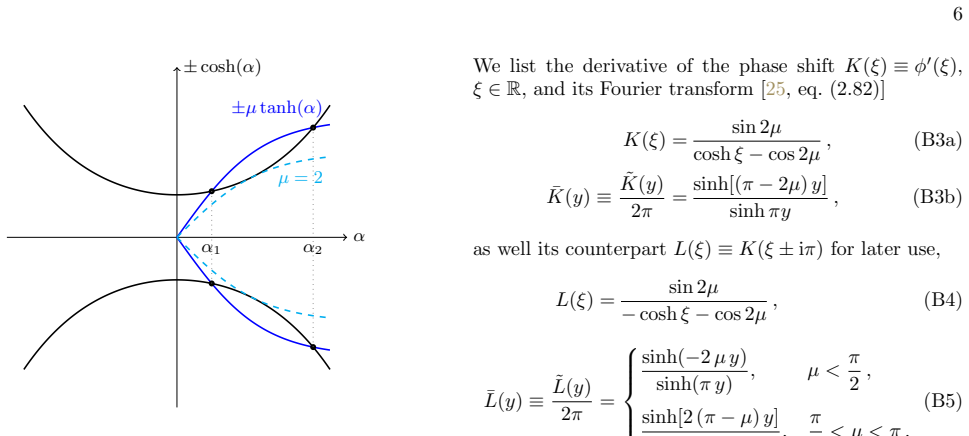
CalculateT µν andjby eq. (12). We note that we assume a positive current densityj >0 and positive rapiditiesα 1,2 >0 without loss of generality. 6 α ±cosh(α) ±µtanh(α) µ= 2 α1 α2 FIG. 2. States of rapiditiesα 1 ≤α≤α 2 are populated in the non-zero current ground state. All quantities are in units ofm s; the energy per state of rapidityαis drawn in black, ...
-
[5]
Philipsen, The QCD equation of state from the lattice, Prog
O. Philipsen, The QCD equation of state from the lattice, Prog. Part. Nucl. Phys.70, 55 (2013), arXiv:1207.5999
-
[6]
H.-T. Ding, F. Karsch, and S. Mukherjee, Thermo- dynamics of strong-interaction matter from Lattice QCD, Int. J. Mod. Phys. E24, 1530007 (2015), arXiv:1504.05274
work page Pith review arXiv 2015
-
[7]
Aarts, Introductory lectures on lattice QCD at nonzero baryon number, J
G. Aarts, Introductory lectures on lattice QCD at nonzero baryon number, J. Phys. Conf. Ser.706, 022004 (2016), arXiv:1512.05145
- [8]
- [9]
-
[10]
K. Chatziioannou, H. T. Cromartie, S. Gandolfi, I. Tews, D. Radice, A. W. Steiner, and A. L. Watts, Neutron stars and the dense matter equation of state, Rev. Mod. Phys. 97, 045007 (2025), arXiv:2407.11153
- [11]
- [12]
- [13]
-
[14]
P. Adhikariet al., Strongly interacting matter in extreme magnetic fields, Prog. Part. Nucl. Phys.146, 104199 (2026), arXiv:2412.18632
- [15]
-
[16]
Computational complexity and fundamental limitations to fermionic quantum Monte Carlo simulations
M. Troyer and U.-J. Wiese, Computational complex- ity and fundamental limitations to fermionic quantum Monte Carlo simulations, Phys. Rev. Lett.94, 170201 (2005), arXiv:cond-mat/0408370
work page Pith review arXiv 2005
-
[17]
E. Y. Loh, J. E. Gubernatis, R. T. Scalettar, S. R. White, D. J. Scalapino, and R. L. Sugar, Sign problem in the nu- merical simulation of many-electron systems, Phys. Rev. B41, 9301 (1990)
work page 1990
-
[18]
M. D’Elia and M.-P. Lombardo, Finite density QCD via imaginary chemical potential, Phys. Rev. D67, 014505 (2003), arXiv:hep-lat/0209146
-
[19]
T. D. Cohen, Functional integrals for QCD at nonzero chemical potential and zero density, Phys. Rev. Lett.91, 222001 (2003), arXiv:hep-ph/0307089
work page Pith review arXiv 2003
- [20]
- [21]
-
[22]
F. D. M. Haldane, Quantum field ground state of the sine- gordon model with finite soliton density: exact results, Journal of Physics A: Mathematical and General15, 507 (1982)
work page 1982
-
[23]
Coleman, The Quantum Sine-Gordon Equation as the Massive Thirring Model, Phys
S. Coleman, The Quantum Sine-Gordon Equation as the Massive Thirring Model, Phys. Rev. D11, 2088 (1975)
work page 2088
-
[24]
Mandelstam, Soliton Operators for the Quantized Sine-Gordon Equation, Phys
S. Mandelstam, Soliton Operators for the Quantized Sine-Gordon Equation, Phys. Rev. D11, 3026 (1975)
work page 1975
-
[25]
Rajaraman,Solitons and instantons
R. Rajaraman,Solitons and instantons. An introduc- tion to solitons and instantons in quantum field theory (North-Holland, 1982)
work page 1982
-
[26]
T. D. Cohen and M. Li, Exact effective potential for a scalar source coupled to the sine-Gordon model: Test of effective potentials for composite nucleons, Phys. Rev. C 42, 970 (1990)
work page 1990
-
[27]
T. D. Cohen, Mean Field Theory and Solitonic Matter, Nucl. Phys. A495, 545 (1989)
work page 1989
-
[28]
H. Bergknoff and H. B. Thacker, Structure and Solution of the Massive Thirring Model, Phys. Rev. D19, 3666 (1979)
work page 1979
-
[29]
H. B. Thacker, Exact Integrability in Quantum Field Theory and Statistical Systems, Rev. Mod. Phys.53, 253 (1981)
work page 1981
-
[30]
E. S. Allhands, A numerical method for solving fredholm integral equations of the second kind (2022)
work page 2022
discussion (0)
Sign in with ORCID, Apple, or X to comment. Anyone can read and Pith papers without signing in.