Recognition: no theorem link
Droplet Deformation and Emulsion Rheology in Two-Dimensional Odd Stokes Flow
Pith reviewed 2026-05-11 03:24 UTC · model grok-4.3
The pith
The leading-order deformation of a droplet in two-dimensional shear flow remains unchanged by odd viscosity, while the emulsion's apparent viscosities depend on the odd-viscosity difference.
A machine-rendered reading of the paper's core claim, the machinery that carries it, and where it could break.
Core claim
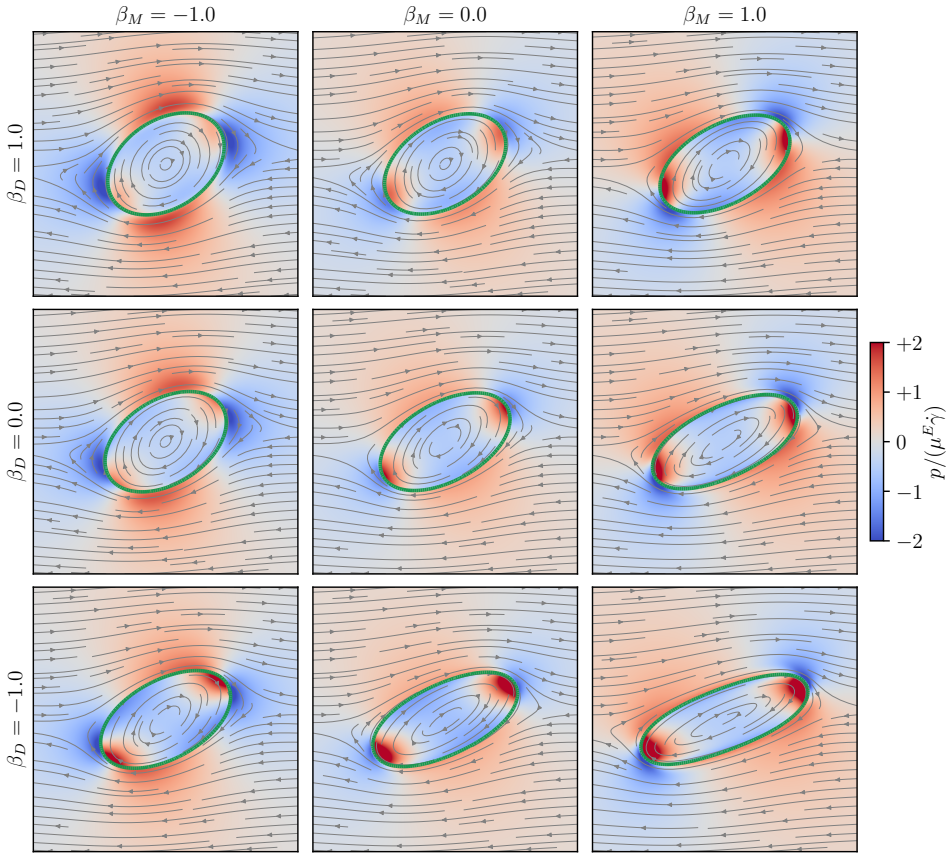
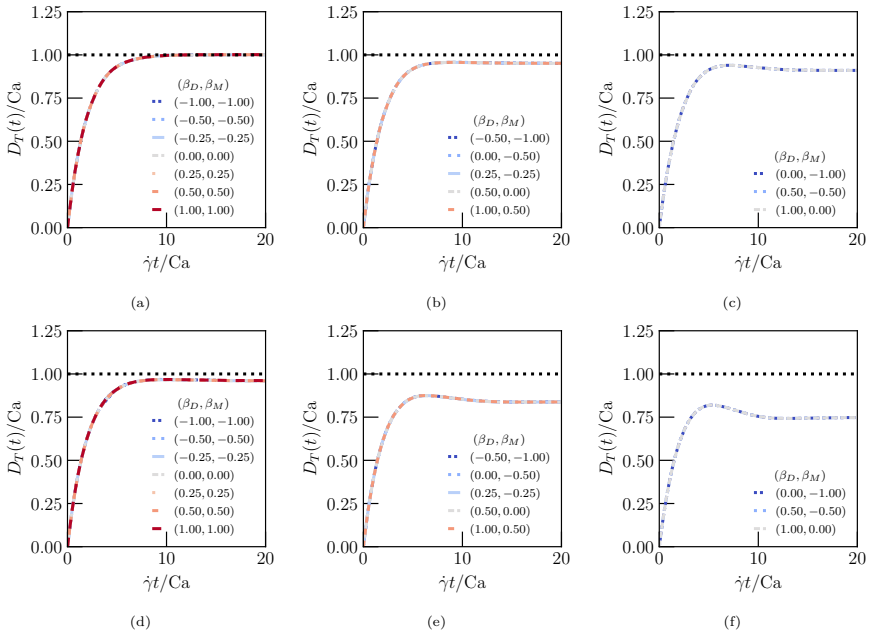
Within the framework of two-dimensional odd Stokes flow, the steady-state Taylor deformation parameter of the droplet satisfies D_T^∞ = Ca + O(Ca²), so the leading-order deformation is identical to the classical even-viscous result. Closed-form expressions are derived for the apparent even and odd viscosities of a dilute emulsion, and it is shown that the flow field depends solely on the difference in odd viscosity across the interface rather than on the individual values. Direct numerical simulations further demonstrate that odd-viscous corrections to the droplet deformation appear at higher orders in the capillary number.
What carries the argument
The analytical solution of the odd Stokes equations for a nearly circular droplet interface, obtained by expanding the shape in powers of the capillary number and matching even and odd stress and velocity boundary conditions.
Load-bearing premise
Viscosity differences between droplet and exterior remain moderate so that the droplet stays close to circular and the expansion in capillary number remains valid.
What would settle it
Measurement of the steady-state droplet aspect ratio at small capillary number Ca ≈ 0.05 in a fluid with known odd viscosity; the claim holds if the deformation parameter matches Ca to within a few percent, with deviations appearing only at larger Ca or larger viscosity contrasts.
Figures






read the original abstract
We study the deformation of a two-dimensional viscous droplet in simple shear in the presence of odd viscosity. We derive an analytical solution for the droplet shape and surrounding flow field within the framework of odd Stokes flow, allowing for differences in both even and odd viscosity between the droplet and the surrounding fluid. This solution yields closed-form expressions for the macroscopic apparent even and odd viscosities of a dilute emulsion. We show that, provided all viscosity differences remain moderate, the steady-state Taylor deformation parameter satisfies $D_T^\infty = \text{Ca} + \mathcal{O}(\text{Ca}^2)$ so that the leading-order droplet deformation is unchanged from the classical (even-viscous) result. Nevertheless, pronounced effects emerges beyond leading order, where our direct numerical simulations reveal odd-viscous differences to the droplet deformation. In addition, we show that the flow is influenced only by the difference in odd viscosity between the droplet and the medium and not on their individual values. Our analysis clarifies how odd viscosity might modify the effective rheology of dilute emulsions and provides a framework for interpreting droplet-based measurements of odd-viscous response. Key words: odd viscosity $|$ droplets $|$ emulsions $|$ surface tension $|$ chiral fluids
Editorial analysis
A structured set of objections, weighed in public.
Referee Report
Summary. The manuscript investigates the deformation of a two-dimensional viscous droplet in simple shear flow within the odd Stokes framework, allowing differences in both even and odd viscosities between the droplet and the surrounding fluid. It derives an analytical solution for the droplet shape and flow field, yielding closed-form expressions for the apparent even and odd viscosities of a dilute emulsion. The central result is that, for moderate viscosity differences, the steady-state Taylor deformation parameter satisfies D_T^∞ = Ca + O(Ca²), leaving the leading-order deformation unchanged from the classical even-viscous case. Direct numerical simulations illustrate pronounced odd-viscous effects at higher orders, and the flow is shown to depend only on the difference in odd viscosity.
Significance. If the derivations hold, this work is significant for extending classical emulsion rheology to chiral fluids with odd viscosity. The leading-order invariance of the Taylor deformation provides a clean, parameter-free result that simplifies interpretation and reduces to the known even-viscous limit without redefinition. The closed-form rheology expressions, the independence of the flow from individual odd-viscosity values, and the DNS evidence for higher-order corrections offer a useful framework for droplet-based measurements of odd-viscous response. These elements strengthen the contribution to cond-mat.soft.
minor comments (3)
- Abstract: grammatical error in 'pronounced effects emerges beyond leading order' (should be 'emerge').
- Abstract: 'Key words' should be 'Keywords'.
- The assumption of 'moderate' viscosity differences is load-bearing for the perturbative result but is stated without quantitative bounds or error estimates on the O(Ca²) remainder; this is a presentation issue that can be addressed by adding a brief validity discussion.
Simulated Author's Rebuttal
We thank the referee for the positive assessment and recommendation of minor revision. The referee summary accurately reflects the manuscript's central findings on droplet deformation in odd Stokes flow, including the leading-order invariance of the Taylor deformation parameter and the role of odd-viscosity differences. We appreciate the recognition of the work's significance for chiral fluid rheology. As no specific major comments were listed in the report, we provide no point-by-point responses below.
Circularity Check
Derivation self-contained from governing equations
full rationale
The central result D_T^∞ = Ca + O(Ca²) follows from an analytical solution of the 2D odd Stokes equations with even/odd viscosity jumps and surface tension; the leading-order shape correction is obtained by balancing the viscous traction discontinuity against capillary pressure in the small-Ca expansion, reproducing the classical even-viscous case without redefinition or parameter fitting. Closed-form emulsion viscosities are likewise direct outputs of the same boundary-value solution. DNS are used only to illustrate O(Ca²) odd-viscous corrections, not to close the leading-order claim. No self-citation chains, ansatzes, or fitted-input predictions appear in the load-bearing steps.
Axiom & Free-Parameter Ledger
axioms (2)
- domain assumption The flow obeys the odd Stokes equations with constant even and odd viscosities inside and outside the droplet.
- domain assumption Viscosity differences remain moderate so that the droplet stays nearly circular at leading order.
Reference graph
Works this paper leans on
-
[1]
J. E. Avron, “Odd viscosity”, Journal of Statistical Physics92, 543–557 (1998)
work page 1998
-
[2]
Odd viscosity in chiral active fluids
D. Banerjee, A. Souslov, A. G. Abanov, and V. Vitelli, “Odd viscosity in chiral active fluids”, Nature Communications8, Published 2017-11-17, 1573 (2017)
work page 2017
-
[3]
The odd free surface flows of a colloidal chiral fluid
V. Soni, E. S. Bililign, S. Magkiriadou, S. Sacanna, D. Bartolo, M. J. Shelley, and W. T. M. Irvine, “The odd free surface flows of a colloidal chiral fluid”, Nature Physics15, 1188–1194 (2019)
work page 2019
-
[4]
Odd viscosity and odd elasticity
M. Fruchart, C. Scheibner, and V. Vitelli, “Odd viscosity and odd elasticity”, Annual Review of Condensed Matter Physics 14, 471–510 (2023)
work page 2023
-
[5]
Stokes flows in three-dimensional fluids with odd and parity-violating viscosities
T. Khain, C. Scheibner, M. Fruchart, and V. Vitelli, “Stokes flows in three-dimensional fluids with odd and parity-violating viscosities”, Journal of Fluid Mechanics934, A23 (2022)
work page 2022
-
[6]
Lift force due to odd hall viscosity
E. Kogan, “Lift force due to odd hall viscosity”, Phys. Rev. E94, 043111 (2016)
work page 2016
-
[7]
Hydrodynamic lift of a two-dimensional liquid domain with odd viscosity
Y. Hosaka, S. Komura, and D. Andelman, “Hydrodynamic lift of a two-dimensional liquid domain with odd viscosity”, Phys. Rev. E104, 064613 (2021)
work page 2021
-
[8]
Lift force in odd compressible fluids
R. Lier, C. Duclut, S. Bo, J. Armas, F. J¨ ulicher, and P. Sur´ owka, “Lift force in odd compressible fluids”, Phys. Rev. E108, L023101 (2023)
work page 2023
-
[9]
Odd viscous flow past a sphere at low but non-zero reynolds numbers
R. Lier, “Odd viscous flow past a sphere at low but non-zero reynolds numbers”, Journal of Fluid Mechanics998, A40 (2024)
work page 2024
-
[10]
Swimming at low reynolds number in fluids with odd, or hall, viscosity
M. F. Lapa and T. L. Hughes, “Swimming at low reynolds number in fluids with odd, or hall, viscosity”, Phys. Rev. E89, 043019 (2014)
work page 2014
-
[11]
Chirotactic response of microswimmers in fluids with odd viscos- ity
Y. Hosaka, M. Chatzittofi, R. Golestanian, and A. Vilfan, “Chirotactic response of microswimmers in fluids with odd viscos- ity”, Phys. Rev. Res.6, L032044 (2024)
work page 2024
-
[12]
Null-divergence nature of the odd viscous stress for an incompressible liquid
E. Kirkinis, “Null-divergence nature of the odd viscous stress for an incompressible liquid”, Phys. Rev. Fluids8, 014104 (2023)
work page 2023
-
[13]
Odd droplets: fluids with odd viscosity and highly deformable interfaces
H. Fran¸ ca and M. Jalaal, “Odd droplets: fluids with odd viscosity and highly deformable interfaces”, arXiv preprint (2025)
work page 2025
-
[14]
The breakup of small drops and bubbles in shear flows
A. Acrivos, “The breakup of small drops and bubbles in shear flows”, Annals of the New York Academy of Sciences404, 1–11 (1983)
work page 1983
-
[15]
The deformation of small viscous drops and bubbles in shear flows
J. M. Rallison, “The deformation of small viscous drops and bubbles in shear flows”, Annual Review of Fluid Mechanics16, 45–66 (1984)
work page 1984
-
[16]
Dynamics of drop deformation and breakup in viscous fluids
H. A. Stone, “Dynamics of drop deformation and breakup in viscous fluids”, Annual Review of Fluid Mechanics26, 65–102 (1994)
work page 1994
-
[17]
The viscosity of a fluid containing small drops of another fluid
G. I. Taylor, “The viscosity of a fluid containing small drops of another fluid”, Proceedings of the Royal Society of London. Series A, Containing Papers of a Mathematical and Physical Character138, 41–48 (1932)
work page 1932
-
[18]
The formation of emulsions in definable fields of flow
G. I. Taylor, “The formation of emulsions in definable fields of flow”, Proceedings of the Royal Society of London. Series A, Containing Papers of a Mathematical and Physical Character146, 501–523 (1934)
work page 1934
-
[19]
Lamb,Cambridge mathematical library: hydrodynamics, en, 6th ed
H. Lamb,Cambridge mathematical library: hydrodynamics, en, 6th ed. (Cambridge University Press, Cambridge, England, Nov. 1993)
work page 1993
-
[20]
Rheology of two-dimensional dilute emulsions
T. Appleford, V. Sanjay, and M. Jalaal, “Rheology of two-dimensional dilute emulsions”, Phys. Rev. Fluids11, 033607 (2026)
work page 2026
-
[21]
Two-dimensional bubbles in slow viscous flows
S. Richardson, “Two-dimensional bubbles in slow viscous flows”, Journal of Fluid Mechanics33, 475–493 (1968)
work page 1968
-
[22]
Two-dimensional bubbles in slow viscous flows. part 2
S Richardson, “Two-dimensional bubbles in slow viscous flows. part 2”, Journal of Fluid Mechanics58, 115–127 (1973)
work page 1973
-
[23]
The bursting of two-dimensional drops in slow viscous flow
J. D. Buckmaster and J. E. Flaherty, “The bursting of two-dimensional drops in slow viscous flow”, J. Fluid Mech.60, 625–639 (1973)
work page 1973
-
[24]
Stokesian dynamics with odd viscosity
H. Yuan and M. Olvera de la Cruz, “Stokesian dynamics with odd viscosity”, Phys. Rev. Fluids8, 054101 (2023)
work page 2023
-
[25]
Deformation and burst of a liquid droplet freely suspended in a linear shear field
D. Barth` es-Biesel and A. Acrivos, “Deformation and burst of a liquid droplet freely suspended in a linear shear field”, Journal of Fluid Mechanics61, 1–22 (1973)
work page 1973
-
[26]
Note on the time-dependent deformation of a viscous drop which is almost spherical
J. M. Rallison, “Note on the time-dependent deformation of a viscous drop which is almost spherical”, Journal of Fluid Mechanics98, 625–633 (1980)
work page 1980
-
[27]
An accurate adaptive solver for surface-tension-driven interfacial flows
S. Popinet, “An accurate adaptive solver for surface-tension-driven interfacial flows”, Journal of Computational Physics228, 5838–5866 (2009)
work page 2009
-
[28]
A quadtree-adaptive multigrid solver for the serre–green–naghdi equations
S. Popinet, “A quadtree-adaptive multigrid solver for the serre–green–naghdi equations”, Journal of Computational Physics 302, 336–358 (2015)
work page 2015
-
[29]
Gerris: a tree-based adaptive solver for the incompressible euler equations in complex geometries
S. Popinet, “Gerris: a tree-based adaptive solver for the incompressible euler equations in complex geometries”, Journal of Computational Physics190, 572–600 (2003)
work page 2003
-
[30]
Non-reciprocal capillary waves
H. du Plessis, P. Cosme, H. Fran¸ ca, and M. Jalaal, “Non-reciprocal capillary waves”, arXiv preprint (2025). 21
work page 2025
discussion (0)
Sign in with ORCID, Apple, or X to comment. Anyone can read and Pith papers without signing in.