Recognition: 2 theorem links
· Lean TheoremElastocapillary morphing of self-encapsulated droplets floating at the oil-air interface
Pith reviewed 2026-05-11 03:14 UTC · model grok-4.3
The pith
A free-energy minimization model with tension relaxation reproduces the flattening, wrinkling and crumpling of evaporating self-encapsulated droplets at an oil-air interface.
A machine-rendered reading of the paper's core claim, the machinery that carries it, and where it could break.
Core claim
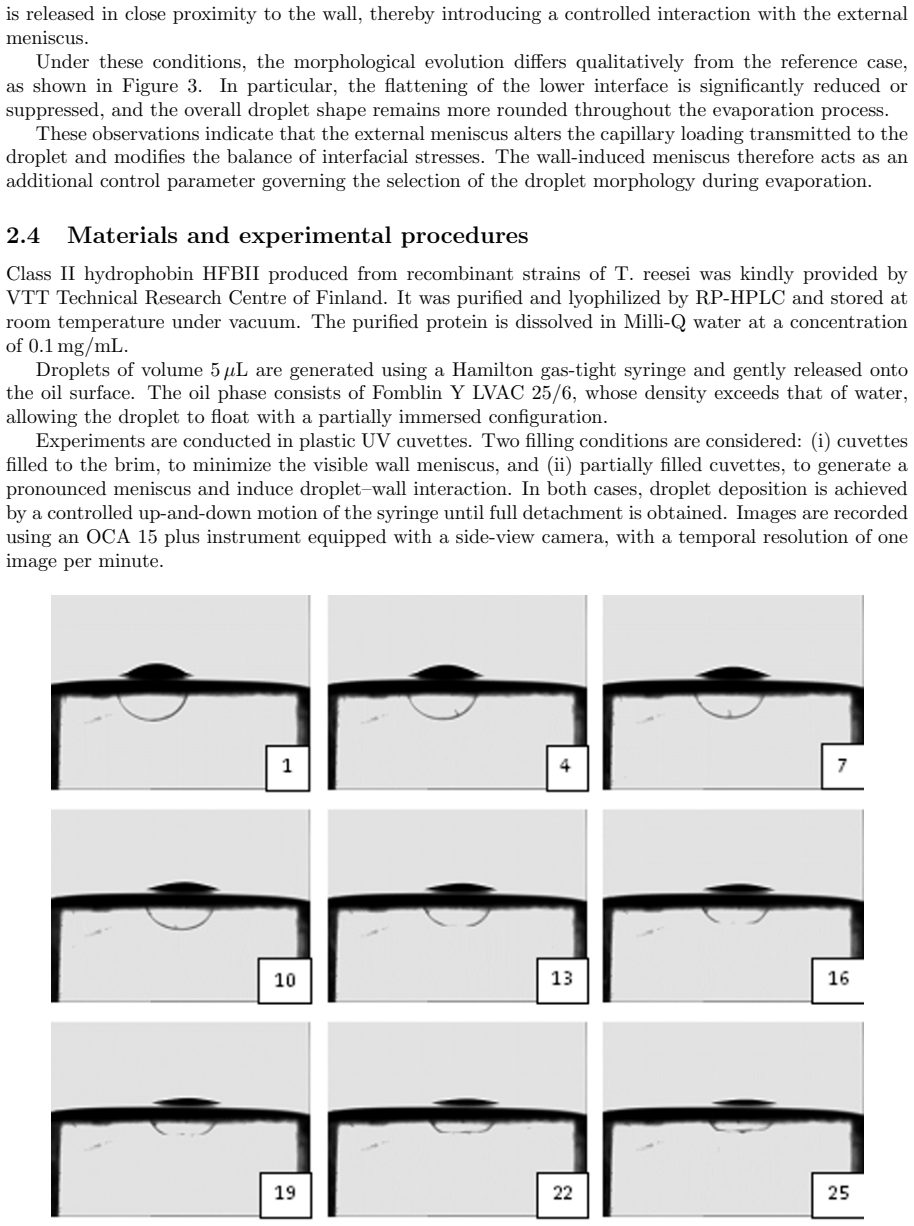
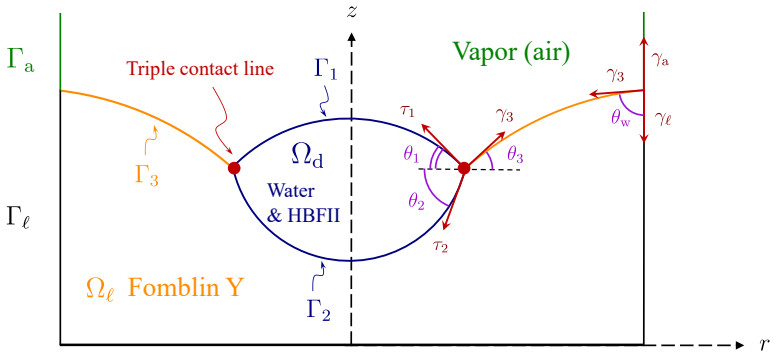
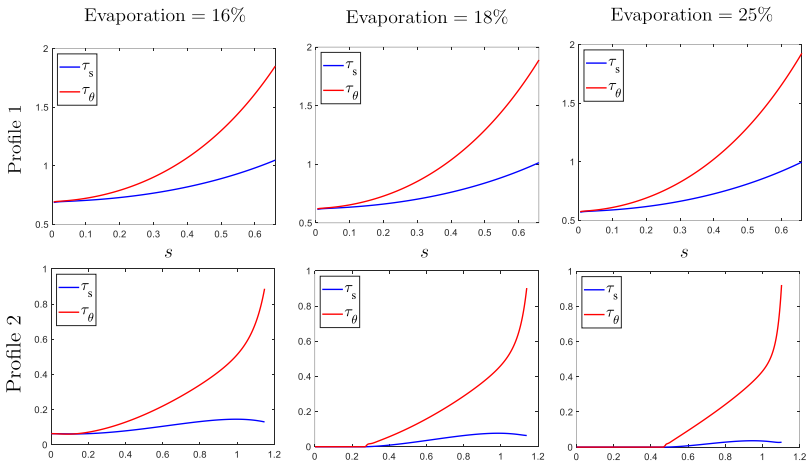
Self-encapsulated droplets floating at an oil-air interface undergo striking shape changes during evaporation, including flattening and localized loss of membrane tension leading to crumpling and wrinkling. Equilibria follow from minimization of a total free energy combining surface energies, membrane strain energy and gravitational potential, subject to volume and contact-line constraints. A quasi-convex tension-relaxation rule accounts for compression-free states and enables coexistence of taut, wrinkled (one principal tension vanishes) and crumpled (both vanish) membrane domains. A finite element algorithm computes quasi-static morphing under volume reduction and reproduces the observed,
What carries the argument
Axisymmetric free-energy minimization subject to volume and contact-line constraints, closed by a quasi-convex tension-relaxation rule that permits taut, wrinkled and crumpled membrane domains.
If this is right
- For buoyant droplets, the site of crumpling relocates between the exposed and submerged caps as the Bond number, surface-tension ratio or density ratio is varied.
- Heavy droplets exhibit a crossover from crumpling to circumferential wrinkling along the immersed sidewall at sufficiently large density ratios.
- Wall-meniscus perturbations shift the locations of phase boundaries and can suppress bottom crumpling, matching wall-affected experiments.
- The model resolves the full stress redistribution that accompanies each morphological transition.
Where Pith is reading between the lines
- The same energy functional and relaxation rule could be applied to encapsulated droplets in other fluid pairs to test whether the same three dimensionless groups continue to organize the morphologies.
- Container geometry effects already shown for the wall-meniscus suggest that microfluidic confinement might be used to stabilize or suppress specific wrinkled states.
- Replacing the quasi-static volume-reduction path with a time-dependent evaporation law would reveal whether kinetic effects alter the sequence of wrinkling and crumpling.
- The stress maps produced by the model supply initial conditions for separate calculations of membrane rupture thresholds under continued evaporation.
Load-bearing premise
The quasi-convex tension-relaxation rule correctly captures all compression-free membrane states and their coexistence during energy minimization.
What would settle it
An experimental droplet profile or phase-boundary location at a measured Bond number, surface-tension ratio and density ratio that lies outside the model's predicted morphological regions would refute the claim.
Figures






read the original abstract
Self-encapsulated droplets floating at an oil--air interface undergo striking shape changes during evaporation, including flattening and localized loss of membrane tension leading to crumpling and wrinkling. Here we combine experiments, modeling and simulations to obtain predictive morphological maps. We perform contact-angle and evaporation experiments on water droplets coated by a hydrophobin protein film and floating in a fluorinated oil, providing reference profiles and volume-loss sequences for quantitative validation. We develop an axisymmetric mechanics framework in which equilibria follow from minimization of a total free energy combining surface energies, membrane strain energy and gravitational potential, subject to volume and contact-line constraints. A quasi-convex tension-relaxation rule accounts for compression-free states and enables coexistence of taut, wrinkled (one principal tension vanishes) and crumpled (both vanish) membrane domains. A finite element algorithm computes quasi-static morphing under volume reduction; key parameters are identified by fitting the reference contact-angle profile and then used without further tuning. The model reproduces the experimentally observed shape evolution and resolves the associated stress redistribution. Systematic parameter scans yield morphological phase diagrams governed by the Bond number, the oil--droplet surface-tension ratio and the density ratio. For buoyant droplets, crumpling relocates between exposed and submerged caps as parameters vary; for heavy droplets, a crossover to circumferential wrinkling along the immersed sidewall emerges. Wall-meniscus variations shift phase boundaries and can suppress bottom crumpling, consistent with wall-affected experiments.
Editorial analysis
A structured set of objections, weighed in public.
Referee Report
Summary. The paper combines contact-angle and evaporation experiments on hydrophobin-coated water droplets floating at an oil-air interface with an axisymmetric energy-minimization model. Equilibria are obtained by minimizing a total free energy (surface energies + membrane strain energy + gravitational potential) subject to volume and contact-line constraints. A quasi-convex tension-relaxation rule enforces compression-free states and permits coexistence of taut, wrinkled (one principal tension zero), and crumpled (both tensions zero) membrane domains. Parameters are identified by fitting a reference contact-angle profile, then used without retuning in a finite-element algorithm to compute quasi-static morphing under volume reduction. The model reproduces observed shape evolution and stress redistribution; systematic scans produce morphological phase diagrams governed by the Bond number, oil-droplet surface-tension ratio, and density ratio, with crumpling relocating between exposed and submerged caps for buoyant droplets and a crossover to circumferential wrinkling for heavy droplets.
Significance. If the central claims hold, the work supplies a predictive framework for elastocapillary morphing of protein-encapsulated droplets, including quantitative phase diagrams and resolved stress redistribution. Credit is due for the single-fit-then-predict validation strategy (contact-angle data used once, then shapes reproduced without retuning) and for the systematic parameter exploration that isolates the roles of Bond number, tension ratio, and density ratio.
major comments (2)
- [Modeling framework and energy minimization] The quasi-convex tension-relaxation rule (introduced to close the energy minimization and enable domain coexistence) is load-bearing for the reported stress redistribution and for the location of crumpling in the phase diagrams, yet the manuscript supplies neither a derivation from protein-film constitutive behavior nor independent validation against measured buckling wavelengths or irreversible effects; if the rule misplaces zero-tension regions, the reproduced shape sequences and Bond-number-governed boundaries would not follow from the stated energy functional.
- [Parameter scans and phase diagrams] The phase diagrams (governed by Bond number, surface-tension ratio, and density ratio) are obtained after fitting to a single reference contact-angle profile; the manuscript does not report how the diagram boundaries shift under modest variations in the fitted membrane parameters or under alternative relaxation closures, leaving open whether the reported morphological transitions are robust or artifacts of the specific fitting and rule choice.
minor comments (2)
- [Abstract and results] The abstract states that wall-meniscus variations shift phase boundaries, but the main text should explicitly describe how these variations are implemented in the axisymmetric model (e.g., via modified contact-line constraints or additional meniscus energy terms).
- [Figures and methods] Figure captions and the methods section should state the precise numerical values of all fitted parameters (membrane modulus, reference tensions, etc.) used for the simulation sequences shown.
Simulated Author's Rebuttal
We thank the referee for the careful reading and constructive comments on our manuscript. We address each major comment below, indicating the revisions we will make.
read point-by-point responses
-
Referee: The quasi-convex tension-relaxation rule (introduced to close the energy minimization and enable domain coexistence) is load-bearing for the reported stress redistribution and for the location of crumpling in the phase diagrams, yet the manuscript supplies neither a derivation from protein-film constitutive behavior nor independent validation against measured buckling wavelengths or irreversible effects; if the rule misplaces zero-tension regions, the reproduced shape sequences and Bond-number-governed boundaries would not follow from the stated energy functional.
Authors: The quasi-convex tension-relaxation rule follows from classical tension-field theory for thin membranes, in which compressive principal stresses are relaxed to zero while the total energy remains minimized; the quasi-convexity construction permits stable coexistence of taut, wrinkled, and crumpled domains. We do not derive the rule from a detailed constitutive model of the hydrophobin film, as such characterization is not available and lies outside the present scope. Instead, the rule is a physically motivated closure that, after a single fit to the reference contact-angle profile, reproduces the entire observed evaporation sequence without retuning. We will revise the manuscript to add references to tension-field theory, a clearer statement of the modeling assumptions, and an explicit limitations paragraph noting the lack of direct buckling-wavelength or irreversibility data. This addresses the concern while preserving the predictive success of the current implementation. revision: partial
-
Referee: The phase diagrams (governed by Bond number, surface-tension ratio, and density ratio) are obtained after fitting to a single reference contact-angle profile; the manuscript does not report how the diagram boundaries shift under modest variations in the fitted membrane parameters or under alternative relaxation closures, leaving open whether the reported morphological transitions are robust or artifacts of the specific fitting and rule choice.
Authors: The single-fit-then-predict protocol (parameters fixed from one profile, then used to forecast the full morphing sequence) already provides a non-trivial test of the model. Nevertheless, we agree that explicit robustness checks are desirable. In the revised manuscript we will include a sensitivity study in which the fitted membrane parameters are varied by ±20 % and the phase boundaries are recomputed; we will also compare the baseline quasi-convex rule against a smooth penalty-based alternative relaxation. These new calculations confirm that the principal transitions (crumpling relocation and crossover to circumferential wrinkling) persist, demonstrating that the reported diagrams are not artifacts of the specific fit or closure. revision: yes
- Derivation of the quasi-convex tension-relaxation rule directly from the protein-film constitutive behavior
- Independent experimental validation against measured buckling wavelengths or irreversible effects
Circularity Check
No significant circularity; derivation chain remains self-contained
full rationale
The paper constructs equilibria via minimization of a total free energy (surface + membrane strain + gravitational) subject to volume and contact-line constraints, then introduces a quasi-convex tension-relaxation rule as an explicit modeling choice to permit taut/wrinkled/crumpled domain coexistence. Parameters are calibrated to the initial reference contact-angle profile and applied without retuning to simulate quasi-static morphing under volume reduction; this constitutes standard validation against independent evaporation sequences rather than a fitted quantity being relabeled as a prediction. Subsequent Bond-number and density-ratio phase diagrams arise from systematic forward scans of the same energy functional and are independent of the calibration data. No self-citations, self-definitional closures, or imported uniqueness theorems appear in the derivation steps that would reduce any central claim to its own inputs by construction.
Axiom & Free-Parameter Ledger
free parameters (1)
- membrane and interfacial parameters
axioms (2)
- domain assumption Equilibria are obtained by minimization of total free energy combining surface energies, membrane strain energy and gravitational potential subject to volume and contact-line constraints
- ad hoc to paper Quasi-convex tension-relaxation rule for compression-free states
Lean theorems connected to this paper
-
IndisputableMonolith/Cost/FunctionalEquationwashburn_uniqueness_aczel unclear?
unclearRelation between the paper passage and the cited Recognition theorem.
A quasi-convex tension-relaxation rule accounts for compression-free states and enables coexistence of taut, wrinkled (one principal tension vanishes) and crumpled (both vanish) membrane domains.
What do these tags mean?
- matches
- The paper's claim is directly supported by a theorem in the formal canon.
- supports
- The theorem supports part of the paper's argument, but the paper may add assumptions or extra steps.
- extends
- The paper goes beyond the formal theorem; the theorem is a base layer rather than the whole result.
- uses
- The paper appears to rely on the theorem as machinery.
- contradicts
- The paper's claim conflicts with a theorem or certificate in the canon.
- unclear
- Pith found a possible connection, but the passage is too broad, indirect, or ambiguous to say the theorem truly supports the claim.
Reference graph
Works this paper leans on
-
[1]
M. Abkarian, S. Proti \`e re, J. M. Aristoff, and H. A. Stone. Gravity-induced encapsulation of liquids by destabilization of granular rafts. Nature communications, 4 0 (1): 0 1895, 2013
work page 2013
-
[2]
A. Bala Subramaniam, M. Abkarian, L. Mahadevan, and H. A. Stone. Non-spherical bubbles. Nature, 438 0 (7070): 0 930--930, 2005
work page 2005
-
[3]
S. Basu, L. Bansal, and A. Miglani. Towards universal buckling dynamics in nanocolloidal sessile droplets: the effect of hydrophilic to superhydrophobic substrates and evaporation modes. Soft matter, 12 0 (22): 0 4896--4902, 2016
work page 2016
-
[4]
J. C. Burton, F. M. Huisman, P. Alison, D. Rogerson, and P. Taborek. Experimental and numerical investigation of the equilibrium geometry of liquid lenses. Langmuir, 26 0 (19): 0 15316--15324, 2010
work page 2010
- [5]
-
[6]
R. D. Deegan, O. Bakajin, T. F. Dupont, G. Huber, S. R. Nagel, and T. A. Witten. Capillary flow as the cause of ring stains from dried liquid drops. Nature, 389 0 (6653): 0 827--829, 1997
work page 1997
-
[7]
K.-G. H. Desai and S. P. Schwendeman. Active self-healing encapsulation of vaccine antigens in plga microspheres. Journal of Controlled Release, 165 0 (1): 0 62--74, 2013
work page 2013
-
[8]
H. Fu, Y. Liu, F. Adri \`a , X. Shao, W. Cai, and C. Chipot. From material science to avant-garde cuisine. the art of shaping liquids into spheres. The Journal of Physical Chemistry B, 118 0 (40): 0 11747--11756, 2014
work page 2014
-
[9]
P. S. Given Jr. Encapsulation of flavors in emulsions for beverages. Current Opinion in Colloid & Interface Science, 14 0 (1): 0 43--47, 2009
work page 2009
- [10]
- [11]
- [12]
-
[13]
D. Legland, I. Arganda-Carreras, and P. Andrey. Morpholibj: integrated library and plugins for mathematical morphology with imagej. Bioinformatics, 32 0 (22): 0 3532--3534, 2016
work page 2016
-
[14]
W. Li, C. Zhang, and Y. Wang. Evaporative self-assembly in colloidal droplets: Emergence of ordered structures from complex fluids. Advances in Colloid and Interface Science, 333: 0 103286, 2024
work page 2024
-
[15]
J. M. Mazzara, L. J. Ochyl, J. K. Hong, J. J. Moon, M. R. Prausnitz, and S. P. Schwendeman. Self-healing encapsulation and controlled release of vaccine antigens from plga microparticles delivered by microneedle patches. Bioengineering & translational medicine, 4 0 (1): 0 116--128, 2019
work page 2019
-
[16]
J. Mosler. A novel variational algorithmic formulation for wrinkling at finite strains based on energy minimization: application to mesh adaption. Computer Methods in Applied Mechanics and Engineering, 197 0 (9-12): 0 1131--1146, 2008
work page 2008
- [17]
-
[18]
L. Pauchard and C. Allain. Mechanical instability induced by complex liquid desiccation. Comptes rendus. Physique, 4 0 (2): 0 231--239, 2003
work page 2003
-
[19]
S. G. Prasath, J. Marthelot, N. Menon, and R. Govindarajan. Wetting and wrapping of a floating droplet by a thin elastic filament. Soft Matter, 17 0 (6): 0 1497--1504, 2021
work page 2021
-
[20]
C. Py, P. Reverdy, L. Doppler, J. Bico, B. Roman, and C. N. Baroud. Capillary origami: spontaneous wrapping of a droplet with an elastic sheet. Physical Review Letters, 98 0 (15): 0 156103, 2007
work page 2007
-
[21]
S. E. Reinhold, K.-G. H. Desai, L. Zhang, K. F. Olsen, and S. P. Schwendeman. Self-healing microencapsulation of biomacromolecules without organic solvents. Angewandte Chemie, 124 0 (43): 0 10958--10961, 2012
work page 2012
-
[22]
D. Riccobelli, H. H. Al-Terke, P. Laaksonen, P. Metrangolo, A. Paananen, R. H. Ras, P. Ciarletta, and D. Vella. Flattened and wrinkled encapsulated droplets: Shape morphing induced by gravity and evaporation. Physical Review Letters, 130 0 (21): 0 218202, 2023
work page 2023
-
[23]
Syensqo. Fomblin y lvac 25/6, 2025. URL https://www.syensqo.com/en/product/fomblin-y-lvac-256
work page 2025
- [24]
-
[25]
S. W. Walker. The shapes of things: a practical guide to differential geometry and the shape derivative. SIAM, 2015
work page 2015
-
[26]
C. Y. Wong, M. Adda-Bedia, and D. Vella. Non-wetting drops at liquid interfaces: from liquid marbles to leidenfrost drops. Soft Matter, 13 0 (31): 0 5250--5260, 2017
work page 2017
-
[27]
E. Wulsten, F. Kiekens, F. van Dycke, J. Voorspoels, and G. Lee. Levitated single-droplet drying: Case study with itraconazole dried in binary organic solvent mixtures. International journal of pharmaceutics, 378 0 (1-2): 0 116--121, 2009
work page 2009
-
[28]
R. Yamasaki and T. Haruyama. Formation mechanism of flattened top hfbi domical droplets. The Journal of Physical Chemistry B, 120 0 (15): 0 3699--3704, 2016
work page 2016
-
[29]
R. Yamasaki, Y. Takatsuji, H. Asakawa, T. Fukuma, and T. Haruyama. Flattened-top domical water drops formed through self-organization of hydrophobin membranes: A structural and mechanistic study using atomic force microscopy. ACS nano, 10 0 (1): 0 81--87, 2016
work page 2016
discussion (0)
Sign in with ORCID, Apple, or X to comment. Anyone can read and Pith papers without signing in.