Recognition: no theorem link
Limits of Stable Near-Field Probing in Nanophotonic Traps
Pith reviewed 2026-05-11 02:33 UTC · model grok-4.3
The pith
Near-field probing of trapped atoms is inherently transient because probe light heats them and reduces their coupling.
A machine-rendered reading of the paper's core claim, the machinery that carries it, and where it could break.
Core claim
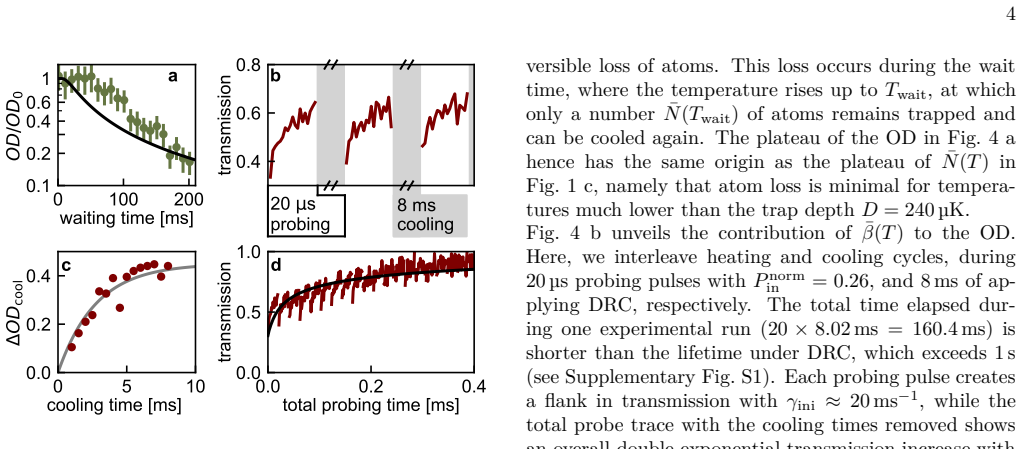
We experimentally demonstrate that this effect renders optical probing of trapped particles with near fields an inherently transient process. Specifically, we trap cold atoms in a two-color dipole trap surrounding an optical nanofiber and probe them with the evanescent field of guided, resonant light. The scattering of this probe light heats up the atoms, leading to a decrease of the coupling strength as well as loss of atoms. We observe both effects via a concurrent decrease of the absorption signal. In addition, we demonstrate that the coupling strength can be recovered by cooling the atoms back to their initial temperature.
What carries the argument
Temperature-dependent position spread that lowers mean near-field coupling strength
If this is right
- Absorption signals from resonant near-field probes decrease over time as atoms heat and spread.
- Atoms are lost from the trap during prolonged near-field exposure.
- Coupling strength returns to its initial value once the atoms are recooled.
- Any application requiring long-term stable coupling must either limit probe duration or actively manage temperature.
Where Pith is reading between the lines
- Similar transient behavior is likely whenever trapped particles interface with strongly position-dependent fields, such as in other waveguide or photonic-crystal geometries.
- Pulsed probing interleaved with cooling intervals could extend the usable interaction time without changing the trap design.
- Designs that integrate local cooling or feedback on atom temperature would directly address the root cause of the instability.
Load-bearing premise
The drop in absorption signal is driven mainly by the heating-induced widening of the atoms' position distribution rather than by atom loss alone.
What would settle it
Continuous cooling applied during probing keeps the absorption signal constant over the same time interval.
Figures


read the original abstract
Near-fields around nanophotonic structures and waveguides can be used to optically interface particles ranging from atoms and molecules to microscopic biological and synthetic particles. Due to the strong, non-linear dependence of the near-field coupling strength on the particles' position, a change of the spread of the particles' position will change their mean coupling strength. When the particles are trapped, this position spread depends on their temperature, generally leading to temperature-dependent coupling. Here, we experimentally demonstrate that this effect renders optical probing of trapped particles with near fields an inherently transient process. Specifically, we trap cold atoms in a two-color dipole trap surrounding an optical nanofiber and probe them with the evanescent field of guided, resonant light. The scattering of this probe light heats up the atoms, leading to a decrease of the coupling strength as well as loss of atoms. We observe both effects via a concurrent decrease of the absorption signal. In addition, we demonstrate that the coupling strength can be recovered by cooling the atoms back to their initial temperature. Our findings are relevant for numerous situations where stable coupling of trapped particles to a nanophotonic structure is required.
Editorial analysis
A structured set of objections, weighed in public.
Referee Report
Summary. The paper claims that near-field optical probing of trapped particles is inherently transient because resonant probe scattering heats the particles, increasing their position spread and thereby reducing their average coupling strength to the evanescent field. Using cold atoms in a two-color dipole trap around an optical nanofiber, the authors probe with guided resonant light, observe a concurrent decrease in absorption signal from both heating-induced coupling reduction and atom loss, and demonstrate partial recovery of the signal upon recooling the atoms to their initial temperature.
Significance. If the central attribution holds, the result identifies a fundamental limitation for stable nanophotonic interfaces with trapped particles, with relevance to atom-photon coupling, molecular trapping, and related nanophotonic applications. The experimental observation of signal recovery upon recooling provides direct evidence that at least part of the effect is reversible and temperature-dependent rather than purely irreversible loss.
major comments (1)
- [Experimental results and discussion (as described in abstract)] The central claim that the process is 'inherently transient' due to temperature-dependent position spread requires quantifying the relative contributions of reversible coupling reduction versus irreversible atom loss. The abstract notes both effects and partial recovery upon recooling, but without an explicit rate-equation model (incorporating measured heating rates, trap frequencies, and Boltzmann-averaged overlap with the evanescent field) or independent thermometry, the partitioning of the absorption drop (∝ N × coupling) cannot be determined. This is load-bearing for the 'inherently transient due to this effect' conclusion.
minor comments (1)
- [Abstract] The abstract would benefit from a brief statement of the observed fractional recovery (e.g., percentage of signal restored) to allow readers to gauge the reversible component immediately.
Simulated Author's Rebuttal
We thank the referee for their careful reading and constructive feedback, which highlights an important aspect of our central claim. We address the major comment below and will revise the manuscript accordingly to strengthen the quantitative support for our conclusions.
read point-by-point responses
-
Referee: The central claim that the process is 'inherently transient' due to temperature-dependent position spread requires quantifying the relative contributions of reversible coupling reduction versus irreversible atom loss. The abstract notes both effects and partial recovery upon recooling, but without an explicit rate-equation model (incorporating measured heating rates, trap frequencies, and Boltzmann-averaged overlap with the evanescent field) or independent thermometry, the partitioning of the absorption drop (∝ N × coupling) cannot be determined. This is load-bearing for the 'inherently transient due to this effect' conclusion.
Authors: We agree that an explicit quantitative partitioning would strengthen the attribution of the transient behavior to the temperature-dependent coupling reduction. Our current manuscript demonstrates both reversible (heating-induced position spread) and irreversible (atom loss) contributions through the observed absorption decrease and the partial signal recovery upon recooling, which directly evidences the temperature dependence. However, we acknowledge that without a model, the relative weights remain qualitative. In the revised version, we will add a rate-equation model that incorporates our measured heating rates from resonant scattering, the known trap frequencies of the two-color dipole trap, and a Boltzmann-averaged overlap integral between the atomic position distribution and the evanescent field intensity. This will allow estimation of the fractional contribution of coupling reduction versus loss to the absorption signal drop. We note that independent thermometry is not available in the present setup, but the model combined with the recooling recovery data will provide the requested partitioning and reinforce that the heating-induced effect renders stable near-field probing inherently transient. revision: yes
Circularity Check
No significant circularity: direct experimental observation without derivation chain
full rationale
The paper reports an experimental demonstration of heating and signal decay in near-field probing of trapped atoms, with observations of absorption decrease and partial recovery upon recooling. No load-bearing mathematical derivation, fitted-parameter prediction, or self-citation chain is present that reduces the central claim to its inputs by construction. The result rests on direct measurements rather than equations or prior author work that would create circularity.
Axiom & Free-Parameter Ledger
axioms (2)
- domain assumption The near-field coupling strength depends non-linearly on particle position.
- domain assumption Trapped particles' position spread depends on their temperature.
Forward citations
Cited by 1 Pith paper
-
$\Lambda$-enhanced gray-molasses loading and EIT cooling of neutral atoms in nanophotonic traps
Lambda-enhanced gray-molasses loading yields a six-fold increase in trapped cesium atoms and EIT cooling extends storage time five-fold in nanophotonic nanofiber traps.
Reference graph
Works this paper leans on
-
[1]
C. R. Taitt, G. P. Anderson, and F. S. Ligler, Evanes- cent wave fluorescence biosensors: Advances of the last decade, Biosensors and Bioelectronics76, 103 (2016), 30th Anniversary Issue
work page 2016
-
[2]
N. Toropov, G. Cabello, M. P. Serrano, R. R. Gutha, M. Rafti, and F. Vollmer, Review of biosensing with whispering-gallery mode lasers, Light: Science & Appli- cations10, 42 (2021)
work page 2021
-
[3]
K. N. Fish, Total internal reflection fluorescence (TIRF) microscopy, Curr Protoc.2, 517 (2022)
work page 2022
-
[4]
P. P. Kamath, S. Sil, V. G. Truong, and S. N. Chor- maic, Particle trapping with optical nanofibers: a review, Biomed. Opt. Express14, 6172 (2023)
work page 2023
-
[5]
J. Wu, W. Liu, and T. Ngai, Total internal reflection mi- croscopy: a powerful tool for exploring interactions and dynamics near interfaces, Soft Matter19, 4611 (2023)
work page 2023
- [6]
-
[7]
J. O. Arroyo and P. Kukura, Non-fluorescent schemes for single-molecule detection, imaging and spectroscopy, Nature Photonics10, 11 (2016)
work page 2016
-
[8]
D. Rychtarik, B. Engeser, H.-C. Nägerl, and R. Grimm, Two-dimensional bose-einstein condensate in an optical surface trap, Phys. Rev. Lett.92, 173003 (2004)
work page 2004
- [9]
-
[10]
T. Aoki, B. Dayan, E. Wilcut, W. P. Bowen, A. S. Parkins, T. J. Kippenberg, K. J. Vahala, and H. J. Kimble, Observation of strong coupling between one atom and a monolithic microresonator, Nature443, 671 (2006)
work page 2006
-
[11]
K. Hakuta and K. P. Nayak, Manipulating single atoms and photons using optical nanofibers, Advances in Natu- ral Sciences: Nanoscience and Nanotechnology3, 015005 (2012)
work page 2012
-
[12]
X. Zhou, H. Tamura, T.-H. Chang, and C.-L. Hung, Trapped atoms and superradiance on an integrated nanophotonic microring circuit, Phys. Rev. X14, 031004 (2024)
work page 2024
-
[13]
A. Bouscal, M. Kemiche, S. Mahapatra, N. Fayard, J. Berroir, T. Ray, J.-J. Greffet, F. Raineri, A. Leven- son, K. Bencheikh, C. Sauvan, A. Urvoy, and J. Lau- rat, Systematic design of a robust half-w1 photonic crys- tal waveguide for interfacing slow light and trapped cold atoms, New Journal of Physics26, 023026 (2024)
work page 2024
- [14]
-
[15]
M. Lee, H. Hong, J. Yu, F. Mujid, A. Ye, C. Liang, and J. Park, Wafer-scaleδwaveguides for integrated two- dimensional photonics, Science381, 648 (2023)
work page 2023
-
[16]
K. P. Nayak, M. Sadgrove, R. Yalla, F. L. Kien, and K. Hakuta,Nanofiberquantumphotonics, Journal ofOp- tics20, 073001 (2018)
work page 2018
-
[17]
G. Anetsberger, O. Arcizet, Q. P. Unterreithmeier, R. Rivière, E. M. Schliesser, A. Weig, J. P. Kotthaus, and T. J. Kippenberg, Near-field cavity optomechanics with nanomechanical oscillators, Nature Physics5, 909 (2009)
work page 2009
- [18]
- [19]
- [20]
-
[21]
D. Suárez-Forero, M. Jalali Mehrabad, C. Vega, A. González-Tudela, and M. Hafezi, Chiral quantum op- tics: Recent developments and future directions, PRX Quantum6, 020101 (2025)
work page 2025
-
[22]
N. V. Corzo, B. Gouraud, A. Chandra, A. Goban, A. S. Sheremet, D. V. Kupriyanov, and J. Laurat, Large bragg reflection from one-dimensional chains of trapped atoms nearananoscalewaveguide,Phys.Rev.Lett.117,133603 (2016)
work page 2016
-
[23]
H. L. Sørensen, J.-B. Béguin, K. W. Kluge, I. Iakoupov, A. S. Sørensen, J. H. Müller, E. S. Polzik, and J. Ap- pel, Coherent backscattering of light off one-dimensional atomic strings, Phys. Rev. Lett.117, 133604 (2016)
work page 2016
- [24]
-
[25]
H. S. Han, A. Lee, K. Sinha, F. K. Fatemi, and S. L. Rol- ston, Observation of vacuum-induced collective quantum beats, Phys. Rev. Lett.127, 073604 (2021)
work page 2021
- [26]
-
[27]
Rauschenbeutel, Emergence of second-order coher- ence in superfluorescence, Phys
C.Bach, F.Tebbenjohanns, C.Liedl, P.Schneeweiss,and A. Rauschenbeutel, Emergence of second-order coher- ence in superfluorescence, Phys. Rev. Lett.136, 063402 (2026)
work page 2026
-
[28]
B. Gouraud, D. Maxein, A. Nicolas, O. Morin, and J. Laurat, Demonstration of a memory for tightly guided light in an optical nanofiber, Phys. Rev. Lett.114, 180503 (2015)
work page 2015
- [29]
-
[30]
N. V. Corzo, J. Raskop, A. Chandra, A. S. Sheremet, B. Gouraud, and J. Laurat, Waveguide-coupled single collective excitation of atomic arrays, Nature566, 359 (2019)
work page 2019
-
[31]
C. Østfeldt, J.-B. S. Béguin, F. T. Pedersen, E. S. Polzik, J. H. Müller, and J. Appel, Dipole force free optical con- trol and cooling of nanofiber trapped atoms, Opt. Lett. 42, 4315 (2017)
work page 2017
-
[32]
S. B. Markussen, J. Appel, C. Østfeldt, J.-B. S. Béguin, E. S. Polzik, and J. H. Müller, Measurement and sim- ulation of atomic motion in nanoscale optical trapping potentials, Applied Physics B126, 73 (2020)
work page 2020
-
[33]
T. D. Karanikolaou, R. J. Bettles, and D. E. Chang, Near-resonant light scattering by an atom in a state- dependent trap, New Journal of Physics26, 043005 (2024)
work page 2024
- [34]
- [35]
-
[36]
S. T. Dawkins, R. Mitsch, D. Reitz, E. Vetsch, and A. Rauschenbeutel, Dispersive optical interface based on nanofiber-trapped atoms, Phys. Rev. Lett.107, 243601 (2011)
work page 2011
- [37]
-
[38]
Y. Meng, A. Dareau, P. Schneeweiss, and A. Rauschen- beutel, Near-ground-state cooling of atoms optically trapped 300 nm away from a hot surface, Phys. Rev. X8, 031054 (2018)
work page 2018
-
[39]
P. M. Morse, Diatomic molecules according to the wave mechanics.ii.vibrationallevels,Phys.Rev.34,57(1929)
work page 1929
-
[40]
N. Schlosser, G. Reymond, and P. Grangier, Collisional blockade in microscopic optical dipole traps, Phys. Rev. Lett.89, 023005 (2002)
work page 2002
-
[41]
F. Le Kien, V. I. Balykin, and K. Hakuta, Atom trap and waveguide using a two-color evanescent light field around a subwavelength-diameter optical fiber, Phys. Rev. A70, 063403 (2004)
work page 2004
-
[42]
E. F. d. Lima and J. E. M. Hornos, Matrix elements for the morse potential under an external field, Journal of Physics B: Atomic, Molecular and Optical Physics38, 815 (2005)
work page 2005
-
[43]
F. Le Kien, P. Schneeweiss, and A. Rauschenbeutel, State-dependent potentials in a nanofiber-based two- color trap for cold atoms, Phys. Rev. A88, 033840 (2013)
work page 2013
-
[44]
M. Martinez-Dorantes, W. Alt, J. Gallego, S. Ghosh, L. Ratschbacher, and D. Meschede, State-dependent flu- orescence of neutral atoms in optical potentials, Phys. Rev. A97, 023410 (2018)
work page 2018
-
[45]
B. Albrecht, Y. Meng, C. Clausen, A. Dareau, P. Schneeweiss, and A. Rauschenbeutel, Fictitious magnetic-field gradients in optical microtraps as an ex- perimental tool for interrogating and manipulating cold atoms, Phys. Rev. A94, 061401 (2016)
work page 2016
- [46]
-
[47]
S. Mahmoodian, M. Čepulkovskis, S. Das, P. Lodahl, K. Hammerer, and A. S. Sørensen, Strongly correlated photon transport in waveguide quantum electrodynam- ics with weakly coupled emitters, Phys. Rev. Lett.121, 143601 (2018)
work page 2018
-
[48]
A. S. Prasad, J. Hinney, S. Mahmoodian, K. Hammerer, S. Rind, P. Schneeweiss, A. S. Sørensen, J. Volz, and A. Rauschenbeutel, Correlating photons using the collec- tive nonlinear response of atoms weakly coupled to an optical mode, Nature Photonics14, 719 (2020)
work page 2020
-
[49]
S. Scheel, S. Y. Buhmann, C. Clausen, and P. Schneeweiss, Directional spontaneous emission and lateral casimir-polder force on an atom close to a nanofiber, Phys. Rev. A92, 043819 (2015). 7 Supplemental Materials LIFETIMES IN THE NANOFIBER TRAPS To measure the lifetimes of atoms in the traps, we prepare ground-state-cooled atoms in the traps around the na...
work page 2015
discussion (0)
Sign in with ORCID, Apple, or X to comment. Anyone can read and Pith papers without signing in.