Recognition: no theorem link
J=0 metastable state of Th²⁺ for a hyperfine-free nuclear clock
Pith reviewed 2026-05-11 02:23 UTC · model grok-4.3
The pith
A J=0 metastable state in Th²⁺ is measured as a platform for a hyperfine-free nuclear clock with the ²²⁹Th transition.
A machine-rendered reading of the paper's core claim, the machinery that carries it, and where it could break.
Core claim
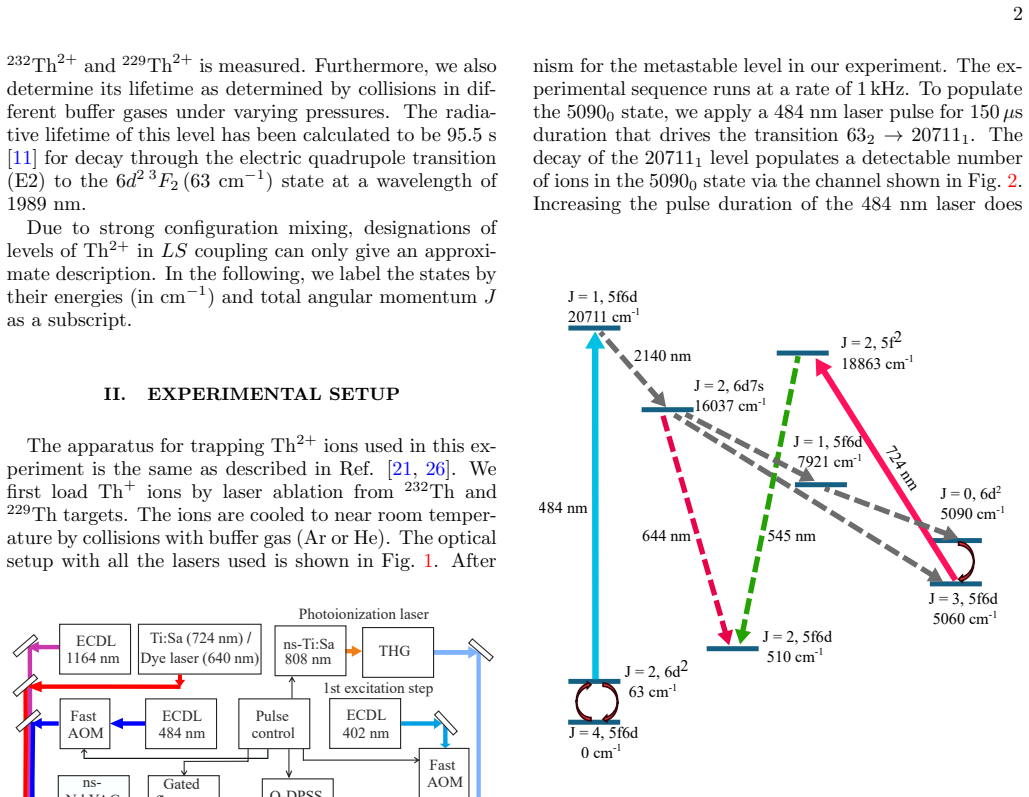
The 6d² ³P₀ state in Th²⁺, linked only by an electric-quadrupole transition to the nearby ³F₂ level, can be laser-populated and exhibits an isotope shift that quantifies electronic-nuclear charge overlap, thereby offering a route to excite the low-energy ²²⁹Th nuclear resonance without the dominant hyperfine interactions of the electron shell.
What carries the argument
The J=0 electronic metastable state 6d² ³P₀ at 5090 cm⁻¹, which removes hyperfine splitting and dipole radiation while permitting quadrupole access to a nearby level and direct driving of the nuclear transition.
If this is right
- The nuclear resonance can be excited independent of leading hyperfine structure.
- External-field shifts acting through the electron shell are strongly suppressed.
- State lifetime in vacuum is limited only by the nuclear transition rate or weaker processes.
- The measured isotope shift supplies a direct probe of nuclear charge distribution effects on the electronic levels.
Where Pith is reading between the lines
- A clock built on this state could reduce common-mode frequency noise that arises from electron-shell interactions in trapped-ion systems.
- Testing would require extending the trap vacuum to demonstrate that the observed collisional loss channel disappears while nuclear excitation remains possible.
- Similar J=0 metastable configurations in other heavy ions could be searched for analogous hyperfine-free nuclear-clock applications.
Load-bearing premise
Collisional mixing with the nearby ³G₃ level is the dominant loss mechanism and the state's lifetime will remain long enough in ultrahigh vacuum for practical nuclear-clock operation without other significant perturbations.
What would settle it
Observation of the ²²⁹Th nuclear transition driven from this J=0 state in ultrahigh vacuum, together with a measured lifetime long compared with the required interrogation time.
Figures


read the original abstract
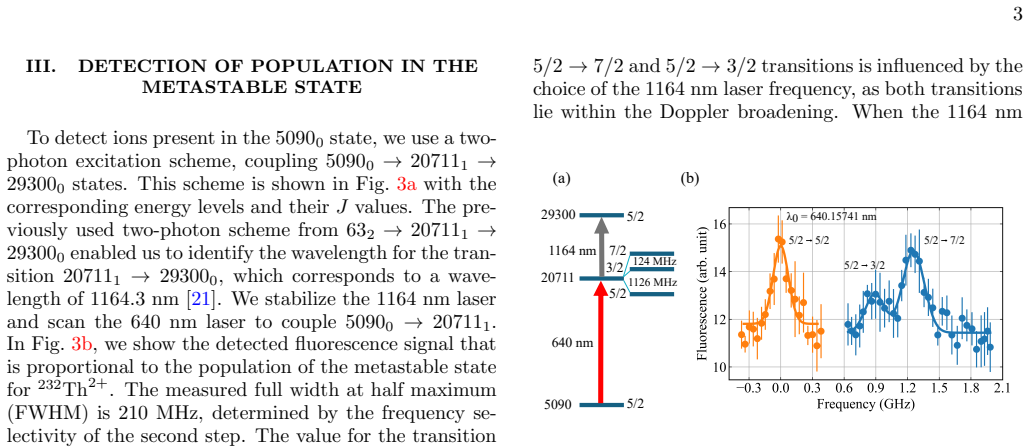
We present measurements on a metastable state in $\mathrm{Th}^{2+}$ with the electronic configuration $6d^2\,{}^3P_0\,(5090\ \mathrm{cm^{-1}})$. This is motivated by the prospect of using the state in laser excitation of the low-energy $^{229}$Th nuclear resonance independent from the leading hyperfine interactions. The $6d^2\,{}^3P_0$ state has no dipole-allowed radiative decay channel and is connected to the second ground state $6d^2\,{}^3F_2\,(63\ \mathrm{cm^{-1}})$ through an electric quadrupole transition only. We populate the state by laser excitation at 484~nm via a higher excited level and detect its population in laser-induced fluorescence. The isotope shift of the $J=0$ level between $^{232}\mathrm{Th}^{2+}$ and $^{229}\mathrm{Th}^{2+}$ is determined as a measure of the interaction of electronic and nuclear charge distributions. The lifetime of the level in our ion trap with buffer gas is limited by collisional mixing with the nearby state $5f6d\,{}^3G_3\,(5060\ \mathrm{cm^{-1}})$. In ultrahigh vacuum, it could serve as a hyperfine-free nuclear clock that is largely immune to field-induced frequency shifts via the electron shell.
Editorial analysis
A structured set of objections, weighed in public.
Referee Report
Summary. The manuscript reports laser excitation at 484 nm to populate the 6d² ³P₀ (J=0, 5090 cm⁻¹) metastable state in Th²⁺, followed by laser-induced fluorescence detection. It measures the isotope shift of this level between ²³²Th²⁺ and ²²⁹Th²⁺ and determines the state's lifetime in a buffer-gas ion trap, where it is limited by collisional mixing to the nearby 5f6d ³G₃ level at 5060 cm⁻¹. The authors conclude that in ultrahigh vacuum this state could enable a hyperfine-free nuclear clock using the ²²⁹Th resonance, largely immune to electron-shell field shifts.
Significance. The experimental demonstration of population and detection of a J=0 state in Th²⁺ supplies useful spectroscopic data, including the isotope shift, and correctly identifies the absence of dipole decay channels as a potential advantage for nuclear-clock applications. If the lifetime extrapolation and nuclear-transition accessibility hold, the work could contribute to clocks with reduced sensitivity to external fields; however, the manuscript provides no quantitative support for these extrapolations.
major comments (3)
- [Lifetime results section] Lifetime results section: the statement that the lifetime 'is limited by collisional mixing' with the 5f6d ³G₃ state is presented without pressure-dependent lifetime data or extracted rate coefficients, so the extrapolation to ultrahigh vacuum required for the clock claim cannot be verified.
- [Discussion of radiative decay] Discussion of radiative decay: no calculated electric-quadrupole (E2) matrix element or radiative rate between 6d² ³P₀ and 6d² ³F₂ is supplied, leaving the natural lifetime in the collision-free limit unknown.
- [Nuclear-clock proposal (abstract and conclusion)] Nuclear-clock proposal (abstract and conclusion): the claim that the state 'could serve as a hyperfine-free nuclear clock' is not accompanied by any estimate of the nuclear-transition matrix element, selection-rule analysis, or assessment of residual field sensitivities from this specific electronic state.
minor comments (2)
- [Abstract] Abstract: quantitative values for the measured lifetime and isotope shift are omitted, reducing the abstract's informativeness.
- [Notation] Notation: the energy difference between ³P₀ and ³G₃ is given only to the nearest 30 cm⁻¹; a more precise value or discussion of the mixing mechanism would aid reproducibility.
Simulated Author's Rebuttal
We thank the referee for the careful and constructive review of our manuscript. The comments have prompted us to clarify several points and to moderate the presentation of the clock proposal. We address each major comment below.
read point-by-point responses
-
Referee: [Lifetime results section] Lifetime results section: the statement that the lifetime 'is limited by collisional mixing' with the 5f6d ³G₃ state is presented without pressure-dependent lifetime data or extracted rate coefficients, so the extrapolation to ultrahigh vacuum required for the clock claim cannot be verified.
Authors: We agree that the identification of collisional mixing would be strengthened by pressure-dependent data and extracted rate coefficients, which are not reported in the present work. The inference is based on the 30 cm⁻¹ separation to the ³G₃ level and the known efficiency of such mixing in buffer-gas traps. In the revised manuscript we have changed the wording to 'appears limited by collisional mixing' and have explicitly stated that the measured lifetime applies to the buffer-gas environment. Any suggestion of a verified ultrahigh-vacuum lifetime has been removed; the clock application is now described as requiring further characterization in UHV. revision: partial
-
Referee: [Discussion of radiative decay] Discussion of radiative decay: no calculated electric-quadrupole (E2) matrix element or radiative rate between 6d² ³P₀ and 6d² ³F₂ is supplied, leaving the natural lifetime in the collision-free limit unknown.
Authors: We acknowledge that a quantitative E2 rate would allow a concrete estimate of the natural lifetime. Performing the required atomic-structure calculation lies outside the scope of this experimental study. We have added a short paragraph noting that the transition is strictly E2 (J=0 to J=2, no E1 channel) and referencing existing theoretical lifetime estimates for Th²⁺ levels of similar character, which indicate radiative lifetimes of seconds or longer. The revised text now states that the collision-free lifetime remains to be determined experimentally or by detailed theory. revision: partial
-
Referee: [Nuclear-clock proposal (abstract and conclusion)] Nuclear-clock proposal (abstract and conclusion): the claim that the state 'could serve as a hyperfine-free nuclear clock' is not accompanied by any estimate of the nuclear-transition matrix element, selection-rule analysis, or assessment of residual field sensitivities from this specific electronic state.
Authors: The manuscript's main result is the experimental population, detection, and isotope-shift measurement of the J=0 electronic state. The nuclear-clock suggestion rests on the fact that J=0 eliminates electronic hyperfine structure, thereby removing the dominant source of field-induced shifts for the nuclear transition. Detailed nuclear matrix-element calculations and a full sensitivity analysis require combined nuclear-electronic theory that is beyond the present scope. We have revised the abstract and conclusion to present the application as a promising direction that motivates further work, rather than as a demonstrated capability. revision: partial
Circularity Check
No circularity: purely experimental measurements with no derivation chain
full rationale
The paper reports experimental population of the 6d² ³P₀ state via 484 nm laser excitation, measurement of its isotope shift between ²³²Th²⁺ and ²²⁹Th²⁺, and determination that its lifetime in a buffer-gas trap is limited by collisional mixing to the nearby 5f6d ³G₃ level. No equations, fitted parameters, or predictions are presented that reduce by construction to the paper's own inputs. The forward-looking statement that the state 'could serve as a hyperfine-free nuclear clock' in ultrahigh vacuum is a qualitative suggestion resting on external assumptions about loss channels and nuclear coupling, not a derivation internal to the paper. Self-citations, if present, are not load-bearing for any claimed result.
Axiom & Free-Parameter Ledger
axioms (1)
- standard math Standard selection rules for electric quadrupole (E2) transitions and electronic configuration assignments in heavy ions.
Reference graph
Works this paper leans on
-
[1]
for decay through the electric quadrupole transition (E2) to the 6d 2 3 F2 (63 cm −1) state at a wavelength of 1989 nm. Due to strong configuration mixing, designations of levels of Th 2+ inLScoupling can only give an approxi- mate description. In the following, we label the states by their energies (in cm −1) and total angular momentumJ as a subscript. I...
work page 1989
-
[2]
and Th2+ as discussed here are cases where the lead- ing hyperfine interactions of the nucleus with the electron shell are minimized. 207111 632 484 nm 1×10 -2 s-1 Δ Nuclear clock transition 148 nm 640 nm 6d2,3P0 (Ig = 5/2+) 6d2,3P0 (Im = 3/2+) FIG. 7: Schematic of a hyperfine-free nuclear clock with Th2+. Here 484 nm and 640 nm lasers drive a coherent Ra...
- [3]
-
[4]
C. J. Campbell, A. G. Radnaev, A. Kuzmich, V. A. Dzuba, V. V. Flambaum, and A. Derevianko, Phys. Rev. Lett.108, 120802 (2012). 6
work page 2012
- [5]
- [6]
- [7]
-
[8]
T. Ooi, J. F. Doyle, C. Zhang, J. S. Higgins, J. Ye, K. Beeks, T. Sikorsky, and T. Schumm, Nature650, 72 (2026)
work page 2026
- [9]
- [10]
-
[11]
S. L. Redman, G. Nave, and C. J. Sansonetti, The As- trophysical Journal Supplement Series211, 4 (2014)
work page 2014
-
[12]
E. Bi´ emont, P. Palmeri, P. Quinet, Z. G. Zhang, and S. Svanberg, The Astrophysical Journal567, 1276 (2002)
work page 2002
-
[13]
M. S. Safronova, U. I. Safronova, and C. W. Clark, Phys. Rev. A90, 032512 (2014)
work page 2014
- [14]
-
[15]
C. J. Campbell, A. G. Radnaev, and A. Kuzmich, Phys. Rev. Lett.106, 223001 (2011)
work page 2011
-
[16]
C. J. Campbell, A. V. Steele, L. R. Churchill, M. V. De- Palatis, D. E. Naylor, D. N. Matsukevich, A. Kuzmich, and M. S. Chapman, Phys. Rev. Lett.102, 233004 (2009)
work page 2009
-
[17]
A. G. Radnaev, C. J. Campbell, and A. Kuzmich, Phys. Rev. A86, 060501 (2012)
work page 2012
-
[18]
U. I. Safronova, W. R. Johnson, and M. S. Safronova, Phys. Rev. A74, 042511 (2006)
work page 2006
-
[19]
M. S. Safronova, U. I. Safronova, and M. G. Kozlov, Phys. Rev. A97, 012511 (2018)
work page 2018
-
[20]
V. V. Flambaum, V. A. Dzuba, and E. Peik, Phys. Rev. A112, 023103 (2025)
work page 2025
- [21]
-
[22]
M. V. Okhapkin, D. M. Meier, E. Peik, M. S. Safronova, M. G. Kozlov, and S. G. Porsev, Phys. Rev. A92, 020503 (2015)
work page 2015
-
[23]
J. Thielking, M. V. Okhapkin, P. G lowacki, D. M. Meier, L. von der Wense, B. Seiferle, C. E. D¨ ullmann, P. G. Thirolf, and E. Peik, Nature556, 321 (2018)
work page 2018
-
[24]
A. Yamaguchi, Y. Shigekawa, H. Haba, H. Kikunaga, K. Shirasaki, M. Wada, and H. Katori, Nature629, 62 (2024)
work page 2024
- [25]
-
[26]
V. A. Dzuba and V. V. Flambaum, Phys. Rev. A111, 053109 (2025)
work page 2025
-
[27]
V. I. Yudin, A. V. Taichenachev, O. N. Prudnikov, M. Y. Basalaev, A. N. Goncharov, S. V. Chepurov, and V. G. Pal’chikov, JETP Letters121, 345 (2025)
work page 2025
-
[28]
O. A. Herrera-Sancho, M. V. Okhapkin, K. Zimmer- mann, C. Tamm, E. Peik, A. V. Taichenachev, V. I. Yudin, and P. G lowacki, Phys. Rev. A85, 033402 (2012)
work page 2012
-
[29]
O. A. Herrera-Sancho, N. Nemitz, M. V. Okhapkin, and E. Peik, Phys. Rev. A88, 012512 (2013)
work page 2013
-
[30]
P. Staanum, I. S. Jensen, R. G. Martinussen, D. Voigt, and M. Drewsen, Phys. Rev. A69, 032503 (2004)
work page 2004
-
[31]
M. Fan, C. A. Holliman, A. Contractor, C. Zhang, S. F. Gebretsadkan, and A. M. Jayich, Phys. Rev. A105, 042801 (2022)
work page 2022
-
[32]
B. A. Palmer and R. J. Engleman,Atlas of the thorium spectrum, Tech. Rep. (Los Alamos National Laboratory (LANL), Los Alamos, NM (United States), 1983)
work page 1983
-
[33]
J. E. Bjorkholm and P. F. Liao, Phys. Rev. A14, 751 (1976)
work page 1976
-
[34]
E. C. Cook, A. D. Vira, and W. D. Williams, Phys. Rev. A101, 042503 (2020)
work page 2020
-
[35]
M. S. Safronova, S. G. Porsev, M. G. Kozlov, J. Thielk- ing, M. V. Okhapkin, P. G lowacki, D. M. Meier, and E. Peik, Phys. Rev. Lett.121, 213001 (2018)
work page 2018
-
[36]
R. A. M¨ uller, A. V. Maiorova, S. Fritzsche, A. V. Volotka, R. Beerwerth, P. Glowacki, J. Thielking, D.-M. Meier, M. Okhapkin, E. Peik, and A. Surzhykov, Phys. Rev. A 98, 020503 (2018)
work page 2018
-
[37]
D. P. Moehs and D. A. Church, Phys. Rev. A58, 1111 (1998)
work page 1998
- [38]
-
[39]
Tr¨ abert, Atoms12, 10.3390/atoms12120073 (2024)
E. Tr¨ abert, Atoms12, 10.3390/atoms12120073 (2024)
-
[40]
M. A. Gearba, J. H. Wells, P. H. Rich, J. M. Wesemann, L. A. Zimmerman, B. M. Patterson, R. J. Knize, and J. F. Sell, Phys. Rev. A99, 022706 (2019)
work page 2019
-
[41]
M. Endo, H. Nagaoka, and F. Wani, Opt. Express29, 42887 (2021)
work page 2021
- [42]
-
[43]
D. Moritz, K. Scharl, M. Wiesinger, G. Holthoff, T. Teschler, M. I. Hussain, J. R. Crespo L´ opez-Urrutia, T. Dickel, S. Ding, C. E. D¨ ullmann, E. R. Hudson, S. Kraemer, L. L¨ obell, C. Mokry, J. Runke, B. Seiferle, L. von der Wense, F. Zacherl, and P. G. Thirolf, The European Physical Journal D79, 127 (2025)
work page 2025
- [44]
-
[45]
S. P. Carman, J. Rudolph, B. E. Garber, M. J. Van de Graaff, H. Swan, Y. Jiang, M. Nantel, M. Abe, R. L. Barcklay, and J. M. Hogan, Phys. Rev. X15, 031051 (2025)
work page 2025
- [46]
-
[47]
P. O. Schmidt, T. Rosenband, C. Langer, W. M. Itano, J. C. Bergquist, and D. J. Wineland, Science309, 749 (2005)
work page 2005
- [48]
-
[49]
Y. Shigekawa, A. Yamaguchi, K. Tokoi, N. Sato, H. Kiku- naga, K. Shirasaki, Y. Kasamatsu, M. Wada, and H. Haba, Nature Physics 10.1038/s41567-026-03251-1 (2026)
-
[50]
P. V. Bilous, H. Bekker, J. C. Berengut, B. Seiferle, L. von der Wense, P. G. Thirolf, T. Pfeifer, J. R. C. 7 L´ opez-Urrutia, and A. P´ alffy, Phys. Rev. Lett.124, 192502 (2020)
work page 2020
-
[51]
S. G. Porsev, C. Cheung, and M. S. Safronova, Quantum Science and Technology6, 034014 (2021)
work page 2021
-
[52]
F. F. Karpeshin, S. Wycech, I. M. Band, M. B. Trzhaskovskaya, M. Pf¨ utzner, and J.˙Zylicz, Phys. Rev. C57, 3085 (1998)
work page 1998
-
[53]
K. Pachucki, S. Wycech, J. ˙Zylicz, and M. Pf¨ utzner, Phys. Rev. C64, 064301 (2001)
work page 2001
discussion (0)
Sign in with ORCID, Apple, or X to comment. Anyone can read and Pith papers without signing in.