Recognition: 2 theorem links
· Lean TheoremPair creation as a source of longitudinal chiral magnetoconductivity
Pith reviewed 2026-05-11 02:22 UTC · model grok-4.3
The pith
Real electron-positron pair production induces axial charge nonconservation and generates an electric current parallel to the magnetic field without any external chiral chemical potential.
A machine-rendered reading of the paper's core claim, the machinery that carries it, and where it could break.
Core claim
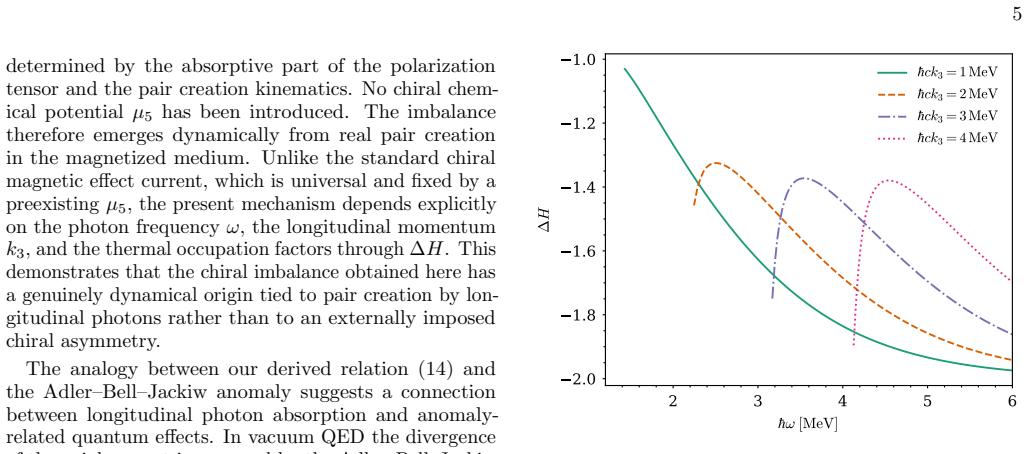
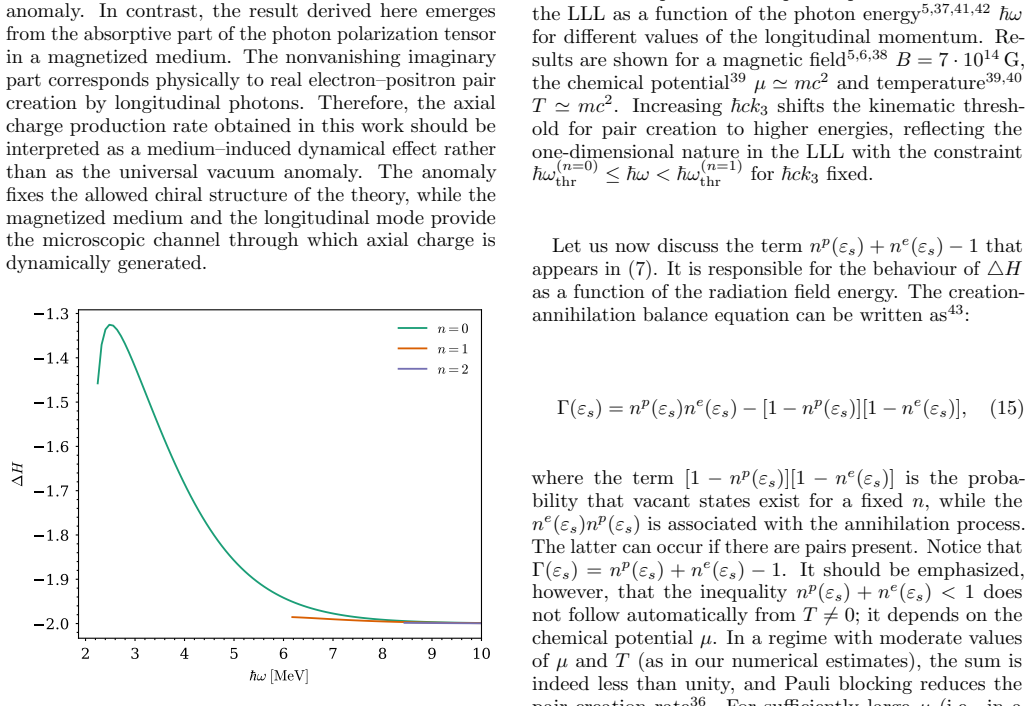
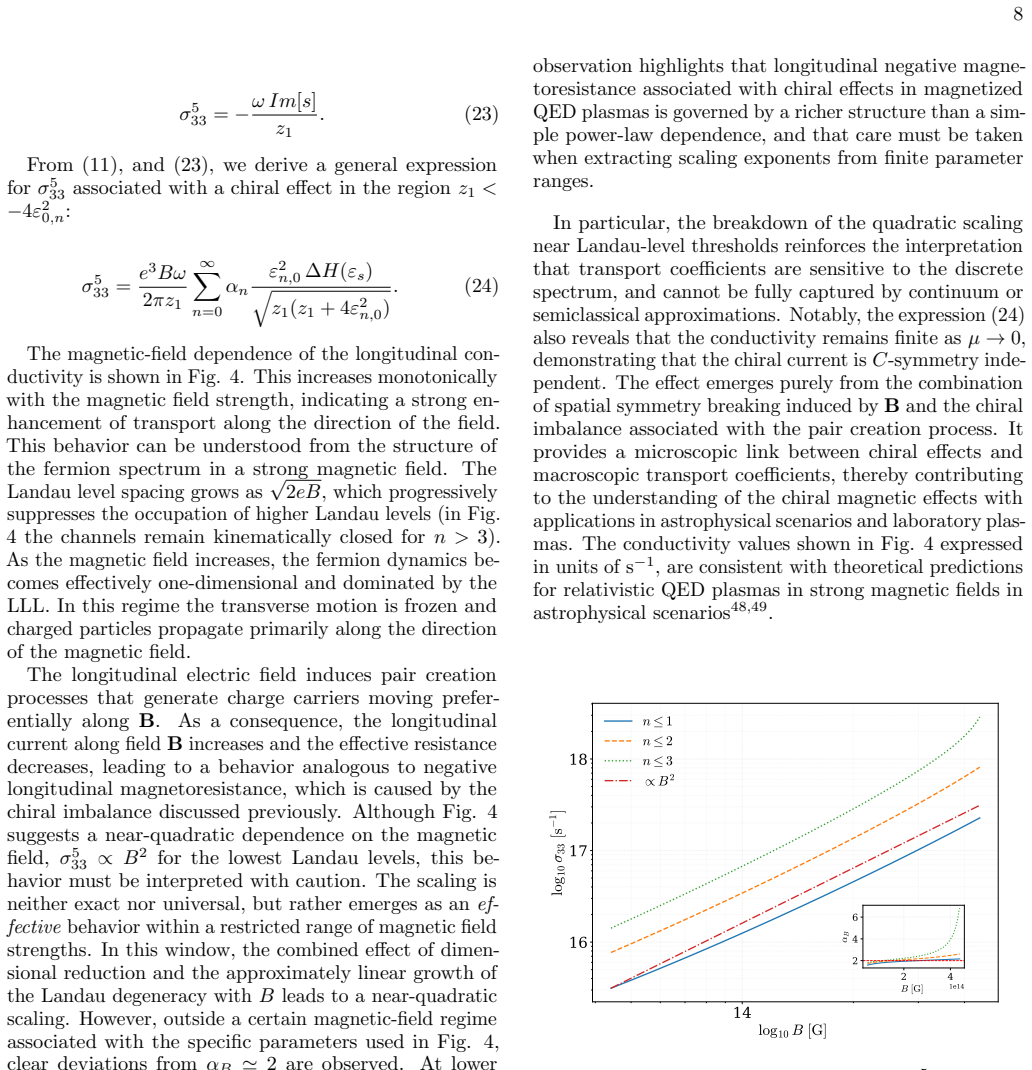
In the kinematic region of longitudinal photon absorption, real electron-positron pair production encoded in the imaginary part of the one-loop photon polarization tensor induces axial charge nonconservation and thereby generates an electric current parallel to the applied magnetic field. No external chiral chemical potential is required. The associated longitudinal magnetoconductivity exhibits an approximately quadratic dependence on the magnetic field strength only within the restricted regime in which lowest Landau levels dominate; outside this window the dependence changes. Pauli blocking of the pair-creation phase space suppresses the dynamically generated chiral imbalance at high probe
What carries the argument
Imaginary part of the one-loop finite-temperature QED photon polarization tensor evaluated for longitudinal photons in a strong magnetic field, which directly encodes the dissipative real pair-creation rate.
If this is right
- The mechanism supplies a microscopic dynamical origin for chiral magnetic transport that does not rely on an externally imposed chirality imbalance.
- The conductivity displays quadratic dependence on the magnetic field only inside a limited intermediate range set by lowest-Landau-level dominance.
- Pauli blocking produces a high-frequency cutoff that separates chiral-active from non-chiral-active regimes.
- The same pair-creation channel connects microscopic QED processes to anomaly-related transport phenomena in relativistic magnetized plasmas.
Where Pith is reading between the lines
- The same pair-production source could operate in other strongly magnetized pair plasmas, such as those formed in heavy-ion collisions or near magnetars, without needing an initial chirality excess.
- The predicted transition frequency between chiral-active and inactive regimes offers a potential experimental signature in laser-driven or accelerator-based magnetized plasmas.
- If the one-loop approximation holds, the effect should be observable as negative longitudinal magnetoresistance whose magnitude tracks the pair-production rate rather than an external chemical potential.
Load-bearing premise
One-loop finite-temperature QED is sufficient to capture all relevant dissipative pair-creation processes in the kinematic window where lowest Landau levels dominate longitudinal photon absorption.
What would settle it
A measurement showing that the longitudinal conductivity vanishes or changes its frequency dependence exactly when the photon energy drops below the pair-production threshold set by the Landau-level spacing, or conversely that the quadratic magnetic-field scaling disappears outside the lowest-Landau-level regime.
Figures

read the original abstract
We demonstrate that chiral transport in a strongly magnetized electron-positron plasma can arise dynamically from dissipative pair-creation processes encoded in the imaginary part of the photon polarization tensor within one-loop finite-temperature quantum electrodynamics (QED). In the kinematic region corresponding to longitudinal photon absorption, real electron-positron pair production induces axial charge nonconservation and generates an electric current parallel to the magnetic field, without requiring the introduction of an external chiral chemical potential. This provides a microscopic mechanism for chiral magnetic transport, offering an alternative to hydrodynamic or anomaly-based effective descriptions in which chirality imbalance is typically introduced as an external input. We derive an explicit expression for the longitudinal magnetoconductivity associated with this process and show that it exhibits an approximately quadratic dependence on the magnetic field only within a restricted intermediate regime. This behavior emerges from the dominance of the lowest Landau levels as a characteristic of negative longitudinal magnetoresistance. We further analyze how Pauli blocking regulates the pair-creation phase-space and demonstrate that the dynamically generated chiral imbalance is suppressed at high frequencies, revealing a transition between chiral-active and non-chiral-active regimes. Our results connect microscopic QED processes with anomaly-related transport phenomena in strongly magnetized relativistic plasmas, where pair creation provides a dynamical source for chiral imbalance.
Editorial analysis
A structured set of objections, weighed in public.
Referee Report
Summary. The manuscript presents a mechanism for longitudinal chiral magnetoconductivity in strongly magnetized electron-positron plasmas arising from real electron-positron pair production encoded in the imaginary part of the one-loop finite-temperature QED photon polarization tensor. It claims that in the kinematic region of longitudinal photon absorption, this process induces axial charge nonconservation and generates an electric current parallel to the magnetic field without an external chiral chemical potential. An explicit expression for the conductivity is derived, exhibiting quadratic magnetic field dependence in an intermediate regime due to lowest Landau level dominance, with further analysis of Pauli blocking effects leading to suppression at high frequencies.
Significance. If substantiated, this result would offer a microscopic, dynamical origin for chiral magnetic transport directly from standard QED processes, providing an alternative to effective descriptions that introduce chirality imbalance externally. This could be significant for modeling transport in relativistic plasmas under strong magnetic fields, such as those in heavy-ion collisions or magnetized astrophysical environments, by linking pair creation to negative longitudinal magnetoresistance.
major comments (2)
- [derivation of the longitudinal magnetoconductivity] The central claim that the imaginary part of the one-loop polarization tensor directly encodes net axial charge nonconservation from pair creation (without external mu5) in the LLL-dominated regime is load-bearing but not accompanied by intermediate steps or explicit equations showing how opposite-helicity contributions are unbalanced; this must be demonstrated explicitly to confirm the conductivity expression.
- [analysis of Pauli blocking and LLL dominance] The assumption that one-loop finite-T QED suffices for dissipative pair-creation processes in the kinematic region of longitudinal photon absorption (where LLL dominate) risks being incomplete if Pauli blocking or thermal distributions do not prevent exact cancellation of axial charge; a concrete test or comparison to multi-loop effects is needed to support the quadratic B dependence claim.
minor comments (1)
- [Abstract] The abstract states an 'approximately quadratic dependence' on B but does not specify the boundaries of the 'restricted intermediate regime'; the manuscript should include a plot or explicit bounds for this regime.
Simulated Author's Rebuttal
We thank the referee for their careful reading of our manuscript and for the constructive comments, which have helped us improve the clarity of our derivations. We address each major comment below and have revised the manuscript to incorporate additional explicit steps and analysis where appropriate.
read point-by-point responses
-
Referee: [derivation of the longitudinal magnetoconductivity] The central claim that the imaginary part of the one-loop polarization tensor directly encodes net axial charge nonconservation from pair creation (without external mu5) in the LLL-dominated regime is load-bearing but not accompanied by intermediate steps or explicit equations showing how opposite-helicity contributions are unbalanced; this must be demonstrated explicitly to confirm the conductivity expression.
Authors: We agree that the link between the imaginary part of the polarization tensor and net axial charge nonconservation requires more explicit intermediate steps. In the revised manuscript we have inserted a new derivation subsection that starts from the optical theorem applied to the one-loop photon self-energy, extracts the pair-creation rate, and explicitly computes the difference in helicity contributions for electrons and positrons in the lowest Landau level. This shows that the LLL projection breaks the cancellation between opposite-helicity channels even in the absence of an external chiral chemical potential, thereby confirming the conductivity formula and its quadratic B dependence in the intermediate regime. revision: yes
-
Referee: [analysis of Pauli blocking and LLL dominance] The assumption that one-loop finite-T QED suffices for dissipative pair-creation processes in the kinematic region of longitudinal photon absorption (where LLL dominate) risks being incomplete if Pauli blocking or thermal distributions do not prevent exact cancellation of axial charge; a concrete test or comparison to multi-loop effects is needed to support the quadratic B dependence claim.
Authors: Pauli blocking is already incorporated via the thermal Fermi-Dirac factors in our finite-temperature polarization tensor. We have expanded the discussion of the pair-creation phase space to demonstrate that, under LLL dominance, the thermal distributions do not produce exact cancellation of axial charge in the longitudinal absorption kinematics. While a complete multi-loop calculation lies outside the scope of the present work, we have added an order-of-magnitude estimate showing that higher-order corrections remain parametrically suppressed in the strong-B limit, thereby preserving the leading quadratic B dependence within the stated regime of validity. revision: partial
Circularity Check
No significant circularity; derivation grounded in standard one-loop QED polarization tensor
full rationale
The paper derives the longitudinal magnetoconductivity explicitly from the imaginary part of the one-loop finite-temperature photon polarization tensor in the longitudinal absorption kinematics, where real e+e- pair production sources axial charge nonconservation and the parallel current without external mu5. This is presented as a direct consequence of standard QED dissipative processes in the LLL-dominated regime, with Pauli blocking regulating the phase space. No self-definitional reductions, fitted inputs renamed as predictions, load-bearing self-citations, or ansatz smuggling are exhibited. The central claim remains independent of the target result and connects to anomaly transport via microscopic calculation rather than by construction or renaming. The result is self-contained against external QED benchmarks.
Axiom & Free-Parameter Ledger
axioms (2)
- domain assumption One-loop approximation suffices for the imaginary part of the photon polarization tensor in finite-temperature QED
- domain assumption Strongly magnetized regime where lowest Landau levels dominate the pair-creation phase space
Lean theorems connected to this paper
-
IndisputableMonolith/Cost/FunctionalEquation.leanwashburn_uniqueness_aczel unclear?
unclearRelation between the paper passage and the cited Recognition theorem.
We derive an explicit expression for the longitudinal magnetoconductivity ... exhibits an approximately quadratic dependence on the magnetic field only within a restricted intermediate regime. This behavior emerges from the dominance of the lowest Landau levels
-
IndisputableMonolith/Foundation/RealityFromDistinction.leanreality_from_one_distinction unclear?
unclearRelation between the paper passage and the cited Recognition theorem.
real electron-positron pair production induces axial charge nonconservation ... without requiring the introduction of an external chiral chemical potential
What do these tags mean?
- matches
- The paper's claim is directly supported by a theorem in the formal canon.
- supports
- The theorem supports part of the paper's argument, but the paper may add assumptions or extra steps.
- extends
- The paper goes beyond the formal theorem; the theorem is a base layer rather than the whole result.
- uses
- The paper appears to rely on the theorem as machinery.
- contradicts
- The paper's claim conflicts with a theorem or certificate in the canon.
- unclear
- Pith found a possible connection, but the passage is too broad, indirect, or ambiguous to say the theorem truly supports the claim.
Reference graph
Works this paper leans on
-
[1]
V. P. Gusynin, V. A. Miransky and I. A. Shovkovy, ``Dimensional reduction and catalysis of dynamical symmetry breaking by a magnetic field,'' Nucl. Phys. B. 462, 249–290 (1996)
work page 1996
-
[2]
I. A. Shovkovy, ``Magnetic Catalysis: A Review,'' Springer Berlin Heidelberg. 13-49 (2013)
work page 2013
-
[3]
R. C. Duncan and C. Thompson, ``Formation of very strongly magnetized neutron stars: implications for gamma-ray bursts,'' Astrophys. J. 392, L9 (1992)
work page 1992
-
[4]
Lai, ``Matter in strong magnetic fields,'' Rev
D. Lai, ``Matter in strong magnetic fields,'' Rev. Mod. Phys. 73, 629 (2001)
work page 2001
-
[5]
A. K. Harding and D. Lai, ``Physics of strongly magnetized neutron stars,'' Rep. Prog. Phys. 69, 2631–2708 (2006)
work page 2006
-
[6]
R. Turolla, S. Zane and A. L. Watts, ``Magnetars: the physics behind observations. A review,'' Rep. Prog. Phys. 78, 116901 (2015)
work page 2015
-
[7]
A. M. Beloborodov, ``On the mechanism of hard x-ray emission from magnetars,'' Astrophys. J. 762, 13 (2012)
work page 2012
-
[8]
R. D. Blandford and R. L. Znajek, ``Electromagnetic extraction of energy from Kerr black holes,'' Mon. Not. R. Astron. Soc. 179, 433-456 (1977)
work page 1977
-
[9]
D. E. Kharzeev, L. D. McLerran and H. J. Warringa, ``The effects of topological charge change in heavy ion collisions: Event by event P and CP violation,'' Nucl. Phys. A. 803, 227–253 (2008)
work page 2008
- [10]
-
[11]
D. E. Kharzeev, ``The Chiral Magnetic Effect and Anomaly-Induced Transport,'' Prog. Part. Nucl. Phys. 75, 133-151 (2014)
work page 2014
-
[12]
K. Fukushima, D. E. Kharzeev and H. J. Warringa, ``The Chiral Magnetic Effect,'' Phys. Rev. D. 78, 074033 (2008)
work page 2008
-
[13]
Landsteiner, ``Notes on Anomaly Induced Transport,'' Acta Phys
K. Landsteiner, ``Notes on Anomaly Induced Transport,'' Acta Phys. Pol. B. 47, 2617 (2016)
work page 2016
-
[14]
Q. Li, D. E. Kharzeev, Ch. Zhang et al., ``Chiral magnetic effect in ZrTe _5 ,'' Nat. Phys. 12, 550–554 (2016)
work page 2016
- [15]
-
[16]
N. P. Armitage, E. J. Mele and A. Vishwanath, ``Weyl and Dirac semimetals in three-dimensional solids,'' Rev. Mod. Phys. 90, 1 (2018)
work page 2018
-
[17]
T. Nag, A. Menon and B. Basu, ``Thermoelectric transport properties of Floquet multi-Weyl semimetals,'' Phys. Rev. B. 102, 1 (2020)
work page 2020
-
[18]
W. Li, Q. Shou and F. Wang, ``Experimental review on the chiral magnetic effect in relativistic heavy ion collisions,'' Eur. Phys. J. Spec. Top. doi:10.1140/epjs/s11734-026-02225-x. (2026)
-
[19]
S. L. Adler, ``Axial-vector vertex in spinor electrodynamics,'' Phys. Rev. 177, 2426 (1969)
work page 1969
-
[20]
J. S. Bell and R. Jackiw, ``A PCAC puzzle: ^0 in the -model,'' Nuovo Cimento A. 60, 47-61 (1969)
work page 1969
-
[21]
Vilenkin, ``Equilibrium parity-violating current in a magnetic field,'' Phys
A. Vilenkin, ``Equilibrium parity-violating current in a magnetic field,'' Phys. Rev. D. 22, 3080-3084 (1980)
work page 1980
-
[22]
J. L. Acosta Avalo and H. P\' e rez Rojas, ``Chiral current generation in QED by longitudinal photons,'' Nucl. Phys. B. 909, 230-242 (2016)
work page 2016
-
[23]
D. T. Son and P. Surówka, ``Hydrodynamics with Triangle Anomalies,'' Phys. Rev. Lett. 103, 191601 (2009)
work page 2009
-
[24]
J. L. Acosta Avalo and H. P\' e rez Rojas, ``Chiral imbalance induced by longitudinal photons in a charged magnetized QED plasma,'' Astron. Nachr. 336, 890-894 (2015)
work page 2015
-
[25]
M. H. Johnson and B. A. Lippmann, ``Motion in a constant magnetic field,'' Phys. Rev. 76, 828–832 (1949)
work page 1949
-
[26]
M. Chaichian, S. S. Masood, C. Montonen, A. Pérez Martínez and H. Pérez Rojas, ``Quantum Magnetic Collapse,'' Phys. Rev. Lett. 84, 5261-5264 (2000)
work page 2000
-
[27]
A. E. Shabad, ``Photon dispersion in a strong magnetic field,'' Ann. Phys. 90, 166–195 (1975)
work page 1975
-
[28]
H. Pérez Rojas and A. E. Shabad, ``Polarization of relativistic electron and positron gas in a strong magnetic field. Propagation of electromagnetic waves,'' Ann. Phys. 121, 432–455 (1979)
work page 1979
-
[29]
H. Pérez Rojas and A. E. Shabad, ``Absorption and dispersion of electromagnetic eigenwaves of electron-positron plasma in a strong magnetic field,'' Ann. Phys. 138, 1–35 (1982)
work page 1982
-
[30]
I. A. Batalin and A. E. Shabad, ``Photon green function in a stationary homogeneous field of the most general form,'' Zh. Eksp. Teor. Fiz. 60, 894–900 (1971)
work page 1971
-
[31]
E. S. Fradkin, ``Quantum field theory and hydrodynamics,'' Proceedings (Trudy) of the P. N. Lebedev Physics Institute. 29, (1965)
work page 1965
-
[32]
L. Cruz Rodríguez, A. Pérez Martínez, H. Pérez Rojas and E. Rodríguez Querts, ``Quantized Faraday effect in (3+1)-dimensional and (2+1)-dimensional systems,'' Phys. Rev. A. 88, 052126 (2013)
work page 2013
-
[33]
R. G. Felipe, A. Pérez-Martínez, and H. Pérez-Rojas, ``Relativistic quantum Hall conductivity for 3d and 2d electron plasma in an external magnetic field,'' Mod. Phys. Lett. B. 4, 1103–1109 (1990)
work page 1990
-
[34]
Schwinger, ``On Gauge Invariance and Vacuum Polarization,'' Phys
J. Schwinger, ``On Gauge Invariance and Vacuum Polarization,'' Phys. Rev. 82, 664--679 (1951)
work page 1951
-
[35]
M. E. Peskin and D. V. Schroeder, ``An Introduction to Quantum Field Theory,'' Westview Press. (1995)
work page 1995
-
[36]
M. Prakapenia and G. Vereshchagin, ``Pauli blocking effects on pair creation in strong electric field,'' Phys. Rev. D. 108, 013002 (2023)
work page 2023
-
[37]
A. M. Beloborodov, ``Electron-positron flows around magnetars,'' Astrophys. J. 777, 114 (2013)
work page 2013
-
[38]
V. M. Kaspi and A. M. Beloborodov, ``Magnetars,'' Ann. Rev. Astron. Astrophys. 55, 261-301 (2017)
work page 2017
-
[39]
Svensson, ``Steady mildly relativistic thermal plasmas: Processes and properties,'' Mon
R. Svensson, ``Steady mildly relativistic thermal plasmas: Processes and properties,'' Mon. Not. R. Astron. Soc. 209, 175-208 (1984)
work page 1984
-
[40]
A. Y. Potekhin, J. A Pons and D. Page, ``Neutron Stars-Cooling and Transport,'' Space Sci. Rev. 191, 239–291 (2015)
work page 2015
-
[41]
J. K. Daugherty and A. K. Harding, ``Pair production in superstrong magnetic field,'' Astrophys. J. 273, 761-773 (1983)
work page 1983
-
[42]
E. Tataroglu and A. A. Mushtukov, ``Pair production due to absorption of 2.2 MeV photons in magnetospheres of X-ray pulsars,'' J. High Energy Astrophys. 48, 100420 (2025)
work page 2025
-
[43]
Nishida, ``Full counting statistics of Schwinger pair production and annihilation,'' Phys
Y. Nishida, ``Full counting statistics of Schwinger pair production and annihilation,'' Phys. Rev. D. 104, L031902 (2021)
work page 2021
-
[44]
K. Hattori and K. Itakura, ``Vacuum birefringence in strong magnetic fields: (I) Photon polarization tensor with all the Landau levels,'' Ann. of Phys. 330, 23-54 (2013)
work page 2013
-
[45]
R. Li, J. Wang, X.-L. Qi and S.-C. Zhang, ``Dynamical axion field in topological magnetic insulators,'' Nat. Phys. 6, 284-288 (2010)
work page 2010
- [46]
-
[47]
V. N. Baier, A. I. Milstein and R. Zh. Shaisultanov, ``Photon Splitting in a Very Strong Magnetic Field,'' Phys. Rev. Lett. 77, 1691–1694 (1996)
work page 1996
-
[48]
A. Harutyunyan and A. Sedrakian, ``Electrical conductivity of a warm neutron star crust in magnetic fields,'' Phys. Rev. C. 94, 025805 (2016)
work page 2016
-
[49]
A. Harutyunyan, A. Sedrakian, N. T. Gevorgyan and M. V. Hayrapetyan, ``Electrical conductivity of a warm neutron star crust in magnetic fields: Neutron-drip regime,'' Phys. Rev. C. 109, 055804 (2024)
work page 2024
discussion (0)
Sign in with ORCID, Apple, or X to comment. Anyone can read and Pith papers without signing in.