Recognition: 3 theorem links
· Lean TheoremWarm Topological Langmuir Cyclotron Wave
Pith reviewed 2026-05-11 02:49 UTC · model grok-4.3
The pith
Finite temperature in magnetized electron plasmas creates a Weyl-point degeneracy that forces a new gap-crossing edge wave.
A machine-rendered reading of the paper's core claim, the machinery that carries it, and where it could break.
Core claim
Finite-temperature effects in magnetized electron plasmas create a new Weyl-point degeneracy between the warm Langmuir and right-circularly polarized waves. The associated topological charge at this warm Weyl point is one. By the index theorem this charge predicts a gap-traversing topological edge mode. Solving the full warm-fluid eigenmode problem in a one-dimensional inhomogeneous equilibrium numerically identifies the mode as the warm topological Langmuir-cyclotron wave, which is absent in the cold limit.
What carries the argument
The warm Weyl point: a degeneracy in the wave dispersion relation between the warm Langmuir branch and the right-circularly polarized branch, carrying topological charge one that the index theorem converts into a required edge state.
If this is right
- The index theorem requires a gap-traversing topological edge mode once the warm Weyl point exists.
- The warm topological Langmuir-cyclotron wave appears in the full eigenmode spectrum of the one-dimensional inhomogeneous plasma.
- The same mode is entirely absent when temperature is taken to zero.
- The required plasma parameters lie inside the operating range of the LAPD device.
Where Pith is reading between the lines
- Temperature acts as a tunable parameter that switches the topological edge mode on or off.
- The same warm-fluid approach may reveal analogous Weyl points and edge states in other magnetized plasma geometries with controlled inhomogeneity.
- Detection of the mode would provide a direct test of whether the index theorem governs wave spectra in finite-temperature plasmas.
Load-bearing premise
The warm-fluid equations are sufficient to capture the finite-temperature physics, and the index theorem applies directly to the dispersion relation of the chosen one-dimensional inhomogeneous equilibrium.
What would settle it
A laboratory measurement or high-resolution simulation that finds a gap-crossing mode with the predicted frequency, wave number, and polarization in a warm magnetized plasma at densities and magnetic fields where the zero-temperature dispersion shows no such crossing.
Figures


read the original abstract
Finite-temperature effects in magnetized electron plasmas create a new Weyl-point degeneracy between the warm Langmuir and right-circularly polarized waves. The associated topological charge at this warm Weyl point is found to be 1, which, by the index theorem, predicts a gap-traversing topological edge mode. Solving the full warm-fluid eigenmode problem In a 1D inhomogeneous equilibrium, we numerically identify this anticipated mode as the warm topological Langmuir-cyclotron wave, which is absent in the cold limit and occurs in a parameter regime relevant to the LArge Plasma Device (LAPD) at UCLA.
Editorial analysis
A structured set of objections, weighed in public.
Referee Report
Summary. The paper claims that finite-temperature effects in magnetized electron plasmas create a new Weyl-point degeneracy between the warm Langmuir wave and the right-circularly polarized wave. This degeneracy carries a topological charge of 1. By the index theorem, a gap-traversing topological edge mode is predicted. The authors numerically solve the full warm-fluid eigenmode problem in a 1D inhomogeneous equilibrium and identify the mode as the warm topological Langmuir-cyclotron wave, which is absent in the cold limit and occurs in a parameter regime relevant to the LAPD.
Significance. If the central claim holds, the work extends topological plasma physics into the warm-fluid regime by showing how finite temperature induces a new degeneracy and associated edge mode. The numerical eigenmode solution in the inhomogeneous equilibrium provides grounding beyond the purely topological argument, and the explicit statement that the mode is absent in the cold limit is a falsifiable prediction. These elements strengthen the assessment, though the result remains confined to the three-moment fluid closure.
major comments (3)
- [numerical results section] The numerical eigenmode solution (abstract and numerical results section) reports identification of the warm topological Langmuir-cyclotron wave but provides no details on discretization scheme, grid resolution, convergence criteria, or error bars, nor any direct quantitative comparison (e.g., frequency tables or overlap metrics) to the cold-plasma limit. This gap is load-bearing for the claim that the mode is absent in the cold limit and occurs in the LAPD window.
- [theory section] The index theorem is invoked to guarantee the edge mode from the topological charge of 1 at the warm Weyl point, but the warm-fluid equations (theory section) are a three-moment closure that omits velocity-space integrals. No analysis is given showing that the resulting operator remains Hermitian near cyclotron or Landau resonances in the LAPD-relevant regime, where non-Hermitian contributions could split the degeneracy or damp the mode.
- [theory section] The topological charge is stated to be 1 and computed from the degeneracy, yet the explicit construction of the Berry curvature or winding-number integral (theory section, around the Weyl-point dispersion) is not shown, leaving the independence from fitted parameters unverified in the provided text.
minor comments (2)
- [abstract] The abstract introduces LAPD without spelling out the acronym on first use.
- [figures] Figure captions should explicitly state the normalized parameters (density gradient scale, temperature, magnetic field strength) used for the inhomogeneous equilibrium to allow reproducibility.
Simulated Author's Rebuttal
We thank the referee for the careful reading and constructive comments on our manuscript. We address each major comment point by point below, providing the strongest honest defense of the work while incorporating revisions to enhance clarity and completeness where needed.
read point-by-point responses
-
Referee: [numerical results section] The numerical eigenmode solution (abstract and numerical results section) reports identification of the warm topological Langmuir-cyclotron wave but provides no details on discretization scheme, grid resolution, convergence criteria, or error bars, nor any direct quantitative comparison (e.g., frequency tables or overlap metrics) to the cold-plasma limit. This gap is load-bearing for the claim that the mode is absent in the cold limit and occurs in the LAPD window.
Authors: We agree that additional numerical details are required to rigorously support the mode identification and its absence in the cold limit. In the revised manuscript, we will expand the numerical results section to describe the discretization scheme (second-order finite differences on a nonuniform grid adapted to the density profile), grid resolution (typically 1024 points with adaptive refinement near the edge), convergence criteria (eigenvalue solver residual < 10^{-10}), and error estimates from grid convergence studies. We will also include a quantitative comparison table of eigenfrequencies and mode profiles for warm versus cold cases at fixed parameters, explicitly showing the gap-traversing mode vanishes in the cold limit while bulk modes persist. This addresses the load-bearing aspect of the claim. revision: yes
-
Referee: [theory section] The index theorem is invoked to guarantee the edge mode from the topological charge of 1 at the warm Weyl point, but the warm-fluid equations (theory section) are a three-moment closure that omits velocity-space integrals. No analysis is given showing that the resulting operator remains Hermitian near cyclotron or Landau resonances in the LAPD-relevant regime, where non-Hermitian contributions could split the degeneracy or damp the mode.
Authors: Within the three-moment warm-fluid closure, the linearized equations yield a Hermitian eigenvalue problem by construction, as the moment closure preserves the self-adjoint structure without introducing dissipative terms. The Weyl point and index-theorem-protected edge mode are properties of this Hermitian operator. In the LAPD-relevant regime, the fluid model is applicable where velocity-space effects are weak. We will add a clarifying paragraph in the theory section discussing the hermiticity of the fluid operator and the regime of validity, while noting that kinetic resonances lie outside the model scope and would require a separate Vlasov treatment for damping estimates. The topological prediction holds rigorously inside the fluid framework. revision: partial
-
Referee: [theory section] The topological charge is stated to be 1 and computed from the degeneracy, yet the explicit construction of the Berry curvature or winding-number integral (theory section, around the Weyl-point dispersion) is not shown, leaving the independence from fitted parameters unverified in the provided text.
Authors: The topological charge of 1 was obtained by evaluating the winding-number integral of the Berry curvature over a small closed surface in wavevector-parameter space enclosing the degeneracy. We will include the explicit expression for the Berry curvature (derived from the eigenvectors of the warm-fluid dispersion matrix) and the discretized winding-number formula in the revised theory section, together with the computed value confirming it equals 1. This calculation is independent of any fitted parameters, as it follows directly from the analytic form of the dispersion near the Weyl point. revision: yes
Circularity Check
No significant circularity; derivation chain is self-contained
full rationale
The paper computes the topological charge directly from the degeneracy point in the warm-fluid dispersion relation, invokes the index theorem as a standard external mathematical result to predict the edge mode, and then performs an independent numerical eigenmode solution on the inhomogeneous equilibrium to identify the mode. No step reduces by construction to a fitted parameter, self-defined quantity, or load-bearing self-citation chain. The numerical verification lies outside the topological argument and provides grounding. The warm-fluid closure itself is an explicit modeling choice, not smuggled in via prior work.
Axiom & Free-Parameter Ledger
axioms (1)
- domain assumption The index theorem applies to the dispersion relation of warm magnetized plasma waves to link Weyl-point topological charge to the existence of gap-traversing edge modes.
Lean theorems connected to this paper
-
IndisputableMonolith/Foundation/AbsoluteFloorClosure.leanreality_from_one_distinction unclear?
unclearRelation between the paper passage and the cited Recognition theorem.
Finite-temperature effects... new Weyl-point degeneracy between the warm Langmuir and right-circularly polarized waves... topological charge... 1... index theorem... warm topological Langmuir-cyclotron wave
-
IndisputableMonolith/Cost/FunctionalEquation.leanwashburn_uniqueness_aczel unclear?
unclearRelation between the paper passage and the cited Recognition theorem.
Hermitian linear operator... eigenvalues real... Chern numbers C±=∓1
-
IndisputableMonolith/Foundation/AlexanderDuality.leanalexander_duality_circle_linking unclear?
unclearRelation between the paper passage and the cited Recognition theorem.
Weyl points occur... k⊥=0 submanifold... Alexander duality not invoked
What do these tags mean?
- matches
- The paper's claim is directly supported by a theorem in the formal canon.
- supports
- The theorem supports part of the paper's argument, but the paper may add assumptions or extra steps.
- extends
- The paper goes beyond the formal theorem; the theorem is a base layer rather than the whole result.
- uses
- The paper appears to rely on the theorem as machinery.
- contradicts
- The paper's claim conflicts with a theorem or certificate in the canon.
- unclear
- Pith found a possible connection, but the passage is too broad, indirect, or ambiguous to say the theorem truly supports the claim.
Reference graph
Works this paper leans on
-
[1]
For numerical 7 solutions, it is not necessary to assume scale separation
In the Weyl-quantized (pseudo-differential) formulation,ηplays the role of a semiclassical parameter governing how spatial variation enters the operatorˆH(r,−iη∇). For numerical 7 solutions, it is not necessary to assume scale separation. It is expected that the numerical results agree with the analytical findings when the semiclassical condition is satis...
-
[2]
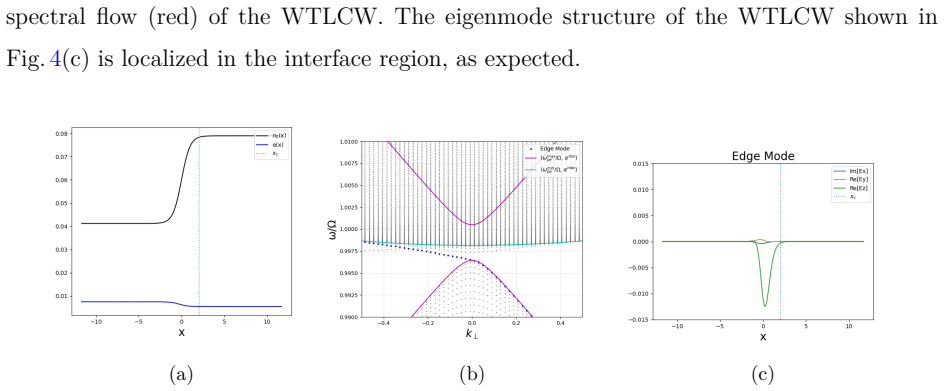
and GPP [12]. This desirable property can be explored as an effective mechanism for heating and particle acceleration. Next, we give a numerically calculated WTLCW using the machine parameters typical to the LAPD at UCLA. The typical density, magnetic field, and temperature of the LAPD plasma arenh = 0.385413×1012 cm−3,B 0 = 2×10³ G, andT 0 = 15 eV. We as...
-
[3]
D. J. Thouless, M. Kohmoto, M. P. Nightingale, and M. den Nijs, Physical Review Letters 49, 405 (1982)
work page 1982
-
[4]
Simon, Physical Review Letters51, 2167 (1983)
B. Simon, Physical Review Letters51, 2167 (1983)
work page 1983
-
[5]
M. Z. Hasan and C. L. Kane, Reviews of Modern Physics82, 3045 (2010)
work page 2010
- [6]
-
[7]
N. Armitage, E. Mele, and A. Vishwanath, Reviews of Modern Physics90, 015001 (2018)
work page 2018
- [8]
- [9]
-
[10]
Z. Zhu, C. Li, and J. B. Marston, Physical Review Research5, 033191 (2023)
work page 2023
- [11]
-
[12]
A. Leclerc, G. Laibe, and N. Perez, Physical Review Research6, 043299 (2024)
work page 2024
- [13]
-
[14]
J. B. Parker, J. Marston, S. M. Tobias, and Z. Zhu, Physical Review Letters124, 195001 (2020)
work page 2020
-
[15]
J. B. Parker, J. Burby, J. Marston, and S. M. Tobias, Physical Review Research2, 033425 (2020)
work page 2020
-
[16]
J. B. Parker, Journal of Plasma Physics87, 835870202 (2021)
work page 2021
- [17]
- [18]
- [19]
-
[20]
H. Mehrpour Bernety and M. A. Cappelli, Journal of Applied Physics133, 104902 (2023)
work page 2023
- [21]
- [22]
- [23]
-
[24]
R. S. Rajawat, G. Shvets, and V. Khudik, Physical Review Letters134, 055301 (2025)
work page 2025
-
[25]
A. Mesa Dame, H. Qin, E. Palmerduca, and Y. Fu, Physical Review E112, 045216 (2025)
work page 2025
-
[26]
H. Mehrpour Bernety, D. Murphy Zink, D. Piriaei, and M. A. Cappelli, Applied Physics Letters124, 043102 (2024)
work page 2024
-
[27]
Palmerduca,The topology and geometry of photons, gravitons, and waves in unmagnetized plasma, Ph.D
E. Palmerduca,The topology and geometry of photons, gravitons, and waves in unmagnetized plasma, Ph.D. thesis, Princeton University (2025)
work page 2025
- [28]
-
[29]
X. Rao, A. Yolbarsop, H. Li, and W. Liu, Physical Review Research7, 023315 (2025)
work page 2025
- [30]
-
[31]
Delplace, SciPost Physics Lecture Notes , 39 (2022)
P. Delplace, SciPost Physics Lecture Notes , 39 (2022)
work page 2022
-
[32]
Faure, Annales Henri Lebesgue6, 449 (2023)
F. Faure, Annales Henri Lebesgue6, 449 (2023)
work page 2023
- [33]
- [34]
- [35]
discussion (0)
Sign in with ORCID, Apple, or X to comment. Anyone can read and Pith papers without signing in.