Recognition: 2 theorem links
· Lean TheoremFinite-q photon-drag shift current in two-dimensional massive chiral Dirac fermions
Pith reviewed 2026-05-11 02:03 UTC · model grok-4.3
The pith
Chirality reorganizes the sign topology of finite-q photocurrents in massive Dirac fermions.
A machine-rendered reading of the paper's core claim, the machinery that carries it, and where it could break.
Core claim
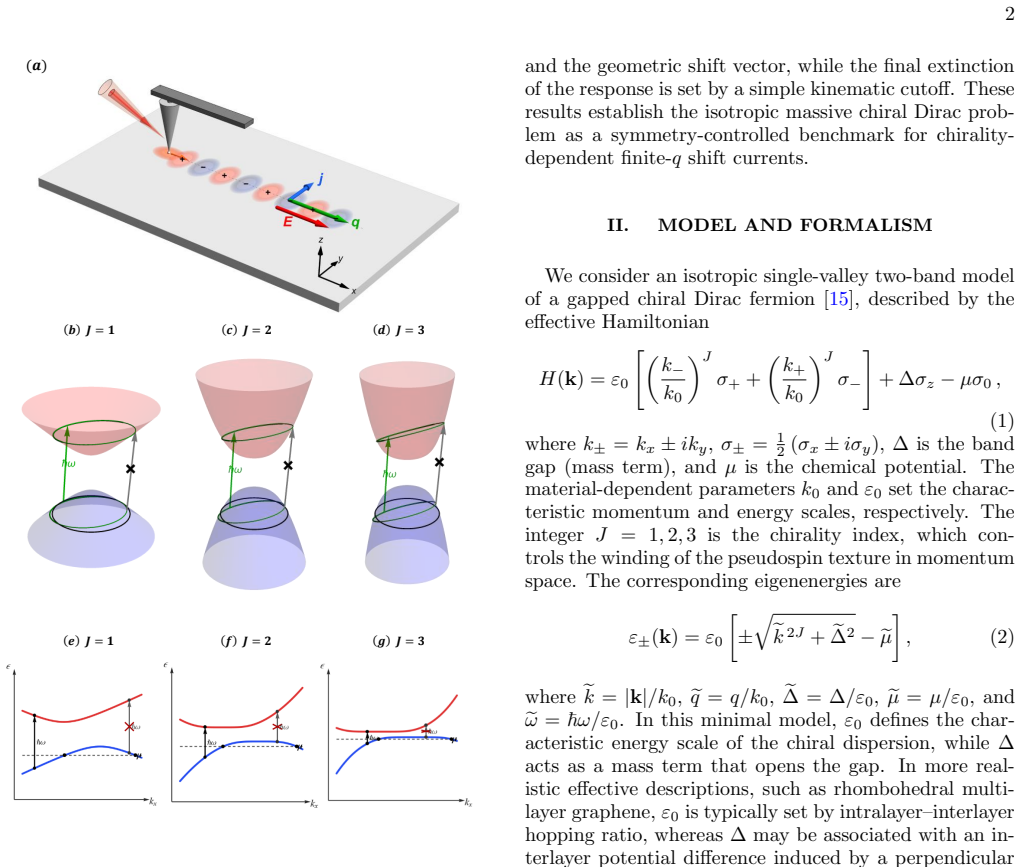
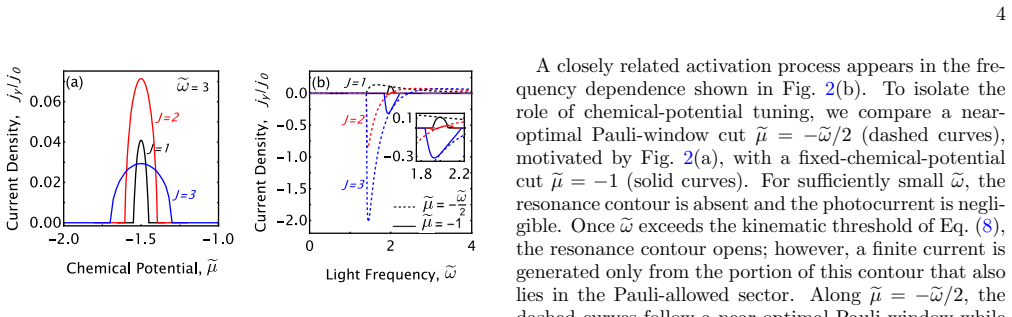
The central result is that chirality qualitatively reorganizes the sign topology of the finite-q photocurrent j(q). For J=1, the photocurrent remains broadly positive, whereas higher-chirality sectors (J ≥ 2) generically develop internal zero-current contours and sign reversals within the kinematically allowed region. The photocurrent is symmetry-constrained to be purely transverse, j(q) ∝ ẑ × q, and vanishes in the strictly vertical-transition limit q=0 in centrosymmetric systems. Pauli blocking further shapes the response by selecting the active portion of the resonance contour, while its extinction at large Δ or q follows from a simple kinematic cutoff.
What carries the argument
the full finite-q non-vertical shift-current response function evaluated directly in the isotropic massive chiral Dirac Hamiltonian with index J
If this is right
- The photocurrent is symmetry-forced to remain purely transverse to q for all J.
- The response vanishes exactly at q=0 for vertical transitions in centrosymmetric systems.
- Pauli blocking restricts the active segment of the resonance contour for every chirality.
- Kinematic cutoffs cause the current to disappear at sufficiently large detuning or momentum transfer.
- Higher J introduces zero-current lines and sign changes absent in the J=1 case.
Where Pith is reading between the lines
- The transverse locking implies the current direction is fixed once the light propagation geometry is chosen.
- The kinematic cutoff supplies a parameter-free estimate for the momentum window in which the effect can be observed.
- Similar chirality-dependent sign reorganization may appear in other finite-q nonlinear responses such as rectification or second-harmonic generation within the same model.
Load-bearing premise
The calculation assumes an idealized isotropic single-valley massive chiral Dirac model and that direct evaluation of the full finite-q non-vertical response is feasible and accurate without unstated approximations or additional material effects.
What would settle it
Mapping the photocurrent sign as a function of momentum q in a J=2 system and finding no internal zero contours or reversals inside the allowed region would falsify the claim.
Figures


read the original abstract
We investigate the photon-drag shift current in an isotropic single-valley two-dimensional massive chiral Dirac model with chirality index $J=1,2,3$ by directly evaluating the full finite-$q$ non-vertical response beyond the perturbative small-$q$ regime. Our central result is that chirality qualitatively reorganizes the sign topology of the finite-$q$ photocurrent $\mathbf{ j}(\mathbf{ q})$. For $J=1$, the photocurrent remains broadly positive, whereas higher-chirality sectors ($J \ge 2$) generically develop internal zero-current contours and sign reversals within the kinematically allowed region. We further show that the photocurrent is symmetry-constrained to be purely transverse, $\mathbf{j}(\mathbf{q}) \propto \hat{\mathbf{z}}\times\mathbf{q}$, and vanishes in the strictly vertical-transition limit $q=0$ in centrosymmetric systems. Pauli blocking further shapes the response by selecting the active portion of the resonance contour, while its extinction at large $\Delta$ or $q$ follows from a simple kinematic cutoff. These results establish the isotropic massive chiral Dirac problem as a symmetry-controlled benchmark for chirality-dependent finite-$q$ shift currents.
Editorial analysis
A structured set of objections, weighed in public.
Referee Report
Summary. The manuscript investigates the photon-drag shift current in an isotropic single-valley two-dimensional massive chiral Dirac model for chirality indices J=1,2,3. It directly evaluates the full finite-q non-vertical response function beyond the small-q perturbative limit. The central claim is that the chirality index qualitatively reorganizes the sign topology of the photocurrent j(q): for J=1 the current remains broadly positive across the kinematically allowed region, while for J≥2 internal zero-current contours and sign reversals generically appear. Additional results establish that j(q) is symmetry-constrained to be purely transverse (j(q) ∝ ẑ × q) and vanishes at q=0 in centrosymmetric systems, with Pauli blocking and kinematic cutoffs shaping the response.
Significance. If the direct evaluation holds, the work supplies a clean, symmetry-controlled benchmark for chirality-dependent finite-q shift currents in idealized Dirac models. The qualitative distinction between J=1 and higher-J sectors, together with the explicit transverse symmetry and vanishing at q=0, offers falsifiable predictions that can be tested in candidate materials. The absence of free parameters and the framing as a benchmark rather than a material-specific prediction are strengths.
major comments (2)
- The abstract and summary state that results follow from 'direct evaluation of the full finite-q non-vertical response,' yet no explicit expression for the response function, integration contour, or numerical/analytic method is provided in the visible text. Without this, the central claim that sign reversals appear for J≥2 cannot be independently verified.
- The kinematic cutoff at large Δ or q is invoked to explain extinction of the photocurrent, but the precise condition (e.g., the relation between photon energy, gap, and |q|) is not stated as an equation. This makes it difficult to assess whether the reported zero contours are robust or artifacts of the cutoff implementation.
minor comments (3)
- Notation for the chirality index J and the massive Dirac Hamiltonian should be introduced with an explicit equation in the model section.
- The statement that the current is 'purely transverse' would benefit from a short symmetry argument (e.g., under mirror or time-reversal) placed before the numerical results.
- Figure captions should explicitly label the color scale for sign changes and indicate the kinematic boundary used for the plots.
Simulated Author's Rebuttal
We thank the referee for the careful reading of our manuscript and the constructive comments. We address each major point below and will revise the manuscript to improve clarity and verifiability of the results.
read point-by-point responses
-
Referee: The abstract and summary state that results follow from 'direct evaluation of the full finite-q non-vertical response,' yet no explicit expression for the response function, integration contour, or numerical/analytic method is provided in the visible text. Without this, the central claim that sign reversals appear for J≥2 cannot be independently verified.
Authors: We agree that the main text lacks sufficient detail on the explicit form of the response function. In the revised manuscript we will add the full integral expression for the finite-q non-vertical shift-current response, specify the momentum-space integration contour and the resonance condition, and describe the numerical evaluation procedure (including any analytic reductions). This will enable independent verification of the reported sign topology for J=1 versus J≥2. revision: yes
-
Referee: The kinematic cutoff at large Δ or q is invoked to explain extinction of the photocurrent, but the precise condition (e.g., the relation between photon energy, gap, and |q|) is not stated as an equation. This makes it difficult to assess whether the reported zero contours are robust or artifacts of the cutoff implementation.
Authors: We concur that the kinematic cutoff should be stated explicitly. In the revision we will insert the precise energy-momentum conservation condition relating ħω, the gap Δ, and |q| that defines the boundary of the kinematically allowed region. We will also clarify that the zero contours inside this region arise from the resonance structure and Pauli blocking, not from the cutoff itself. revision: yes
Circularity Check
No significant circularity detected
full rationale
The paper obtains its central result—that chirality index J reorganizes the sign topology of finite-q photocurrent—via direct evaluation of the full finite-q non-vertical response function in the stated isotropic single-valley massive chiral Dirac model. The provided abstract and skeptic summary describe symmetry constraints (purely transverse j(q), vanishing at q=0), Pauli blocking, and kinematic cutoffs as shaping the response, with no fitted parameters, self-definitional reductions, or load-bearing self-citations invoked to justify the topology. Results are presented as explicit computation establishing a benchmark, rendering the derivation chain self-contained.
Axiom & Free-Parameter Ledger
axioms (1)
- domain assumption The system is described by an isotropic single-valley two-dimensional massive chiral Dirac model with chirality index J.
Lean theorems connected to this paper
-
IndisputableMonolith/Cost/FunctionalEquation.leanwashburn_uniqueness_aczel unclearWe investigate the photon-drag shift current in an isotropic single-valley two-dimensional massive chiral Dirac model with chirality index J=1,2,3 by directly evaluating the full finite-q non-vertical response
-
IndisputableMonolith/Foundation/RealityFromDistinction.leanreality_from_one_distinction unclearthe photocurrent is symmetry-constrained to be purely transverse, j(q) ∝ ẑ × q, and vanishes in the strictly vertical-transition limit q=0
Reference graph
Works this paper leans on
-
[1]
V. M. Fridkin, Crystallography Reports46, 654 (2001)
work page 2001
- [2]
-
[3]
A. M. Glass, D. von der Linde, and T. J. Negran, Applied Physics Letters25, 233 (1974)
work page 1974
-
[4]
B. I. Sturman and V. M. Fridkin,The Photovoltaic and Photorefractive Effects in Noncentrosymmetric Materials (Gordon and Breach Science Publishers, 1992)
work page 1992
- [5]
-
[6]
J. E. Sipe and A. I. Shkrebtii, Physical Review B61, 5337 (2000)
work page 2000
- [7]
- [8]
-
[9]
S. M. Young and A. M. Rappe, Physical Review Letters 109, 116601 (2012)
work page 2012
-
[10]
L.-k. Shi, D. Zhang, K. Chang, and J. C. W. Song, Phys- ical Review Letters126, 197402 (2021)
work page 2021
- [11]
-
[12]
Y. Xiong, L.-k. Shi, and J. C. W. Song, Physical Review B106, 205423 (2022)
work page 2022
- [13]
-
[14]
A. A. Gunyaga, M. V. Durnev, and S. A. Tarasenko, Physical Review B108, 115402 (2023)
work page 2023
- [15]
- [16]
- [17]
-
[18]
E. McCann and M. Koshino, Reports on Progress in Physics76, 056503 (2013)
work page 2013
- [19]
-
[20]
F. Winterer, F. R. Geisenhof, N. Fernandez, A. M. Seiler, F. Zhang, and R. T. Weitz, Nature Physics20, 422 (2024)
work page 2024
-
[21]
T. Han, Z. Lu, G. Scuri, J. Sung, J. Wang, T. Han, K. Watanabe, T. Taniguchi, H. Park, and L. Ju, Nature Nanotechnology19, 181 (2024)
work page 2024
-
[22]
Y. Sha, J. Zheng, K. Liu, H. Du, K. Watanabe, T. Taniguchi, J. Jia, Z. Shi, R. Zhong, and G. Chen, Science384, 414 (2024)
work page 2024
discussion (0)
Sign in with ORCID, Apple, or X to comment. Anyone can read and Pith papers without signing in.