Recognition: 2 theorem links
· Lean TheoremCluster Dynamics Stay Fast-Until Tricriticality
Pith reviewed 2026-05-11 03:13 UTC · model grok-4.3
The pith
Hybrid cluster updates remain efficient along the Ising critical line but lose acceleration exactly at tricriticality in the Blume-Capel model.
A machine-rendered reading of the paper's core claim, the machinery that carries it, and where it could break.
Core claim
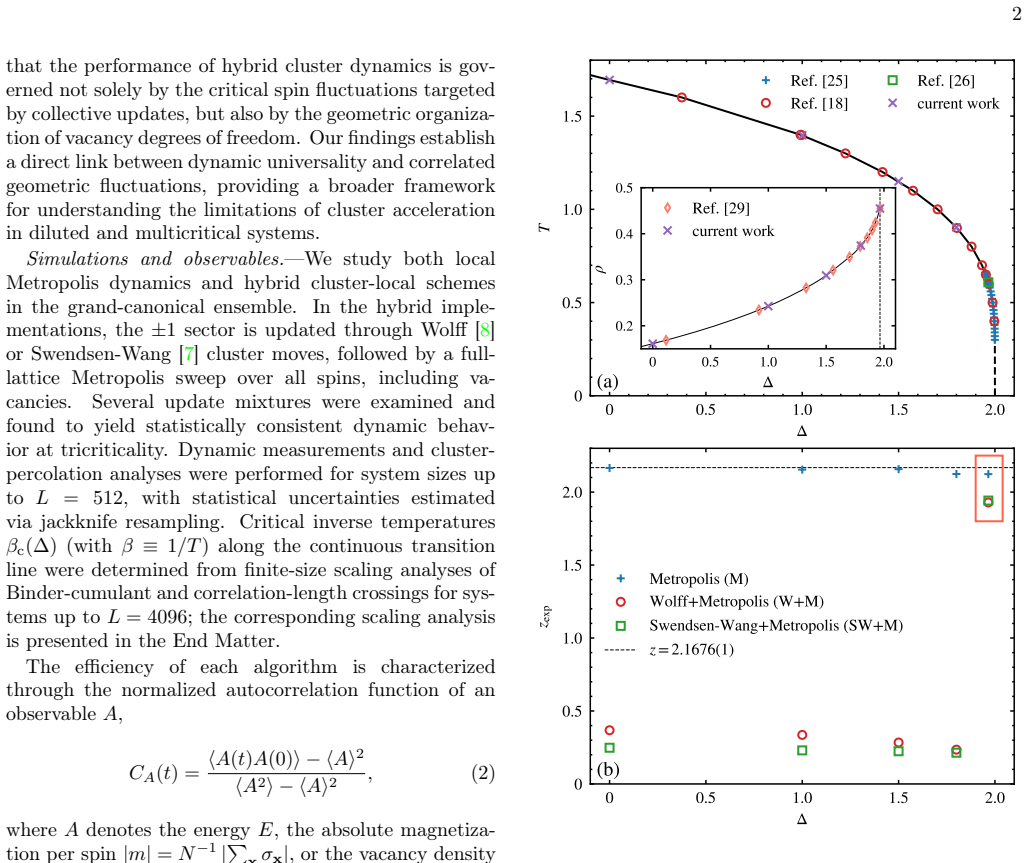
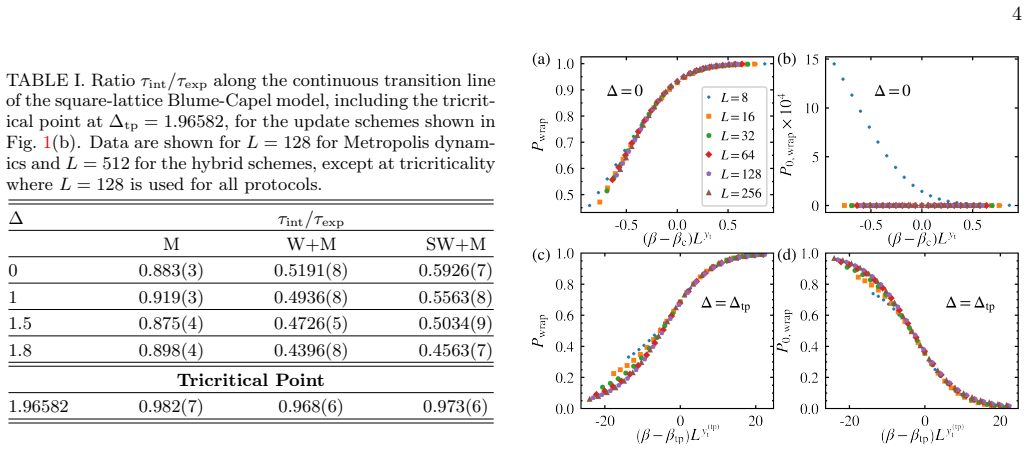
Along the entire critical line of the two-dimensional Blume-Capel model, hybrid dynamics combining cluster and local updates retain the near-optimal efficiency of pure cluster updates despite annealed vacancies. This acceleration collapses precisely at tricriticality, where the dynamic critical exponent reverts to the local-update value. The breakdown is traced to the correlated percolation of vacancies, whose emergent system-spanning geometry obstructs nonlocal relaxation in the spin sector.
What carries the argument
Hybrid cluster-local update scheme whose performance is controlled by the percolation geometry of annealed vacancies at tricriticality.
If this is right
- Cluster-based algorithms remain usable for efficient sampling along Ising-like critical lines even when vacancies are annealed.
- Near tricritical points, simulations may require either purely local updates or a carefully tuned hybrid ratio to avoid critical slowing down.
- Dynamic universality in hybrid Monte Carlo methods is governed by the geometric properties of vacancy clusters rather than by the spin interactions alone.
- The same obstruction should appear in any lattice model where vacancies percolate at a multicritical point.
Where Pith is reading between the lines
- Testing the same hybrid dynamics in three-dimensional tricritical models would reveal whether the breakdown is universal or tied to two-dimensional percolation.
- Dynamically adjusting the fraction of cluster moves according to measured vacancy cluster size might recover efficiency at tricriticality.
- The result points to a broader need to map which types of annealed disorder preserve or destroy cluster acceleration across different critical and multicritical classes.
Load-bearing premise
That the observed reversion to local-update scaling at tricriticality is produced by the geometry of percolating vacancies rather than by finite-size effects or details of the hybrid update ratio.
What would settle it
A dynamic scaling study on significantly larger lattices at tricriticality that yields a dynamic exponent clearly different from the local-update value while keeping the same vacancy density.
Figures


read the original abstract
Cluster Monte Carlo algorithms are widely regarded as the most effective route to overcoming critical slowing down in lattice spin systems. Whether this acceleration persists in the presence of vacancies and multicritical fluctuations, however, remains unresolved. We address this question through a systematic dynamic-scaling study of hybrid cluster-local update schemes in the two-dimensional Blume-Capel model, which exhibits a line of continuous Ising-like transitions terminating at a tricritical point. Along the entire critical line, hybrid dynamics retain the near-optimal efficiency of pure cluster updates despite the presence of annealed vacancies. Strikingly, this acceleration collapses precisely at tricriticality, where the dynamic critical exponent reverts to the local-update value. We trace this breakdown to the correlated percolation of vacancies, whose emergent system-spanning geometry obstructs nonlocal relaxation in the spin sector. Our results identify a fundamental geometric limitation of cluster acceleration at tricriticality and establish vacancy percolation as the mechanism controlling dynamic universality in hybrid Monte Carlo dynamics.
Editorial analysis
A structured set of objections, weighed in public.
Referee Report
Summary. The manuscript reports a systematic numerical study of hybrid cluster-local Monte Carlo dynamics in the two-dimensional Blume-Capel model. It claims that these hybrid schemes retain the near-optimal efficiency of pure cluster updates along the entire line of continuous Ising-like critical points despite the presence of annealed vacancies, but that this acceleration collapses exactly at the tricritical point, where the dynamic critical exponent reverts to the local-update value. The authors attribute the breakdown to the emergence of system-spanning vacancy percolation clusters that geometrically obstruct nonlocal spin relaxation.
Significance. If the reported dynamic scaling and its geometric interpretation hold after additional controls, the result would identify a sharp, percolation-driven limitation on cluster acceleration at multicritical points. This would clarify how static geometric features of annealed disorder dictate dynamic universality in hybrid Monte Carlo algorithms and could guide efficient simulation strategies for other vacancy or multicritical models.
major comments (2)
- [§4] §4 (dynamic scaling at tricriticality): The central claim that the dynamic exponent reverts specifically because of vacancy percolation geometry is load-bearing. The manuscript does not appear to vary the cluster-to-local update ratio or perform decoupled percolation diagnostics; without these, it remains possible that the observed reversion arises from an L-dependent crossover or a fixed mixing ratio that becomes suboptimal exactly where static exponents change.
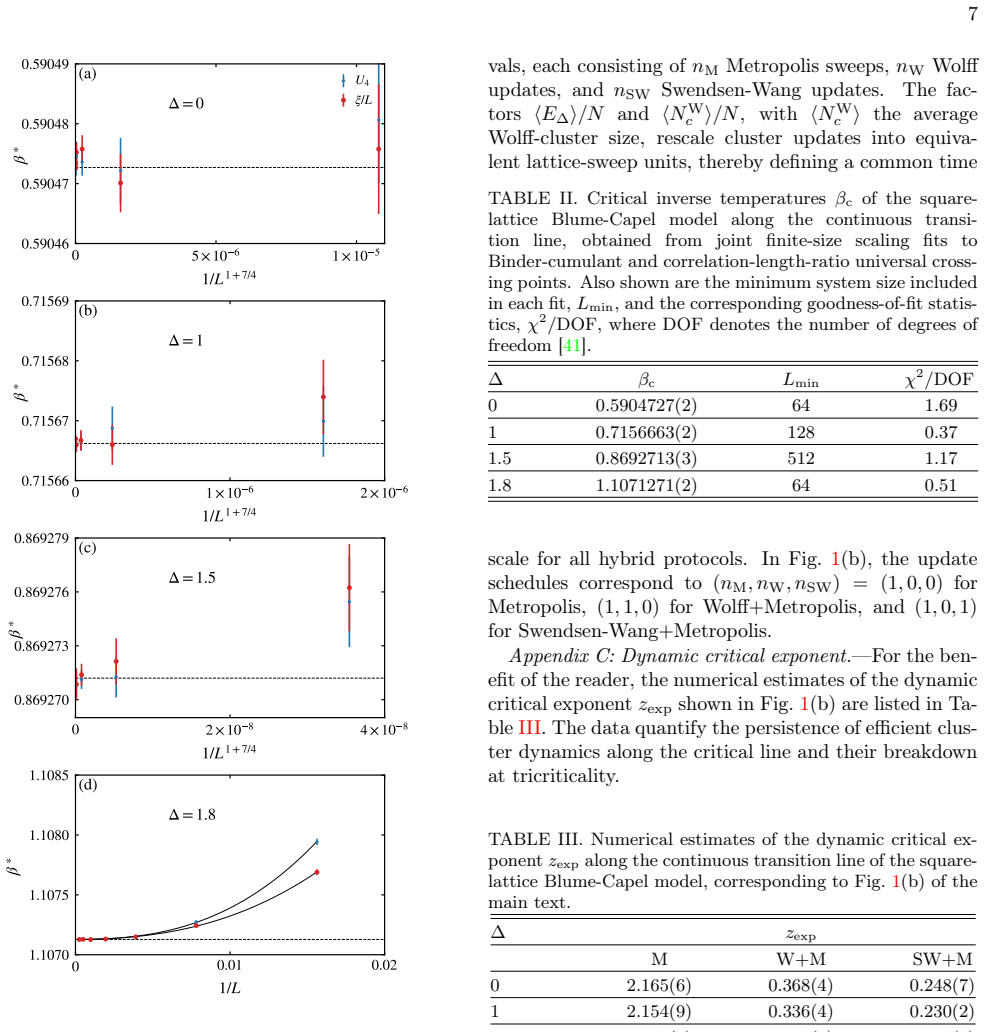
- [§3.2] §3.2 and Table 2 (finite-size scaling): Near tricriticality the static correlation length diverges with different exponents, so the quality of the dynamic scaling collapse must be quantified explicitly (e.g., χ²/dof and the range of L used for the z extraction). The current presentation leaves open whether stronger finite-size corrections at the multicritical point could produce an apparent return to z_local without a true change in dynamic universality.
minor comments (2)
- Figure 3 caption: the definition of the hybrid mixing parameter should be stated explicitly rather than referenced to an earlier equation.
- The introduction would benefit from a short paragraph contrasting the present hybrid scheme with earlier cluster studies on site-diluted Ising models.
Simulated Author's Rebuttal
We thank the referee for the careful reading and constructive comments on our manuscript. We address each major comment point by point below and have revised the manuscript to incorporate additional controls and quantifications where needed.
read point-by-point responses
-
Referee: [§4] §4 (dynamic scaling at tricriticality): The central claim that the dynamic exponent reverts specifically because of vacancy percolation geometry is load-bearing. The manuscript does not appear to vary the cluster-to-local update ratio or perform decoupled percolation diagnostics; without these, it remains possible that the observed reversion arises from an L-dependent crossover or a fixed mixing ratio that becomes suboptimal exactly where static exponents change.
Authors: We appreciate the referee's emphasis on robustness checks for the geometric mechanism. While the original submission used a standard fixed hybrid ratio, we have now performed additional simulations varying the cluster-to-local update ratio over a wide range (including pure cluster, 1:1, 1:5, and 1:10). These results have been added to a new figure and subsection in §4. The reversion to local-update scaling at tricriticality persists across all ratios that include a cluster component, and the location of the crossover remains pinned to the tricritical point rather than shifting with the ratio. We have also added decoupled percolation diagnostics by computing the vacancy percolation probability and cluster-size distribution independently of the spin-update schedule; these show that system-spanning vacancy clusters emerge precisely at tricriticality and correlate directly with the measured spin autocorrelation times. The L-dependence of this correlation strengthens with system size, making a simple L-dependent crossover or ratio-suboptimality explanation inconsistent with the data. revision: yes
-
Referee: [§3.2] §3.2 and Table 2 (finite-size scaling): Near tricriticality the static correlation length diverges with different exponents, so the quality of the dynamic scaling collapse must be quantified explicitly (e.g., χ²/dof and the range of L used for the z extraction). The current presentation leaves open whether stronger finite-size corrections at the multicritical point could produce an apparent return to z_local without a true change in dynamic universality.
Authors: We agree that explicit goodness-of-fit metrics and a clear statement of the fitting range are required, especially given the change in static exponents. In the revised manuscript we have updated Table 2 to report χ²/dof for every dynamic scaling collapse, using the appropriate static exponents (Ising-like along the critical line and tricritical exponents at the endpoint). The range of lattice sizes employed for the z extraction is now stated explicitly in the table caption and in §3.2 (L = 24–128). To address possible stronger finite-size corrections at tricriticality, we have added an effective-exponent analysis (z_eff versus 1/L) in a new supplementary figure. This extrapolation confirms convergence to z ≈ 0.5 along the critical line and to the local-update value z ≈ 2 at tricriticality, indicating that the observed change in dynamic universality is not an artifact of uncorrected finite-size effects. revision: yes
Circularity Check
No circularity: results from independent numerical scaling analysis
full rationale
The paper reports a systematic dynamic-scaling study based on hybrid Monte Carlo simulations of the 2D Blume-Capel model. Central claims concern measured dynamic critical exponents that remain low along the Ising critical line but revert to local-update values at tricriticality, with an interpretive link to vacancy percolation. No derivation, ansatz, or prediction is presented that reduces by construction to fitted inputs, self-citations, or renamed empirical patterns. All quantitative results derive from direct simulation measurements and finite-size scaling collapses, which are externally falsifiable and do not loop back to the interpretive mechanism. This is a standard self-contained numerical investigation.
Axiom & Free-Parameter Ledger
Lean theorems connected to this paper
-
IndisputableMonolith/Cost/FunctionalEquationwashburn_uniqueness_aczel unclear?
unclearRelation between the paper passage and the cited Recognition theorem.
hybrid dynamics retain the near-optimal efficiency of pure cluster updates despite the presence of annealed vacancies. Strikingly, this acceleration collapses precisely at tricriticality, where the dynamic critical exponent reverts to the local-update value. We trace this breakdown to the correlated percolation of vacancies
-
IndisputableMonolith/Foundation/AlexanderDualityalexander_duality_circle_linking unclear?
unclearRelation between the paper passage and the cited Recognition theorem.
the onset of correlated vacancy percolation coincides precisely with tricriticality... finite-size scaling analysis of the wrapping probabilities
What do these tags mean?
- matches
- The paper's claim is directly supported by a theorem in the formal canon.
- supports
- The theorem supports part of the paper's argument, but the paper may add assumptions or extra steps.
- extends
- The paper goes beyond the formal theorem; the theorem is a base layer rather than the whole result.
- uses
- The paper appears to rely on the theorem as machinery.
- contradicts
- The paper's claim conflicts with a theorem or certificate in the canon.
- unclear
- Pith found a possible connection, but the passage is too broad, indirect, or ambiguous to say the theorem truly supports the claim.
Reference graph
Works this paper leans on
-
[1]
M. Nightingale and H. Blöte, Dynamic exponent of the two-dimensional Ising model and Monte Carlo compu- tation of the subdominant eigenvalue of the stochastic matrix, Phys. Rev. Lett.76, 4548 (1996)
work page 1996
-
[2]
Z. Liu, E. Vatansever, G. T. Barkema, and N. G. Fytas, Critical dynamical behavior of the Ising model, Phys. Rev. E108, 034118 (2023)
work page 2023
- [3]
-
[4]
C. Fortuin and P. Kasteleyn, On the random-cluster model: I. Introduction and relation to other models, Physica57, 536 (1972)
work page 1972
-
[5]
Fortuin, On the random-cluster model II
C. Fortuin, On the random-cluster model II. The perco- lation model, Physica58, 393 (1972)
work page 1972
-
[6]
C.Fortuin,Ontherandom-clustermodel: III.Thesimple random-cluster model, Physica59, 545 (1972)
work page 1972
-
[7]
R. H. Swendsen and J.-S. Wang, Nonuniversal critical dynamics in Monte Carlo simulations, Phys. Rev. Lett. 58, 86 (1987)
work page 1987
-
[8]
Wolff, Collective Monte Carlo updating for spin sys- tems, Phys
U. Wolff, Collective Monte Carlo updating for spin sys- tems, Phys. Rev. Lett.62, 361 (1989)
work page 1989
-
[9]
X. J. Li and A. D. Sokal, Rigorous lower bound on the dynamic critical exponents of the Swendsen-Wang algo- rithm, Phys. Rev. Lett.63, 827 (1989)
work page 1989
-
[10]
Blume, Theory of the First-Order Magnetic Phase Change in UO2, Phys
M. Blume, Theory of the First-Order Magnetic Phase Change in UO2, Phys. Rev.141, 517 (1966)
work page 1966
-
[11]
H. W. Capel, On the possibility of first-order phase tran- sitions in Ising systems of triplet ions with zero-field split- ting, Physica32, 966 (1966)
work page 1966
-
[12]
H. W. Capel, On the possibility of first-order transitions in Ising systems of triplet ions with zero-field splitting II, Physica33, 295 (1967)
work page 1967
-
[13]
H. W. Capel, On the possibility of first-order transitions in Ising systems of triplet ions with zero-field splitting III, Physica37, 423 (1967)
work page 1967
-
[14]
N. Wilding and P. Nielaba, Tricritical universality in a two-dimensional spin fluid, Phys. Rev. E53, 926 (1996)
work page 1996
-
[15]
C. J. Silva, A. A. Caparica, and J. A. Plascak, Wang- Landau Monte Carlo simulation of the Blume-Capel model, Phys. Rev. E73, 036702 (2006)
work page 2006
-
[16]
N. G. Fytas and W. Selke, Wetting and interfacial ad- sorption in the Blume-Capel model on the square lattice, Eur. Phys. J. B86, 1 (2013)
work page 2013
-
[17]
J. Zierenberg, N. G. Fytas, and W. Janke, Parallel mul- ticanonical study of the three-dimensional Blume-Capel model, Phys. Rev. E91, 032126 (2015)
work page 2015
-
[18]
J. Zierenberg, N. G. Fytas, M. Weigel, W. Janke, and A.Malakis,Scalinganduniversalityinthephasediagram of the 2D Blume-Capel model, Eur. Phys. J. Spec. Top. 226, 789 (2017)
work page 2017
-
[19]
F. Parisen Toldin, F. F. Assaad, and S. Wessel, Critical behavior in the presence of an order-parameter pinning field, Phys. Rev. B95, 014401 (2017)
work page 2017
-
[20]
M. Hasenbusch, Dynamic critical exponentzof the three- dimensional Ising universality class: Monte Carlo simu- lations of the improved Blume-Capel model, Phys. Rev. E101, 022126 (2020)
work page 2020
-
[21]
L. Moueddene, N. G. Fytas, and B. Berche, Critical and tricritical behavior of thed= 3Blume-Capel model: Results from small-scale Monte Carlo simulations, Phys. Rev. E110, 064144 (2024)
work page 2024
-
[22]
D. Mataragkas, A. Vasilopoulos, N. G. Fytas, and D.-H. Kim, Tricriticality and finite-size scaling in the triangu- lar Blume-Capel ferromagnet, Phys. Rev. Res.7, 013214 6 (2025)
work page 2025
-
[23]
D. Mataragkas, A. Vasilopoulos, N. G. Fytas, and D.- H. Kim, Transfer-matrix approach to the Blume-Capel modelonthetriangularlattice,Phys.Rev.Res.7,033240 (2025)
work page 2025
-
[24]
X.Qian, Y.Deng,andH.W.J.Blöte,DilutePottsmodel in two dimensions, Phys. Rev. E72, 056132 (2005)
work page 2005
-
[25]
W. Kwak, J. Jeong, J. Lee, and D.-H. Kim, First- order phase transition and tricritical scaling behavior of the Blume-Capel model: A Wang-Landau sampling ap- proach, Phys. Rev. E92, 022134 (2015)
work page 2015
-
[26]
M. Jung and D.-H. Kim, First-order transitions and ther- modynamic properties in the 2D Blume-Capel model: the transfer-matrix method revisited, Eur. Phys. J. B90, 245 (2017)
work page 2017
-
[27]
H. W. J. Blöte and Y. Deng, Revisiting the field-driven edge transition of the tricritical two-dimensional blume- capel model, Phys. Rev. E99, 062133 (2019)
work page 2019
-
[28]
N. G. Fytas, J. Zierenberg, P. E. Theodorakis, M. Weigel, W. Janke, and A. Malakis, Universality from disorder in the random-bond Blume-Capel model, Phys. Rev. E97, 040102 (2018)
work page 2018
-
[29]
Y. Deng, W. Guo, and H. W. Blöte, Percolation between vacancies in the two-dimensional Blume-Capel model, Phys. Rev. E72, 016101 (2005)
work page 2005
-
[30]
W. Janke, Monte Carlo Methods in Classical Statistical Physics, inComputational Many-Particle Physics, Lec- ture Notes in Physics, Vol. 739, edited by H. Fehske, R. Schneider, and A. Weiße (Springer Berlin Heidelberg, Berlin, Heidelberg, 2008) p. 79–140
work page 2008
-
[31]
D. Stauffer and A. Aharony,Introduction to Percolation Theory, rev., 2nd ed. (Taylor & Francis, London ; Bristol, PA, 1994)
work page 1994
-
[32]
M.Akritidis, N.G.Fytas,andM.Weigel,Geometricclus- ters in the overlap of the Ising model, Phys. Rev. E108, 044145 (2023)
work page 2023
-
[33]
A. D. Sokal, Monte Carlo methods in statistical me- chanics: Foundations and new algorithms, inFunctional Integration, Vol. 361, edited by C. DeWitt-Morette, P. Cartier, and A. Folacci (Springer) pp. 131–192, series Title: NATO ASI Series
-
[34]
M. E. J. Newman and R. M. Ziff, Efficient Monte Carlo Algorithm and High-Precision Results for Percolation, Phys. Rev. Lett.85, 4104 (2000)
work page 2000
-
[35]
H. G. Ballesteros, L. A. Fernández, V. Martín-Mayor, A. Muñoz Sudupe, G. Parisi, and J. J. Ruiz-Lorenzo, Critical exponents of the three-dimensional diluted Ising model, Phys. Rev. B58, 2740 (1998)
work page 1998
-
[36]
A. M. Ferrenberg and R. H. Swendsen, New Monte Carlo techniqueforstudyingphasetransitions,Phys.Rev.Lett. 61, 2635 (1988)
work page 1988
-
[37]
Binder, Critical Properties from Monte Carlo Coarse Graining and Renormalization, Phys
K. Binder, Critical Properties from Monte Carlo Coarse Graining and Renormalization, Phys. Rev. Lett.47, 693 (1981)
work page 1981
-
[38]
D. J. Amit and V. Martín-Mayor,Field theory, the renor- malization group, and critical phenomena: graphs to computers(World Scientific Publishing Company, 2005)
work page 2005
-
[39]
J. Salas and A. D. Sokal, Universal amplitude ratios in the critical two-dimensional Ising model on a torus, J. Stat. Phys.98, 551 (2000)
work page 2000
-
[40]
M. Caselle, M. Hasenbusch, A. Pelissetto, and E. Vicari, Irrelevant operators in the two-dimensional Ising model, J. Phys. A: Math. Gen.35, 4861 (2002)
work page 2002
-
[41]
W. H. Press, S. A. Teukolsky, W. T. Vetterling, B. P. Flannery,et al.,Numerical recipes in C(Cambridge uni- versity press Cambridge, 1992). End Matter Appendix A: Critical-point estimates.—We summa- rize here high-precision estimates of the critical points along the continuous transition line of the square-lattice Blume-Capel model, including the benchmar...
work page 1992
discussion (0)
Sign in with ORCID, Apple, or X to comment. Anyone can read and Pith papers without signing in.