Recognition: no theorem link
Anomalous magnetotransport in a non-collinear correlated kagome ferromagnet MgMn6Sn6
Pith reviewed 2026-05-11 03:23 UTC · model grok-4.3
The pith
MgMn6Sn6 shows a large intrinsic anomalous Hall conductivity of 0.29 e²/h per kagome layer that stays nearly constant with field direction.
A machine-rendered reading of the paper's core claim, the machinery that carries it, and where it could break.
Core claim
Single-crystal neutron diffraction reveals a non-collinear in-plane arrangement of Mn moments within the kagome bilayer. Magnetotransport measurements combined with first-principles calculations then show that the anomalous Hall conductivity contains a substantial intrinsic contribution of approximately 0.29 e²/h per kagome layer that is nearly isotropic with respect to field orientation. At low temperatures this conductivity acquires a pronounced anisotropic extrinsic component. The large Sommerfeld coefficient, observed in the absence of f-electrons, is interpreted as a signature of enhanced electron correlation driven by the non-collinear magnetic order.
What carries the argument
The non-collinear arrangement of Mn magnetic moments within the basal plane of the kagome bilayer, which generates a substantial Berry-curvature-driven intrinsic anomalous Hall conductivity while also modulating low-temperature scattering.
Load-bearing premise
That the large Sommerfeld coefficient directly signals enhanced electron correlation caused by the absence of f-electrons and that the non-collinear magnetic structure is the main driver of the observed magnetotransport features.
What would settle it
Neutron diffraction data showing collinear rather than non-collinear Mn moments, or first-principles Berry-curvature calculations yielding an intrinsic Hall conductivity far below 0.29 e²/h per layer, would falsify the claimed intrinsic contribution and its link to the magnetic structure.
Figures
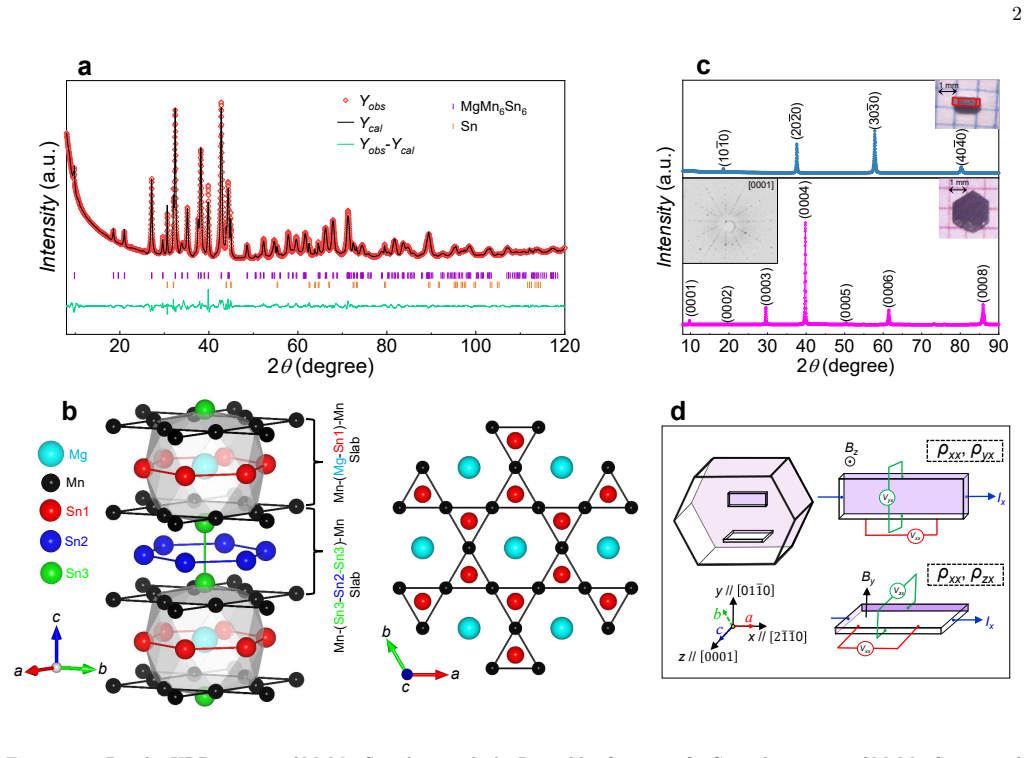


read the original abstract
Magnetic kagome metals provide a fertile platform for exploring unusual magnetotransport phenomena arising from the intricate interplay between electronic topology, electron correlations, and magnetic order. MgMn6Sn6 is a room-temperature kagome ferromagnet with strong in-plane magnetic anisotropy. Here, we report a combined study of single-crystal neutron diffraction (SCND) and magnetotransport properties of MgMn6Sn6, supported by first-principles calculations. Our SCND measurements reveal a non-collinear arrangement of Mn magnetic moments within the basal plane of the kagome bilayer. The Hall conductivity shows a substantial intrinsic contribution of approximately 0.29 e^2/h per kagome layer, which is nearly isotropic with respect to the field orientation. At low temperatures, the anomalous Hall conductivity develops a pronounced anisotropic extrinsic component, highlighting the directional sensitivity of scattering processes. The significantly large value of the Sommerfeld coefficient, in the absence of f-electrons, underscores enhanced electron correlation. Therefore, the non-collinear kagome ferromagnet MgMn6Sn6 is a promising candidate for studying the effects of electron correlation on magnetotransport properties.
Editorial analysis
A structured set of objections, weighed in public.
Referee Report
Summary. The manuscript reports single-crystal neutron diffraction (SCND) measurements on MgMn6Sn6 revealing a non-collinear arrangement of Mn moments within the kagome bilayer basal plane. Combined with magnetotransport data and first-principles calculations, it identifies a substantial intrinsic anomalous Hall conductivity of approximately 0.29 e²/h per kagome layer that is nearly isotropic with field orientation, an anisotropic extrinsic component that emerges at low temperatures, and a large Sommerfeld coefficient interpreted as evidence of enhanced electron correlations in the absence of f-electrons.
Significance. If the central claims hold, the work adds a well-characterized example of Berry-phase-driven anomalous Hall effect in a non-collinear kagome ferromagnet, with the reported intrinsic value and its isotropy providing a concrete benchmark. The explicit use of SCND to establish the magnetic structure, standard separation of intrinsic versus extrinsic Hall contributions, and supporting calculations constitute a strength; the Sommerfeld-coefficient discussion is supplementary and does not underpin the magnetotransport results.
minor comments (3)
- [Abstract] The abstract states numerical values for the Hall conductivity and Sommerfeld coefficient without error bars or fitting details; the full manuscript should ensure these uncertainties, raw data, and analysis procedures are clearly presented in the results and methods sections.
- The normalization of the Hall conductivity per kagome layer is central to the isotropy claim; a brief explicit statement of the layer thickness or unit-cell volume used for this conversion would improve clarity.
- Figure captions and text should consistently distinguish the temperature regimes where the extrinsic anisotropic component dominates from the higher-temperature isotropic intrinsic regime.
Simulated Author's Rebuttal
We thank the referee for the careful reading of our manuscript and the positive overall assessment. The recommendation for minor revision is noted. No specific major comments were provided in the report, so we have no point-by-point responses to address. We will incorporate minor improvements to the manuscript in the revised version.
Circularity Check
No significant circularity detected
full rationale
The paper's claims rest on experimental SCND data for the non-collinear Mn structure, direct magnetotransport measurements yielding the Hall conductivity values, and standard first-principles Berry curvature computations to separate intrinsic (~0.29 e²/h per layer) and extrinsic contributions. No equations, fits, or predictions reduce by construction to the paper's own inputs or self-citations; the Sommerfeld coefficient discussion is supplementary and does not drive the magnetotransport results. The derivation chain is self-contained against external benchmarks with no load-bearing self-referential steps.
Axiom & Free-Parameter Ledger
axioms (2)
- domain assumption Standard decomposition of anomalous Hall conductivity into intrinsic (Berry curvature) and extrinsic (scattering) contributions
- domain assumption Large Sommerfeld coefficient indicates enhanced electron correlations in the absence of f-electrons
Reference graph
Works this paper leans on
-
[1]
(Ω·cm)−1 whichareindependentofthescatteringrate, consistent with a system possessing significant Berry cur- vature contributions. Therefore, the intrinsic AHC,σint xy, of MgMn6Sn6 is estimated to be∼0.29e 2/hper kagome layer. This value is comparable to those reported for other members of the rare-earth basedRMn6Sn6 family, 7 -4 -2 0 2 4-6 -3 0 3 6 ryx (m...
work page 2021
- [2]
-
[3]
J.-X. Yin, S. S. Zhang, H. Li, K. Jiang, G. Chang, B. Zhang, B. Lian, C. Xiang, I. Belopolski, H. Zheng, et al., Giant and anisotropic many-body spin-orbit tun- ability in a strongly correlated kagome magnet, Nature 562, 91 (2018)
work page 2018
-
[4]
S. Paschen and Q. Si, Quantum phases driven by strong correlations, Nature Reviews Physics3, 9 (2021)
work page 2021
-
[5]
E. Morosan, D. Natelson, A. H. Nevidomskyy, and Q. Si, Strongly correlated materials, Advanced Materials24, 4896 (2012)
work page 2012
-
[6]
Y. Wang, H. Wu, G. T. McCandless, J. Y. Chan, and M. N. Ali, Quantum states and intertwining phases in kagome materials, Nature Reviews Physics5, 635 (2023)
work page 2023
-
[7]
D. Di Sante, T. Neupert, G. Sangiovanni, R. Thomale, R. Comin, J. G. Checkelsky, I. Zeljkovic, and S. D. Wil- son, Kagome metals, Reviews of Modern Physics98, 015002 (2026)
work page 2026
-
[8]
Z. Li, J. Zhuang, L. Wang, H. Feng, Q. Gao, X. Xu, W. Hao, X. Wang, C. Zhang, K. Wu,et al., Realization offlatbandwithpossiblenontrivialtopologyinelectronic kagome lattice, Science advances4, eaau4511 (2018)
work page 2018
-
[9]
M. Kang, L. Ye, S. Fang, J.-S. You, A. Levitan, M. Han, J. I. Facio, C. Jozwiak, A. Bostwick, E. Rotenberg,et al., Dirac fermions and flat bands in the ideal kagome metal FeSn, Nature materials19, 163 (2020)
work page 2020
-
[10]
Y. Hu, X. Wu, Y. Yang, S. Gao, N. C. Plumb, A. P. Schnyder, W.Xie, J.Ma,andM.Shi,Tunabletopological dirac surface states and van hove singularities in kagome metal GdV6Sn6, Science Advances8, eadd2024 (2022)
work page 2022
-
[11]
T. Neupert, M. M. Denner, J.-X. Yin, R. Thomale, and M. Z. Hasan, Charge order and superconductivity in kagome materials, Nature Physics18, 137 (2022)
work page 2022
-
[12]
X. Teng, L. Chen, F. Ye, E. Rosenberg, Z. Liu, J.-X. Yin, Y.-X. Jiang, J. S. Oh, M. Z. Hasan, K. J. Neubauer, et al., Discovery of charge density wave in a kagome lat- tice antiferromagnet, Nature609, 490 (2022)
work page 2022
- [13]
-
[14]
M. Kang, S. Fang, J. Yoo, B. R. Ortiz, Y. M. Oey, J. Choi, S. H. Ryu, J. Kim, C. Jozwiak, A. Bostwick, et al., Charge order landscape and competition with su- perconductivity in kagome metals, Nature Materials22, 186 (2023)
work page 2023
-
[15]
P. Park, B. R. Ortiz, M. Sprague, A. P. Sakhya, S. A. Chen, M. D. Frontzek, W. Tian, R. Sibille, D. G. Maz- zone, C. Tabata,et al., Spin density wave and van hove singularity in the kagome metal CeTi3Bi4, Nature Com- munications16, 4384 (2025)
work page 2025
-
[16]
R. Karplus and J. Luttinger, Hall effect in ferromagnet- ics, Physical Review95, 1154 (1954)
work page 1954
-
[17]
Smit, The spontaneous hall effect in ferromagnetics i, Physica21, 877 (1955)
J. Smit, The spontaneous hall effect in ferromagnetics i, Physica21, 877 (1955)
work page 1955
-
[18]
Smit, The spontaneous hall effect in ferromagnetics ii, Physica24, 39 (1958)
J. Smit, The spontaneous hall effect in ferromagnetics ii, Physica24, 39 (1958)
work page 1958
-
[19]
N. Nagaosa, J. Sinova, S. Onoda, A. H. MacDonald, and N. P. Ong, Anomalous hall effect, Reviews of modern physics82, 1539 (2010)
work page 2010
-
[20]
E. Liu, Y. Sun, N. Kumar, L. Muechler, A. Sun, L. Jiao, S.-Y. Yang, D. Liu, A. Liang, Q. Xu,et al., Giant anomalous hall effect in a ferromagnetic kagome-lattice semimetal, Nature physics14, 1125 (2018)
work page 2018
-
[21]
X. Li, L. Xu, L. Ding, J. Wang, M. Shen, X. Lu, Z. Zhu, and K. Behnia, Anomalous nernst and righi-leduc effects in Mn3Sn: Berry curvature and entropy flow, Physical review letters119, 056601 (2017)
work page 2017
- [22]
-
[23]
L. Ye, M. Kang, J. Liu, F. Von Cube, C. R. Wicker, T. Suzuki, C. Jozwiak, A. Bostwick, E. Rotenberg, D. C. Bell,et al., Massive dirac fermions in a ferromagnetic kagome metal, Nature555, 638 (2018)
work page 2018
-
[24]
Q. Wang, S. Sun, X. Zhang, F. Pang, and H. Lei, Anoma- lous hall effect in a ferromagnetic Fe3Sn2 single crystal with a geometrically frustrated Fe bilayer kagome lattice, Phys. Rev. B94, 075135 (2016)
work page 2016
-
[25]
Q. Du, Z. Hu, M.-G. Han, F. Camino, Y. Zhu, and C. Petrovic, Topological hall effect anisotropy in kagome bilayer metal Fe 3Sn2, Physical Review Letters129, 236601 (2022)
work page 2022
-
[26]
B. P. Belbase, L. Ye, B. Karki, J. I. Facio, J.-S. You, J. G. Checkelsky, J. Van Den Brink, and M. P. Ghimire, Large anomalous hall effect in single crystals of the kagome weyl ferromagnet Fe3Sn, Physical Review B108, 075164 (2023)
work page 2023
-
[27]
B. R. Ortiz, H. Miao, D. S. Parker, F. Yang, G. D. Samolyuk, E. M. Clements, A. Rajapitamahuni, T. Yil- maz, E. Vescovo, J. Yan,et al., Evolution of highly anisotropic magnetism in the titanium-based kagome metalsLnTi 3Bi4 (Ln: La···Gd 3+, Eu2+, Yb2+), Chem- istry of Materials35, 9756 (2023)
work page 2023
-
[28]
W. Ma, X. Xu, J.-X. Yin, H. Yang, H. Zhou, Z.-J. Cheng, Y. Huang, Z. Qu, F. Wang, M. Z. Hasan, and S. Jia, Rare earth engineering inRMn 6Sn6 (R= Gd-Tm, Lu) topo- logical kagome magnets, Phys. Rev. Lett.126, 246602 (2021)
work page 2021
-
[29]
Y. Lee, R. Skomski, X. Wang, P. P. Orth, Y. Ren, B. Kang, A. K. Pathak, A. Kutepov, B. N. Harmon, R. J. McQueeney, I. I. Mazin, and L. Ke, Interplay between magnetism and band topology in the kagome magnets RMn6Sn6, Phys. Rev. B108, 045132 (2023)
work page 2023
-
[30]
S.X.Riberolles, T.Han, T.J.Slade, J.M.Wilde, A.Sap- kota, W. Tian, Q. Zhang, D. L. Abernathy, L. D. San- jeewa, S. Bud’ko,et al., New insight into tuning magnetic phases ofRMn 6Sn6 kagome metals, npj Quantum Mate- rials9, 42 (2024)
work page 2024
- [31]
-
[32]
J.-X. Yin, W. Ma, T. A. Cochran, X. Xu, S. S. Zhang, H.-J. Tien, N. Shumiya, G. Cheng, K. Jiang, B. Lian, et al., Quantum-limit chern topological magnetism in TbMn6Sn6, Nature583, 533 (2020). 13
work page 2020
-
[33]
D. C. Jones, S. Das, H. Bhandari, X. Liu, P. Siegfried, M. P. Ghimire, S. S. Tsirkin, I. Mazin, and N. J. Ghimire, Origin of spin reorientation and intrinsic anomalous hall effectinthekagomeferrimagnetTbMn 6Sn6,PhysicalRe- view B110, 115134 (2024)
work page 2024
-
[34]
L. Gao, S. Shen, Q. Wang, W. Shi, Y. Zhao, C. Li, W. Cao, C. Pei, J.-Y. Ge, G. Li,et al., Anomalous hall ef- fect in ferrimagnetic metalRMn6Sn6 (R= Tb, Dy, Ho) with clean Mn kagome lattice, Applied Physics Letters 119(2021)
work page 2021
-
[35]
K. Fruhling, A. Streeter, S. Mardanya, X. Wang, P. Baral, O. Zaharko, I. I. Mazin, S. Chowdhury, W. D. Ratcliff, and F. Tafti, Topological hall effect induced by chiral fluctuations in ErMn6Sn6, Phys. Rev. Mater.8, 094411 (2024)
work page 2024
-
[36]
B. Wang, E. Yi, L. Li, J. Qin, B.-F. Hu, B. Shen, and M. Wang, Magnetotransport properties of the kagome magnet TmMn6Sn6, Phys. Rev. B106, 125107 (2022)
work page 2022
- [37]
-
[38]
N. J. Ghimire, R. L. Dally, L. Poudel, D. Jones, D. Michel, N. T. Magar, M. Bleuel, M. A. McGuire, J. Jiang, J. Mitchell,et al., Competing magnetic phases and fluctuation-driven scalar spin chirality in the kagome metal YMn6Sn6, Science Advances6, eabe2680 (2020)
work page 2020
-
[39]
S. Mozaffari, S.-H. Do, R. P. Madhogaria, A. F. Savvi- dou, B. W. Casas, W. R. Meier, R. Xue, E. S. Choi, L. Balicas, and D. G. Mandrus, Diverse magnetic phase diagram and anomalous hall effect in antiferromagnetic LuMn6Sn6, Phys. Rev. B112, 115147 (2025)
work page 2025
- [40]
-
[41]
D. Chen, C. Le, C. Fu, H. Lin, W. Schnelle, Y. Sun, and C. Felser, Large anomalous hall effect in the kagome fer- romagnet LiMn6Sn6, Phys. Rev. B103, 144410 (2021)
work page 2021
- [42]
-
[43]
Z. Song, Z. Chen, X. Kan, S. Wang, M. Wang, G. Zheng, and Y. Ma, Magnetocaloric effect in kagome MgMn6Sn6, Materials Today Physics46, 101493 (2024)
work page 2024
-
[44]
Z. Song, Z. Chen, X. Kan, S. Wang, C. Zhu, M. Wang, G. Zheng, and Y. Ma, Critical behavior in the ferromag- net MgMn6Sn6 single crystal with HfFe6Ge6-type struc- ture, Journal of Magnetism and Magnetic Materials601, 172182 (2024)
work page 2024
- [45]
-
[46]
G. Venturini, Filling the CoSn host-cell: the HfFe6Ge6- type and the related structures, Zeitschrift für Kristallographie-Crystalline Materials221, 511 (2006)
work page 2006
-
[47]
R. Pal, K. Deb, N. Kumar, B. Büchner, A. Alfonsov, and V. Kataev, Ferromagnetic resonance spectroscopy on the kagome magnet MgMn6Sn6, Applied Magnetic Res- onance56, 1507 (2025)
work page 2025
-
[48]
V. Petříček, L. Palatinus, J. Plášil, and M. Dušek, Jana2020-a new version of the crystallographic com- puting system jana, Zeitschrift für Kristallographie- Crystalline Materials238, 271 (2023)
work page 2023
- [49]
-
[50]
S. Chen, Z. Zhang, V. Antropov, and Y. Sun, Compu- tational discovery of ferromagneticAT6X 6 kagome com- pounds, arXiv preprint arXiv:2512.13431 (2025)
work page internal anchor Pith review Pith/arXiv arXiv 2025
- [51]
-
[52]
Berger, Side-jump mechanism for the hall effect of fer- romagnets, Physical Review B2, 4559 (1970)
L. Berger, Side-jump mechanism for the hall effect of fer- romagnets, Physical Review B2, 4559 (1970)
work page 1970
-
[53]
Y. Tian, L. Ye, and X. Jin, Proper scaling of the anoma- lous hall effect, Physical review letters103, 087206 (2009)
work page 2009
-
[54]
W. Ma, X. Xu, Z. Wang, H. Zhou, M. Marshall, Z. Qu, W. Xie, and S. Jia, Anomalous hall effect in the distorted kagome magnets (Nd, Sm)Mn6Sn6, Phys. Rev. B103, 235109 (2021)
work page 2021
- [55]
-
[56]
M. Lyu, Y. Liu, S. Zhang, J. Liu, J. Yang, Y. Wang, Y. Feng, X. Dong, B. Wang, H. Wei,et al., Anomalous hall effect and electronic correlation in a spin-reoriented kagome antiferromagnet LuFe6Sn6, Chinese Physics B 33, 107507 (2024)
work page 2024
- [57]
-
[58]
G. Pokharel, S. M. Teicher, B. R. Ortiz, P. M. Sarte, G. Wu, S. Peng, J. He, R. Seshadri, and S. D. Wilson, Electronic properties of the topological kagome metals YV6Sn6 and GdV6Sn6, Physical Review B104, 235139 (2021)
work page 2021
- [59]
-
[60]
Z. Riedel, P. Murgatroyd, C. Kengle, P. Vianez, A. Schmidt, X. Du, K. Allen, T. Kim, C. Lane, Y. W. Li,et al., Structural modulation, physical properties, and electronic band structure of the kagome metal UCr6Ge6, arXiv preprint arXiv:2511.05376 (2025)
work page internal anchor Pith review arXiv 2025
-
[61]
L. Li, S. Chi, W. Ma, K. Guo, G. Xu, and S. Jia, Enhanced anomalous hall effect in kagome magnet YbMn6Sn6 withintermediate-valenceytterbium,Chinese Physics B33, 057501 (2024)
work page 2024
-
[62]
H. Wang, L. Jiang, Z. Zhou, R. Wang, A. Wang, Y. Chai, M. He, G. Han, J. Ying, X. Lu,et al., Magnetic frus- tration driven high thermoelectric performance in the kagome antiferromagnet YMn6Sn6, Physical Review B 108, 155135 (2023). 14
work page 2023
-
[63]
Y.Xiao, Y.Chen, H.Ni, Y.Li, Z.Wen, Y.Cui, Y.Zhang, S. Liu, C. Wang, R. Zhong,et al., Preparation, crystal structure, and properties of the kagome metal ThV6Sn6, Inorganic Chemistry63, 23288 (2024)
work page 2024
- [64]
- [65]
-
[66]
K. Guo, J. Ye, S. Guan, and S. Jia, Triangular kondo lattice in YbV6Sn6 and its quantum critical behavior in a magnetic field, Physical Review B107, 205151 (2023)
work page 2023
- [67]
-
[68]
Y. Xiao, Q. Duan, X. Xu, Z. Li, S. Guo, H. Tan, and R. Zhong, Kagome metal GdNb6Sn6: A 4d transition metal playground for topological magnetism and electron correlations, Physical Review B111, 205103 (2025)
work page 2025
-
[69]
G. Pokharel, B. Ortiz, J. Chamorro, P. Sarte, L. Kautzsch, G. Wu, J. Ruff, and S. D. Wilson, Highly anisotropic magnetism in the vanadium-based kagome metal TbV6Sn6, Physical Review Materials6, 104202 (2022)
work page 2022
-
[70]
S. M. Thomas, C. S. Kengle, W. Simeth, C.-y. Lim, Z. W. Riedel, K. Allen, A. Schmidt, M. Ruf, S. Gim, J. D. Thompson,et al., Unusual 5f magnetism in new kagome material UV6Sn6, npj Quantum Materials10, 66 (2025)
work page 2025
-
[71]
J.-G. Cheng, J.-S. Zhou, Y.-F. Yang, H. Zhou, K. Mat- subayashi, Y. Uwatoko, A. MacDonald, and J. Good- enough, Possible kondo physics near a metal-insulator crossover in theA-site ordered perovskite CaCu3Ir4O12, Physical Review Letters111, 176403 (2013)
work page 2013
-
[72]
M. Laad, L. Craco, and E. Müller-Hartmann, Heavy- fermion behavior of the spinel-based transition-metal ox- ide LiV2O4, Physical Review B67, 033105 (2003)
work page 2003
-
[73]
H. Kotegawa, M. Matsuda, F. Ye, Y. Tani, K. Uda, Y. Kuwata, H. Tou, E. Matsuoka, H. Sugawara, T. Saku- rai,et al., Helimagnetic structure and heavy-fermion-like behavior in the vicinity of the quantum critical point in Mn3P, Physical Review Letters124, 087202 (2020)
work page 2020
-
[74]
C. P. Agilent and P. CrysAlis, Agilent technologies ltd, Yarnton, Oxfordshire, England2014(2014)
work page 2014
-
[75]
D. A. Keen, M. J. Gutmann, and C. C. Wilson, SXD - the single-crystal diffractometer at the ISIS spallation neutron source, Journal of Applied Crystallography39, 714 (2006)
work page 2006
-
[76]
M. Gutmann, SXD2001 - a program for treating data from tof neutron single-crystal diffraction, Acta Crystal- lographica Section A61, c164 (2005)
work page 2005
-
[77]
P. J. Becker and P. Coppens, Extinction within the limit of validity of the darwin transfer equations. i. general for- malism for primary and secondary extinction and their applications to spherical crystals, Foundations of Crys- tallography30, 129 (1974)
work page 1974
-
[78]
J. Hafner, Ab-initio simulations of materials using vasp: Density-functional theory and beyond, Journal of Com- putational Chemistry29, 2044 (2008)
work page 2044
-
[79]
J. P. Perdew and Y. Wang, Accurate and simple ana- lyticrepresentationoftheelectron-gascorrelationenergy, Phys. Rev. B45, 13244 (1992)
work page 1992
-
[80]
G. Kresse and D. Joubert, From ultrasoft pseudopoten- tials to the projector augmented-wave method, Physical review b59, 1758 (1999)
work page 1999
discussion (0)
Sign in with ORCID, Apple, or X to comment. Anyone can read and Pith papers without signing in.