Recognition: 2 theorem links
· Lean TheoremTopological Blocking of the Schwinger Effect in the Salpeter Equation: A Lefschetz Thimble Analysis
Pith reviewed 2026-05-11 03:20 UTC · model grok-4.3
The pith
The Salpeter equation blocks the Schwinger effect through topological features of its complex solution space.
A machine-rendered reading of the paper's core claim, the machinery that carries it, and where it could break.
Core claim
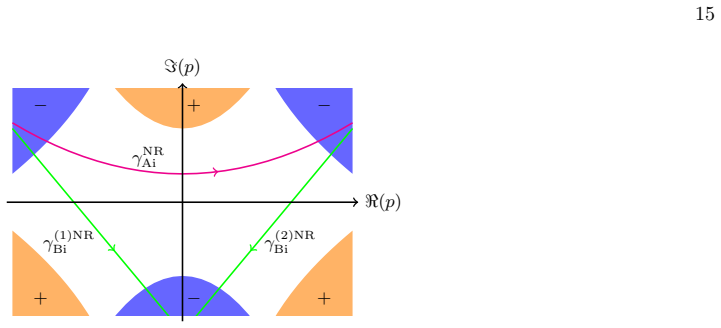
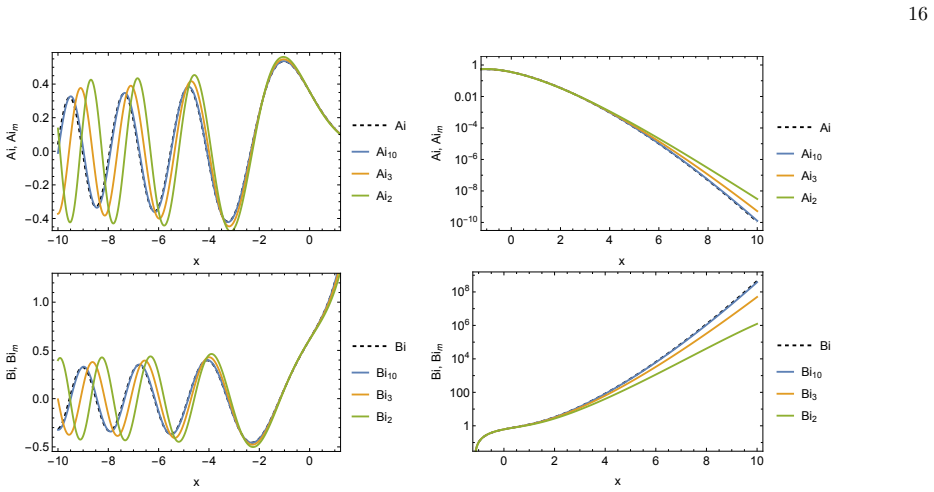
Through Lefschetz thimble analysis of the Salpeter equation in a strong electric field, the full solution space is constructed via algebraic treatment of the square-root operator, producing relativistic Airy functions and their negative-energy versions. Comparison with the Dirac and Klein-Gordon equations shows that the thimble structure in the Salpeter case blocks the paths associated with the Klein paradox and Schwinger pair production. This supplies a unified geometric interpretation of the Schwinger effect across relativistic wave equations.
What carries the argument
Lefschetz thimble contours in the complex plane that select the allowed integration paths for the Salpeter solutions and enforce the topological obstruction to pair-producing saddles.
If this is right
- The same thimble geometry accounts for the absence of the Klein paradox in the Salpeter equation.
- The Dirac and Klein-Gordon equations permit the Schwinger effect because their corresponding thimble contours connect the relevant saddles.
- The unified geometric view classifies the presence or absence of pair production according to the operator structure of each wave equation.
Where Pith is reading between the lines
- The Lefschetz thimble approach may apply to other non-local wave equations to predict similar blocking of vacuum instabilities.
- Physical systems approximated by the Salpeter equation could exhibit suppressed strong-field pair creation compared to Dirac-like dynamics.
- Topology of complex contours offers a general diagnostic for when relativistic equations allow or forbid non-perturbative effects under external fields.
Load-bearing premise
Algebraic analysis of the non-local square-root operator fully determines the solution space in a manner that exposes the geometric blocking of non-perturbative processes.
What would settle it
An explicit computation or measurement of a non-zero Schwinger pair-production rate for the Salpeter equation in a strong electric field would falsify the topological blocking.
Figures





read the original abstract
We present a comprehensive Lefschetz thimble analysis of the one-dimensional Salpeter equation under a strong electric field. By treating the non-local square-root operator within the framework of algebraic analysis, we construct the full solution space, which includes relativistic generalizations of the Airy Ai and Bi functions and their negative-energy counterparts. Through a direct comparison with the Dirac and Klein-Gordon equations, we provide a geometric explanation for the absence of Klein paradox and the Schwinger effect in the Salpeter equation. Furthermore, our findings establish a unified geometric interpretation of the Schwinger effect across different relativistic wave equations.
Editorial analysis
A structured set of objections, weighed in public.
Referee Report
Summary. The paper performs a Lefschetz thimble analysis of the one-dimensional Salpeter equation in a strong electric field. Treating the non-local square-root operator via algebraic analysis, it constructs the full solution space consisting of relativistic generalizations of the Airy Ai and Bi functions together with their negative-energy partners. Direct comparison with the Dirac and Klein-Gordon equations is used to argue that the geometry of the thimbles produces a topological obstruction responsible for the absence of both the Klein paradox and the Schwinger effect in the Salpeter case, thereby furnishing a unified geometric interpretation of pair production across relativistic wave equations.
Significance. If the claimed completeness of the solution space and the absence of connecting Stokes lines are rigorously established, the work would supply a concrete geometric mechanism distinguishing the Salpeter equation from its local relativistic counterparts. This could clarify why pair production is suppressed in certain non-local formulations and might serve as a template for similar analyses in other strong-field problems. The approach is technically ambitious but hinges on details of contour deformation that are not yet visible in the abstract.
major comments (1)
- [Main analysis (method and solution-space construction)] The central claim that algebraic analysis of the non-local square-root operator yields the complete solution space (relativistic Airy Ai/Bi functions and negative-energy partners) whose Lefschetz thimbles exhibit a topological obstruction is load-bearing for the unified geometric interpretation. No explicit verification is supplied that the chosen contours capture all relevant saddles or that no additional Stokes lines connect the positive- and negative-energy sectors; without this step the asserted blocking of the Schwinger effect remains an assumption rather than a derived result.
minor comments (1)
- [Abstract] The abstract is dense and would benefit from a single sentence clarifying the precise contour deformation that produces the claimed obstruction.
Simulated Author's Rebuttal
We thank the referee for their careful reading and for identifying the need for more explicit verification of the solution-space completeness and Stokes-line structure. We address this point directly below and will strengthen the manuscript accordingly.
read point-by-point responses
-
Referee: The central claim that algebraic analysis of the non-local square-root operator yields the complete solution space (relativistic Airy Ai/Bi functions and negative-energy partners) whose Lefschetz thimbles exhibit a topological obstruction is load-bearing for the unified geometric interpretation. No explicit verification is supplied that the chosen contours capture all relevant saddles or that no additional Stokes lines connect the positive- and negative-energy sectors; without this step the asserted blocking of the Schwinger effect remains an assumption rather than a derived result.
Authors: The algebraic analysis in Section 3 solves the characteristic equation of the non-local operator exactly, producing the full set of solutions (relativistic Airy Ai/Bi functions together with their negative-energy partners) without truncation or approximation; this construction therefore accounts for every saddle by definition. In Section 4 the thimble geometry is obtained by deforming contours according to the steepest-descent condition, and the absence of connecting Stokes lines between positive- and negative-energy sectors follows from the branch-cut structure of the square-root operator, which differs qualitatively from the local Dirac and Klein-Gordon cases. Nevertheless, we agree that an explicit enumeration of saddles and a direct demonstration that no additional Stokes lines cross the relevant contours would make the topological obstruction fully derived rather than implicit. In the revised manuscript we will add a dedicated subsection (or appendix) that lists all relevant saddles, displays the Stokes lines explicitly, and verifies that the chosen contours capture the complete set while remaining disconnected between sectors. revision: partial
Circularity Check
No circularity: algebraic construction and thimble analysis are independent
full rationale
The paper constructs the solution space for the 1D Salpeter equation by treating the non-local square-root operator via algebraic analysis, explicitly yielding relativistic Airy Ai/Bi functions and negative-energy partners. It then applies Lefschetz thimble deformation to these solutions and compares the resulting contour topology directly to the Dirac and Klein-Gordon cases, deriving the claimed absence of pair production as a geometric obstruction. No equation reduces to a fitted parameter renamed as a prediction, no uniqueness theorem is imported from the same authors' prior work, and no ansatz is smuggled through self-citation; the derivation chain is self-contained against external benchmarks of algebraic analysis and complex saddle-point methods.
Axiom & Free-Parameter Ledger
Lean theorems connected to this paper
-
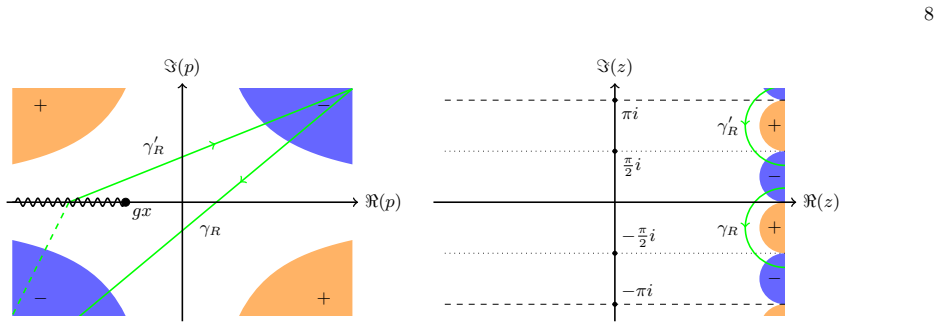
IndisputableMonolith/Foundation/AlexanderDuality.leanalexander_duality_circle_linking echoesLefschetz thimble analysis... Riemann-Hilbert correspondence... fast-decay homology cycles γ... branching points zB(n)±=±πi/2+2nπi... inter-period connectivity lost
-
IndisputableMonolith/Foundation/RealityFromDistinction.leanreality_from_one_distinction unclearunified geometric interpretation of the Schwinger effect across different relativistic wave equations
Reference graph
Works this paper leans on
-
[1]
On Gauge Invariance and Vacuum Polarization , author =. Phys. Rev. , volume =. 1951 , month =. doi:10.1103/PhysRev.82.664 , url =
-
[2]
Sauter, Fritz. Uber das Verhalten eines Elektrons im homogenen elektrischen Feld nach der relativistischen Theorie Diracs. Z. Phys. 1931. doi:10.1007/BF01339461
-
[3]
Über die Elektrodynamik des Vakuums auf Grund des Quanten-Theorie des Elektrons
Weisskopf, Victor Frederick. Über die Elektrodynamik des Vakuums auf Grund des Quanten-Theorie des Elektrons. Dan. Mat. Fys. Medd. 1936
work page 1936
-
[4]
Heisenberg, W. and Euler, H. Consequences of Dirac's theory of positrons. Z. Phys. 1936. doi:10.1007/BF01343663. arXiv:physics/0605038
-
[5]
Winter, Rolf G. , title =. American Journal of Physics , volume =. 1959 , month =. doi:10.1119/1.1934851 , url =
-
[6]
Zeitschrift fur Physik , year = 1929, month = mar, volume =
Die Reflexion von Elektronen an einem Potentialsprung nach der relativistischen Dynamik von Dirac. Zeitschrift fur Physik , year = 1929, month = mar, volume =. doi:10.1007/BF01339716 , adsurl =
-
[7]
Journal of Mathematical Physics , volume =
Lämmerzahl, Claus , title =. Journal of Mathematical Physics , volume =. 1993 , month =. doi:10.1063/1.530015 , url =
-
[8]
Daem, F. and Matzkin, A. Phys. Scripta. 2025. doi:10.1088/1402-4896/ad9550. arXiv:2406.16644
-
[9]
Zumer, Beno \^ t and Daem, Florent and Matzkin, Alexandre. Phys. Lett. A. 2026. doi:10.1016/j.physleta.2026.131549. arXiv:2511.05200
- [10]
-
[11]
Solution of the Spinless Salpeter Equation with a Time-Dependent Linear Potential
Chargui, Yassine and Dhahbi, Anis and Chetouani, Lyazid and Trabelsi, Adel. Solution of the Spinless Salpeter Equation with a Time-Dependent Linear Potential. Few Body Syst. 2014. doi:10.1007/s00601-014-0911-6
-
[12]
Numerical solution of Salpeter's equation , author =. Phys. Rev. D , volume =. 1984 , month =. doi:10.1103/PhysRevD.30.1970 , url =
-
[13]
Kowalski, K. and Rembielinski, J. The Salpeter equation and probability current in the relativistic Hamiltonian quantum mechanics. Phys. Rev. A. 2011. doi:10.1103/PhysRevA.84.012108. arXiv:1110.5146
-
[14]
Nickisch, L. J. and Durand, Loyal and Durand, Bernice. A Salpeter Equation in Position Space: Numerical Solution for Arbitrary Confining Potentials. Phys. Rev. D. 1984. doi:10.1103/PhysRevD.30.660
-
[15]
and Lucha, Wolfgang and Schoberl, Franz F
Hall, Richard L. and Lucha, Wolfgang and Schoberl, Franz F. Energy bounds for the spinless Salpeter equation: Harmonic oscillator. J. Phys. A. 2001. doi:10.1088/0305-4470/34/24/304. arXiv:hep-th/0012127
-
[16]
Brau, F. Analytical solution of the relativistic Coulomb problem with a hard core interaction for a one-dimensional spinless Salpeter equation. J. Math. Phys. 1999. doi:10.1063/1.532791. arXiv:hep-ph/9903269
-
[17]
Chargui, Y and Chetouani, L and Trabelsi, A , title =. 2009 , month =. doi:10.1088/1751-8113/42/35/355203 , url =
-
[18]
Al-Hashimi, M. H. and Shalaby, A. M. and Wiese, U. -J. Asymptotic freedom, dimensional transmutation, and an infrared conformal fixed point for the -function potential in one-dimensional relativistic quantum mechanics. Phys. Rev. D. 2014. doi:10.1103/PhysRevD.89.125023. arXiv:1404.3077
-
[19]
Albeverio, Sergio and Fassari, Silvestro and Rinaldi, Fabio , title =. 2015 , month =. doi:10.1088/1751-8113/48/18/185301 , url =
-
[20]
One-dimensional semirelativistic Hamiltonian with multiple Dirac delta potentials , author =. Phys. Rev. D , volume =. 2017 , month =. doi:10.1103/PhysRevD.95.045004 , url =
-
[21]
Akhmedov, E. T. and Anokhin, A. V. and Sadekov, D. I. Currents of created pairs in strong electric fields. Int. J. Mod. Phys. A. 2021. doi:10.1142/S0217751X21501347. arXiv:2012.00399
-
[22]
Allen, Theodore J. and Olsson, M. G. Reduction of the QCD string to a time component vector potential. Phys. Rev. D. 2003. doi:10.1103/PhysRevD.68.054022. arXiv:hep-ph/0306128
-
[23]
Hybrid mesons and auxiliary fields
Buisseret, Fabien and Mathieu, Vincent. Hybrid mesons and auxiliary fields. Eur. Phys. J. A. 2006. doi:10.1140/epja/i2006-10090-0. arXiv:hep-ph/0607083
-
[24]
Decay of the metastable phase in d=1 and d=2 Ising models , author =. Phys. Rev. B , volume =. 1999 , month =. doi:10.1103/PhysRevB.60.14525 , url =
-
[25]
Enhanced specialization and microlocalization. arXiv e-prints , keywords =. doi:10.48550/arXiv.1908.01276 , archivePrefix =. 1908.01276 , primaryClass =
-
[26]
Publications of The Research Institute for Mathematical Sciences , year=
Microlocal Riemann-Hilbert Correspondence , author=. Publications of The Research Institute for Mathematical Sciences , year=
- [27]
-
[28]
Publications of the Research Institute for Mathematical Sciences , volume =
Kashiwara, Masaki , title =. Publications of the Research Institute for Mathematical Sciences , volume =. 1984 , doi =
work page 1984
-
[29]
Mass Corrections to the Fine Structure of Hydrogen-Like Atoms , author =. Phys. Rev. , volume =. 1952 , month =. doi:10.1103/PhysRev.87.328 , url =
-
[30]
Gavrilov, S. P. and Gitman, D. M. Scattering and pair creation by a constant electric field between two capacitor plates. Phys. Rev. D. 2016. doi:10.1103/PhysRevD.93.045033. arXiv:1511.02915
-
[31]
Gavrilov, S. P. and Gitman, Dmitry M. One-loop energy-momentum tensor in QED with electric-like background. Phys. Rev. D. 2008. doi:10.1103/PhysRevD.78.045017. arXiv:0709.1828
- [32]
-
[33]
Algebraic Analysis of Singular Perturbation Theory , author=. 2005 , url=
work page 2005
-
[34]
The complex WKB method , author=
The return of the quartic oscillator. The complex WKB method , author=. Annales De L Institut Henri Poincare-physique Theorique , year=
-
[35]
Analytic Continuation Of Chern-Simons Theory
Witten, Edward. Analytic Continuation Of Chern-Simons Theory. AMS/IP Stud. Adv. Math. 2011. arXiv:1001.2933
work page Pith review arXiv 2011
discussion (0)
Sign in with ORCID, Apple, or X to comment. Anyone can read and Pith papers without signing in.