Recognition: no theorem link
Quasiparticle properties of a single Λ impurity in symmetric nuclear matter with a regulated NΛ interaction
Pith reviewed 2026-05-11 02:50 UTC · model grok-4.3
The pith
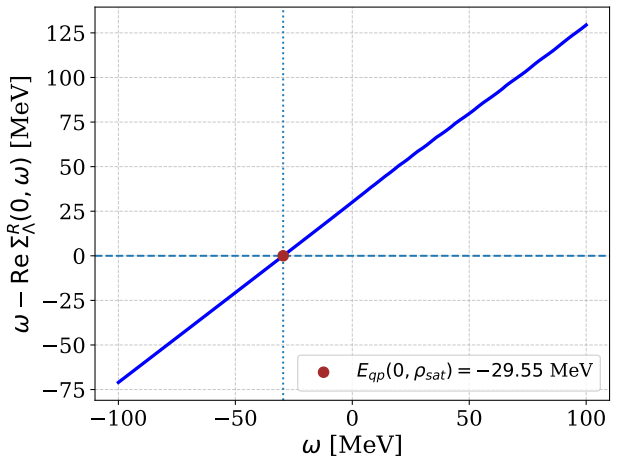
A single Lambda hyperon in nuclear matter binds at -29.55 MeV at zero momentum.
A machine-rendered reading of the paper's core claim, the machinery that carries it, and where it could break.
Core claim
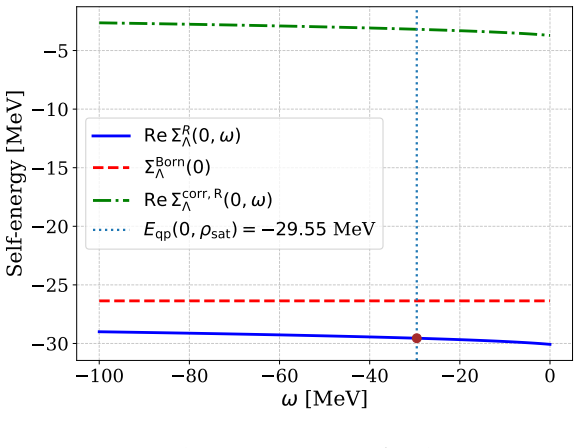
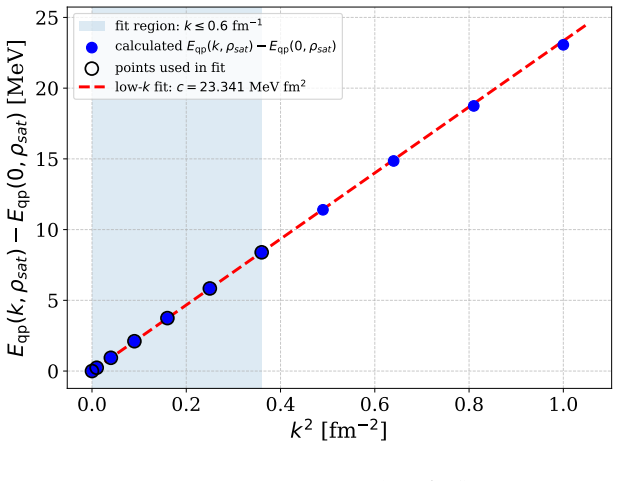
A non-local regulated contact potential fitted to vacuum N Lambda scattering data produces, via the in-medium ladder T-matrix, a retarded self-energy whose zero-momentum quasiparticle pole lies at E_qp(0, rho_sat) = -29.55 MeV. This pole is composed of a static Born contribution of -26.36 MeV and a dynamical correlation contribution of -3.19 MeV; the corresponding spectral function is sharply peaked with residue Z(0)=0.98 and damping width Gamma(0)=0.023 MeV. At finite momentum the binding decreases while the residue and width change only weakly, yielding m_Lambda^*/m_Lambda = 0.747 from a low-momentum fit.
What carries the argument
The retarded Lambda self-energy computed from the in-medium N Lambda ladder T-matrix that sums repeated scattering inside the nucleonic medium.
If this is right
- The quasiparticle energy rises from -29.55 MeV at zero momentum to -6.49 MeV at k=1 fm^{-1}.
- The residue stays near 0.98 and the width remains below 0.1 MeV over the same momentum range.
- A low-momentum expansion of the dispersion yields an effective mass ratio m_Lambda^*/m_Lambda = 0.747.
- The dynamical correlation piece supplies only about 11 percent of the total binding, indicating that repeated scattering supplies a modest but necessary correction.
Where Pith is reading between the lines
- The same regulated interaction could be inserted into finite-nucleus calculations to predict single-Lambda levels in light hypernuclei.
- The small size of the dynamical term suggests that a simpler Born-level estimate may already give the correct order of magnitude for other hyperons.
- Extending the momentum range or adding three-body forces would test whether the effective mass ratio remains stable.
- The narrow width implies that the Lambda propagates as a coherent quasiparticle over distances comparable to nuclear sizes.
Load-bearing premise
That the ladder summation of the regulated contact interaction, with couplings fixed only by vacuum scattering data, already captures the dominant medium effects without large higher-order corrections.
What would settle it
A precise measurement of the Lambda quasiparticle energy or the width of its spectral function in symmetric nuclear matter at saturation density that deviates significantly from -29.55 MeV or 0.023 MeV.
Figures


read the original abstract
We explore the quasiparticle properties of a single $\Lambda$ hyperon propagating through symmetric nuclear matter using the Green's function formalism. The $N\Lambda$ interaction is described by a non-local regulated low-momentum contact potential with a leading-order constant term and a next-to-leading-order derivative correction. The two coupling constants in the ${}^1S_0$ and ${}^3S_1$ channels are fixed by matching the vacuum on-shell $T$ matrix to the scattering length and effective range obtained from modern next-to-next-to-leading-order chiral effective field theory. Using this effective interaction, we calculate the retarded $\Lambda$ self-energy from the in-medium $N\Lambda$ ladder $T$ matrix, which sums repeated $N\Lambda$ scattering in the nucleonic medium. At saturation density, the zero-momentum quasiparticle pole is found at $E_{\rm qp}(0,\rho_{\rm sat})=-29.55~{\rm MeV}$, in good agreement with the empirical depth of the single $\Lambda$ potential in nuclear matter. The self-energy decomposition gives a static Born contribution $\Sigma_\Lambda^{\rm Born}(0)=-26.36~{\rm MeV}$ and a dynamical correlation contribution ${\rm Re}\,\Sigma_\Lambda^{\rm corr,R}(0,E_{\rm qp})=-3.19~{\rm MeV}$, showing that repeated in-medium $N\Lambda$ scattering is needed to reproduce the empirical binding scale. The quasiparticle remains narrow and well defined, with a large residue $Z(0)=0.98$, a small damping width $\Gamma(0)=0.023~{\rm MeV}$, and a sharp spectral peak near the quasiparticle energy. At finite momentum, the $\Lambda$ quasiparticle becomes less bound, with $E_{\rm qp}(k,\rho_{\rm sat})$ increasing from $-29.55~{\rm MeV}$ at $k=0$ to $-6.49~{\rm MeV}$ at $k=1~{\rm fm}^{-1}$, while the residue and width change only weakly. A low-momentum fit gives $m_\Lambda^*/m_\Lambda=0.747$, consistent with the range obtained in Brueckner calculations with Nijmegen hyperon--nucleon potentials.
Editorial analysis
A structured set of objections, weighed in public.
Referee Report
Summary. The manuscript calculates the quasiparticle properties of a single Λ hyperon in symmetric nuclear matter within the Green's function formalism. A regulated non-local contact NΛ interaction (leading-order constant plus NLO derivative term) is employed, with its two S-wave coupling constants fixed exclusively by matching the vacuum on-shell T-matrix to NNLO chiral EFT scattering lengths and effective ranges. The retarded Λ self-energy is obtained from the in-medium NΛ ladder T-matrix; at saturation density the zero-momentum quasiparticle pole lies at E_qp(0,ρ_sat) = -29.55 MeV, decomposed into a static Born term of -26.36 MeV and a dynamical correlation term of -3.19 MeV. Additional results include residue Z(0) = 0.98, width Γ(0) = 0.023 MeV, momentum dependence up to k = 1 fm^{-1}, and an effective-mass ratio m_Λ^*/m_Λ = 0.747 extracted from a low-momentum fit.
Significance. If the numerical result holds, the work demonstrates that a vacuum-constrained, regulated contact interaction treated in the ladder approximation can reproduce the empirical depth of the Λ single-particle potential without any medium-specific readjustment of parameters. The explicit separation of Born and correlation contributions, together with the reporting of spectral-function properties (residue, width, and effective mass), supplies a concrete microscopic benchmark for hypernuclear calculations. The approach is parameter-free with respect to nuclear-matter data and therefore offers a controlled test of the sufficiency of two-body ladder resummation.
major comments (2)
- [§4] §4 (results on the self-energy decomposition): The central claim that the ladder resummation is required to reach the empirical binding scale rests on the small dynamical correlation piece (-3.19 MeV). No quantitative estimate is given for the size of omitted higher-order medium corrections (three-body N N Λ forces, density-dependent vertex renormalization, or Pauli blocking in higher partial waves) that could shift the pole by an amount comparable to this correlation energy. Because the quoted agreement with the empirical depth is at the 1 MeV level, such an assessment is load-bearing for the robustness of the result.
- [§3] §3 (formalism of the in-medium T-matrix): The regulated contact interaction is matched only to S-wave vacuum data; the manuscript does not discuss the possible contribution of P-wave or higher channels once the Pauli operator is active in the medium. Given that the effective-mass extraction and the momentum dependence of E_qp(k) are reported, the truncation to S-waves should be justified or its uncertainty quantified.
minor comments (2)
- The numerical values for the regulator cutoff and the precise matching procedure to the chiral EFT scattering lengths/effective ranges are stated only in the text; they should be collected in a dedicated table or appendix for reproducibility.
- The low-momentum fit used to extract m_Λ^*/m_Λ = 0.747 is mentioned without specifying the momentum interval or the functional form employed; this detail is needed to allow direct comparison with other Brueckner calculations.
Simulated Author's Rebuttal
We thank the referee for the positive assessment of our work and the constructive major comments. We address each point below, providing clarifications on the scope of our two-body ladder calculation while incorporating additional discussion into the revised manuscript.
read point-by-point responses
-
Referee: §4 (results on the self-energy decomposition): The central claim that the ladder resummation is required to reach the empirical binding scale rests on the small dynamical correlation piece (-3.19 MeV). No quantitative estimate is given for the size of omitted higher-order medium corrections (three-body N N Λ forces, density-dependent vertex renormalization, or Pauli blocking in higher partial waves) that could shift the pole by an amount comparable to this correlation energy. Because the quoted agreement with the empirical depth is at the 1 MeV level, such an assessment is load-bearing for the robustness of the result.
Authors: We agree that a quantitative estimate of higher-order corrections would strengthen the robustness discussion. Our calculation is performed strictly within the two-body ladder approximation with a vacuum-constrained interaction; estimating the size of three-body NNΛ forces or density-dependent vertex renormalizations would require an extended framework that is beyond the present scope. In the revised manuscript we have added a paragraph in §4 that explicitly states this limitation, notes that the -3.19 MeV correlation term is the dynamical contribution inside the ladder resummation, and emphasizes that the 1 MeV agreement with the empirical depth should be understood as a benchmark for two-body physics. We also reference existing chiral-EFT estimates indicating that three-body contributions to the Λ potential are typically repulsive and of order 1–3 MeV, but we do not claim a precise cancellation. revision: partial
-
Referee: §3 (formalism of the in-medium T-matrix): The regulated contact interaction is matched only to S-wave vacuum data; the manuscript does not discuss the possible contribution of P-wave or higher channels once the Pauli operator is active in the medium. Given that the effective-mass extraction and the momentum dependence of E_qp(k) are reported, the truncation to S-waves should be justified or its uncertainty quantified.
Authors: The regulated contact interaction consists of a leading constant term plus an NLO derivative correction and is matched exclusively to the S-wave scattering lengths and effective ranges from NNLO chiral EFT in the ¹S₀ and ³S₁ channels. Higher partial waves are not included because they would introduce additional low-energy constants not fixed by the vacuum data employed. In the revised §3 we have added a justification paragraph: at saturation density the relevant momenta are low (k_F ≈ 1.36 fm⁻¹), S-waves dominate the low-energy NΛ interaction, and chiral-EFT calculations show that P-wave contributions to the single-Λ potential are typically small and repulsive (estimated < 2 MeV). We note that the reported momentum dependence of E_qp(k) up to 1 fm⁻¹ and the effective-mass ratio are therefore governed primarily by S-wave physics, with an estimated uncertainty from omitted waves of order 10 % or less. A full quantification would require extending the potential to P-waves, which we flag as future work. revision: partial
- Quantitative estimate of the size of omitted higher-order medium corrections (three-body NNΛ forces, density-dependent vertex renormalization, Pauli blocking in higher partial waves) that could shift the quasiparticle pole by an amount comparable to the -3.19 MeV correlation term.
Circularity Check
Derivation uses independent vacuum inputs to compute medium quasiparticle properties without reduction to fitted outputs or self-citations
full rationale
The paper fixes the two low-energy constants of the regulated contact interaction exclusively by matching the vacuum on-shell T-matrix to scattering lengths and effective ranges taken from external next-to-next-to-leading-order chiral EFT. It then evaluates the in-medium ladder T-matrix and the resulting retarded self-energy via the Dyson equation to obtain the quasiparticle pole position, residue, and width as direct outputs. No medium data enter the parameter determination, no self-citations supply load-bearing uniqueness theorems or ansätze, and the reported decomposition into Born and correlation pieces follows from the explicit separation of the self-energy expression rather than from any redefinition of inputs. The numerical agreement with the empirical depth is therefore a genuine prediction, not a tautology.
Axiom & Free-Parameter Ledger
free parameters (1)
- coupling constants in ^1S_0 and ^3S_1 channels
axioms (2)
- domain assumption The in-medium NΛ interaction is accurately described by the ladder summation of the T-matrix
- domain assumption The regulated low-momentum contact potential with LO and NLO terms captures the essential physics
Reference graph
Works this paper leans on
-
[1]
R. E. Chrien, C. B. Dover, Nuclear Systems with Strangeness, Annual Review of Nuclear and Particle Science 39 (Volume 39,) (1989) 113–150. doi:https://doi.org/10.1146/annurev.ns.39.120189.000553. URLhttps://www.annualreviews.org/content/journals/10.1146/annurev.ns.39.120189.000553
-
[2]
A. Gal, E. V. Hungerford, D. J. Millener, Strangeness in nuclear physics, Rev. Mod. Phys. 88 (2016) 035004. doi:10.1103/RevModPhys.88.035004. URLhttps://link.aps.org/doi/10.1103/RevModPhys.88.035004
-
[3]
K. Miwa, K. Nakazawa, H. Tamura, E. Hiyama, T. Takahashi, Nuclear systems with strangeness and baryon–baryon interactions, The Euro- pean Physical Journal A 61 (6) (2025) 128. doi:10.1140/epja/s10050- 025-01571-z. URLhttps://doi.org/10.1140/epja/s10050-025-01571-z
-
[4]
I. Vidaña, Hyperons: the strange ingredients of the nuclear equa- tion of state, Proceedings of the Royal Society A: Mathemati- cal, Physical and Engineering Sciences 474 (2217) (2018) 20180145. doi:10.1098/rspa.2018.0145. URLhttps://doi.org/10.1098/rspa.2018.0145
-
[5]
Y. He, T. R. Saito, H. Ekawa, A. Kasagi, Y. Gao, E. Liu, K. Nakazawa, C. Rappold, M. Taki, Y. K. Tanaka, H. Wang, A. Yanai, J. Yoshida, H. Zhang, Artificial intelligence pioneers the double-strangeness factory, Nature Communications 16 (1) (2025) 11084. doi:10.1038/s41467-025- 66517-x. URLhttps://doi.org/10.1038/s41467-025-66517-x
-
[6]
doi:10.1038/s41586-020- 3001-6
ALICE/Collaboration, Unveiling the strong interaction among hadrons at the lhc, Nature 588 (7837) (2020) 232–238. doi:10.1038/s41586-020- 3001-6. URLhttps://doi.org/10.1038/s41586-020-3001-6 19
-
[7]
S. N. Nakamura, High-precision spectroscopy ofΛhypernuclei with electron and meson beams, Few-Body Systems 67 (2) (2026) 25. doi:10.1007/s00601-026-02044-9. URLhttps://doi.org/10.1007/s00601-026-02044-9
-
[8]
S. Ajimura, H. Hayakawa, T. Kishimoto, H. Kohri, K. Matsuoka, S. Mi- nami, T.Mori, K.Morikubo, E.Saji, A.Sakaguchi, Y.Shimizu, M.Sum- ihama, R. E. Chrien, M. May, P. Pile, A. Rusek, R. Sutter, P. Eugenio, G. Franklin, P. Khaustov, K. Paschke, B. P. Quinn, R. A. Schumacher, J. Franz, T. Fukuda, H. Noumi, H. Outa, L. Gan, L. Tang, L. Yuan, H. Tamura, J. Nak...
-
[9]
K. Tanida, H. Tamura, D. Abe, H. Akikawa, K. Araki, H. Bhang, T. Endo, Y. Fujii, T. Fukuda, O. Hashimoto, K. Imai, H. Hotchi, Y. Kakiguchi, J. H. Kim, Y. D. Kim, T. Miyoshi, T. Murakami, T. Na- gae, H. Noumi, H. Outa, K. Ozawa, T. Saito, J. Sasao, Y. Sato, S. Satoh, R. I. Sawafta, M. Sekimoto, T. Takahashi, L. Tang, H. H. Xia, S. H. Zhou, L. H. Zhu, Measu...
work page 2001
-
[10]
URLhttps://link.aps.org/doi/10.1103/PhysRevLett.86.1982
doi:10.1103/PhysRevLett.86.1982. URLhttps://link.aps.org/doi/10.1103/PhysRevLett.86.1982
-
[11]
H. Hotchi, T. Nagae, H. Outa, H. Noumi, M. Sekimoto, T. Fukuda, H. Bhang, Y. D. Kim, J. H. Kim, H. Park, K. Tanida, O. Hashimoto, H. Tamura, T. Takahashi, Y. Sato, T. Endo, S. Satoh, J. Nishida, T. Miyoshi, T. Saitoh, T. Kishimoto, A. Sakaguchi, S. Ajimura, Y. Shimizu, T. Mori, S. Minami, M. Sumihama, R. Sawafta, L. Tang, Spectroscopy of medium-heavyΛhype...
-
[12]
F. Garibaldi, A. Acha, P. Ambrozewicz, K. A. Aniol, P. Baturin, H. Be- naoum, J. Benesch, P. Y. Bertin, K. I. Blomqvist, W. U. Boeglin, H. Breuer, P. Brindza, P. Bydžovský, A. Camsonne, C. C. Chang, J.- P. Chen, S. Choi, E. A. Chudakov, E. Cisbani, S. Colilli, L. Coman, F. Cusanno, B. J. Craver, G. De Cataldo, C. W. de Jager, R. De Leo, 20 A. P. Deur, C. ...
-
[13]
F. Weber, R. Negreiros, P. Rosenfield, M. Stejner, Pulsars as astrophysical laboratories for nuclear and particle physics, Progress in Particle and Nuclear Physics 59 (1) (2007) 94– 113, international Workshop on Nuclear Physics 28th Course. doi:https://doi.org/10.1016/j.ppnp.2006.12.008. URLhttps://www.sciencedirect.com/science/article/pii/S0146641006000822
-
[14]
H.-J. Schulze, M. Baldo, U. Lombardo, J. Cugnon, A. Lejeune, Hy- peronic nuclear matter in Brueckner theory, Phys. Rev. C 57 (1998) 704–713. doi:10.1103/PhysRevC.57.704. URLhttps://link.aps.org/doi/10.1103/PhysRevC.57.704
-
[15]
I. Vidaña, A. Polls, A. Ramos, L. Engvik, M. Hjorth-Jensen, Hyperon- hyperon interactions and properties of neutron star matter, Phys. Rev. C 62 (2000) 035801. doi:10.1103/PhysRevC.62.035801. URLhttps://link.aps.org/doi/10.1103/PhysRevC.62.035801
-
[16]
P. B. Demorest, T. Pennucci, S. M. Ransom, M. S. E. Roberts, J. W. T. Hessels, A two-solar-mass neutron star measured using Shapiro delay, Nature 467 (7319) (2010) 1081–1083. doi:10.1038/nature09466. URLhttps://doi.org/10.1038/nature09466 21
-
[17]
J. Antoniadis, P. C. C. Freire, N. Wex, T. M. Tauris, R. S. Lynch, M. H. van Kerkwijk, M. Kramer, C. Bassa, V. S. Dhillon, T. Driebe, J. W. T. Hessels, V. M. Kaspi, V. I. Kondratiev, N. Langer, T. R. Marsh, M. A. McLaughlin, T. T. Pennucci, S. M. Ransom, I. H. Stairs, J. van Leeuwen, J. P. W. Verbiest, D. G. Whelan, A massive pulsar in a compact relativis...
-
[18]
H. T. Cromartie, E. Fonseca, S. M. Ransom, P. B. Demorest, Z. Ar- zoumanian, H. Blumer, P. R. Brook, M. E. DeCesar, T. Dolch, J. A. Ellis, R. D. Ferdman, E. C. Ferrara, N. Garver-Daniels, P. A. Gentile, M. L. Jones, M. T. Lam, D. R. Lorimer, R. S. Lynch, M. A. McLaughlin, C. Ng, D. J. Nice, T. T. Pennucci, R. Spiewak, I. H. Stairs, K. Stovall, J. K. Swigg...
-
[19]
G. Burgio, H.-J. Schulze, I. Vidaña, J.-B. Wei, Neutron stars and the nuclear equation of state, Progress in Particle and Nuclear Physics 120 (2021) 103879. doi:https://doi.org/10.1016/j.ppnp.2021.103879. URLhttps://www.sciencedirect.com/science/article/pii/S0146641021000338
-
[20]
D. Lonardoni, A. Lovato, S. Gandolfi, F. Pederiva, Hyperon Puzzle: Hints from Quantum Monte Carlo Calculations, Phys. Rev. Lett. 114 (2015) 092301. doi:10.1103/PhysRevLett.114.092301. URLhttps://link.aps.org/doi/10.1103/PhysRevLett.114.092301
-
[21]
J. Haidenbauer, U. G. Meißner, N. Kaiser, W. Weise, Lambda-nuclear interactionsandhyperonpuzzleinneutronstars, TheEuropeanPhysical Journal A 53 (6) (2017) 121. doi:10.1140/epja/i2017-12316-4. URLhttps://doi.org/10.1140/epja/i2017-12316-4
-
[22]
C. Providência, M. Fortin, H. Pais, A. Rabhi, Hyperonic Stars and the Nuclear Symmetry Energy, Frontiers in Astronomy and Space Sciences Volume 6 - 2019 (2019). doi:10.3389/fspas.2019.00013. URLhttps://www.frontiersin.org/journals/astronomy-and-space-sciences/articles/10.3389/fspas.2019.00013 22
-
[23]
W. Dickhoff, C. Barbieri, Self-consistent green’s function method for nuclei and nuclear matter, Progress in Particle and Nuclear Physics 52 (2) (2004) 377–496. doi:https://doi.org/10.1016/j.ppnp.2004.02.038. URLhttps://www.sciencedirect.com/science/article/pii/S0146641004000535
-
[24]
A. Rios, V. Somà, Self-Consistent Green’s Function Calculation of the Nucleon Mean Free Path, Phys. Rev. Lett. 108 (2012) 012501. doi:10.1103/PhysRevLett.108.012501. URLhttps://link.aps.org/doi/10.1103/PhysRevLett.108.012501
-
[25]
V. Somà, C. Barbieri, T. Duguet, Ab initio Gorkov-Green’s func- tion calculations of open-shell nuclei, Phys. Rev. C 87 (2013) 011303. doi:10.1103/PhysRevC.87.011303. URLhttps://link.aps.org/doi/10.1103/PhysRevC.87.011303
-
[26]
V. Somà, Self-Consistent Green’s Function Theory for Atomic Nuclei, Frontiers in Physics Volume 8 - 2020 (2020). doi:10.3389/fphy.2020.00340. URLhttps://www.frontiersin.org/journals/physics/articles/10.3389/fphy.2020.00340
-
[27]
B. Suleymanli, K. Bozkurt, Green’s function formal- ism for impurity-induced resonances in sub-barrier proton- nucleus scattering, Nuclear Physics A 1070 (2026) 123388. doi:https://doi.org/10.1016/j.nuclphysa.2026.123388. URLhttps://www.sciencedirect.com/science/article/pii/S0375947426000667
-
[28]
N. J. Robertson, W. H. Dickhoff, Correlation effects onΛprop- agation in nuclear matter, Phys. Rev. C 70 (2004) 044301. doi:10.1103/PhysRevC.70.044301. URLhttps://link.aps.org/doi/10.1103/PhysRevC.70.044301
-
[29]
M. Hjorth-Jensen, A. Polls, A. Ramos, H. Müther, Self-energy ofΛin finite nuclei, Nuclear Physics A 605 (4) (1996) 458–474. doi:https://doi.org/10.1016/0375-9474(96)00190-X. URLhttps://www.sciencedirect.com/science/article/pii/037594749600190X
-
[30]
I. Vidaña, Single-particle spectral function of theΛhy- peron in finite nuclei, Nuclear Physics A 958 (2017) 48–70. doi:https://doi.org/10.1016/j.nuclphysa.2016.11.002. URLhttps://www.sciencedirect.com/science/article/pii/S0375947416302767 23
-
[31]
J. Haidenbauer, I. Vidaña, Structure of single-Λhypernuclei with chiral hyperon–nucleon potentials, The European Physical Journal A 56 (2) (2020) 55. doi:10.1140/epja/s10050-020-00055-6. URLhttps://doi.org/10.1140/epja/s10050-020-00055-6
-
[32]
J. Haidenbauer, S. Petschauer, N. Kaiser, U.-G. Meißner, A. Nogga, W. Weise, Hyperon–nucleon interaction at next-to-leading order in chiral effective field theory, Nuclear Physics A 915 (2013) 24–58. doi:https://doi.org/10.1016/j.nuclphysa.2013.06.008. URLhttps://www.sciencedirect.com/science/article/pii/S0375947413006167
-
[33]
J. Haidenbauer, U.-G. Meißner, A. Nogga, H. Le, Hyperon– nucleon interaction in chiral effective field theory at next-to-next-to- leading order, The European Physical Journal A 59 (3) (2023) 63. doi:10.1140/epja/s10050-023-00960-6. URLhttps://doi.org/10.1140/epja/s10050-023-00960-6
-
[34]
X.-L. Ren, E. Epelbaum, J. Gegelia,Λ-nucleon scattering in baryon chiral perturbation theory, Phys. Rev. C 101 (2020) 034001. doi:10.1103/PhysRevC.101.034001. URLhttps://link.aps.org/doi/10.1103/PhysRevC.101.034001
-
[35]
S. Petschauer, J. Haidenbauer, N. Kaiser, U.-G. Meißner, W. Weise, Hyperon-Nuclear Interactions From SU(3) Chiral Ef- fective Field Theory, Frontiers in Physics Volume 8 - 2020 (2020). doi:10.3389/fphy.2020.00012. URLhttps://www.frontiersin.org/journals/physics/articles/10.3389/fphy.2020.00012
-
[36]
J. Song, Z.-W. Liu, K.-W. Li, L.-S. Geng, Test of the hyperon-nucleon interaction within leading order covariant chiral effective field theory, Phys. Rev. C 105 (2022) 035203. doi:10.1103/PhysRevC.105.035203. URLhttps://link.aps.org/doi/10.1103/PhysRevC.105.035203
-
[37]
F. Lorenzi, A. Bardin, L. Salasnich, On-shell approximation for thes-wave scattering theory, Phys. Rev. A 107 (2023) 033325. doi:10.1103/PhysRevA.107.033325. URLhttps://link.aps.org/doi/10.1103/PhysRevA.107.033325
-
[38]
J.Sakurai, J.Napolitano, ModernQuantumMechanics, CambridgeUni- versity Press, 2021. 24
work page 2021
- [39]
-
[40]
D. J. Millener, C. B. Dover, A. Gal,λ-nucleus single-particle potentials, Phys. Rev. C 38 (1988) 2700–2708. doi:10.1103/PhysRevC.38.2700. URLhttps://link.aps.org/doi/10.1103/PhysRevC.38.2700
-
[41]
T. Motoba, Y. Yamamoto, Comparison of(k −, π)and(π, k +)as a functionofmassnumber, NuclearPhysicsA585(1)(1995)29–38, hyper- nuclear and Strange Particle Physics. doi:https://doi.org/10.1016/0375- 9474(94)00540-4. URLhttps://www.sciencedirect.com/science/article/pii/0375947494005404
-
[42]
E. Friedman, A. Gal,λhypernuclear potentials beyond lin- ear density dependence, Nuclear Physics A 1039 (2023) 122725. doi:https://doi.org/10.1016/j.nuclphysa.2023.122725. URLhttps://www.sciencedirect.com/science/article/pii/S0375947423001288
-
[43]
I. Vidaña, A. Polls, A. Ramos, H.-J. Schulze, Hypernuclear structure with the new nijmegen potentials, Phys. Rev. C 64 (2001) 044301. doi:10.1103/PhysRevC.64.044301. URLhttps://link.aps.org/doi/10.1103/PhysRevC.64.044301
-
[44]
J. Taylor, Scattering Theory: The Quantum Theory of Nonrelativistic Collisions, Dover Books on Engineering, Dover Publications, 2012. 25
work page 2012
discussion (0)
Sign in with ORCID, Apple, or X to comment. Anyone can read and Pith papers without signing in.