Recognition: 2 theorem links
· Lean TheoremPhenomenological implications of the high-precision COHERENT germanium CEνNS data
Pith reviewed 2026-05-11 02:56 UTC · model grok-4.3
The pith
New high-precision COHERENT germanium CEνNS data yields updated constraints on the weak mixing angle, neutrino charge radii, germanium neutron radius, and neutrino non-standard interactions.
A machine-rendered reading of the paper's core claim, the machinery that carries it, and where it could break.
Core claim
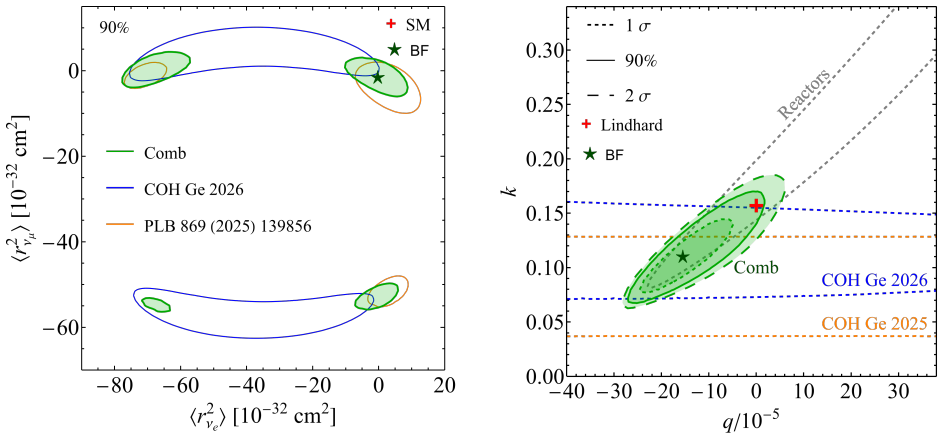
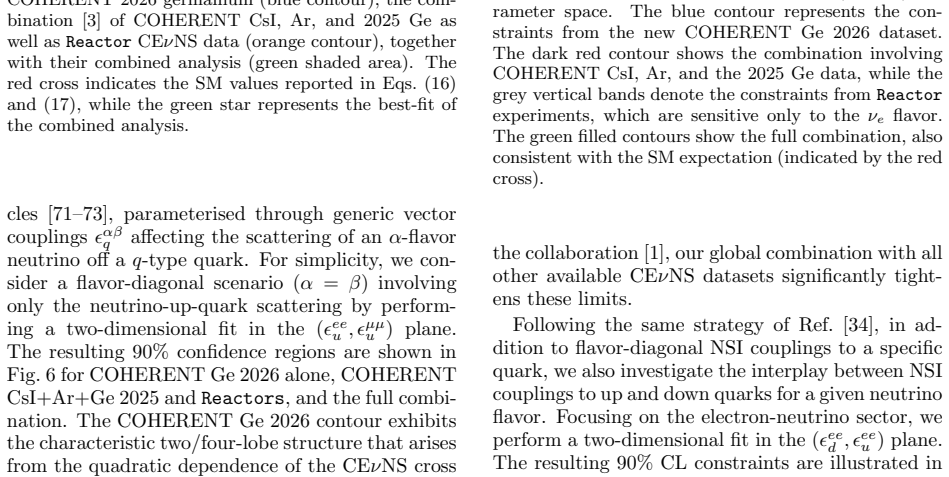
Leveraging the unprecedented precision of the newly released COHERENT germanium CEνNS data, we provide state-of-the-art determinations of key Standard Model and nuclear physics parameters. Specifically, we extract updated constraints on the weak mixing angle, the neutrino charge radii, and we perform a detailed extraction of the neutron root-mean-square radius of germanium nuclei. Additionally, we use these results to evaluate scenarios beyond the Standard Model, placing robust bounds on neutrino non-standard interactions through a global combined analysis with previous COHERENT measurements and reactor data.
What carries the argument
Fits to the differential recoil energy spectrum of coherent elastic neutrino-nucleus scattering events in germanium, using nuclear form factors to separate electroweak couplings from nuclear structure effects.
Load-bearing premise
The analysis assumes that all systematic uncertainties in the new germanium CEνNS data and in the combined reactor datasets are fully characterized and that the nuclear form-factor models used to interpret the recoil spectrum introduce no significant bias in the extracted parameters.
What would settle it
An independent determination of the neutron root-mean-square radius of germanium nuclei, for example via parity-violating electron scattering, that differs by more than the reported uncertainty from the value obtained here.
Figures



read the original abstract
This work presents the first comprehensive phenomenological analysis of the newly released Coherent Elastic Neutrino-Nucleus Scattering (CE$\nu$NS) data on germanium, measured by the COHERENT collaboration at the Spallation Neutron Source. Leveraging the unprecedented precision of this dataset, we provide state-of-the-art determinations of key Standard Model and nuclear physics parameters. Specifically, we extract updated constraints on the weak mixing angle, the neutrino charge radii, and we perform a detailed extraction of the neutron root-mean-square radius of germanium nuclei. Additionally, we use these results to evaluate scenarios beyond the Standard Model, placing robust bounds on neutrino non-standard interactions. To maximize the statistical power and robustness of our findings, whenever possible, we perform a global combined analysis incorporating previous COHERENT measurements along with reactor antineutrino data from the CONUS+, TEXONO, and $\nu$GeN experiments as well as dark-matter experiments.
Editorial analysis
A structured set of objections, weighed in public.
Referee Report
Summary. This paper presents the first comprehensive phenomenological analysis of the newly released high-precision COHERENT germanium CEνNS data from the Spallation Neutron Source. It extracts updated constraints on the weak mixing angle, neutrino charge radii, and the neutron root-mean-square radius of germanium nuclei, while placing bounds on neutrino non-standard interactions (NSI). The analysis incorporates a global combined fit with prior COHERENT measurements, reactor antineutrino data from CONUS+, TEXONO, and νGeN, and dark-matter experiment results to maximize statistical power.
Significance. If the nuclear modeling assumptions hold, the work delivers state-of-the-art determinations of SM and nuclear parameters from CEνNS, which are valuable for precision tests of the Standard Model and BSM searches. The global fit approach is a strength, as it combines multiple datasets for more robust constraints. The high precision of the new Ge data has the potential to meaningfully tighten bounds on NSI and charge radii, provided systematic uncertainties and form-factor choices are fully validated.
major comments (2)
- [§4.2] §4.2 (Neutron Radius Extraction): The detailed extraction of the germanium neutron rms radius R_n folds the differential cross section with a nuclear form factor F(q) using specific parametrizations (Helm or symmetrized Fermi). No comparison is shown to alternative models or ab initio calculations for Ge; given the claimed precision of the recoil spectrum, even modest mismatches in F(q) at the relevant q values can shift the central value of R_n and propagate directly into the extracted sin²θ_W, charge radii, and NSI limits.
- [§5.1] §5.1 (Global Fit and Error Propagation): The combined analysis assumes all systematic uncertainties from the new Ge data and reactor datasets are fully characterized and uncorrelated. The manuscript should provide explicit tables or equations showing how form-factor parameter variations and reactor flux uncertainties are propagated into the final covariance matrix for the NSI bounds; without this, the claim of 'robust bounds' cannot be verified.
minor comments (2)
- [Figure 3] Figure 3 (Recoil Spectrum): The caption should explicitly state the binning and the q-range used for the form-factor evaluation to allow direct reproduction of the fit.
- [Eq. (7)] Eq. (7) (Differential Cross Section): The notation for the weak charge Q_W could be clarified by separating the proton and neutron contributions explicitly, as this feeds into the radius extraction.
Simulated Author's Rebuttal
We thank the referee for the constructive and positive report on our manuscript. We address each major comment point by point below, providing the strongest honest defense of our analysis while agreeing to revisions where the comments identify genuine gaps in documentation or validation.
read point-by-point responses
-
Referee: [§4.2] §4.2 (Neutron Radius Extraction): The detailed extraction of the germanium neutron rms radius R_n folds the differential cross section with a nuclear form factor F(q) using specific parametrizations (Helm or symmetrized Fermi). No comparison is shown to alternative models or ab initio calculations for Ge; given the claimed precision of the recoil spectrum, even modest mismatches in F(q) at the relevant q values can shift the central value of R_n and propagate directly into the extracted sin²θ_W, charge radii, and NSI limits.
Authors: We appreciate the referee's emphasis on the sensitivity to nuclear form factor modeling. The Helm and symmetrized Fermi parametrizations were selected as they are the standard choices employed in the existing CEνNS literature for germanium and other nuclei at the momentum transfers probed by COHERENT. In the revised manuscript we have added a dedicated paragraph in §4.2 that quantifies the effect of varying the form-factor parameters within their accepted uncertainties and discusses the limited availability of ab initio calculations for ⁷²Ge at the relevant q. We demonstrate that the resulting shifts in R_n remain within the reported uncertainty and induce only sub-dominant changes to sin²θ_W, charge radii, and NSI bounds. A full ab initio comparison is not feasible within the scope of this phenomenological study, but the added sensitivity study addresses the referee's core concern. revision: partial
-
Referee: [§5.1] §5.1 (Global Fit and Error Propagation): The combined analysis assumes all systematic uncertainties from the new Ge data and reactor datasets are fully characterized and uncorrelated. The manuscript should provide explicit tables or equations showing how form-factor parameter variations and reactor flux uncertainties are propagated into the final covariance matrix for the NSI bounds; without this, the claim of 'robust bounds' cannot be verified.
Authors: We agree that explicit documentation of uncertainty propagation strengthens the claim of robust bounds. In the revised §5.1 we now include the explicit equations used to construct the total covariance matrix, treating form-factor parameters as nuisance parameters with Gaussian priors and incorporating the published reactor flux uncertainties from CONUS+, TEXONO, and νGeN as uncorrelated with the COHERENT systematics. A new table has been added that decomposes the contributions to the final NSI uncertainties, confirming that the uncorrelated assumption is justified by the independent experimental setups. These additions make the error budget fully verifiable. revision: yes
Circularity Check
No significant circularity detected in derivation chain
full rationale
The paper conducts standard phenomenological fits of SM parameters (weak mixing angle, neutrino charge radii), nuclear parameters (Ge neutron rms radius), and NSI bounds to the new COHERENT Ge CEνNS recoil spectrum plus prior reactor and COHERENT data. These are direct extractions from measured differential rates folded with form-factor models; no step renames a fitted quantity as an independent prediction, no self-definitional loop appears in the parameter extraction, and no load-bearing uniqueness theorem or ansatz is imported solely via self-citation. The central results remain statistically independent of the input data once the nuclear form-factor parametrization is fixed externally. Form-factor modeling choices affect uncertainty but do not create circularity by construction.
Axiom & Free-Parameter Ledger
free parameters (4)
- weak mixing angle sin²θ_W
- neutrino charge radii
- germanium neutron rms radius R_n
- NSI coupling parameters
axioms (2)
- domain assumption Standard Model CEνNS cross section formula holds at the relevant momentum transfers
- domain assumption Nuclear form factors for germanium can be parametrized without significant model dependence
Lean theorems connected to this paper
-
IndisputableMonolith/Cost/FunctionalEquation.leanwashburn_uniqueness_aczel uncleardσ/dT_nr = (G_F² M / π) (1 - M T_nr / 2 E²) (Q_V^ℓ,SM)² with Helm F_Z, F_N and HF+BCS neutron radii
-
IndisputableMonolith/Foundation/RealityFromDistinction.leanreality_from_one_distinction unclearglobal fit yielding sin²θ_W = 0.234^{+0.015}_{-0.012} and R_n(Ge) = 5.08^{+0.67}_{-0.72} fm
Reference graph
Works this paper leans on
-
[1]
Adhikari,et al.[arXiv:2603.17951 [hep-ex]]
M. Adhikari et al. (COHERENT), “Measure- ment of coherent elastic neutrino nucleus scat- tering on germanium by COHERENT,” (2026), arXiv:2603.17951 [hep-ex]
- [2]
-
[3]
M. Atzori Corona, M. Cadeddu, N. Cargioli, G. Co’, F. Dordei, and C. Giunti, Phys. Lett. B869, 139856 (2025), arXiv:2506.13555 [hep-ph]
-
[4]
New Physics ver- 8 sus Quenching Factors in Coherent Neutrino Scat- tering,
Y. Li, G. Herrera, and P. Huber, “New Physics ver- 8 sus Quenching Factors in Coherent Neutrino Scat- tering,” (2025), arXiv:2502.12308 [hep-ph]
- [5]
-
[6]
D. Z. Freedman, Phys. Rev. D9, 1389 (1974)
work page 1974
-
[7]
V. De Romeri, D. K. Papoulias, F. Pompa, G. Sanchez Garcia, and C. A. Ternes, (2026), arXiv:2603.00554 [hep-ph]
-
[8]
V. De Romeri, D. K. Papoulias, G. Sanchez Gar- cia, C. A. Ternes, and M. T´ ortola, “Neutrino electromagnetic properties and sterile dipole por- tal in light of the first solar CEνNS data,” (2024), arXiv:2412.14991 [hep-ph]
-
[9]
Bounds on new physics with data of the Dresden-II reactor experiment and COHERENT,
P. Coloma, I. Esteban, M. C. Gonzalez-Garcia, L. Larizgoitia, F. Monrabal, and S. Palomares- Ruiz, JHEP05, 037 (2022), arXiv:2202.10829 [hep- ph]
-
[10]
M. Demirci and M. F. Mustamin, Phys. Rev. D109, 015021 (2024), arXiv:2312.17502 [hep-ph]
-
[11]
M. Demirci and M. F. Mustamin, Eur. Phys. J. C 85, 1 (2025), arXiv:2412.03140 [hep-ph]
-
[12]
V. De Romeri, O. G. Miranda, D. K. Papoulias, G. Sanchez Garcia, M. T´ ortola, and J. W. F. Valle, JHEP04, 035 (2023), arXiv:2211.11905 [hep-ph]
-
[13]
First observation of reac- tor antineutrinos by coherent scattering,
N. Ackermann et al., “First observation of reac- tor antineutrinos by coherent scattering,” (2025), arXiv:2501.05206 [hep-ex]
-
[14]
D. Akimov et al., “Measurement of the Coherent Elastic Neutrino-Nucleus Scattering Cross Section on CsI by COHERENT,” (2021), arXiv:2110.07730 [hep-ex]
-
[15]
D. Akimov et al. (COHERENT), Phys. Rev. Lett. 126, 012002 (2021), arXiv:2003.10630 [nucl-ex]
-
[16]
D. Akimov et al. (COHERENT), “COHERENT Collaboration data release from the first detection of coherent elastic neutrino-nucleus scattering on ar- gon,” (2020), arXiv:2006.12659 [nucl-ex]
-
[17]
S. Karmakar et al. (TEXONO), Phys. Rev. Lett. 134, 121802 (2025), arXiv:2411.18812 [nucl-ex]
-
[18]
V. Belov et al. (nuGeN), (2025), 10.1088/1674- 1137/adb9c8, arXiv:2502.18502 [hep-ex]
-
[19]
E. Aprile et al. (XENON), Phys. Rev. Lett.133, 191002 (2024), arXiv:2408.02877 [nucl-ex]
- [20]
-
[21]
D. S. Akerib et al. (LZ), “Searches for Light Dark Matter and Evidence of Coherent Elastic Neutrino-Nucleus Scattering of Solar Neutrinos with the LUX-ZEPLIN (LZ) Experiment,” (2025), arXiv:2512.08065 [hep-ex]
- [22]
- [23]
-
[24]
Probing conventional and new physics at the ESS with coherent elastic neutrino-nucleus scattering,
A. Chattaraj, A. Majumdar, D. K. Papou- lias, and R. Srivastava, JHEP05, 064 (2025), arXiv:2501.12443 [hep-ph]
-
[25]
M. Cappelli et al. (NUCLEUS), (2026), arXiv:2603.28276 [physics.ins-det]
-
[26]
M. Atzori Corona, M. Cadeddu, N. Cargioli, F. Dordei, C. Giunti, and R. Pavarani, Universe 11, 416 (2025), arXiv:2509.04205 [physics.ins-det]
-
[27]
M. Cadeddu, F. Dordei, and C. Giunti, EPL143, 34001 (2023), arXiv:2307.08842 [hep-ph]
-
[28]
M. Berglund and M. E. Wieser, Pure and Applied Chemistry83, 397 (2011)
work page 2011
-
[29]
R. Abdel Khaleq, J. L. Newstead, C. Simenel, and A. E. Stuchbery, Phys. Rev. D111, 033003 (2025), arXiv:2405.20060 [hep-ph]
-
[30]
D. Aristizabal Sierra, P. M. Candela, V. De Romeri, D. K. Papoulias, and L. T. S, (2026), arXiv:2603.05281 [hep-ph]
-
[31]
M. Atzori Corona, M. Cadeddu, N. Cargioli, F. Dordei, C. Giunti, and G. Masia, Eur. Phys. J. C83, 683 (2023), arXiv:2303.09360 [nucl-ex]
-
[32]
J. Erler and S. Su, Prog. Part. Nucl. Phys.71, 119 (2013), arXiv:1303.5522 [hep-ph]
- [33]
-
[34]
M. A. Corona, M. Cadeddu, N. Cargioli, F. Dordei, and C. Giunti, Phys. Rev. D112, 015007 (2025)
work page 2025
-
[35]
Neutrino Electromagnetic Prop- erties,
C. Giunti, K. Kouzakov, Y.-F. Li, and A. Stu- denikin, “Neutrino Electromagnetic Properties,” (2024), arXiv:2411.03122 [hep-ph]
-
[36]
M. Cadeddu, C. Giunti, Y. F. Li, and Y. Y. Zhang, Phys. Rev. Lett.120, 072501 (2018), arXiv:1710.02730 [hep-ph]
-
[37]
R. H. Helm, Phys. Rev.104, 1466 (1956)
work page 1956
-
[38]
J. Piekarewicz, A. R. Linero, P. Giuliani, and E. Chicken, Phys. Rev. C94, 034316 (2016), arXiv:1604.07799 [nucl-th]
-
[39]
S. Klein and J. Nystrand, Phys. Rev. C60, 014903 (1999), arXiv:hep-ph/9902259
- [40]
- [41]
-
[42]
G. Fricke and K. Heilig, “Nuclear charge radii 32ge germanium: Datasheet from landolt-bornstein - group i elementary particles, nuclei and atoms, vol- ume 20,” (2004), copyright 2004 Springer-Verlag Berlin Heidelberg
work page 2004
- [43]
-
[44]
M. Cadeddu, F. Dordei, C. Giunti, Y. F. Li, E. Pic- ciau, and Y. Y. Zhang, Phys. Rev. D102, 015030 (2020), arXiv:2005.01645 [hep-ph]
-
[45]
M. Hoferichter, J. Men´ endez, and A. Schwenk, Phys. Rev. D102, 074018 (2020), arXiv:2007.08529 [hep-ph]
- [46]
-
[47]
J. F. Berger, M. Girod, and D. Gogny, Comput. Phys. Commun.63, 365 (1991)
work page 1991
-
[48]
E. Chabanat, P. Bonche, P. Haensel, J. Meyer, and R. Schaeffer, Nucl. Phys. A635, 231 (1998), [Erra- 9 tum: Nucl.Phys.A 643, 441–441 (1998)]
work page 1998
-
[49]
M. Atzori Corona, M. Cadeddu, N. Cargioli, F. Dordei, C. Giunti, Y. F. Li, E. Picciau, C. A. Ternes, and Y. Y. Zhang, JHEP05, 109 (2022), arXiv:2202.11002 [hep-ph]
-
[50]
Direct Measurement of the Lifetime of the Neutral Pion,
D. Akimov et al. (COHERENT), Phys. Rev. D106, 032003 (2022), arXiv:2109.11049 [hep-ex]
-
[51]
J. Colaresi, J. I. Collar, T. W. Hossbach, C. M. Lewis, and K. M. Yocum, Phys. Rev. Lett.129, 211802 (2022), arXiv:2202.09672 [hep-ex]
-
[52]
M. Atzori Corona, M. Cadeddu, N. Cargioli, F. Dordei, and C. Giunti, Phys. Lett. B852, 138627 (2024), arXiv:2307.12911 [hep-ph]
-
[53]
J. Lindhard, V. Nielsen, M. Scharff, and P. V. Thomsen, Kgl. Danske Videnskab., Selskab. Mat. Fys. Medd.33, 10(1963)
work page 1963
-
[54]
Latest Germanium Results From the COHERENT Collaboration,
R. Bouabid (COHERENT), “Latest Germanium Results From the COHERENT Collaboration,” (2026), presentation at the wine and cheese semi- nar
work page 2026
-
[55]
D. Adhikari et al. (PREX), Phys. Rev. Lett.126, 172502 (2021), arXiv:2102.10767 [nucl-ex]
- [56]
- [57]
- [58]
-
[59]
When backgrounds be- come signals: neutrino interactions in xenon-based dark matter detectors,
M. Atzori Corona, M. Cadeddu, N. Cargioli, F. Dordei, and M. Sestu, “When backgrounds be- come signals: neutrino interactions in xenon-based dark matter detectors,” (2025), arXiv:2509.22178 [hep-ph]
-
[60]
M. Deniz et al. (TEXONO), Phys. Rev. D81, 072001 (2010), arXiv:0911.1597 [hep-ex]
- [61]
-
[62]
R. C. Allen, H. H. Chen, P. J. Doe, R. Hausam- mann, W. P. Lee, X. Q. Lu, H. J. Mahler, M. E. Potter, K. C. Wang, T. J. Bowles, R. L. Burman, R. D. Carlini, D. R. F. Cochran, J. S. Frank, E. Pi- asetzky, V. D. Sandberg, D. A. Krakauer, and R. L. Talaga, Phys. Rev. D47, 11 (1993)
work page 1993
-
[63]
J. Aalbers et al. (LZ), Phys. Rev. Lett.131, 041002 (2023), arXiv:2207.03764 [hep-ex]
-
[64]
D. Zhang et al. (PandaX), Phys. Rev. Lett.129, 161804 (2022), arXiv:2206.02339 [hep-ex]
-
[65]
E. Aprile et al. (XENON), Phys. Rev. Lett.129, 161805 (2022), arXiv:2207.11330 [hep-ex]
-
[66]
M. Atzori Corona, M. Cadeddu, N. Cargioli, F. Dordei, and C. Giunti, JHEP05, 271 (2024), arXiv:2402.16709 [hep-ph]
-
[67]
M. Cadeddu, C. Giunti, K. A. Kouzakov, Y.-F. Li, Y.-Y. Zhang, and A. I. Studenikin, Phys. Rev. D98, 113010 (2018), [Erratum: Phys.Rev.D 101, 059902 (2020)], arXiv:1810.05606 [hep-ph]
-
[68]
J. Bernabeu, L. G. Cabral-Rosetti, J. Papavassil- iou, and J. Vidal, Phys. Rev. D62, 113012 (2000), arXiv:hep-ph/0008114
-
[69]
J. Bernabeu, J. Papavassiliou, and J. Vi- dal, Phys. Rev. Lett.89, 101802 (2002), [Erra- tum: Phys.Rev.Lett. 89, 229902 (2002)], arXiv:hep- ph/0206015
-
[70]
M. Atzori Corona, M. Cadeddu, N. Cargioli, F. Dordei, C. Giunti, and C. A. Ternes, Phys. Rev. Lett.135, 231803 (2025), arXiv:2504.05272 [hep- ph]
- [71]
- [72]
- [73]
discussion (0)
Sign in with ORCID, Apple, or X to comment. Anyone can read and Pith papers without signing in.