Recognition: no theorem link
Price and Payoff: Non-Determinism in Fault Tolerant Quantum Computation
Pith reviewed 2026-05-11 03:11 UTC · model grok-4.3
The pith
Accounting for non-determinism in magic-state production allows fewer factories and reduces space-time volume in fault-tolerant quantum computation.
A machine-rendered reading of the paper's core claim, the machinery that carries it, and where it could break.
Core claim
Non-determinism inflates total execution time while deflating peak per-cycle resource demand. Consequently the space-time-optimal factory count lies below the deterministic prediction, and stochastic-aware provisioning reduces space-time volume by up to 27 percent while requiring up to 30 percent fewer factories across benchmarks.
What carries the argument
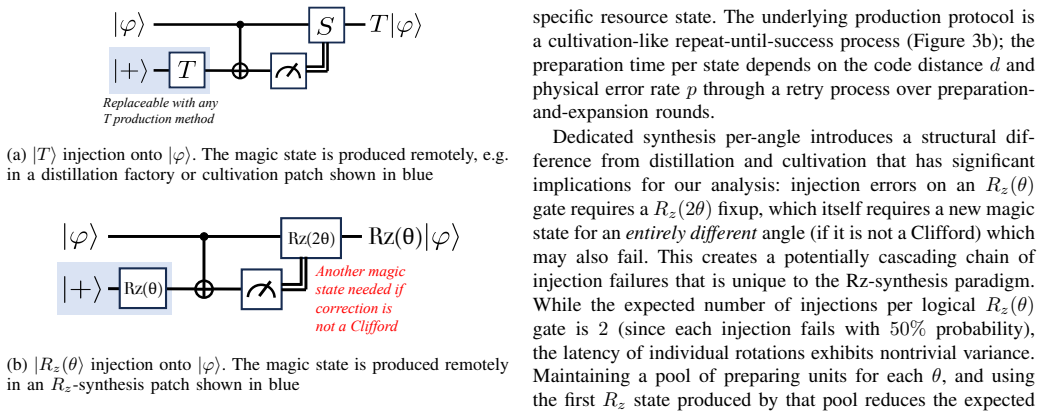
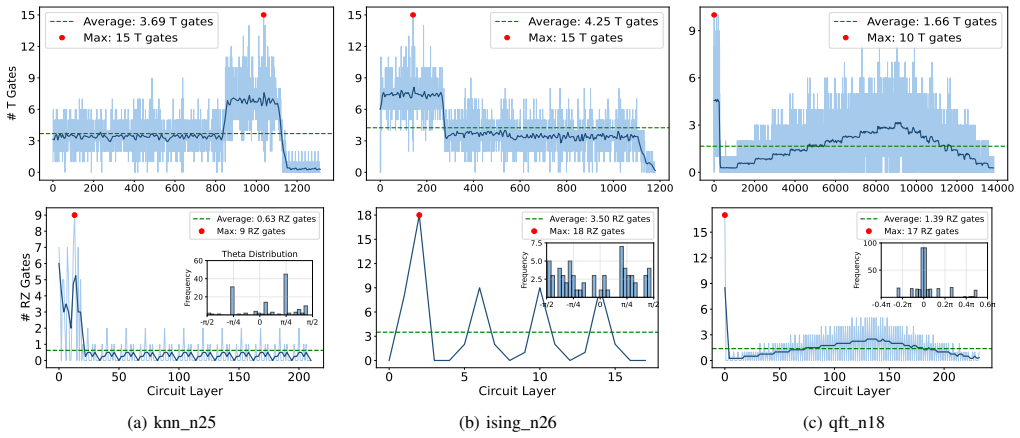
A simulation framework that couples circuit scheduling with stochastic models of magic-state production timing for distillation, cultivation, and Rz synthesis.
If this is right
- Fewer factories suffice to reach the space-time minimum once production variance is included.
- Static deterministic estimation over-provisions factories and mis-states the true cost of execution.
- Each preparation mechanism (distillation, cultivation, synthesis) exhibits its own shifted tradeoff curve.
- Resource planning must treat production as a stochastic process rather than a fixed schedule.
Where Pith is reading between the lines
- Scheduling algorithms that deliberately exploit natural production variance could yield further gains.
- Similar stochastic smoothing may appear in other non-deterministic quantum operations beyond magic states.
- Future resource-estimation tools should default to probabilistic rather than worst-case or average-case inputs.
Load-bearing premise
The timing statistics assumed for stochastic magic-state production match those of real hardware.
What would settle it
A hardware experiment that measures production delay distributions with substantially lower variance than the models and finds no reduction in required factories or space-time volume.
Figures





read the original abstract
A promising approach to achieving scalable fault-tolerant quantum computation is the use of quantum error correction (QEC) codes augmented with magic states i.e. resource states produced via distillation, cultivation, or $R_z$ synthesis and teleported into the circuit as needed. Because magic-state production dominates the space-time volume of fault-tolerant programs, system architects must decide how many production units to allocate. Current approaches rely on deterministic analysis that either provisions for worst-case peak demand (wasting valuable qubit resources on factories that are never simultaneously utilized) or assumes average demand, which increases execution time. In this work, we build a simulation framework that couples circuit scheduling with different stochastic magic state production models, and use it to quantify the impact of non-determinism on circuit execution. We show that non-determinism has a dual effect that deterministic models cannot capture: it inflates total execution time (the price), while deflating peak per-cycle resource demand (the payoff). For distillation-based architectures, this demand smoothing shifts the space-time-optimal provisioning point: fewer factories are needed to minimize space-time volume than deterministic analysis predicts. Across benchmarks, stochastic-aware provisioning reduces space-time volume by up to 27% compared to the deterministic optimum for distillation, while requiring up to 30% fewer factories. We characterize these effects across each preparation mechanism, map the resulting design-space tradeoffs, and demonstrate that static resource estimation systematically mis-characterizes the cost of fault-tolerant execution. Our results establish that stochastic-aware analysis is necessary for right-sizing the factory allocations and should replace deterministic heuristics as the standard methodology for FTQC resource planning.
Editorial analysis
A structured set of objections, weighed in public.
Referee Report
Summary. The paper claims that non-determinism in magic-state production (via distillation, cultivation, or Rz synthesis) produces a dual effect in fault-tolerant quantum computation: it increases total circuit execution time while decreasing peak per-cycle resource demand. Using a custom simulation framework that couples scheduling to stochastic production models, the authors show that this demand-smoothing shifts the space-time-optimal factory provisioning point, yielding up to 27% lower space-time volume and up to 30% fewer factories than deterministic worst-case analysis for distillation-based architectures. They conclude that deterministic resource estimation systematically mis-characterizes costs and that stochastic-aware provisioning should become standard.
Significance. If the underlying stochastic models prove representative of hardware timing statistics, the dual-effect insight and the quantitative provisioning shifts would be significant for FTQC architecture. The work supplies concrete benchmarks across production mechanisms and demonstrates that ignoring variance leads to suboptimal factory counts, which could improve qubit utilization in near-term fault-tolerant systems. The simulation-based approach is a practical step beyond purely analytic deterministic models.
major comments (3)
- [Simulation framework] The simulation framework section provides no explicit description of the stochastic models (distributions, parameters, variance, or inter-production correlations) used for distillation, cultivation, and Rz synthesis. Because the headline 27% space-time-volume and 30% factory-count reductions rest entirely on the demand-smoothing produced by these models, the absence of model specification and any calibration against hardware data makes the quantitative claims unverifiable from the manuscript.
- [Results and benchmarks] Results reporting (including the 27% and 30% figures) contains no error bars, confidence intervals, or sensitivity sweeps over model parameters such as production-time variance or correlation structure. Without these, it is impossible to determine whether the reported improvements are robust or artifacts of the particular stochastic realizations chosen.
- [Discussion and conclusions] The central argument that stochastic-aware provisioning is strictly superior to deterministic optima assumes the production models capture real-device timing statistics. No empirical validation or comparison to measured hardware data is presented; if real variance or scheduling-induced correlations differ materially, the deflation in peak demand (and therefore the provisioning benefit) may shrink or disappear.
minor comments (2)
- Notation for space-time volume and per-cycle demand should be defined once in a dedicated notation table or early in the methods section to avoid repeated inline redefinitions.
- [Simulation framework] The manuscript would benefit from an explicit statement of the number of Monte-Carlo trials run for each benchmark and the random-seed policy used to ensure reproducibility.
Simulated Author's Rebuttal
We thank the referee for their constructive report and for highlighting areas where additional clarity and robustness checks would strengthen the manuscript. We address each major comment below and commit to revisions that improve verifiability without altering the core claims.
read point-by-point responses
-
Referee: [Simulation framework] The simulation framework section provides no explicit description of the stochastic models (distributions, parameters, variance, or inter-production correlations) used for distillation, cultivation, and Rz synthesis. Because the headline 27% space-time-volume and 30% factory-count reductions rest entirely on the demand-smoothing produced by these models, the absence of model specification and any calibration against hardware data makes the quantitative claims unverifiable from the manuscript.
Authors: We agree that the stochastic models require more explicit specification to allow independent verification. The manuscript references the models (geometric success for distillation, log-normal timing for cultivation, and binomial for Rz synthesis) but does not tabulate the exact parameters, variance values, or independence assumptions in the main text. In the revision we will insert a dedicated subsection (new Section 3.2) that fully specifies each distribution, lists all numerical parameters used in the reported experiments, states the assumption of independent production events, and notes the absence of inter-production correlations. This addition will make the demand-smoothing effect reproducible from the text alone. revision: yes
-
Referee: [Results and benchmarks] Results reporting (including the 27% and 30% figures) contains no error bars, confidence intervals, or sensitivity sweeps over model parameters such as production-time variance or correlation structure. Without these, it is impossible to determine whether the reported improvements are robust or artifacts of the particular stochastic realizations chosen.
Authors: We accept this criticism. The current results are based on single-run simulations for each benchmark. In the revised version we will (i) execute each experiment over 50 independent random seeds, (ii) report mean space-time volume and factory count together with standard deviation and 95% confidence intervals, and (iii) add a sensitivity subsection that varies the production-time variance parameter by ±20% around the nominal values and shows that the 27% and 30% improvements remain qualitatively intact. These changes will be presented in an expanded Results section and a new supplementary figure. revision: yes
-
Referee: [Discussion and conclusions] The central argument that stochastic-aware provisioning is strictly superior to deterministic optima assumes the production models capture real-device timing statistics. No empirical validation or comparison to measured hardware data is presented; if real variance or scheduling-induced correlations differ materially, the deflation in peak demand (and therefore the provisioning benefit) may shrink or disappear.
Authors: We acknowledge that the paper relies on theoretical stochastic models rather than direct hardware measurements. The revised Discussion will explicitly list the modeling assumptions, note that real-device timing statistics may exhibit different variance or correlations, and qualify the quantitative gains as conditional on the fidelity of the chosen models. We will also add a short paragraph outlining how future work could calibrate the models against experimental data. However, the present study contains no hardware timing traces, so we cannot perform or cite such a calibration. revision: partial
- Direct empirical validation of the stochastic production models against measured hardware timing statistics.
Circularity Check
No circularity: results are simulation outputs, not reductions to inputs
full rationale
The paper constructs a simulation framework that couples circuit scheduling to stochastic models of magic-state production (distillation, cultivation, Rz synthesis). The headline quantitative claims (up to 27% space-time volume reduction and 30% fewer factories) are reported as emergent statistics from executing this framework on benchmarks. No equations, parameter fits, or self-citations are shown to define the target metrics in terms of themselves; the stochastic models serve as external inputs whose accuracy is an assumption, not a tautology. The derivation chain therefore remains self-contained and non-circular.
Axiom & Free-Parameter Ledger
Reference graph
Works this paper leans on
-
[1]
Y . Akahoshi, K. Maruyama, H. Oshima, S. Sato, and K. Fujii, “Par- tially fault-tolerant quantum computing architecture with error-corrected clifford gates and space-time efficient analog rotations,”PRX quantum, vol. 5, no. 1, p. 010337, 2024
work page 2024
-
[2]
Assessing requirements to scale to practical quantum advantage
M. E. Beverland, P. Murali, M. Troyer, K. M. Svore, T. Hoefler, V . Kliuchnikov, G. H. Low, M. Soeken, A. Sundaram, and A. Vaschillo, “Assessing requirements to scale to practical quantum advantage,”arXiv preprint arXiv:2211.07629, 2022
work page internal anchor Pith review arXiv 2022
-
[3]
Magic-state distillation with low overhead,
S. Bravyi and J. Haah, “Magic-state distillation with low overhead,” Physical Review A—Atomic, Molecular, and Optical Physics, vol. 86, no. 5, p. 052329, 2012
work page 2012
-
[4]
Universal quantum computation with ideal clifford gates and noisy ancillas,
S. Bravyi and A. Kitaev, “Universal quantum computation with ideal clifford gates and noisy ancillas,”Physical Review A, vol. 71, no. 2, Feb. 2005. [Online]. Available: http://dx.doi.org/10.1103/PhysRevA.71. 022316
-
[5]
Averting multi-qubit burst errors in surface code magic state factories,
J. D. Chadwick, C. Kang, J. Viszlai, S. F. Lin, and F. T. Chong, “Averting multi-qubit burst errors in surface code magic state factories,” in2024 IEEE International Conference on Quantum Computing and Engineering (QCE), vol. 1. IEEE, 2024, pp. 1089–1101
work page 2024
-
[6]
Y . Ding, A. Holmes, A. Javadi-Abhari, D. Franklin, M. Martonosi, and F. Chong, “Magic-state functional units: Mapping and scheduling multi-level distillation circuits for fault-tolerant quantum architectures,” in2018 51st Annual IEEE/ACM International Symposium on Microarchitecture (MICRO). IEEE, Oct. 2018, p. 828–840. [Online]. Available: http://dx.doi....
-
[7]
Restrictions on transversal encoded quantum gate sets,
B. Eastin and E. Knill, “Restrictions on transversal encoded quantum gate sets,”Physical review letters, vol. 102, no. 11, p. 110502, 2009
work page 2009
-
[8]
Fowler, Matteo Mariantoni, John M
A. G. Fowler, M. Mariantoni, J. M. Martinis, and A. N. Cleland, “Surface codes: Towards practical large-scale quantum computation,” Physical Review A, vol. 86, no. 3, Sep. 2012. [Online]. Available: http://dx.doi.org/10.1103/PhysRevA.86.032324
-
[9]
How to factor 2048 bit rsa integers in 8 hours using 20 million noisy qubits,
C. Gidney and M. Eker ˚a, “How to factor 2048 bit rsa integers in 8 hours using 20 million noisy qubits,”Quantum, vol. 5, p. 433, 2021
work page 2048
-
[10]
Magic state cultivation: growing T states as cheap as CNOT gates
C. Gidney, N. Shutty, and C. Jones, “Magic state cultivation: growing t states as cheap as cnot gates,” 2024. [Online]. Available: https://arxiv.org/abs/2409.17595
work page internal anchor Pith review arXiv 2024
-
[11]
B. Giles and P. Selinger, “Remarks on matsumoto and amano’s normal form for single-qubit clifford+t operators,” 2019. [Online]. Available: https://arxiv.org/abs/1312.6584
-
[12]
A. Holmes, Y . Ding, A. Javadi-Abhari, D. Franklin, M. Martonosi, and F. T. Chong, “Resource optimized quantum architectures for surface code implementations of magic-state distillation,”Microprocessors and Microsystems, vol. 67, pp. 56–70, 2019
work page 2019
-
[13]
arXiv preprint arXiv:1611.07995 , year=
T. H ¨aner, M. Roetteler, and K. M. Svore, “Factoring using 2n+2 qubits with toffoli based modular multiplication,” 2017. [Online]. Available: https://arxiv.org/abs/1611.07995
-
[14]
Running a quantum circuit at the speed of data,
N. Isailovic, M. Whitney, Y . Patel, and J. Kubiatowicz, “Running a quantum circuit at the speed of data,” inProceedings of the 35th Annual International Symposium on Computer Architecture, ser. ISCA ’08. USA: IEEE Computer Society, 2008, p. 177–188. [Online]. Available: https://doi.org/10.1109/ISCA.2008.5
-
[15]
Universal transversal gates with color codes: A simplified approach,
A. Kubica and M. E. Beverland, “Universal transversal gates with color codes: A simplified approach,”Physical Review A, vol. 91, no. 3, p. 032330, 2015
work page 2015
-
[16]
Qasmbench: A low-level qasm benchmark suite for nisq evaluation and simulation,
A. Li, S. Stein, S. Krishnamoorthy, and J. Ang, “Qasmbench: A low-level qasm benchmark suite for nisq evaluation and simulation,”
-
[17]
Qasmbench: A low- level quantum benchmark suite for nisq evaluation and simulation,
[Online]. Available: https://arxiv.org/abs/2005.13018
-
[18]
A game of surface codes: Large-scale quantum computing with lattice surgery,
D. Litinski, “A game of surface codes: Large-scale quantum computing with lattice surgery,”Quantum, vol. 3, p. 128, Mar. 2019. [Online]. Available: http://dx.doi.org/10.22331/q-2019-03-05-128
-
[19]
Magic State Distillation: Not as Costly as You Think , volume =
——, “Magic state distillation: Not as costly as you think,” Quantum, vol. 3, p. 205, Dec. 2019. [Online]. Available: http: //dx.doi.org/10.22331/q-2019-12-02-205
-
[20]
Representation of quantum circuits with clifford andπ/8gates,
K. Matsumoto and K. Amano, “Representation of quantum circuits with clifford andπ/8gates,” 2008. [Online]. Available: https: //arxiv.org/abs/0806.3834
-
[21]
Utilizing resource estimation for the development of quantum computing applications,
N. Quetschlich, M. Soeken, P. Murali, and R. Wille, “Utilizing resource estimation for the development of quantum computing applications,” in2024 IEEE International Conference on Quantum Computing and Engineering (QCE), vol. 1. IEEE, 2024, pp. 232–238
work page 2024
-
[22]
Optimal ancilla-free Clifford+T approximation of z-rotations
N. J. Ross and P. Selinger, “Optimal ancilla-free clifford+t approximation of z-rotations,” 2016. [Online]. Available: https://arxiv.org/abs/1403.2975
work page Pith review arXiv 2016
-
[23]
Rescq: Realtime scheduling for continuous angle quantum error correction architectures,
S. Sethi and J. M. Baker, “Rescq: Realtime scheduling for continuous angle quantum error correction architectures,” inProceedings of the 30th ACM International Conference on Architectural Support for Programming Languages and Operating Systems, Volume 2, ser. ASPLOS ’25. ACM, Mar. 2025, p. 1028–1043. [Online]. Available: http://dx.doi.org/10.1145/3676641.3716018
-
[24]
Multiperspective reuse prediction,
S. S. Tannu, Z. A. Myers, P. J. Nair, D. M. Carmean, and M. K. Qureshi, “Taming the instruction bandwidth of quantum computers via hardware-managed error correction,” inProceedings of the 50th Annual IEEE/ACM International Symposium on Microarchitecture, ser. MICRO-50 ’17. Association for Computing Machinery, 2017, p. 679–691. [Online]. Available: https:/...
-
[25]
Quantum error correction for quantum memories,
B. M. Terhal, “Quantum error correction for quantum memories,” Reviews of Modern Physics, vol. 87, no. 2, pp. 307–346, 2015
work page 2015
-
[26]
Distilling magic states in the bicycle architecture,
S. Xu, K. Liu, P. Rall, Z. He, and Y . Ding, “Distilling Magic States in the Bicycle Architecture,” Feb. 2026, arXiv:2602.20546 [quant-ph]. [Online]. Available: http://arxiv.org/abs/2602.20546
-
[27]
Transversal gates for probabilistic implementation of multi-qubit Pauli rotations,
N. Yoshioka, A. Seif, A. Cross, and A. Javadi-Abhari, “Transversal gates for probabilistic implementation of multi-qubit Pauli rotations,” Oct. 2025, arXiv:2510.08290 [quant-ph]. [Online]. Available: http: //arxiv.org/abs/2510.08290
discussion (0)
Sign in with ORCID, Apple, or X to comment. Anyone can read and Pith papers without signing in.