Recognition: no theorem link
Symmetry-Breaking Effects on Form Factors and Observables in B to K₀^*(1430)μ^+μ^- Decay
Pith reviewed 2026-05-11 02:41 UTC · model grok-4.3
The pith
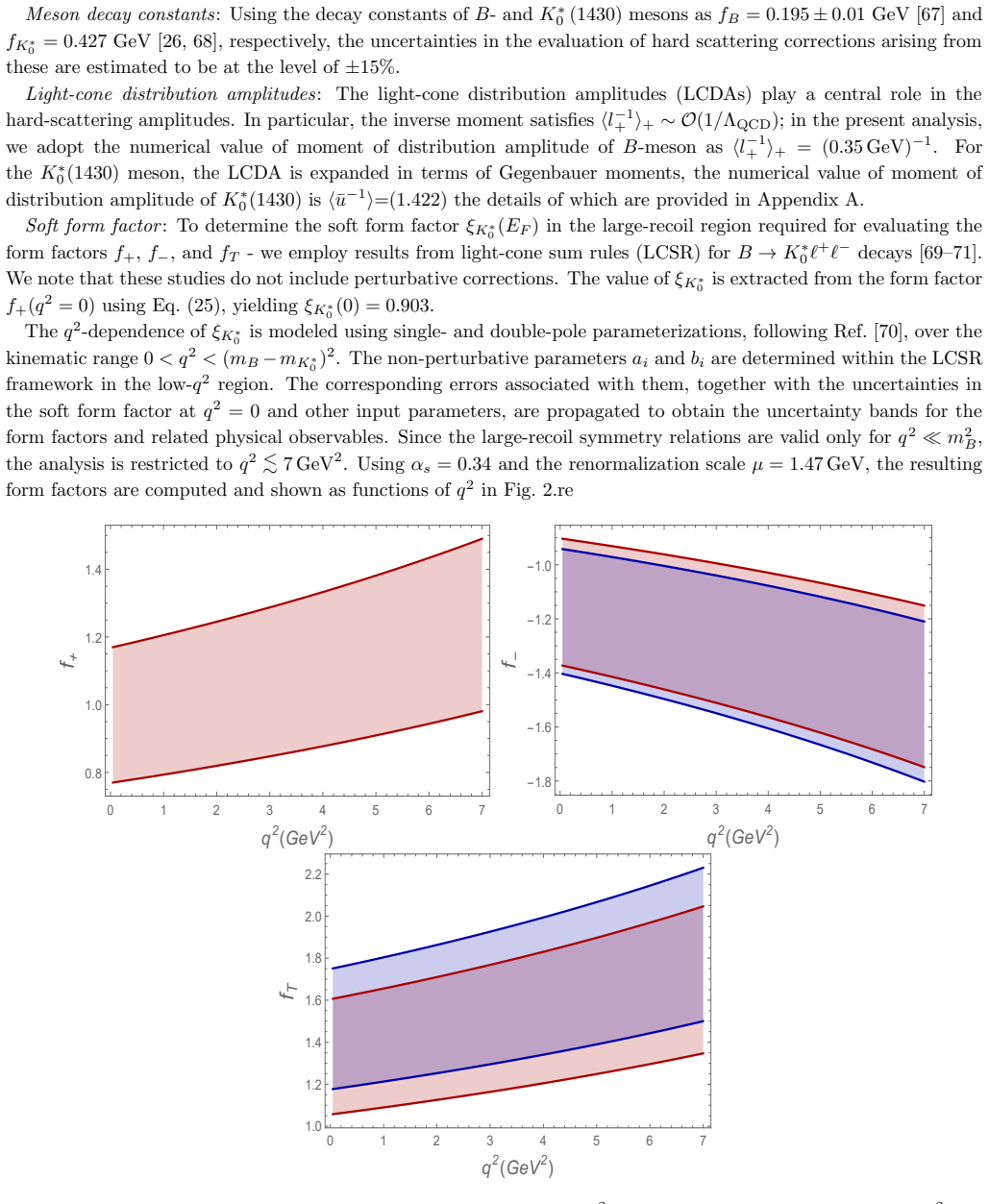
Perturbative QCD corrections to the form factors in B to K0*(1430) mu+ mu- decay induce only about 3% shifts in the branching ratio and normal lepton polarization asymmetry.
A machine-rendered reading of the paper's core claim, the machinery that carries it, and where it could break.
Core claim
In the heavy-quark and large-energy limits, symmetry relations reduce the number of independent form factors governing heavy-to-light B-meson decays. Exploiting these relations, the form factors are parametrized while incorporating symmetry-breaking corrections from perturbative QCD. Using vertex renormalization together with light-cone distribution amplitudes, the vertex and hard-spectator contributions for the B to K0*(1430) transition are computed. These form factors then determine the branching ratio and lepton polarization asymmetries (PL, PN) in B to K0*(1430) mu+ mu-. The perturbative corrections induce modest shifts of ~3% in both the branching ratio and the normal lepton polarizaton
What carries the argument
Symmetry relations valid in the heavy-quark and large-energy limits, which reduce the independent form factors, together with perturbative QCD corrections added through vertex renormalization and light-cone distribution amplitudes.
If this is right
- The branching ratio of B to K0*(1430) mu+ mu- receives a shift of approximately 3% from the perturbative corrections.
- The normal lepton polarization asymmetry in the same decay also shifts by about 3%.
- These small corrections establish a reliable standard-model prediction against which experimental data can be compared.
- Significant deviations from the predicted values would constitute evidence for new physics contributions.
Where Pith is reading between the lines
- The same symmetry-plus-perturbation method could be applied to other B decays involving scalar mesons to check for consistent patterns of small corrections.
- If new physics modifies the underlying form factors, its effects would need to exceed the 3% perturbative shift to be distinguishable in this channel.
- Future high-precision data on this decay could set quantitative bounds on the size of new physics contributions once the standard-model baseline is fixed.
Load-bearing premise
The heavy-quark and large-energy limits allow symmetry relations to reduce the number of independent form factors governing the transition, and perturbative QCD corrections can be reliably computed and added using vertex renormalization together with light-cone distribution amplitudes.
What would settle it
A measurement of the branching ratio or normal lepton polarization asymmetry in B to K0*(1430) mu+ mu- that differs from the calculated standard-model value by substantially more than a few percent, after uncertainties are accounted for.
Figures



read the original abstract
In the heavy-quark and large-energy limits, symmetry relations reduce the number of independent form factors governing heavy-to-light $B$-meson decays. Exploiting these relations, the form factors can be parametrized while systematically incorporating symmetry-breaking corrections from perturbative QCD. Using vertex renormalization together with light-cone distribution amplitudes, we compute the vertex and hard-spectator contributions for the $B \to K_0^*(1430)$ transition. We then analyze the impact of these form factors on physical observables, including the branching ratio and lepton polarization asymmetries $(P_L, P_N)$, in $B \to K_0^*(1430)\mu^+\mu^-$. Our results indicate that perturbative corrections induce modest shifts of $\sim 3\%$ in both the branching ratio and the normal lepton polarization asymmetry. Consequently, any significant deviation observed experimentally from these predictions would provide a clear signal of potential New Physics effects.
Editorial analysis
A structured set of objections, weighed in public.
Referee Report
Summary. The manuscript applies heavy-quark and large-energy symmetry relations to reduce the number of independent form factors for the B → K_0^*(1430) transition. It incorporates symmetry-breaking perturbative QCD corrections using vertex renormalization and light-cone distribution amplitudes to parametrize the form factors. These are then used to evaluate the branching ratio and lepton polarization asymmetries P_L and P_N in the decay B → K_0^*(1430) μ^+ μ^-. The central finding is that the perturbative corrections induce shifts of about 3% in the branching ratio and the normal lepton polarization asymmetry, which could serve as a baseline for detecting New Physics if larger deviations are seen experimentally.
Significance. This calculation offers a concrete assessment of the impact of symmetry-breaking effects in a specific rare B decay, which is useful for the flavor physics community. By quantifying the modest size of the corrections (~3%), it strengthens the case for using these predictions to search for deviations indicative of New Physics. The approach is grounded in established methods, providing a reliable SM reference point. No machine-checked proofs or reproducible code are included, but the method follows standard techniques in the literature for similar decays.
minor comments (3)
- [Introduction and form-factor section] The abstract and introduction should explicitly state the specific light-cone distribution amplitude models adopted for the K_0^* meson and the renormalization scale choices, as these directly affect the size of the quoted 3% shifts.
- [Numerical results] In the numerical analysis, provide a breakdown (e.g., in a table) of the separate vertex and hard-spectator contributions to the form factors before and after corrections, to allow readers to verify the origin of the ~3% effect on the branching ratio and P_N.
- [Observables and results] Clarify the error propagation for the 3% shifts, including variation of input parameters such as LCDA moments or quark masses, to confirm numerical stability.
Simulated Author's Rebuttal
We thank the referee for the positive assessment of our work and the recommendation of minor revision. The referee's summary accurately captures our use of heavy-quark and large-energy symmetry relations to parametrize the B to K0*(1430) form factors, the inclusion of perturbative QCD symmetry-breaking corrections via vertex renormalization and light-cone distribution amplitudes, and the resulting modest ~3% shifts in the branching ratio and normal lepton polarization asymmetry P_N, which serve as a Standard Model baseline for New Physics searches.
Circularity Check
No significant circularity identified
full rationale
The derivation applies standard heavy-quark/large-energy symmetry relations to reduce the number of independent form factors for the B → K0*(1430) transition, then adds perturbative QCD corrections (vertex renormalization plus hard-spectator terms from light-cone distribution amplitudes). The reported ~3% shifts in branching ratio and normal polarization asymmetry are computed outputs from these form factors. No load-bearing step reduces by the paper's own equations or self-citation to a fitted input renamed as prediction, a self-definitional loop, or an ansatz smuggled via prior work by the same authors. The central claim remains independent of its inputs and follows established methods without internal tautology.
Axiom & Free-Parameter Ledger
axioms (1)
- domain assumption Heavy-quark and large-energy limits allow symmetry relations to reduce the number of independent form factors
Reference graph
Works this paper leans on
-
[1]
denotes a scalar meson, provide an additional probe of the underlying flavor dynamics. The study of light scalar mesons with masses below 1.5 GeV serves as an intriguing subject of study due to their non trivial internal structure. While they are usually viewed as conventional quarks-antiquark states [22], alternate descriptions have been proposed dependi...
-
[2]
Further details of these can be found in the Appendix A. Correspondingly the heavy meson projector used in this calculation are: MB jk =− ifBmB 4 1 + /v 2 ϕB +(l+) /n+ +ϕ B −(l+) /n− −l + γν ⊥ ∂ ∂l ν ⊥ γ5 jk l= l+ 2 n+ ,(32) where,ϕ B +(l+) andϕ B −(l+) are the distribution amplitudes of theB-meson which are discussed in Appendix B. The hard scattering am...
-
[3]
Lepton polarizations The lepton pair produced in this decay has longitudinal, normal and transverse components of polarization. The expression for longitudinal polarization can be summarized as: PL(q2)∝ 1− 4m2 l q2 " (−Ceff 9 f+(q2)pµ + 4mb mB +m K∗ 0 Ceff 7 fT (q2)pµ))(−C10f+(q2)pµ)∗ + (−Ceff 9 f+(q2)pµ + 4mb mB +m K∗ 0 Ceff 7 fT (q2)pµ)∗(−C10f+(q2)pµ) #...
-
[4]
R. Aaijet al., (LHCb Collaboration), JHEP06, 133 (2014), arXiv:1403.8044 [hep-ex]
-
[5]
R. Aaijet al., (LHCb Collaboration), JHEP05, 082 (2014), arXiv:1403.8045 [hep-ex]
-
[6]
Aaijet al., (LHCb Collaboration), JHEP09, 179 (2015), arXiv:1506.08777 [hep-ex]
R. Aaijet al., (LHCb Collaboration), JHEP09, 179 (2015), arXiv:1506.08777 [hep-ex]
-
[7]
R. Aaijet al., (LHCb Collaboration), JHEP02, 104 (2016), arXiv:1512.04442 [hep-ex]
-
[8]
R. Aaijet al., (LHCb Collaboration), JHEP11, 047 (2016); erratum: JHEP04, 142 (2017), arXiv:1606.04731 [hep-ex]
-
[9]
R. Aaijet al., (LHCb Collaboration), Phys. Rev. Lett.127(15), 151801 (2021), arXiv:2105.14007 [hep-ex]
-
[10]
Aaijet al.,Angular analysis of the rare decay B0 s →ϕµ +µ−, JHEP11(2021) 043,arXiv:2107.13428
R. Aaijet al., (LHCb Collaboration),JHEP11, 043 (2021),arXiv:2107.13428 [hep-ex]. 16
-
[11]
R. Aaijet al., (LHCb Collaboration), Phys. Rev. D108(3), 032002 (2023), arXiv:2212.09153 [hep-ex]
-
[12]
Aaijet al.,Test of lepton universality in b→sℓ +ℓ− decays, Phys
R. Aaijet al., (LHCb Collaboration), Phys. Rev. Lett.131(5), 051803 (2023), arXiv:2212.09152 [hep-ex]
-
[13]
Smith [LHCb], [arXiv:2405.11890 [hep-ex]]
M. Smith (LHCb Collaboration), arXiv:2405.11890 [hep-ex]
-
[14]
A. Hayrapetyanet al., (CMS Collaboration), Rept. Prog. Phys.87(7), 077802 (2024), arXiv:2401.07090 [hep-ex]
-
[15]
A. Celis,et al., Phys. Rev. D96(3), 035026 (2017), arXiv:1704.05672 [hep-ph]
- [16]
-
[17]
J. Aebischer,et al., Eur. Phys. J. C80(3), 252 (2020), arXiv:1903.10434 [hep-ph]
-
[18]
Alasfaret al., JHEP12, 016 (2020), arXiv:2007.04400 [hep-ph]
L. Alasfaret al., JHEP12, 016 (2020), arXiv:2007.04400 [hep-ph]
-
[19]
G. Isidoriet al., Phys. Lett. B830, 137151 (2022), arXiv:2110.09882 [hep-ph]
-
[20]
M. Ciuchiniet al., Phys. Rev. D107(5), 055036 (2023), arXiv:2212.10516 [hep-ph]
-
[21]
G. Hiller and F. Kr¨ uger, Phys. Rev. D69, 074020 (2004), arXiv:hep-ph/0310219
-
[22]
M. Bordone, G. Isidori and A. Pattori, Eur. Phys. J. C76(8), 440 (2016), arXiv:1605.07633 [hep-ph]
-
[23]
D. Mishra and N. Mahajan, Phys. Rev. D103(5), 056022 (2021), arXiv:2010.10853 [hep-ph]
-
[24]
G. Isidori, S. Nabeebaccus and R. Zwicky, JHEP12, 104 (2020), arXiv:2009.00929 [hep-ph]
-
[25]
L. Chenet al., Phys. Rev. D105, 016002 (2022), arXiv:2112.00915 [hep-ph]
-
[26]
S. Cheng and J. M. Shen, Eur. Phys. J. C80, 554 (2020), arXiv:1907.08401 [hep-ph]
- [27]
-
[28]
A. Bharucha, D. M. Straub and R. Zwicky, J. High Energy Phys.08, 098 (2016), arXiv:1503.05534 [hep-ph]
- [29]
- [30]
- [31]
-
[32]
C.-Y. Cheung, W.-M. Zhang and G.-L. Lin, Phys. Rev. D52, 2915 (1995), arXiv:hep-ph/9505232
-
[33]
W.-M. Zhang, G.-L. Lin and C.-Y. Cheung, Int. J. Mod. Phys. A11, 3297 (1996), arXiv:hep-ph/9412394
-
[34]
H.-M. Choi and C.-R. Ji, Phys. Lett. B460, 461 (1999), arXiv:hep-ph/9903496
-
[35]
M. A. Shifman, A. I. Vainshtein and V. I. Zakharov, Nucl. Phys. B147, 448 (1979)
work page 1979
-
[36]
V. A. Novikovet al., Nucl. Phys. B191, 301 (1981)
work page 1981
-
[37]
I. I. Balitsky, V. M. Braun and A. V. Kolesnichenko, Nucl. Phys. B312, 509 (1989)
work page 1989
-
[38]
V. M. Braun and I. E. Filyanov, Z. Phys. C44, 157 (1989)
work page 1989
-
[39]
V. L. Chernyak and I. R. Zhitnitsky, Nucl. Phys. B345, 137 (1990)
work page 1990
-
[40]
Y.-Y. Keum, H.-N. Li and A. I. Sanda, Phys. Lett. B504, 6 (2001), arXiv:hep-ph/0004004
-
[41]
Y.-Y. Keum, H.-N. Li and A. I. Sanda, Phys. Rev. D63, 054008 (2001), arXiv:hep-ph/0004173
- [42]
-
[43]
N. Gubernari, A. Kokulu and D. van Dyk, J. High Energy Phys.01, 150 (2019), arXiv:1811.00983 [hep-ph]
-
[44]
M. Beneke and T. Feldmann, Nucl. Phys. B592, 3 (2001), arXiv:hep-ph/0008255
- [45]
-
[46]
H. Hatanaka and K.-C. Yang, Phys. Rev. D78, 094023 (2008), arXiv:0804.3198 [hep-ph]
- [47]
-
[48]
S. Momeni and R. Khosravi, Phys. Rev. D96, 016018 (2017), arXiv:1804.04844 [hep-ph]
- [49]
- [50]
- [51]
-
[52]
M. Neubert, Phys. Rep.245, 259 (1994), arXiv:hep-ph/9306320
-
[53]
J. Charleset al., Phys. Rev. D60, 014001 (1999), arXiv:hep-ph/9812358
- [54]
- [55]
-
[56]
A. Khodjamirian, T. Mannel and Y. M. Wang, J. High Energy Phys.02, 010 (2013), arXiv:1211.0234 [hep-ph]
-
[57]
A. Khodjamirianet al., J. High Energy Phys.09, 089 (2010), arXiv:1006.4945 [hep-ph]
- [58]
- [59]
-
[60]
M. Beneke and T. Feldmann, Eur. Phys. J. C33, S241 (2004), arXiv:hep-ph/0308303
-
[61]
M. Beneke and T. Feldmann, Nucl. Phys. B685, 249 (2004), arXiv:hep-ph/0311335
-
[62]
Weak decays beyond leading logarithms,
G. Buchalla, A. J. Buras and M. E. Lautenbacher, Rev. Mod. Phys.68, 1125 (1996), arXiv:hep-ph/9512380
- [63]
- [64]
- [65]
-
[66]
A. Sikandaret al., Phys. Rev. D100, 056013 (2019), arXiv:1909.04384 [hep-ph]
- [67]
-
[68]
A. Khodjamirianet al., Phys. Lett. B410, 275 (1997), arXiv:hep-ph/9706303
- [69]
-
[70]
P. Gelhausenet al., Phys. Rev. D88, 014015 (2013), arXiv:1305.5432 [hep-ph]
- [71]
- [72]
- [73]
-
[74]
R. Khosravi, Phys. Rev. D109, 036003 (2024), arXiv:2401.05155 [hep-ph]
-
[75]
B. Aubertet al., Phys. Rev. D80, 111105 (2009), arXiv:0907.1681 [hep-ex]
-
[76]
M. Beneke and J. Rohrwild, Eur. Phys. J. C71, 1818 (2011), arXiv:1110.3228 [hep-ph]
- [77]
-
[78]
H.-Y. Chenget al., Phys. Rev. D73, 014017 (2006), arXiv:hep-ph/0508104. 18
discussion (0)
Sign in with ORCID, Apple, or X to comment. Anyone can read and Pith papers without signing in.