Recognition: 2 theorem links
· Lean TheoremError Correction of Beamsplitter-Generated Entangled GKP States
Pith reviewed 2026-05-11 03:05 UTC · model grok-4.3
The pith
Interfering qunaught states on a beamsplitter generates all four GKP Bell states with 69% fidelity and enables error-corrected lifetime extension.
A machine-rendered reading of the paper's core claim, the machinery that carries it, and where it could break.
Core claim
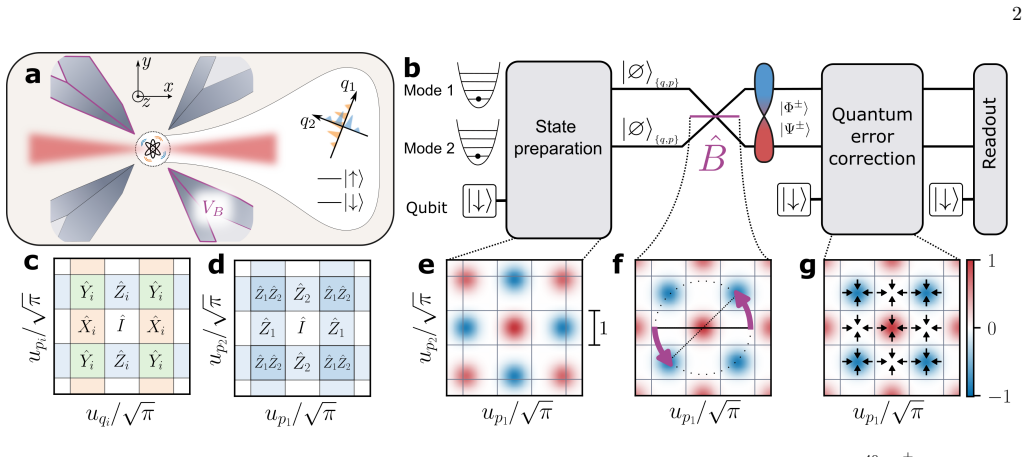
Using two motional modes of a trapped ion, we demonstrate the generation of entangled states of GKP qubits by interfering two qunaught states on a beamsplitter. We generate all four Bell states with an average fidelity of 69%, and subsequently demonstrate an extension of the entangled state lifetime through the use of quantum error correction. These results complete the set of Gaussian operations required for quantum computing with GKP codes.
What carries the argument
The linear beamsplitter-like coupling between two bosonic modes applied to qunaught states, which preserves the GKP grid structure and is fault-tolerant.
Load-bearing premise
The states produced retain the full GKP error-correcting properties after the beamsplitter and the lifetime extension is caused by the error correction rather than other factors.
What would settle it
An experiment that measures the decay rate of the logical information with and without applying the error-correction protocol, expecting slower decay only when the protocol is used.
Figures


read the original abstract
To be useful, quantum computers will be required to successfully correct errors occurring at the hardware level. Bosonic codes provide a hardware-efficient option for error correction, but fault-tolerance further requires that the available gate interactions be compatible with the code. A promising bosonic code is the Gottesman-Kitaev-Preskill (GKP) code, for which a linear beamsplitter-like coupling between two bosonic modes is fault-tolerant, making this a key primitive for building larger systems. Here, using two motional modes of a trapped ion, we demonstrate the generation of entangled states of GKP qubits by interfering two qunaught states, which have a grid structure but carry no logical information, on a beamsplitter. We generate all four Bell states with an average fidelity of 69%, and subsequently demonstrate an extension of the entangled state lifetime through the use of quantum error correction. These results complete the set of Gaussian operations required for quantum computing with GKP codes and enable explorations of multi-mode bosonic encodings as well as fundamental tests of information channels.
Editorial analysis
A structured set of objections, weighed in public.
Referee Report
Summary. The paper experimentally demonstrates the generation of all four GKP-encoded Bell states by interfering two qunaught states on a beamsplitter using two motional modes of a trapped ion, reporting an average fidelity of 69%. It further claims to show an extension of the entangled-state lifetime via quantum error correction, thereby completing the set of Gaussian operations needed for fault-tolerant GKP quantum computing.
Significance. If the generated states are confirmed to be true GKP qubits whose grid structure and error-correctability are preserved, the result would be significant: it supplies the missing beamsplitter primitive for multi-mode GKP encodings and opens the door to larger-scale bosonic fault-tolerant architectures. The work is an experimental demonstration rather than a derivation, so its value hinges on the quality of the supporting data.
major comments (2)
- [Abstract] Abstract: the central claim of 69% average fidelity for the four Bell states is presented without error bars, raw data, detailed tomography description, or post-selection/calibration procedures. These omissions are load-bearing because the fidelity is the primary evidence that the beamsplitter output consists of GKP-encoded qubits rather than other entangled states.
- [Error-correction demonstration] Error-correction section: the reported lifetime extension is attributed to GKP quantum error correction, yet no post-generation stabilizer measurements (e.g., Re[⟨D(√π)⟩]) or Wigner tomography confirming retention of the logical grid peaks are described. Without this verification, the lifetime improvement cannot be unambiguously linked to GKP-specific correction rather than unrelated effects such as cooling or dynamical decoupling.
minor comments (1)
- [Abstract] The abstract and main text would benefit from explicit statements of the number of experimental repetitions and the precise definition of fidelity used (e.g., whether it includes logical or physical qubit tomography).
Simulated Author's Rebuttal
We thank the referee for their careful reading and constructive comments on our manuscript. We address each major comment below and have revised the manuscript to improve clarity and provide additional supporting details where appropriate.
read point-by-point responses
-
Referee: [Abstract] Abstract: the central claim of 69% average fidelity for the four Bell states is presented without error bars, raw data, detailed tomography description, or post-selection/calibration procedures. These omissions are load-bearing because the fidelity is the primary evidence that the beamsplitter output consists of GKP-encoded qubits rather than other entangled states.
Authors: We agree that the abstract should be more informative. In the revised manuscript we have updated the abstract to report the average fidelity as 69% with associated uncertainties and to note that it is extracted from two-mode quantum state tomography. The full tomography reconstruction procedure, post-selection criteria on the qunaught preparation, and calibration steps are described in the Methods section and Supplementary Information, where the raw data and analysis code are also referenced. The GKP character is corroborated by the grid structure visible in the reconstructed Wigner functions of the individual modes. revision: yes
-
Referee: [Error-correction demonstration] Error-correction section: the reported lifetime extension is attributed to GKP quantum error correction, yet no post-generation stabilizer measurements (e.g., Re[⟨D(√π)⟩]) or Wigner tomography confirming retention of the logical grid peaks are described. Without this verification, the lifetime improvement cannot be unambiguously linked to GKP-specific correction rather than unrelated effects such as cooling or dynamical decoupling.
Authors: We acknowledge that explicit post-correction verification strengthens the interpretation. The revised manuscript now includes stabilizer measurements (Re[⟨D(√π)⟩] on the logical subspace) taken after the error-correction sequence, together with Wigner tomograms at extended times that show retention of the grid peaks when correction is applied. These data are contrasted with control runs that omit the correction pulses, where the grid structure decays faster, indicating that the observed lifetime extension arises from the GKP-specific correction protocol rather than unrelated mechanisms. revision: yes
Circularity Check
No circularity: experimental demonstration relies on measured quantities, not self-referential derivations
full rationale
The paper is an experimental report on generating Bell states from qunaught states via beamsplitter and demonstrating lifetime extension with QEC. No derivation chain, equations, or first-principles predictions are presented that reduce by construction to fitted inputs, self-citations, or ansatzes. Reported fidelities (69% average) and lifetime extensions are direct experimental measurements. The central claims rest on physical implementation and data, not on any loop where outputs are defined as inputs. Self-citations, if present for prior GKP work, are not load-bearing for the experimental results here.
Axiom & Free-Parameter Ledger
Lean theorems connected to this paper
-
IndisputableMonolith/Foundation/Cost/FunctionalEquation.leanwashburn_uniqueness_aczel unclear?
unclearRelation between the paper passage and the cited Recognition theorem.
We generate all four Bell states with an average fidelity of 69%, and subsequently demonstrate an extension of the entangled state lifetime through the use of quantum error correction.
-
IndisputableMonolith/Foundation/AlexanderDuality.leanalexander_duality_circle_linking unclear?
unclearRelation between the paper passage and the cited Recognition theorem.
The 50/50 beamsplitter ˆB = e^{-iπ/4(ˆq1ˆp2−ˆp1ˆq2)} performs a π/4 rotation in the two-mode phase space...
What do these tags mean?
- matches
- The paper's claim is directly supported by a theorem in the formal canon.
- supports
- The theorem supports part of the paper's argument, but the paper may add assumptions or extra steps.
- extends
- The paper goes beyond the formal theorem; the theorem is a base layer rather than the whole result.
- uses
- The paper appears to rely on the theorem as machinery.
- contradicts
- The paper's claim conflicts with a theorem or certificate in the canon.
- unclear
- Pith found a possible connection, but the passage is too broad, indirect, or ambiguous to say the theorem truly supports the claim.
Reference graph
Works this paper leans on
-
[1]
D. Gottesman, A. Kitaev, and J. Preskill, Encoding a qubit in an oscillator, Physical Review A64, 012310 (2001)
work page 2001
-
[2]
S. Glancy and E. Knill, Error analysis for encoding a qubit in an oscillator, Physical Review A73, 012325 (2006)
work page 2006
-
[3]
N. C. Menicucci, Fault-tolerant measurement-based quantum computing with continuous-variable cluster states, Physical Review Letters112, 120504 (2014)
work page 2014
-
[4]
B. W. Walshe, B. Q. Baragiola, R. N. Alexander, and N. C. Menicucci, Continuous-variable gate teleportation and bosonic- code error correction, Physical Review A102, 062411 (2020)
work page 2020
-
[5]
M. H. Shaw, A. C. Doherty, and A. L. Grimsmo, Logical gates and read-out of superconducting Gottesman-Kitaev-Preskill qubits, arXiv:2403.02396 [quant-ph] 10.48550/arXiv.2403.02396 (2024)
- [6]
-
[7]
Z. Wang and L. Jiang, Passive environment-assisted quantum communication with GKP states, Physical Review X15, 021003 (2025)
work page 2025
-
[8]
Preskill, Quantum computing in the NISQ era and beyond, Quantum2, 79 (2018)
J. Preskill, Quantum computing in the NISQ era and beyond, Quantum2, 79 (2018)
work page 2018
-
[9]
How to factor 2048 bit RSA integers with less than a million noisy qubits
C. Gidney, How to factor 2048 bit RSA integers with less than a million noisy qubits, arXiv:2505.15917 [quant-ph] 10.48550/arXiv.2505.15917 (2025)
work page internal anchor Pith review doi:10.48550/arxiv.2505.15917 2048
- [10]
-
[11]
V. V. Albert, Bosonic coding: introduction and use cases, inQuantum Fluids of Light and Matter, Vol. 209 (IOS Press,
-
[12]
Gottesman, Quantum error correction and fault-tolerance (2005)
D. Gottesman, Quantum error correction and fault-tolerance (2005)
work page 2005
-
[13]
C. Fl¨ uhmann, T. L. Nguyen, M. Marinelli, V. Negnevitsky, K. Mehta, and J. P. Home, Encoding a qubit in a trapped-ion mechanical oscillator, Nature566, 513 (2019)
work page 2019
- [14]
-
[15]
B. De Neeve, T.-L. Nguyen, T. Behrle, and J. P. Home, Error correction of a logical grid state qubit by dissipative pumping, Nature Physics18, 296 (2022)
work page 2022
-
[16]
V. V. Sivak, A. Eickbusch, B. Royer, S. Singh, I. Tsioutsios, S. Ganjam, A. Miano, B. L. Brock, A. Z. Ding, L. Frunzio, S. M. Girvin, R. J. Schoelkopf, and M. H. Devoret, Real-time quantum error correction beyond break-even, Nature616, 50 (2023)
work page 2023
-
[17]
B. L. Brock, S. Singh, A. Eickbusch, V. V. Sivak, A. Z. Ding, L. Frunzio, S. M. Girvin, and M. H. Devoret, Quantum error correction of qudits beyond break-even, Nature641, 612 (2025)
work page 2025
- [18]
-
[19]
V. G. Matsos, C. H. Valahu, M. J. Millican, T. Navickas, X. C. Kolesnikow, M. J. Biercuk, and T. R. Tan, Universal quantum gate set for Gottesman–Kitaev–Preskill logical qubits, Nature Physics21, 1664 (2025)
work page 2025
-
[20]
B. W. Walshe, B. Q. Baragiola, H. Ferretti, J. Gefaell, M. Vasmer, R. Weil, T. Matsuura, T. Jaeken, G. Pantaleoni, Z. Han, T. Hillmann, N. C. Menicucci, I. Tzitrin, and R. N. Alexander, Linear-optical quantum computation with arbitrary error- correcting codes, Physical Review Letters134, 100602 (2025). 12
work page 2025
-
[21]
P. Campagne-Ibarcq, A. Eickbusch, S. Touzard, E. Zalys-Geller, N. E. Frattini, V. V. Sivak, P. Reinhold, S. Puri, S. Shankar, R. J. Schoelkopf, L. Frunzio, M. Mirrahimi, and M. H. Devoret, Quantum error correction of a qubit en- coded in grid states of an oscillator, Nature584, 368 (2020)
work page 2020
-
[22]
M. V. Larsen, J. E. Bourassa, S. Kocsis, J. F. Tasker, R. S. Chadwick, C. Gonz´ alez-Arciniegas, J. Hastrup, C. E. Lopetegui- Gonz´ alez, F. M. Miatto, A. Motamedi, R. Noro, G. Roeland, R. Baby, H. Chen, P. Contu, I. Di Luch, C. Drago, M. Gies- brecht, T. Grainge, I. Krasnokutska, M. Menotti, B. Morrison, C. Puviraj, K. Rezaei Shad, B. Hussain, J. McMahon...
work page 2025
- [23]
-
[24]
S. L. Braunstein, Squeezing as an irreducible resource, Physical Review A71, 055801 (2005)
work page 2005
-
[25]
B. Q. Baragiola, G. Pantaleoni, R. N. Alexander, A. Karanjai, and N. C. Menicucci, All-Gaussian universality and fault tolerance with the Gottesman-Kitaev-Preskill code, Physical Review Letters123, 200502 (2019)
work page 2019
- [26]
- [27]
-
[28]
K. Noh, S. M. Girvin, and L. Jiang, Encoding an oscillator into many oscillators, Physical Review Letters125, 080503 (2020)
work page 2020
-
[29]
Bruckeet al., in preparation (2026), in preparation
E. Bruckeet al., in preparation (2026), in preparation
work page 2026
-
[30]
Q. A. Turchette, C. J. Myatt, B. E. King, C. A. Sackett, D. Kielpinski, W. M. Itano, C. Monroe, and D. J. Wineland, Decoherence and decay of motional quantum states of a trapped atom coupled to engineered reservoirs, Physical Review A62, 053807 (2000)
work page 2000
-
[31]
K. R. Brown, C. Ospelkaus, Y. Colombe, A. C. Wilson, D. Leibfried, and D. J. Wineland, Coupled quantized mechanical oscillators, Nature471, 196 (2011)
work page 2011
-
[32]
D. J. Gorman, P. Schindler, S. Selvarajan, N. Daniilidis, and H. H¨ affner, Two-mode coupling in a single-ion oscillator via parametric resonance, Physical Review A89, 062332 (2014)
work page 2014
-
[33]
P.-Y. Hou, J. J. Wu, S. D. Erickson, D. C. Cole, G. Zarantonello, A. D. Brandt, S. Geller, A. Kwiatkowski, S. Glancy, E. Knill, A. C. Wilson, D. H. Slichter, and D. Leibfried, Coherent coupling and non-destructive measurement of trapped-ion mechanical oscillators, Nature Physics20, 1636 (2024)
work page 2024
-
[34]
J. Metzner, A. Quinn, S. Brudney, I. D. Moore, S. C. Burd, D. J. Wineland, and D. T. C. Allcock, Two-mode squeezing and SU(1,1) interferometry with trapped ions, Physical Review A110, 022613 (2024)
work page 2024
-
[35]
S. C. Burd, R. Srinivas, J. J. Bollinger, A. C. Wilson, D. J. Wineland, D. Leibfried, D. H. Slichter, and D. T. C. Allcock, Quantum amplification of mechanical oscillator motion, Science364, 1163 (2019)
work page 2019
-
[36]
J. Hastrup, K. Park, J. B. Brask, R. Filip, and U. L. Andersen, Measurement-free preparation of grid states, npj Quantum Information7, 17 (2021)
work page 2021
-
[37]
C. Fl¨ uhmann and J. P. Home, Direct characteristic-function tomography of quantum states of the trapped-ion motional oscillator, Physical Review Letters125, 043602 (2020)
work page 2020
-
[38]
C. H. Valahu, V. C. Olaya-Agudelo, R. J. MacDonell, T. Navickas, A. D. Rao, M. J. Millican, J. B. P´ erez-S´ anchez, J. Yuen- Zhou, M. J. Biercuk, C. Hempel, T. R. Tan, and I. Kassal, Direct observation of geometric-phase interference in dynamics around a conical intersection, Nature Chemistry15, 1503 (2023)
work page 2023
-
[39]
J. Hastrup and U. L. Andersen, Improved readout of qubit-coupled Gottesman–Kitaev–Preskill states, Quantum Science and Technology6, 035016 (2021)
work page 2021
-
[40]
C. A. Riofr´ ıo, D. Gross, S. T. Flammia, T. Monz, D. Nigg, R. Blatt, and J. Eisert, Experimental quantum compressed sensing for a seven-qubit system, Nature Communications8, 15305 (2017)
work page 2017
-
[41]
M. Harlander, R. Lechner, M. Brownnutt, R. Blatt, and W. H¨ ansel, Trapped-ion antennae for the transmission of quantum information, Nature471, 200 (2011)
work page 2011
- [42]
-
[43]
C. Vuillot, H. Asasi, Y. Wang, L. P. Pryadko, and B. M. Terhal, Quantum error correction with the toric Gottesman- Kitaev-Preskill code, Physical Review A99, 032344 (2019)
work page 2019
-
[44]
K. Noh, C. Chamberland, and F. G. Brand˜ ao, Low-overhead fault-tolerant quantum error correction with the surface-GKP code, PRX Quantum3, 010315 (2022)
work page 2022
-
[45]
M. H. Shaw, A. C. Doherty, and A. L. Grimsmo, Stabilizer subsystem decompositions for single- and multimode Gottesman- Kitaev-Preskill codes, PRX Quantum5, 010331 (2024)
work page 2024
-
[46]
S. Singh, B. Royer, and S. M. Girvin, Towards non-Abelian quantum signal processing: efficient control of hybrid continuous- and discrete-variable architectures, arXiv:2504.19992 [quant-ph] 10.48550/arXiv.2504.19992 (2026)
-
[47]
T. Chalermpusitarak and T.-R. Tan, private communication (2026)
work page 2026
-
[48]
K. Duivenvoorden, B. M. Terhal, and D. Weigand, Single-mode displacement sensor, Physical Review A95, 012305 (2017). 13 SUPPLEMENTARY MATERIAL Appendix A: Experimental setup Fig. S 1. Top view schematic of the experimental setup. The gray box indicates the shape of the vacuum chamber. In the z direction, the ion is trapped approximately 500µm away from th...
work page 2017
discussion (0)
Sign in with ORCID, Apple, or X to comment. Anyone can read and Pith papers without signing in.