Recognition: 3 theorem links
· Lean TheoremA Time-Domain Method of Auxiliary Sources for Analyzing Transient Electromagnetic Interactions with GSTC-Modeled Metasurfacess
Pith reviewed 2026-05-11 02:08 UTC · model grok-4.3
The pith
A time-domain formulation converts GSTC to convolutions for MAS-based transient metasurface analysis.
A machine-rendered reading of the paper's core claim, the machinery that carries it, and where it could break.
Core claim
The frequency-domain impedance GSTC can be rewritten as a causal convolution in the time domain and embedded inside the MAS formulation, yielding a stable and accurate scheme for computing the transient electromagnetic fields that interact with 2D GSTC-modeled metasurfaces.
What carries the argument
Causal convolution form of the impedance-type Generalized Sheet Transition Condition (GSTC) integrated into the Method of Auxiliary Sources (MAS) to enforce the metasurface boundary conditions at each time step.
If this is right
- Direct computation of time-stepped scattered fields from metasurfaces under arbitrary incident waveforms.
- Avoidance of separate frequency sweeps followed by inverse transforms.
- Numerical stability preserved through the causal convolution operator.
- Framework remains applicable to any 2D geometry treatable by MAS.
Where Pith is reading between the lines
- The method may reduce memory and time costs relative to volumetric time-domain solvers when the metasurface is electrically thin.
- It could serve as a building block for hybrid solvers that couple MAS regions to other time-domain techniques.
- Adaptation to time-varying or nonlinear GSTC models would require only changes to the convolution kernel.
Load-bearing premise
The frequency-domain impedance type GSTC can be transformed into a causal, convolution-based TD representation that remains stable and accurate when integrated into the MAS formulation.
What would settle it
Numerical comparison of the TD-MAS fields against inverse Fourier transforms of frequency-domain MAS results for the same metasurface and a known broadband pulse; persistent discrepancy in amplitude or timing would show the transformation or integration fails.
Figures


read the original abstract
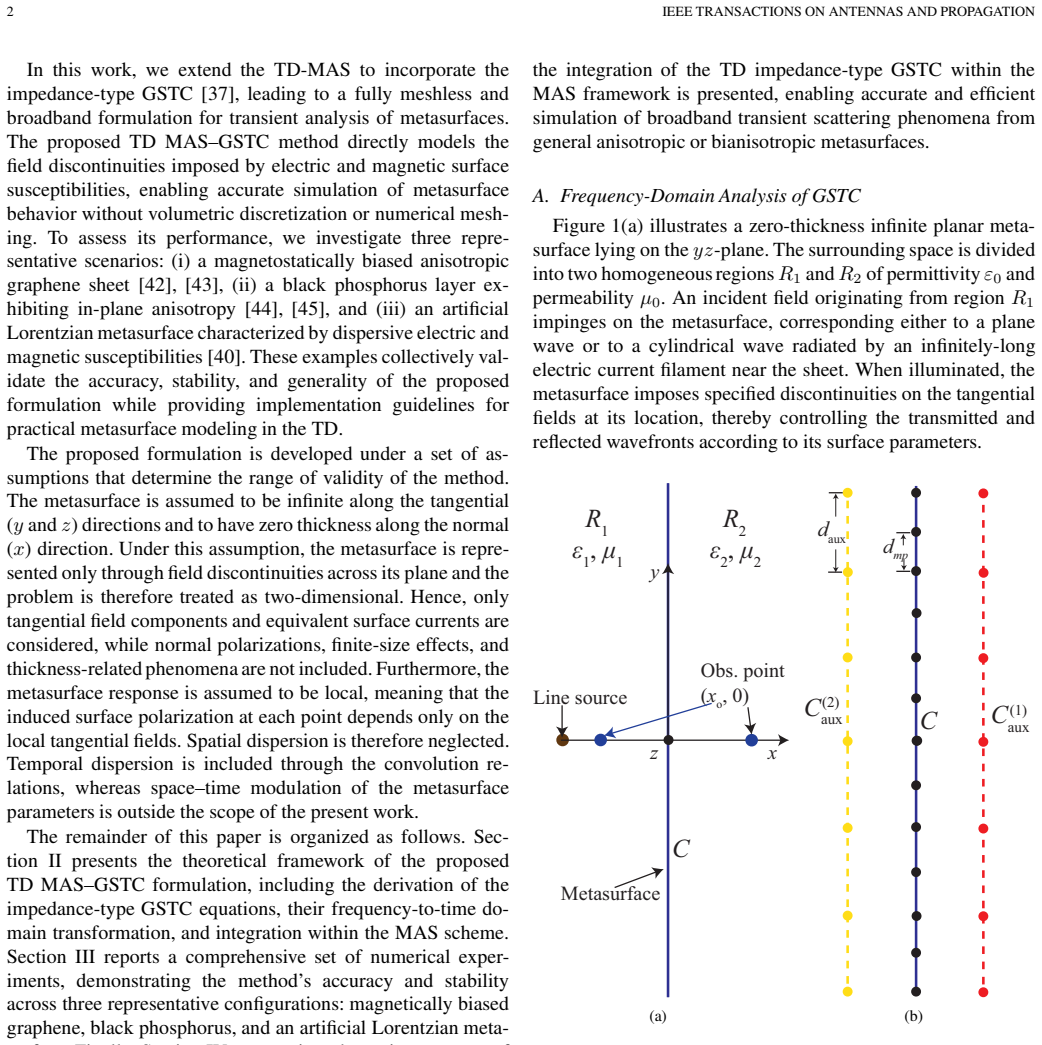
This paper presents a time domain (TD) formulation for modeling the transient electromagnetic response of two-dimensional (2D) metasurfaces using the Method of Auxiliary Sources (MAS) combined with the Generalized Sheet Transition Condition (GSTC). In the proposed approach, the frequency-domain impedance type GSTC is transformed into a causal, convolution-based TD representation and integrated within the MAS formulation. rfaces.
Editorial analysis
A structured set of objections, weighed in public.
Referee Report
Summary. This paper presents a time-domain (TD) formulation for modeling the transient electromagnetic response of two-dimensional (2D) metasurfaces using the Method of Auxiliary Sources (MAS) combined with the Generalized Sheet Transition Condition (GSTC). The frequency-domain impedance-type GSTC is transformed into a causal, convolution-based TD representation and integrated within the MAS formulation.
Significance. If the transformation produces a strictly causal, stable convolution kernel whose discrete implementation integrates accurately with the MAS time-stepping scheme and yields predictions matching known benchmarks, the work would provide a computationally efficient tool for transient analysis of metasurface scattering, extending established frequency-domain MAS techniques to broadband and pulsed excitations without requiring full volumetric discretizations.
major comments (1)
- Abstract: The central claim rests on transforming the frequency-domain impedance GSTC into a causal convolution operator that remains stable and accurate in the MAS time-stepping scheme, yet the abstract supplies no explicit kernel, pole-residue representation, stability analysis, or numerical validation against known cases; this absence is load-bearing because the method's validity cannot be assessed without evidence that the discrete convolution preserves causality and does not introduce instabilities or inaccuracies.
minor comments (2)
- Title: 'Metasurfacess' contains a typographical error and should read 'Metasurfaces'.
- Abstract: The final sentence appears truncated ('rfaces.').
Simulated Author's Rebuttal
We thank the referee for their careful reading and constructive feedback on our manuscript. We address the single major comment below and have revised the abstract to improve clarity while preserving its concise nature.
read point-by-point responses
-
Referee: Abstract: The central claim rests on transforming the frequency-domain impedance GSTC into a causal convolution operator that remains stable and accurate in the MAS time-stepping scheme, yet the abstract supplies no explicit kernel, pole-residue representation, stability analysis, or numerical validation against known cases; this absence is load-bearing because the method's validity cannot be assessed without evidence that the discrete convolution preserves causality and does not introduce instabilities or inaccuracies.
Authors: The abstract is intended as a high-level overview of the TD-MAS formulation. The explicit causal convolution kernel (including its pole-residue representation derived from the inverse Fourier transform of the frequency-domain GSTC), the stability analysis of the discrete implementation, and the numerical validations against benchmark cases are all provided in detail in Sections III, IV, and V of the manuscript, respectively. These sections demonstrate that the kernel is strictly causal, the time-stepping scheme remains stable, and results match known solutions without introducing instabilities or inaccuracies. To address the referee's concern, we have revised the abstract to include a brief reference to the causal convolution kernel and the validation results. This makes the abstract more informative regarding the method's foundation without altering its length or focus. revision: yes
Circularity Check
No significant circularity; derivation is self-contained
full rationale
The paper's central step is the conversion of the established frequency-domain impedance GSTC into a causal convolution-based time-domain operator, followed by its integration into the standard MAS framework for transient 2D metasurface analysis. No equation or claim reduces to a fitted parameter renamed as a prediction, a self-definitional loop, or a load-bearing self-citation whose validity depends on the present work. The transformation is described as a direct, standard extension of known frequency-to-time techniques in electromagnetics, with the resulting formulation remaining independent of its own outputs. This is the expected non-circular outcome for a methodological paper that applies existing tools to a new domain.
Axiom & Free-Parameter Ledger
axioms (1)
- domain assumption Frequency-domain impedance-type GSTC admits a causal convolution representation in time domain
Lean theorems connected to this paper
-
IndisputableMonolith/Cost/FunctionalEquation.leanwashburn_uniqueness_aczel unclear?
unclearRelation between the paper passage and the cited Recognition theorem.
frequency-domain impedance-type GSTC is transformed into a causal, convolution-based TD representation and integrated within the MAS formulation
-
IndisputableMonolith/Foundation/ArithmeticFromLogic.leanLogicNat unclear?
unclearRelation between the paper passage and the cited Recognition theorem.
time-stepped evaluation of the scattered or transmitted fields... discrete time convolutions
-
IndisputableMonolith/Foundation/RealityFromDistinction.leanreality_from_one_distinction unclear?
unclearRelation between the paper passage and the cited Recognition theorem.
numerical experiments... anisotropic graphene, black phosphorus, artificial Lorentzian metasurface
What do these tags mean?
- matches
- The paper's claim is directly supported by a theorem in the formal canon.
- supports
- The theorem supports part of the paper's argument, but the paper may add assumptions or extra steps.
- extends
- The paper goes beyond the formal theorem; the theorem is a base layer rather than the whole result.
- uses
- The paper appears to rely on the theorem as machinery.
- contradicts
- The paper's claim conflicts with a theorem or certificate in the canon.
- unclear
- Pith found a possible connection, but the passage is too broad, indirect, or ambiguous to say the theorem truly supports the claim.
Reference graph
Works this paper leans on
-
[1]
Time-domain scattering characteris- tics and jamming effectiveness in corner reflectors,
Y . Luo, L. Guo, Y . Zuo, and W. Liu, “Time-domain scattering characteris- tics and jamming effectiveness in corner reflectors,” IEEE Access, vol. 9, pp. 15 696–15 707, 2021
work page 2021
-
[2]
Fast- Fourier Time-Domain SAR reconstruction for millimeter-wa ve FMCW 3-D imaging,
A. V . Muppala, A. Y . Nashashibi, E. Afshari, and K. Saraba ndi, “Fast- Fourier Time-Domain SAR reconstruction for millimeter-wa ve FMCW 3-D imaging,” IEEE Trans. Microw. Theory Techn. , vol. 72, no. 12, pp. 7028–7038, Dec. 2024
work page 2024
-
[3]
J. Carrasco-Garc´ ıa, D. Porras-Sanchiz, P . Carrasco-Garc´ ıa, J. L. Herrero- Pacheco, I. Mart´ ın-Nieto, J. M. Benito-Herrero, and P . Hue rta-Hurtado, “Time-domain electromagnetics as a geophysical tool in hyd rogeological exploitation projects in mesozoic formations,” Appl. Sci., vol. 12, no. 17, p. 8655, 2022
work page 2022
-
[4]
A. Parshin, A. Bashkeev, Y . Davidenko, M. Persova, S. Iak ovlev, S. Bukhalov, N. Grebenkin, and M. Tokareva, “Lightweight un manned aerial system for time-domain electromagnetic prospectin g—the next stage in applied UA V-geophysics,” Appl. Sci. , vol. 11, no. 5, p. 2060, 2021
work page 2060
-
[5]
C. Guo, W. Xu, M. Cai, S. Duan, J. Fu, and X. Zhang, “A review : Application of terahertz nondestructive testing technolo gy in electrical insulation materials,” IEEE Access, vol. 10, pp. 121 547–121 560, 2022
work page 2022
-
[6]
Overview of imaging methods based on terahertz time-domain spectroscopy,
Q. Wang, L. Xie, and Y . Ying, “Overview of imaging methods based on terahertz time-domain spectroscopy,” Appl. Spectrosc. Rev., vol. 57, no. 3, pp. 249–264, 2021
work page 2021
-
[7]
C. L. Holloway, E. F. Kuester, J. A. Gordon, J. O’Hara, J. B ooth, and D. R. Smith, “An overview of the theory and applications of metasu rfaces: The two-dimensional equivalents of metamaterials,” IEEE Antennas Propag. Mag., vol. 54, no. 2, pp. 10–35, 2012
work page 2012
-
[8]
K. Achouri and C. Caloz, Electromagnetic Metasurfaces: Theory and Applications. John Wiley & Sons, 2021
work page 2021
-
[9]
Beam steering to ward multibeam radiation by time-coding metasurface antennas,
M. Nadi, A. Cheldavi, and S. H. Sedighy, “Beam steering to ward multibeam radiation by time-coding metasurface antennas, ” IEEE Trans. Antennas Propag., vol. 72, no. 6, pp. 4829–4838, 2024
work page 2024
-
[10]
Compact metasurface-based optical pulse-sh aping device,
R. Geromel, P . Georgi, M. Protte, S. Lei, T. Bartley, L. H uang, and T. Zentgraf, “Compact metasurface-based optical pulse-sh aping device,” Nano Lett., vol. 23, no. 8, pp. 3196–3201, 2023
work page 2023
-
[11]
X. Wang and C. Caloz, “Pseudorandom sequence (space–ti me- modulated) metasurfaces: Principles, operations, and app lications,” IEEE Antennas Propag. Mag., vol. 64, no. 4, pp. 135–144, 2022
work page 2022
-
[12]
Space and time modulations of light with metasurfaces: Rec ent progress and future prospects,
E. Mikheeva, C. Kyrou, F. Bentata, S. Khadir, S. Cueff, a nd P . Genevet, “Space and time modulations of light with metasurfaces: Rec ent progress and future prospects,” ACS Photonics, vol. 9, no. 5, pp. 1458–1482, 2022
work page 2022
-
[13]
Q. Ren, S. Y an, and A. Z. Elsherbeni, Advances in Time-Domain Compu- tational Electromagnetic Methods. John Wiley & Sons, 2022
work page 2022
-
[14]
Gedney, Introduction to the Finite-Difference Time-Domain (FDTD) Method for Electromagnetics
S. Gedney, Introduction to the Finite-Difference Time-Domain (FDTD) Method for Electromagnetics. Springer Nature, 2022
work page 2022
-
[15]
Fin ite- difference time-domain methods,
F. L. Teixeira, C. Sarris, Y . Zhang, D.-Y . Na, J.-P . Bere nger, Y . Su, M. Okoniewski, W. C. Chew, V . Backman, and J. J. Simpson, “Fin ite- difference time-domain methods,” Nat. Rev. Methods Primers , vol. 3, no. 1, p. 75, 2023
work page 2023
-
[16]
Comsol Multiphysics, Comsol, Inc., 2022
work page 2022
-
[17]
J. Alvarez, L. Angulo, A. Rubio Bretones, and S. G. Garci a, “A spurious- free discontinuous Galerkin time-domain method for the acc urate mod- eling of microwave filters,” IEEE Trans. Microw. Theory Techn., vol. 60, no. 8, pp. 2359–2369, Aug 2012
work page 2012
-
[18]
L. D. Angulo, J. Alvarez, M. F. Pantoja, S. G. Garcia, and A. R. Bretones, “Discontinuous Galerkin time domain methods in computatio nal elec- IEEE TRANSACTIONS ON ANTENNAS AND PROPAGA TION 13 trodynamics: State of the art,” F orum Electromagn. Res. Methods Appl. Technol., vol. 10, no. 4, pp. 1–24, 2015
work page 2015
-
[19]
T. Takahashi, “A fast time-domain boundary element met hod for three- dimensional electromagnetic scattering problems,” J. Comput. Phys., vol. 482, p. 112053, 2023
work page 2023
-
[20]
R. Chen and H. Bagci, “Explicit solution of time domain s calar po- tential surface integral equations for penetrable scatter ers,” in IEEE International Symposium on Antennas and Propagation and US NC-URSI National Radio Science Meeting , 2020, pp. 1001–1002
work page 2020
-
[21]
P . J. Papakanellos, N. L. Tsitsas, and H. T. Anastassiu, “The method of auxiliary sources (MAS) in computational electromagnetic s: A compre- hensive review of advancements over the past two decades,” Electronics, vol. 13, no. 17, 2024
work page 2024
-
[22]
Aspects of the met hod of auxil- iary sources (MAS) in computational electromagnetics,
D. I. Kaklamani and H. T. Anastassiu, “Aspects of the met hod of auxil- iary sources (MAS) in computational electromagnetics,” IEEE Antennas Propag. Mag., vol. 44, no. 3, pp. 48–64, 2002
work page 2002
-
[23]
The method of fundamental solutions for scattering and radiation proble ms,
G. Fairweather, A. Karageorghis, and P . A. Martin, “The method of fundamental solutions for scattering and radiation proble ms,” Engineer . Anal. Boundary Elem., vol. 27, pp. 759–769, 2003
work page 2003
-
[24]
A. H. D. Cheng, C. S. Chen, and A. Karageorghis, An Introduction to the Method of Fundamental Solutions . Singapore: World Scientific, 2025
work page 2025
-
[25]
Y . Leviatan, A. Boag, and A. Boag, “Generalized formula tions for electro- magnetic scattering from perfectly conducting and homogeneous material bodies-theory and numerical solution,” IEEE Trans. Antennas Propag. , vol. 36, no. 12, pp. 1722–1734, 1988
work page 1988
-
[26]
On methods employing auxiliary sources for 2-D electromagnetic scatt ering by non- circular shapes,
N. L. Tsitsas, G. P . Zouros, G. Fikioris, and Y . Leviatan , “On methods employing auxiliary sources for 2-D electromagnetic scatt ering by non- circular shapes,” IEEE Trans. Antennas Propagat. , vol. 66, no. 10, pp. 5443–5452, 2018
work page 2018
-
[27]
A. Ludwig and Y . Leviatan, “Towards a stable two-dimens ional time- domain source-model solution by use of a combined source for mulation,” IEEE Trans. Antennas Propag., vol. 54, no. 10, pp. 3010–3021, 2006
work page 2006
-
[28]
——, “A source-model technique for the analysis of trans ient electromag- netic scattering by a periodic array of cylinders,” IEEE Trans. Antennas Propag., vol. 55, no. 9, pp. 2578–2590, 2007
work page 2007
-
[29]
——, “Time-domain analysis of bandgap characteristics of two- dimensional periodic structures by use of a source-model te chnique,” J. Opt. Soc. Am. A , vol. 25, no. 2, pp. 437–451, 2008
work page 2008
-
[30]
Source-model technique analysis of transient ele ctromagnetic scattering by dielectric cylinders,
——, “Source-model technique analysis of transient ele ctromagnetic scattering by dielectric cylinders,” IET microwaves, antennas & propa- gation, vol. 5, no. 12, pp. 1516–1523, 2011
work page 2011
-
[31]
M. Kouroublakis, N. L. Tsitsas, and Y . Leviatan, “A time -domain method of auxiliary sources for efficient analysis of transient ele ctromagnetic scattering by moderately conductive cylinders,” Eng. Anal. Bound. Elem., accepted for publication
-
[32]
——, “Analysis of two-dimensional transient electroma gnetic shielding using the method of auxiliary sources,” 2025, under review in IEEE Trans. Antennas Propag
work page 2025
-
[33]
General metasurf ace synthesis based on susceptibility tensors,
K. Achouri, M. A. Salem, and C. Caloz, “General metasurf ace synthesis based on susceptibility tensors,” IEEE Trans. Antennas Propag. , vol. 63, no. 7, pp. 2977–2991, 2015
work page 2015
-
[34]
Finite-element mo deling of metasur- faces with generalized sheet transition conditions,
S. Sandeep, J.-M. Jin, and C. Caloz, “Finite-element mo deling of metasur- faces with generalized sheet transition conditions,” IEEE Trans. Antennas Propag., vol. 65, no. 5, pp. 2413–2420, 2017
work page 2017
-
[35]
J. Dugan, T. J. Smy, and S. Gupta, “Accelerated IE-GSTC s olver for large- scale metasurface field scattering problems using fast mult ipole method (fmm),” IEEE Transactions on Antennas and Propagation, vol. 70, no. 10, pp. 9524–9533, 2022
work page 2022
-
[36]
IE-GSTC metasurface field solver using surface susceptibility tensors with normal polariza bilities,
T. Smy, V . Tiukuvaara, S. Gupta et al., “IE-GSTC metasurface field solver using surface susceptibility tensors with normal polariza bilities,” arXiv preprint arXiv:2105.05875, 2021
-
[37]
Simulation of cylindrical metasurfaces using GSTC- MFCM,
K. Wang, J.-J. Laurin, Q. Zhang, M. A. M. Hassan, Q. Zhang , and K. Wu, “Simulation of cylindrical metasurfaces using GSTC- MFCM,” IEEE Trans. Antennas Propag., vol. 69, no. 1, pp. 263–272, 2020
work page 2020
-
[38]
Generalize d sheet transi- tion condition FDTD simulation of metasurface,
Y . V ahabzadeh, N. Chamanara, and C. Caloz, “Generalize d sheet transi- tion condition FDTD simulation of metasurface,” IEEE Trans. Antennas Propag., vol. 66, no. 1, pp. 271–280, 2017
work page 2017
-
[39]
FDTD stabil ity analysis of metasurface gstcs with normal surface polarizations,
K. V . K. Ha, J. Dugan, T. J. Smy, and S. Gupta, “FDTD stabil ity analysis of metasurface gstcs with normal surface polarizations,” i n 2025 19th European Conference on Antennas and Propagation (EuCAP) . IEEE, 2025, pp. 1–4
work page 2025
-
[40]
FDTD simu- lation of dispersive metasurfaces with lorentzian surface susceptibilities,
T. J. Smy, S. A. Stewart, J. G. N. Rahmeier, and S. Gupta, “ FDTD simu- lation of dispersive metasurfaces with lorentzian surface susceptibilities,” IEEE Access, vol. 8, pp. 83 027–83 040, 2020
work page 2020
-
[41]
S. Tian, K. Wu, and Q. Ren, “Modeling of metasurfaces usi ng discontinu- ous galerkin time-domain method based on generalized sheet transition conditions,” IEEE Trans. Antennas Propag. , vol. 70, no. 8, pp. 6905– 6917, 2022
work page 2022
-
[42]
M. Kouroublakis, N. L. Tsitsas, and G. Fikioris, “Shiel ding effectiveness of magnetostatically-biased anisotropic graphene by the m ethod of aux- iliary sources with a surface current boundary condition,” IEEE Trans. Antennas Propag., vol. 71, no. 8, pp. 6830–6838, 2023
work page 2023
-
[43]
Unified GSTC -FDTD algorithm for the efficient electromagnetic analysis of 2D d ispersive materials,
S. Jang, J.-W. Baek, J. Cho, and K.-Y . Jung, “Unified GSTC -FDTD algorithm for the efficient electromagnetic analysis of 2D d ispersive materials,” J. Electromagn. Eng. Sci., vol. 23, no. 5, pp. 423–428, 2023
work page 2023
-
[44]
Plasmons and screening in monolayer and multila yer black phosphorus,
T. Low, R. Rold´ an, H. Wang, F. Xia, P . Avouris, L. M. More no, and F. Guinea, “Plasmons and screening in monolayer and multila yer black phosphorus,” Phys. Rev. Lett., vol. 113, no. 10, p. 106802, 2014
work page 2014
-
[45]
Efficient dispersive GS TC-FDTD algorithm using the drude dispersion model,
S. Jang, J. Cho, and K.-Y . Jung, “Efficient dispersive GS TC-FDTD algorithm using the drude dispersion model,” IEEE Access , vol. 10, pp. 59 486–59 494, 2022
work page 2022
-
[46]
W. Zouaghi, D. V oß, M. Gorath, N. Nicoloso, and H. G. Rosk os, “How good would the conductivity of graphene have to be to make sin gle- layer-graphene metamaterials for terahertz frequencies f easible?” Car- bon, vol. 94, pp. 301–308, 2015
work page 2015
discussion (0)
Sign in with ORCID, Apple, or X to comment. Anyone can read and Pith papers without signing in.