Recognition: 2 theorem links
· Lean TheoremMultiscale Structure of Eigenstate Thermalization
Pith reviewed 2026-05-11 01:59 UTC · model grok-4.3
The pith
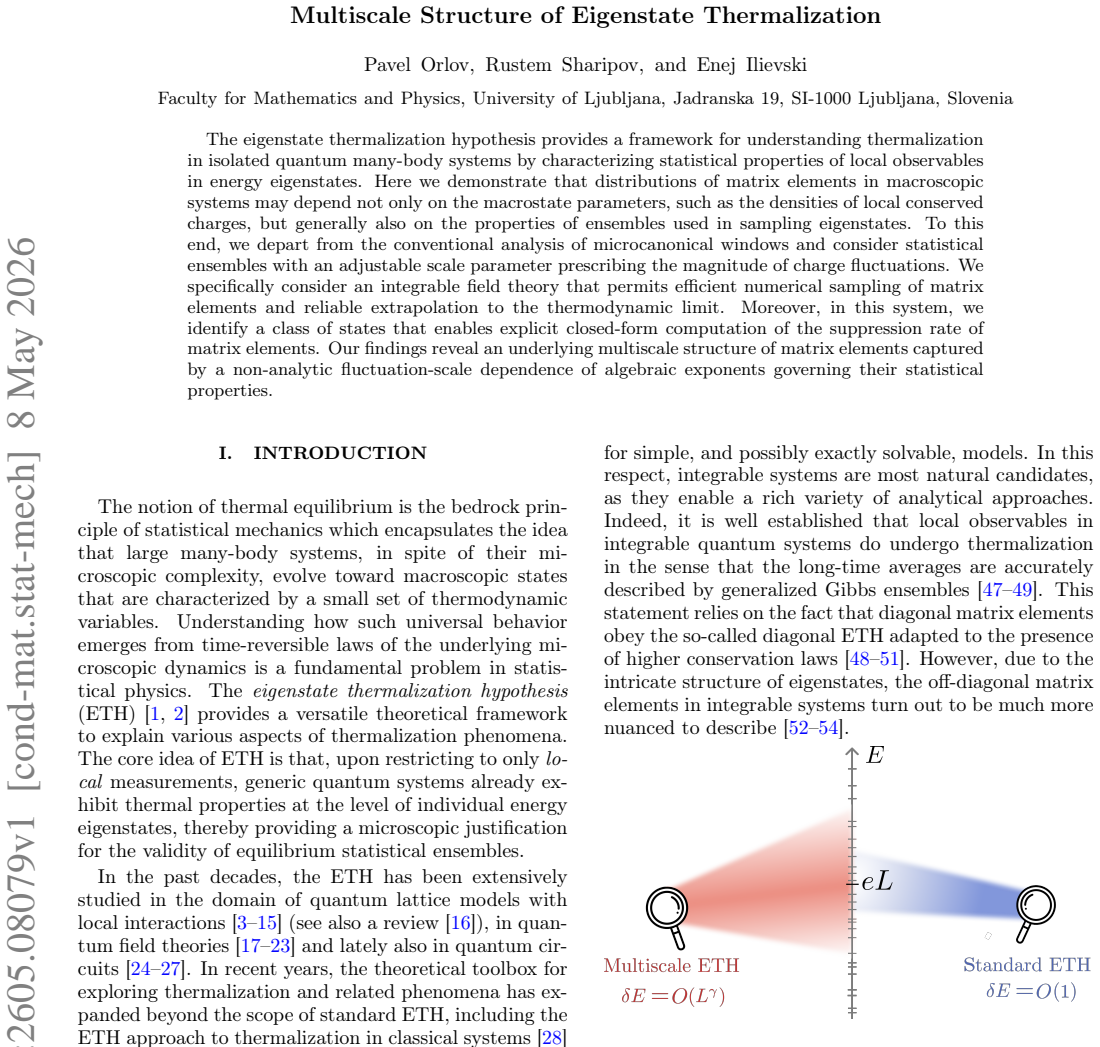
Matrix element distributions in energy eigenstates depend on the scale of charge fluctuations in the sampling ensemble, not only on macrostate densities.
A machine-rendered reading of the paper's core claim, the machinery that carries it, and where it could break.
Core claim
In an integrable field theory, the statistical properties of matrix elements of local observables between eigenstates exhibit algebraic decay whose exponents depend non-analytically on the fluctuation scale of the ensemble used to sample the eigenstates, in addition to any dependence on the macrostate densities of local conserved charges. This reveals an underlying multiscale structure of matrix elements.
What carries the argument
The adjustable scale parameter that prescribes the magnitude of charge fluctuations in the statistical ensembles used to sample eigenstates, which governs the non-analytic change in the algebraic exponents of matrix-element distributions.
If this is right
- Standard microcanonical windows are insufficient to characterize matrix-element distributions in macroscopic systems.
- The suppression rate of matrix elements admits an explicit closed-form expression for a particular class of states.
- Numerical sampling of matrix elements in the model permits reliable extrapolation to the thermodynamic limit.
- Eigenstate thermalization acquires an additional dependence on ensemble properties beyond energy and charge densities.
Where Pith is reading between the lines
- Numerical studies of thermalization in finite systems may need to report the fluctuation scale of their eigenstate sampling procedure.
- The non-analytic dependence suggests that critical points or phase transitions in fluctuation parameters could produce sharp changes in thermalization rates.
- Similar ensemble sensitivity might appear in other observables such as entanglement entropy or out-of-time-order correlators.
- If the structure generalizes, it could refine predictions for how quickly local observables equilibrate after a quench.
Load-bearing premise
Results obtained for one specific integrable field theory and chosen class of states, including reliable extrapolation to the thermodynamic limit, apply to generic macroscopic quantum many-body systems.
What would settle it
Finding that the algebraic exponents governing matrix-element statistics remain independent of the charge-fluctuation scale when the same analysis is performed in a different integrable or non-integrable model at larger system sizes.
Figures


read the original abstract
The eigenstate thermalization hypothesis provides a framework for understanding thermalization in isolated quantum many-body systems by characterizing statistical properties of local observables in energy eigenstates. Here we demonstrate that distributions of matrix elements in macroscopic systems may depend not only on the macrostate parameters, such as the densities of local conserved charges, but generally also on the properties of ensembles used in sampling eigenstates. To this end, we depart from the conventional analysis of microcanonical windows and consider statistical ensembles with an adjustable scale parameter prescribing the magnitude of charge fluctuations. We specifically consider an integrable field theory that permits efficient numerical sampling of matrix elements and reliable extrapolation to the thermodynamic limit. Moreover, in this system, we identify a class of states that enables explicit closed-form computation of the suppression rate of matrix elements. Our findings reveal an underlying multiscale structure of matrix elements captured by a non-analytic fluctuation-scale dependence of algebraic exponents governing their statistical properties.
Editorial analysis
A structured set of objections, weighed in public.
Referee Report
Summary. The paper claims that distributions of matrix elements of local observables in energy eigenstates of macroscopic quantum many-body systems depend not only on macrostate parameters (e.g., densities of conserved charges) but also on the fluctuation scale of the sampling ensemble. This multiscale structure is manifested as a non-analytic dependence of algebraic exponents on the ensemble scale parameter. The claim is supported by efficient numerical sampling of matrix elements and closed-form suppression rates in a specific integrable field theory, with extrapolation to the thermodynamic limit.
Significance. If the multiscale dependence generalizes beyond the specific integrable model, the result would meaningfully extend the eigenstate thermalization hypothesis by identifying an additional controlling parameter (ensemble fluctuation scale) for matrix-element statistics. The provision of both numerical sampling and closed-form results in one model is a concrete strength that allows direct verification of the non-analytic exponent dependence.
major comments (1)
- [Abstract and final discussion] The central claim is phrased for generic macroscopic systems, yet all evidence is obtained in one integrable field theory with a tailored class of states. No derivation from general ETH assumptions, no comparison to non-integrable dynamics, and no argument for why the observed non-analytic scale dependence survives in chaotic systems are provided; this extrapolation is load-bearing for the stated scope and remains unproven.
Simulated Author's Rebuttal
We thank the referee for the positive assessment of the significance of our work and for the constructive comment on the scope of our claims. We address the major point below.
read point-by-point responses
-
Referee: [Abstract and final discussion] The central claim is phrased for generic macroscopic systems, yet all evidence is obtained in one integrable field theory with a tailored class of states. No derivation from general ETH assumptions, no comparison to non-integrable dynamics, and no argument for why the observed non-analytic scale dependence survives in chaotic systems are provided; this extrapolation is load-bearing for the stated scope and remains unproven.
Authors: We agree that the phrasing in the abstract and final discussion presents the multiscale structure as a general feature of macroscopic systems, while all concrete evidence (numerical sampling of matrix elements and closed-form suppression rates) is obtained in one integrable field theory with a specific class of states chosen to permit exact computations. The manuscript contains no derivation from general ETH assumptions, no data from non-integrable dynamics, and no explicit argument that the non-analytic scale dependence must persist in chaotic systems. To correct this, we will revise the abstract and the concluding discussion to state explicitly that the multiscale dependence on ensemble fluctuation scale is demonstrated in the present integrable model, that the underlying mechanism is tied to the adjustable ensemble scale rather than to integrability per se, and that whether the same non-analytic exponent dependence appears in non-integrable or chaotic systems remains an open question for future work. These changes will remove any load-bearing extrapolation while preserving the concrete results obtained in the model. revision: yes
Circularity Check
No circularity: results derived from explicit sampling and closed-form expressions in a specific model
full rationale
The paper's central finding—that matrix-element distributions exhibit non-analytic dependence on ensemble fluctuation scales—is obtained by introducing an adjustable scale parameter into the ensemble definition, then performing direct numerical sampling and closed-form calculations within one integrable field theory for a chosen class of states. No equations or claims reduce the observed algebraic exponents or multiscale structure to a fit of the target quantity itself, nor do they rely on self-citations for uniqueness or ansatz smuggling. The extrapolation to generic systems is stated as an open step rather than derived by construction. The derivation chain is therefore self-contained against external benchmarks.
Axiom & Free-Parameter Ledger
axioms (2)
- domain assumption Standard framework of the eigenstate thermalization hypothesis for local observables in energy eigenstates
- domain assumption Existence of an integrable field theory permitting efficient sampling and closed-form matrix element computations
Lean theorems connected to this paper
-
IndisputableMonolith/Cost/FunctionalEquation.leanwashburn_uniqueness_aczel unclear?
unclearRelation between the paper passage and the cited Recognition theorem.
distributions of matrix elements ... non-analytic fluctuation-scale dependence of algebraic exponents
-
IndisputableMonolith/Foundation/ArithmeticFromLogic.leanembed_strictMono_of_one_lt unclear?
unclearRelation between the paper passage and the cited Recognition theorem.
scaling exponents p(γ) = 0 for γ<1/2, 2γ-1 for γ≥1/2; q(γ) likewise
What do these tags mean?
- matches
- The paper's claim is directly supported by a theorem in the formal canon.
- supports
- The theorem supports part of the paper's argument, but the paper may add assumptions or extra steps.
- extends
- The paper goes beyond the formal theorem; the theorem is a base layer rather than the whole result.
- uses
- The paper appears to rely on the theorem as machinery.
- contradicts
- The paper's claim conflicts with a theorem or certificate in the canon.
- unclear
- Pith found a possible connection, but the passage is too broad, indirect, or ambiguous to say the theorem truly supports the claim.
Reference graph
Works this paper leans on
-
[1]
Analytical results for the staircase diagrams The staircase diagrams, depicted in Fig. (6), enable us to derive an explicit analytic formula for the asymptotic behavior of the matrix elements as a function of distance. In the thermodynamic limit, the suppression rateκbe- comes a function of a single scaling variable, u= d2 L log L d ,(14) wheredhere is pr...
-
[2]
Scaling exponents in modified Vershik ensembles By numerically investigating the scaling properties of κ(L, d)in modified Vershik ensembles, we find thatu is still an adequate scaling parameter, cf. Eq. (14). In particular,κsatisfies the scaling law κ=f κ d2 L log L d . (17) In distinction from the staircase diagrams in Eq. (15), the scaling functionf κ(u...
-
[3]
Distributions of matrix elements in modified Vershik ensembles Apart from the scaling exponents, we also analyzed the full probability distribution of matrix elements. At 7 FIG. 3. Fluctuation scale dependence of ma- trix elements statistics in the modified Ver- shik ensembles.The algebraic scaling exponents p(γ)(blue) andq(γ)(red) quantifying the asymp- ...
-
[4]
Comparison with ETH studies in chaotic models Although no previous work has investigated the regime γ >0, we can nevertheless attempt to infer the scaling exponentpdirectly from the large-frequency asymptotics of the ETH spectral function by expressing the ETH sup- pression rate, Eq. (2), in the form κETH =s(e)− 1 L log|f A(e, ω)|2.(20) While there is str...
-
[5]
Comparison with ETH studies in integrable models As already emphasized earlier, all the previous stud- ies of ETH in integrable systems effectively probe the “thermal” fluctuation scaleγ= 1/2owing to fluctua- tions of higher charges. At this particular value, our results are well-aligned with the recent studies [53, 54] which investigated the structure of...
-
[6]
Forγ <1/2, the first term in Eq. (46) dominates, signifying exponential suppression of the matrix el- ements with the system size,κ=O(1), or equiva- lently |⟨λ| ˆVα |µ⟩ |2 =e −O(L).(49)
-
[7]
In the intervalγ∈[1/2,1), conversely, the sec- ond term in Eq. (46) takes over, leading to a stronger than exponential suppression (alongside an extra multiplicativelog (L)correction), namely, κ=O(L 2γ−1 logL), or |⟨λ| ˆVα |µ⟩ |2 =e −O(L2γ logL) .(50)
-
[8]
Forγ= 1, corresponding to different macrostates, the suppression gets further enhanced to |⟨λ| ˆVα |µ⟩ |2 =e −O(L2).(51) 7 Forα∈Z, vertex operators ˆVα become sparse in the chosen basis, compatibly with a singular behavior ofκ(L,0;α)at these values. 13 B. Modified Vershik ensemble In Sec. VB we introduced the Vershik ensemble as a canonical Gibbs state on...
-
[9]
Scaling exponents Motivated by the analytical result, Eq. (46), we ex- press the distribution meanκ(L, d)in the modified Ver- shik ensemble in terms of the scaling variableu= (d2/L) log(L/d). The data shown in Fig. 7 indicates that uremains a good scaling variable forκ: κ=f κ (u).(57) As also shown in Fig. 7, in the small-uregime,fκ sat- urates to a finit...
work page 2000
-
[10]
[53, 54], we first ex- amine the Vershik ensemble with the fluctuation scale γ= 1/2
Distributions of matrix elements Having analyzed the scaling exponents of the suppres- sion rate and distribution width, we now examine the full probability density functionP(Kλµ)≡PDF(K λµ)of matrix elements parametrized by the normalized pseudo- random variable Kλµ ≡ κλµ −κ δκ .(59) To facilitate a direct comparison with the thermal Gibbs ensembles emplo...
-
[11]
J. M. Deutsch,Quantum statistical mechanics in a closed system,Phys. Rev. A43(1991) 2046
work page 1991
-
[12]
Srednicki,Chaos and quantum thermalization,Phys
M. Srednicki,Chaos and quantum thermalization,Phys. Rev. E50(1994) 888
work page 1994
- [13]
-
[14]
M. Rigol,Quantum quenches and thermalization in one-dimensional fermionic systems,Physical Review A 80(2009)
work page 2009
-
[15]
T. N. Ikeda, Y. Watanabe and M. Ueda,Eigenstate randomization hypothesis: Why does the long-time average equal the microcanonical average?,Physical Review E84(2011)
work page 2011
-
[16]
R. Steinigeweg, J. Herbrych and P. Prelovšek, Eigenstate thermalization within isolated spin-chain systems,Physical Review E87(2013)
work page 2013
-
[17]
S. Sorg, L. Vidmar, L. Pollet and F. Heidrich-Meisner, Relaxation and thermalization in the one-dimensional bose-hubbard model: A case study for the interaction quantum quench from the atomic limit,Phys. Rev. A90 (2014) 033606
work page 2014
- [18]
-
[19]
K. R. Fratus and M. Srednicki,Eigenstate thermalization in systems with spontaneously broken symmetry,Phys. Rev. E92(2015) 040103
work page 2015
-
[20]
R. Mondaini, K. R. Fratus, M. Srednicki and M. Rigol, Eigenstate thermalization in the two-dimensional transverse field ising model,Physical Review E93 (2016)
work page 2016
-
[21]
W. Beugeling, R. Moessner and M. Haque,Finite-size scaling of eigenstate thermalization,Physical Review E 89(2014)
work page 2014
-
[22]
R. Steinigeweg, A. Khodja, H. Niemeyer, C. Gogolin and J. Gemmer,Pushing the limits of the eigenstate thermalization hypothesis towards mesoscopic quantum systems,Physical Review Letters112(2014)
work page 2014
-
[23]
H. Kim, T. N. Ikeda and D. A. Huse,Testing whether all eigenstates obey the eigenstate thermalization hypothesis,Physical Review E90(2014)
work page 2014
-
[24]
T. LeBlond and M. Rigol,Eigenstate thermalization for observables that break Hamiltonian symmetries and its counterpart in interacting integrable systems,Phys. Rev. E102(2020) 062113
work page 2020
-
[25]
A. Dymarsky, N. Lashkari and H. Liu,Subsystem eigenstate thermalization hypothesis,Physical Review E 97(2018)
work page 2018
-
[26]
L. D’Alessio, Y. Kafri, A. Polkovnikov and M. Rigol, From quantum chaos and eigenstate thermalization to statistical mechanics and thermodynamics,Advances in Physics65(2016) 239–362
work page 2016
-
[27]
Eigenstate thermalization hypothesis in conformal field theory,
N. Lashkari, A. Dymarsky and H. Liu,Eigenstate Thermalization Hypothesis in Conformal Field Theory, J. Stat. Mech.1803(2018) 033101 [1610.00302]
- [28]
-
[29]
P. Basu, D. Das, S. Datta and S. Pal,Thermality of eigenstates in conformal field theories,Physical Review E96(2017)
work page 2017
- [30]
-
[31]
L. V. Delacrétaz, A. L. Fitzpatrick, E. Katz and M. T. Walters,Thermalization and chaos in a 1+1d qft, Journal of High Energy Physics2023(2023)
work page 2023
-
[32]
M. Srdinšek, T. Prosen and S. Sotiriadis,Ergodicity breaking and deviation from eigenstate thermalization in relativistic quantum field theory,Physical Review Letters 132(2024)
work page 2024
-
[33]
O. Fukushima and R. Hamazaki,Violation of eigenstate thermalization hypothesis in quantum field theories with higher-form symmetry,Physical Review Letters131 (2023)
work page 2023
-
[34]
A. Chan, A. De Luca and J. Chalker,Eigenstate correlations, thermalization, and the butterfly effect, Physical Review Letters122(2019)
work page 2019
-
[35]
D. Hahn, D. J. Luitz and J. Chalker,Eigenstate correlations, the eigenstate thermalization hypothesis, and quantum information dynamics in chaotic many-body quantum systems,Physical Review X14 (2024)
work page 2024
-
[36]
F. Fritzsch and T. Prosen,Eigenstate thermalization in dual-unitary quantum circuits: Asymptotics of spectral functions,Physical Review E103(2021)
work page 2021
-
[37]
F. Fritzsch, M. F. I. Kieler and A. Bäcker,Eigenstate Correlations in Dual-Unitary Quantum Circuits: Partial Spectral Form Factor,Quantum9(2025) 1709 [2407.19929]
-
[38]
P. Orlov and E. Ilievski,Thermalization in classical systems with discrete phase space, 2026
work page 2026
-
[39]
J. A. Mingo and R. Speicher,Free Probability and Random Matrices. Springer New York, 2017, 10.1007/978-1-4939-6942-5. 21
-
[40]
L. Foini and J. Kurchan,Eigenstate thermalization hypothesis and out of time order correlators,Physical Review E99(2019)
work page 2019
-
[41]
S. Pappalardi, L. Foini and J. Kurchan,Eigenstate thermalization hypothesis and free probability,Physical Review Letters129(2022)
work page 2022
-
[42]
S. Pappalardi, F. Fritzsch and T. Prosen,Full eigenstate thermalization via free cumulants in quantum lattice systems,Phys. Rev. Lett.134(2025) 140404
work page 2025
-
[43]
F. Fritzsch, T. Prosen and S. Pappalardi, Microcanonical free cumulants in lattice systems,Phys. Rev. B111(2025) 054303
work page 2025
-
[44]
G. O. Alves, F. Fritzsch and P. W. Claeys,Probes of full eigenstate thermalization in ergodicity-breaking quantum circuits, 2025
work page 2025
-
[45]
F. Fritzsch and P. W. Claeys,Free probability in a minimal quantum circuit model, 2025
work page 2025
-
[46]
H. A. Camargo, Y. Fu, V. Jahnke, K. Pal and K.-Y. Kim,Quantum signatures of chaos from free probability, 2025
work page 2025
-
[47]
H. J. Chen and J. Kudler-Flam,Free independence and the noncrossing partition lattice in dual-unitary quantum circuits,Phys. Rev. B111(2025) 014311
work page 2025
-
[48]
S. Moudgalya, B. A. Bernevig and N. Regnault, Quantum many-body scars and hilbert space fragmentation: a review of exact results,Reports on Progress in Physics85(2022) 086501
work page 2022
- [49]
-
[50]
M. Kliczkowski, R. Świętek, M. Hopjan and L. Vidmar, Fading ergodicity,Phys. Rev. B110(2024) 134206
work page 2024
-
[51]
P. Sierant, M. Lewenstein, A. Scardicchio, L. Vidmar and J. Zakrzewski,Many-body localization in the age of classical computing*,Reports on Progress in Physics88 (2025) 026502
work page 2025
-
[52]
C. Schönle, D. Jansen, F. Heidrich-Meisner and L. Vidmar,Eigenstate thermalization hypothesis through the lens of autocorrelation functions,Phys. Rev. B103 (2021) 235137
work page 2021
-
[53]
R. Świętek, M. Hopjan, C. Vanoni, A. Scardicchio and L. Vidmar,Scaling theory of fading ergodicity,Phys. Rev. Lett.135(2025) 170401
work page 2025
-
[54]
S. Lu, M. C. Bañuls and J. I. Cirac,Algorithms for quantum simulation at finite energies,PRX Quantum2 (2021) 020321
work page 2021
-
[55]
Y. Yang, J. I. Cirac and M. C. Bañuls,Classical algorithms for many-body quantum systems at finite energies,Phys. Rev. B106(2022) 024307
work page 2022
-
[57]
L. Vidmar and M. Rigol,Generalized Gibbs ensemble in integrable lattice models,Journal of Statistical Mechanics: Theory and Experiment2016(2016) 064007
work page 2016
-
[58]
E. Ilievski, J. De Nardis, B. Wouters, J.-S. Caux, F. H. L. Essler and T. Prosen,Complete Generalized Gibbs Ensembles in an Interacting Theory,Phys. Rev. Lett.115(2015) 157201
work page 2015
-
[59]
E. Ilievski, M. Medenjak and T. Prosen,Quasilocal Conserved Operators in the Isotropic Heisenberg Spin-1/2Chain,Phys. Rev. Lett.115(2015) 120601
work page 2015
-
[60]
A. Dymarsky and K. Pavlenko,Generalized Eigenstate Thermalization Hypothesis in 2D Conformal Field Theories,Physical Review Letters123(2019)
work page 2019
-
[61]
T. Ishii and T. Mori,Strong eigenstate thermalization within a generalized shell in noninteracting integrable systems,Physical Review E100(2019)
work page 2019
-
[62]
T. LeBlond, K. Mallayya, L. Vidmar and M. Rigol, Entanglement and matrix elements of observables in interacting integrable systems,Physical Review E100 (2019)
work page 2019
-
[63]
F. H. L. Essler and A. J. J. M. de Klerk,Statistics of matrix elements of local operators in integrable models, Phys. Rev. X14(2024) 031048
work page 2024
-
[64]
F. Rottoli and V. Alba,Eigenstate thermalization hypothesis for off-diagonal matrix elements in integrable spin chains,Phys. Rev. B113(2026) 054308
work page 2026
-
[65]
M. Srednicki,The approach to thermal equilibrium in quantized chaotic systems,Journal of Physics A: Mathematical and General32(1999) 1163–1175
work page 1999
-
[66]
A. C. Cassidy, C. W. Clark and M. Rigol,Generalized Thermalization in an Integrable Lattice System,Physical Review Letters106(2011)
work page 2011
-
[67]
F. H. L. Essler and M. Fagotti,Quench dynamics and relaxation in isolated integrable quantum spin chains, Journal of Statistical Mechanics: Theory and Experiment2016(2016) 064002
work page 2016
- [68]
- [69]
- [70]
-
[71]
V. E. Korepin,Calculation of norms of bethe wave functions,Communications in Mathematical Physics86 (1982) 391
work page 1982
-
[72]
N. A. Slavnov,Calculation of scalar products of wave functions and form factors in the framework of the algebraic bethe ansatz,Theoretical and Mathematical Physics79(1989) 502
work page 1989
-
[73]
V. E. Korepin, N. M. Bogoliubov and A. G. Izergin, Quantum Inverse Scattering Method and Correlation Functions. Cambridge University Press, Cambridge, 1993, 10.1017/CBO9780511628832
-
[74]
N. Kitanine, J. Maillet and V. Terras,Form factors of the xxz heisenberg finite chain,Nuclear Physics B554 (1999) 647–678
work page 1999
-
[75]
V. A. Alba, V. A. Fateev, A. V. Litvinov and G. M. Tarnopolskiy,On Combinatorial Expansion of the Conformal Blocks Arising from AGT Conjecture, Letters in Mathematical Physics98(2011) 33–64
work page 2011
-
[76]
M. Nazarov and E. Sklyanin,Integrable hierarchy of the quantum benjamin-ono equation,Symmetry, Integrability and Geometry: Methods and Applications (2013)
work page 2013
-
[77]
A. Vershik,Statistical mechanics of combinatorial partitions, and their limit shapes,Functional Analysis and Its Applications30(1996) 90
work page 1996
-
[78]
G. Freiman, A. M. Vershik and Y. V. Yakubovich,A Local Limit Theorem for Random Strict Partitions, 22 Theory of Probability & Its Applications41(1997) 859
work page 1997
-
[79]
Y. V. Yakubovich,Central Limit Theorem for Random Strict Partitions,Journal of Mathematical Sciences107 (2001) 4296
work page 2001
- [80]
-
[81]
E. Rabinovici, A. Sánchez-Garrido, R. Shir and J. Sonner,Krylov complexity from integrability to chaos, Journal of High Energy Physics2022(2022)
work page 2022
discussion (0)
Sign in with ORCID, Apple, or X to comment. Anyone can read and Pith papers without signing in.