Recognition: 2 theorem links
· Lean TheoremProbing Jet-Medium Interactions in Heavy-Ion Collisions Using Energy-Energy Correlators
Pith reviewed 2026-05-12 01:30 UTC · model grok-4.3
The pith
A momentum conservation augmentation reconstructs jet energy-energy correlators to probe medium interactions in heavy-ion collisions.
A machine-rendered reading of the paper's core claim, the machinery that carries it, and where it could break.
Core claim
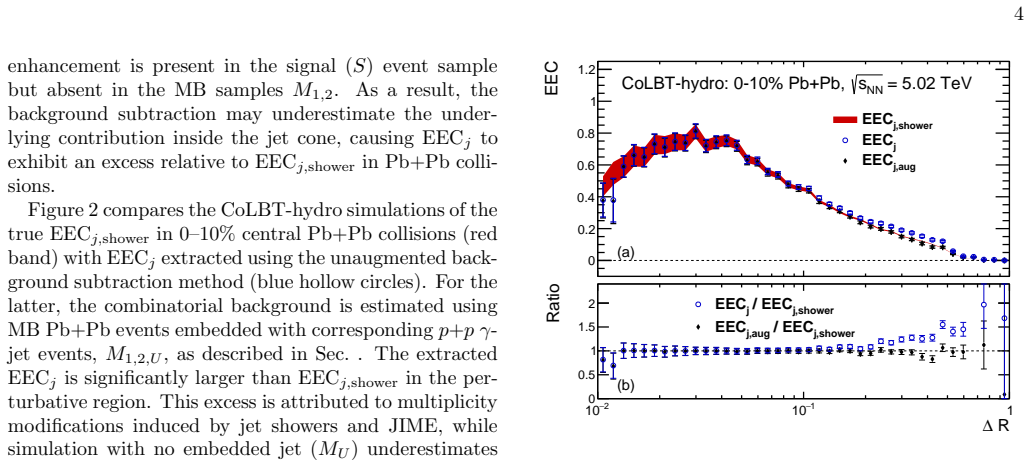
Using an augmentation method based on momentum conservation between near-side and away-side regions in gamma-jet events from 0-10% central Pb+Pb collisions at 5.02 TeV simulated with CoLBT-hydro, the reconstructed energy-energy correlator shows improved agreement with the correlator of hadrons from jet parton splittings. Comparisons of these correlators between Pb+Pb and p+p collisions with different matching conditions are sensitive to jet-medium interaction dynamics and can test the picture of jet energy loss in the quark-gluon plasma followed by fragmentations outside it.
What carries the argument
The momentum conservation augmentation method for correcting multiplicity enhancement in the jet cone due to medium interactions in gamma-jet events.
If this is right
- The method yields an experimentally accessible EEC that matches the EEC from primary jet shower hadrons more closely.
- Comparing Pb+Pb and p+p EECs with varying jet matching conditions becomes sensitive to the dynamics of jet interactions with the medium.
- This provides a new way to test whether jets lose energy in the QGP and then fragment outside it.
- Energy-energy correlators can serve as a probe for both perturbative splittings and nonperturbative medium effects in heavy-ion collisions.
Where Pith is reading between the lines
- This correction technique could be adapted for use with other jet correlation measurements in heavy-ion data to reduce medium-induced biases.
- Successful application might help differentiate between various theoretical models of how jets lose energy and how they fragment.
- Further studies could vary the collision centrality or energy to see how the medium density affects the observed EEC changes.
- Real experimental implementation would benefit from high-statistics gamma-jet samples at the LHC to validate the approach.
Load-bearing premise
The simulation model used correctly describes how jets interact with the surrounding hot matter to produce extra particles, and the momentum-based correction does not create large unwanted distortions when applied to actual experimental measurements.
What would settle it
If applying the augmentation to data produces an EEC that differs markedly from the one expected for jet-originated particles, or if EEC comparisons between heavy-ion and proton collisions show no clear sensitivity to the different matching conditions, the proposed method's effectiveness would be challenged.
Figures



read the original abstract
Energy-energy correlators (EECs) provide a sensitive probe of both perturbative and nonperturbative dynamics in relativistic heavy-ion collisions. Jet-medium interactions enhance particle multiplicity within the jet cone, which must be properly accounted for when extracting the EEC of jet shower hadrons in experiments. To address this issue, we develop an augmentation method that exploits momentum conservation between the near-side and away-side regions, using $\gamma$-jet events with 0-10\% centrality in Pb+Pb collisions at $\sqrt{s_{NN}} = 5.02$ TeV simulated with the CoLBT-hydro model. This approach yields an experimentally reconstructed EEC that shows improved agreement with the EEC of hadrons originating primarily from jet parton splittings. Comparing EECs of jets from Pb+Pb and p+p collisions with different matching conditions can be sensitive to jet medium interaction dynamics, and provide a novel means to test the scenario of jet energy loss in the QGP, followed by fragmentations outside the QGP.
Editorial analysis
A structured set of objections, weighed in public.
Referee Report
Summary. The manuscript develops a momentum-conservation augmentation method for energy-energy correlators (EECs) in γ-jet events to correct for medium-induced multiplicity enhancement when extracting the EEC of jet-shower hadrons. Using CoLBT-hydro simulations of 0-10% central Pb+Pb collisions at √s_NN=5.02 TeV, the authors show that the augmented reconstructed EEC agrees better with the generator-level jet-hadron EEC than the uncorrected version. They argue that EEC comparisons between Pb+Pb and p+p jets under different matching conditions can probe jet-medium interaction dynamics and test the picture of jet energy loss in the QGP followed by fragmentation outside it.
Significance. If the augmentation can be validated to be robust beyond the specific CoLBT-hydro realization of medium response, the approach would supply a practical experimental tool for isolating jet-shower fragmentation patterns in heavy-ion data and thereby constrain models of jet quenching. The emphasis on EECs is timely, given their sensitivity to both perturbative splitting and non-perturbative hadronization. At present, however, the single-model validation restricts the immediate reach of the central claim.
major comments (2)
- [Abstract] Abstract and method description: the claim that the augmentation 'yields an experimentally reconstructed EEC that shows improved agreement with the EEC of hadrons originating primarily from jet parton splittings' rests entirely on comparisons performed inside the same CoLBT-hydro events that generate both the jet fragmentation and the medium response; no cross-validation against an independent jet-medium framework (e.g., JETSCAPE or hybrid models with alternate splitting kernels) is reported, leaving the bias of the momentum-conservation weights unquantified for data whose true medium dynamics are unknown.
- [Method] The central assumption that the near-side/away-side momentum-conservation augmentation recovers the true jet-shower EEC is load-bearing for the proposed experimental application, yet the paper provides no test of how the extracted weights change when the multiplicity enhancement or jet-energy-loss pattern is varied while keeping the same reconstruction procedure.
minor comments (1)
- [Abstract] The abstract would benefit from a brief quantitative statement of the improvement (e.g., a typical reduction in discrepancy or χ² value) rather than the qualitative phrase 'improved agreement'.
Simulated Author's Rebuttal
We thank the referee for the positive assessment of the significance of our work and for the constructive major comments. We address each point below, clarifying the scope of our validation and making revisions to the manuscript to better highlight the method's assumptions and limitations.
read point-by-point responses
-
Referee: [Abstract] Abstract and method description: the claim that the augmentation 'yields an experimentally reconstructed EEC that shows improved agreement with the EEC of hadrons originating primarily from jet parton splittings' rests entirely on comparisons performed inside the same CoLBT-hydro events that generate both the jet fragmentation and the medium response; no cross-validation against an independent jet-medium framework (e.g., JETSCAPE or hybrid models with alternate splitting kernels) is reported, leaving the bias of the momentum-conservation weights unquantified for data whose true medium dynamics are unknown.
Authors: We agree that our validation is performed within the CoLBT-hydro framework. The momentum-conservation augmentation relies on a general kinematic principle that should be applicable across different models of jet-medium interactions. To address the referee's concern, we will revise the manuscript to include an explicit discussion of the potential model dependence of the weights and the need for future cross-validation with other frameworks such as JETSCAPE. This will help readers better assess the applicability to experimental data. revision: partial
-
Referee: [Method] The central assumption that the near-side/away-side momentum-conservation augmentation recovers the true jet-shower EEC is load-bearing for the proposed experimental application, yet the paper provides no test of how the extracted weights change when the multiplicity enhancement or jet-energy-loss pattern is varied while keeping the same reconstruction procedure.
Authors: The referee is correct that varying the multiplicity enhancement or jet energy loss patterns would provide a stronger test of the method's robustness. Our manuscript demonstrates the approach in 0-10% central Pb+Pb collisions with the CoLBT-hydro model. In the revised version, we will add a discussion on the expected sensitivity of the weights to changes in these parameters, based on the physical motivations of the augmentation. A detailed numerical study varying these aspects is planned for future work. revision: partial
Circularity Check
No significant circularity in the derivation chain
full rationale
The paper introduces a momentum-conservation augmentation for EECs in gamma-jet events, developed and tested inside CoLBT-hydro simulations to recover the jet-shower hadron EEC. This is a conventional Monte Carlo validation step for a proposed experimental correction technique, not a reduction of any claimed prediction or first-principles result to its own inputs by construction. No equations are shown to be tautological, no parameters are fitted to a subset and then relabeled as predictions, and no load-bearing self-citations or imported uniqueness theorems appear in the provided text. The central claim—that EEC comparisons with different matching conditions can probe jet-medium dynamics—rests on the physical distinction between Pb+Pb and p+p environments rather than on any internal loop within the augmentation procedure itself.
Axiom & Free-Parameter Ledger
axioms (2)
- standard math Momentum is conserved between near-side and away-side regions in gamma-jet events
- domain assumption The CoLBT-hydro model correctly captures jet-medium interactions and multiplicity enhancement in 0-10% central Pb+Pb collisions at 5.02 TeV
Lean theorems connected to this paper
-
IndisputableMonolith/Cost/FunctionalEquation.leanwashburn_uniqueness_aczel unclear?
unclearRelation between the paper passage and the cited Recognition theorem.
develop an augmentation method that exploits momentum conservation between the near-side and away-side regions, using γ-jet events ... simulated with the CoLBT-hydro model
-
IndisputableMonolith/Foundation/BranchSelection.leanbranch_selection unclear?
unclearRelation between the paper passage and the cited Recognition theorem.
EECj,aug,[data] ... reproduces the expected jet shower EEC from the CoLBT simulations
What do these tags mean?
- matches
- The paper's claim is directly supported by a theorem in the formal canon.
- supports
- The theorem supports part of the paper's argument, but the paper may add assumptions or extra steps.
- extends
- The paper goes beyond the formal theorem; the theorem is a base layer rather than the whole result.
- uses
- The paper appears to rely on the theorem as machinery.
- contradicts
- The paper's claim conflicts with a theorem or certificate in the canon.
- unclear
- Pith found a possible connection, but the passage is too broad, indirect, or ambiguous to say the theorem truly supports the claim.
Reference graph
Works this paper leans on
-
[1]
U. W. Heinz, C. Shen, and H. Song. 2011
work page 2011
- [2]
- [3]
-
[4]
A. S. Kudinoor, D. Pablos, and K. Rajagopal. 2025
work page 2025
- [5]
-
[6]
I. Moult and H. X. Zhu. Energy correlators: A journey from theory to experiment. 2025
work page 2025
-
[7]
CMS Collaboration.Phys. Lett. B, 866:139556, 2025
work page 2025
-
[8]
ALICE Collaboration. Exposing the parton-hadron tran- sition within jets with energy-energy correlators in pp collisions at √s= 5.02 tev. Technical Report CERN- EP-2024-245, 2024
work page 2024
-
[9]
B. Liang-Gilman. Energy-energy correlators in small and large systems. 2025. on behalf of the ALICE Collabora- tion
work page 2025
-
[10]
L. J. Dixon, I. Moult, and H. X. Zhu.Phys. Rev. Lett., 128:111602, 2022
work page 2022
-
[11]
Z. Yang, Y. He, I. Moult, and X.-N. Wang.Phys. Rev. Lett., 129:092001, 2022
work page 2022
-
[12]
Y. Tachibana, A. Angerami, S. A. Bass, S. Cao, et al. Phys. Rev. C, 102:021902, 2020
work page 2020
-
[13]
J. Park, A. Angerami, R. Arora, S. A. Bass, et al.Phys. Rev. C, 103:054908, 2021
work page 2021
-
[14]
W. Chen, S. Cao, T. Luo, L.-G. Pang, and X.-N. Wang. Phys. Lett. B, 777:86, 2018
work page 2018
-
[15]
PHENIX Collaboration.Phys. Rev. C, 102:054910, 2020
work page 2020
-
[16]
R. C. Hwa and C. B. Yang.Phys. Rev. C, 70:024905, 2004
work page 2004
-
[17]
J. Adams et al. Experimental and theoretical challenges in the search for the quark-gluon plasma: The star col- laboration’s critical assessment of the evidence from rhic collisions.Nucl. Phys. A, 757:102–183, 2005
work page 2005
-
[18]
K. Adcox et al. Formation of dense partonic matter in relativistic nucleus-nucleus collisions at rhic: Experimen- tal evaluation by the phenix collaboration.Nucl. Phys. A, 757:184–283, 2005
work page 2005
-
[19]
High Energy Phys., 04:039, 2017
CMS Collaboration.J. High Energy Phys., 04:039, 2017. CMS-HIN-15-015, CERN-EP-2016-242
work page 2017
-
[20]
ATLAS Collaboration. Measurement of the nuclear mod- ification factor for inclusive jets in pb+pb collisions at√sNN = 5.02 tev with the atlas detector.Phys. Rev. Lett., 123:042001, 2019
work page 2019
-
[21]
ATLAS Collaboration. Comparison of inclusive and photon-tagged jet suppression in 5.02 tev pb+pb colli- sions with atlas.Phys. Lett. B, 846:138154, 2023
work page 2023
-
[22]
Measurements of inclusive jet spectra in pp and central pb-pb collisions at√sNN = 5.02 tev.Phys
ALICE Collaboration. Measurements of inclusive jet spectra in pp and central pb-pb collisions at√sNN = 5.02 tev.Phys. Rev. C, 101:034911, 2020
work page 2020
-
[23]
V. T. Pop, M. Gyulassy, J. Barrette, C. Gale, X. N. Wang, N. Xu, and K. Filimonov. The mini-jet scale and energy loss at rhic in the hijing and rqmd models. 2002
work page 2002
-
[24]
S. S. Adler et al.Phys. Rev. Lett., 91:072301, 2003
work page 2003
-
[25]
M. Gyulassy, I. Vitev, X.-N. Wang, and B.-W. Zhang.Jet Quenching and Radiative Energy Loss in Dense Nuclear Matter. 2003
work page 2003
-
[26]
G. Wang and H. Z. Huang. Parton energy loss and path- length dependence in the dense medium at rhic.Phys. Lett. B, 672(1):30, 2009
work page 2009
-
[27]
T. Marshall, P. Suh, G. Wang, and H. Z. Huang. Con- trasting features of parton energy loss in heavy-ion col- lisions at rhic and the lhc.Chin. Phys. C, 49(9):094001, 2025
work page 2025
- [28]
-
[29]
ALICE Collaboration. Exposing the parton-hadron tran- sition within jets with energy-energy correlators in pp collisions at √s= 13 tev. 2024
work page 2024
-
[30]
Z. Yang, Y. He, I. Moult, and X.-N. Wang.Phys. Rev. Lett., 132:011901, 2024
work page 2024
- [31]
-
[32]
W. Chen, S. Cao, T. Luo, L.-G. Pang, and X.-N. Wang. Phys. Lett. B, 810:135783, 2020
work page 2020
-
[33]
W. Zhao, W. Ke, W. Chen, T. Luo, and X.-N. Wang. Phys. Rev. Lett., 128:022302, 2022
work page 2022
-
[34]
Y. He, T. Luo, X.-N. Wang, and Y. Zhu.Phys. Rev. C, 91:054908, 2015. Erratum: Phys. Rev. C 97, 019902(E) (2018)
work page 2015
-
[35]
L. Pang, Q. Wang, and X.-N. Wang.Phys. Rev. C, 86:024911, 2012
work page 2012
-
[36]
L.-G. Pang, Y. Hatta, X.-N. Wang, and B.-W. Xiao. Phys. Rev. D, 91:074027, 2015
work page 2015
-
[37]
L.-G. Pang, H. Petersen, and X.-N. Wang.Phys. Rev. C, 97:064918, 2018
work page 2018
-
[38]
Z. Yang, T. Luo, W. Chen, L.-G. Pang, and X.-N. Wang. Phys. Rev. Lett., 130:052301, 2023
work page 2023
-
[39]
T. Sj¨ ostrand, S. Mrenna, and P. Z. Skands.Comput. Phys. Commun., 178:852, 2008
work page 2008
-
[40]
K. C. Han, R. J. Fries, and C. M. Ko.Phys. Rev. C, 93:045207, 2016
work page 2016
-
[41]
W. Zhao, C. M. Ko, Y. X. Liu, G. Y. Qin, and H. Song. Phys. Rev. Lett., 125:072301, 2020
work page 2020
- [42]
-
[43]
J. S. Moreland, J. E. Bernhard, and S. A. Bass.Phys. Rev. C, 92:011901, 2015
work page 2015
-
[44]
ALICE Collaboration. Exposing the parton-hadron tran- sition within jets with energy-energy correlators in pp collisions at √s= 5.02 tev. Technical Report CERN- 8 EP-2024-245, 2024
work page 2024
-
[45]
CMS Collaboration. Evidence of medium response to hard probes using correlations of z bosons with hadrons in heavy ion collisions. 2025. CMS-HIN-23-006
work page 2025
-
[46]
ATLAS Collaboration. Search for the jet-induced diffu- sion wake in the quark-gluon plasma via measurements of jet-track correlations in photon-jet events in pb+pb collisions at √sNN = 5.02 tev with the atlas detector. Phys. Rev. C, 111:044909, 2025
work page 2025
-
[47]
Y. He, W. Chen, L.-G. Pang, and X.-N. Wang.Phys. Rev. C, 104:044902, 2021
work page 2021
- [48]
-
[49]
J. A. Hanks, A. M. Sickles, B. A. Cole, A. Franz, M. P. McCumber, D. P. Morrison, J. L. Nagle, C. H. Pinken- burg, B. Sahlmueller, P. Steinberg, M. von Steinkirch, and M. Stone.Phys. Rev. C, 86:024908, 2012
work page 2012
- [50]
discussion (0)
Sign in with ORCID, Apple, or X to comment. Anyone can read and Pith papers without signing in.