Recognition: 1 theorem link
· Lean TheoremIon-Optical Tuning of the Large Acceptance Spectrometer for Improved Angular Resolution and Acceptance
Pith reviewed 2026-05-12 01:17 UTC · model grok-4.3
The pith
Adjusting the multipole magnet field strength in the Large Acceptance Spectrometer improves vertical angular resolution while reducing acceptance.
A machine-rendered reading of the paper's core claim, the machinery that carries it, and where it could break.
Core claim
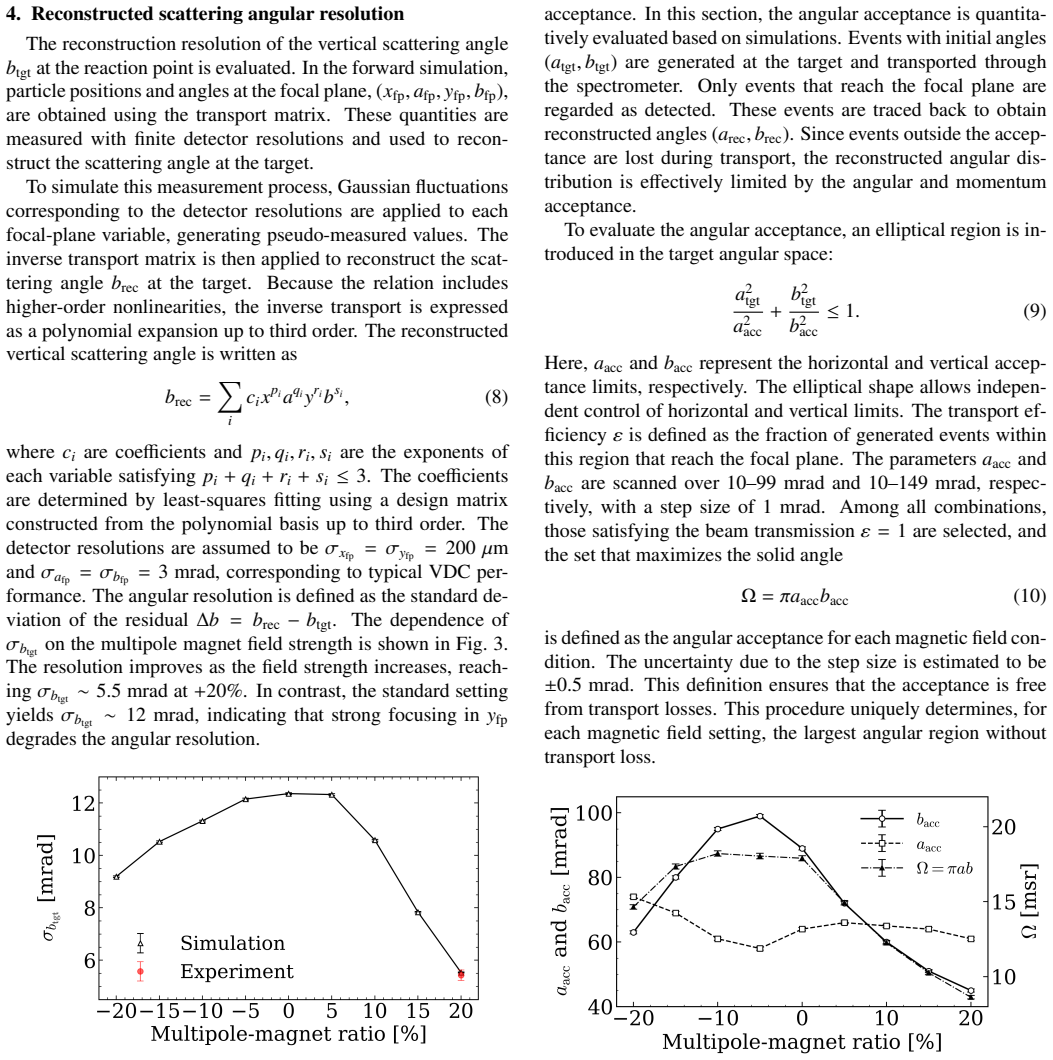
By increasing the multipole magnet field strength, the vertical angular resolution of the Large Acceptance Spectrometer improves, reaching a standard deviation of about 5.5 mrad at +20% field strength, while the vertical acceptance and solid angle decrease. This trade-off arises because enhanced vertical focusing shifts the focal condition away from the nominal focal plane, enabling high-precision angle reconstruction through ion-optical tuning.
What carries the argument
Ion-optical tuning of the multipole magnet field strength, quantified through third-order transfer matrices calculated with GICOSY and particle transport simulations with MOCADI, which determines the resolution as the standard deviation of reconstructed versus true angles and acceptance from transport efficiency within an elliptical gate.
If this is right
- Stronger multipole fields allow higher precision in scattering angle measurements.
- Acceptance decreases as field strength increases, limiting the range of measurable angles.
- Optimal field settings depend on whether the experiment prioritizes resolution or coverage.
- Shifting the focal condition enables reconstruction with improved accuracy.
Where Pith is reading between the lines
- Experimenters could select field strengths based on required precision versus coverage for specific nuclear reactions.
- This tuning approach may extend to optimizing other magnetic spectrometers in similar ion-beam experiments.
- Combined adjustments with additional optical elements could further refine the resolution-acceptance balance.
Load-bearing premise
The third-order transfer matrices and particle transport simulations accurately represent the real spectrometer's behavior without significant discrepancies from higher-order effects or hardware imperfections.
What would settle it
Direct experimental measurement of the vertical angular resolution and acceptance in the physical Large Acceptance Spectrometer at +20% field strength, compared against the simulated values of 5.5 mrad resolution and reduced solid angle.
Figures

read the original abstract
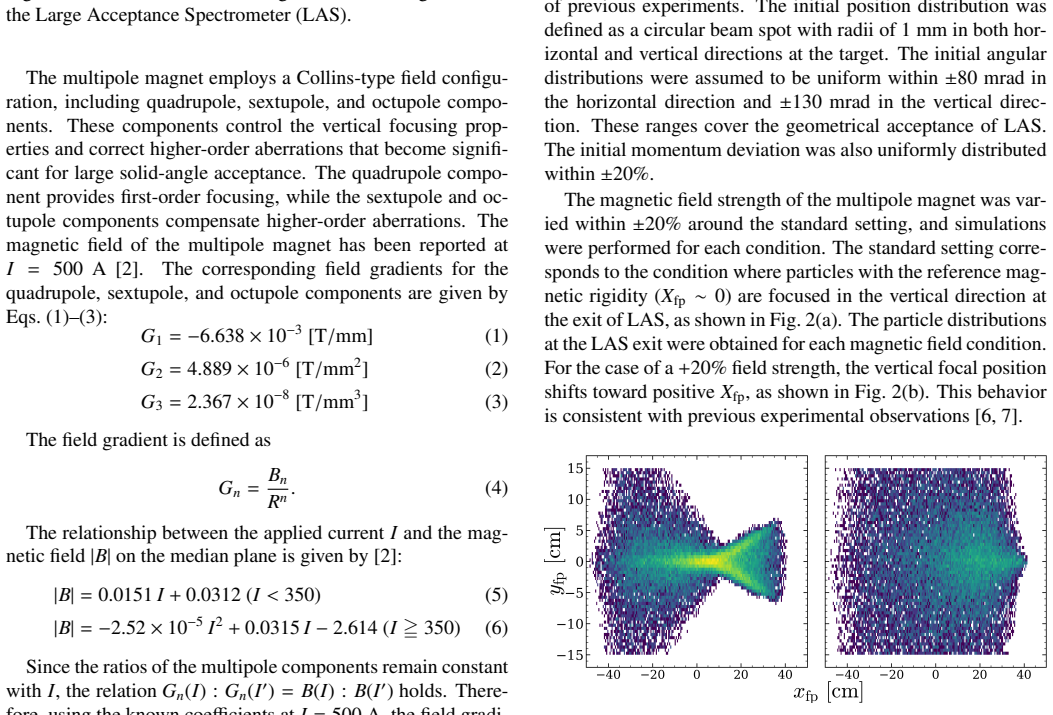
The trade-off between angular resolution and acceptance in scattering-angle measurements with a magnetic spectrometer is quantitatively evaluated for the Large Acceptance Spectrometer (LAS). The dependence on the multipole magnet field strength is investigated. Third-order transfer matrices were calculated with GICOSY, and particle transport was simulated with MOCADI. The vertical angular resolution is defined as the standard deviation between reconstructed and true angles, while the acceptance is determined from the transport efficiency within an elliptical gate in target angle space. The resolution improves with increasing field strength, reaching $\sigma_b \sim 5.5$ mrad at +20\%, consistent with $5.43 \pm 0.20$ mrad. In contrast, stronger fields reduce the vertical acceptance and solid angle. These results demonstrate a trade-off between resolution and acceptance. Enhanced vertical focusing shifts the focal condition away from the nominal focal plane, enabling high-precision reconstruction.
Editorial analysis
A structured set of objections, weighed in public.
Referee Report
Summary. The paper quantitatively evaluates the trade-off between angular resolution and acceptance for scattering-angle measurements in the Large Acceptance Spectrometer (LAS) as a function of multipole magnet field strength. Third-order transfer matrices are computed with GICOSY and particle transport is simulated with MOCADI; vertical angular resolution is defined as the standard deviation between reconstructed and true angles, while acceptance is the transport efficiency inside an elliptical gate in target-angle space. The central result is that resolution improves with stronger fields, reaching σ_b ∼ 5.5 mrad at +20 % field strength (consistent with 5.43 ± 0.20 mrad), while vertical acceptance and solid angle decrease; enhanced vertical focusing is said to shift the focal condition away from the nominal plane, enabling higher-precision reconstruction.
Significance. If the reported simulation results accurately capture the physical ion optics of the LAS, the work supplies a concrete, tunable parameter (multipole field strength) for optimizing spectrometer performance in nuclear-physics experiments, together with an explicit quantification of the resolution–acceptance trade-off. Credit is due for the use of two established, independent codes (GICOSY for third-order matrices, MOCADI for transport) and for the transparent definitions of resolution (standard deviation) and acceptance (elliptical-gate efficiency).
major comments (2)
- [Abstract] Abstract: the headline numerical claim (σ_b ∼ 5.5 mrad at +20 % field strength, consistent with 5.43 ± 0.20 mrad) is obtained exclusively from GICOSY third-order matrices fed into MOCADI; the manuscript provides neither the precise input beam parameters, magnet field maps, nor any experimental benchmark against the real LAS hardware, rendering the quantitative result load-bearing yet unvalidated.
- [Abstract] Abstract: the assertion that “enhanced vertical focusing shifts the focal condition away from the nominal focal plane, enabling high-precision reconstruction” rests on the third-order model; no sensitivity study to omitted fourth-order aberrations, fringe-field effects, or magnet inhomogeneities is reported, which directly affects whether the claimed improvement applies to the physical spectrometer.
minor comments (2)
- [Abstract] The abstract introduces the symbols σ_b and the elliptical gate without prior definition; these should be defined at first use.
- All acronyms (LAS, GICOSY, MOCADI) should be spelled out on first appearance in the main text.
Simulated Author's Rebuttal
We thank the referee for the positive assessment of the work's significance and for highlighting the transparent use of GICOSY and MOCADI. We address each major comment below, clarifying the simulation-based nature of the study while committing to improvements in transparency and discussion of limitations.
read point-by-point responses
-
Referee: [Abstract] Abstract: the headline numerical claim (σ_b ∼ 5.5 mrad at +20 % field strength, consistent with 5.43 ± 0.20 mrad) is obtained exclusively from GICOSY third-order matrices fed into MOCADI; the manuscript provides neither the precise input beam parameters, magnet field maps, nor any experimental benchmark against the real LAS hardware, rendering the quantitative result load-bearing yet unvalidated.
Authors: We agree that the quantitative results are derived from simulations and that explicit input parameters would improve reproducibility. In the revised manuscript we will add the precise beam parameters (energy, emittance, and initial phase-space distribution) together with a description of how the multipole field strengths were scaled relative to the nominal map in GICOSY. Because the present work is a simulation study intended to guide experimental optimization, direct hardware benchmarks lie outside its scope; such validation is planned for a future publication once beam-time data become available. revision: partial
-
Referee: [Abstract] Abstract: the assertion that “enhanced vertical focusing shifts the focal condition away from the nominal focal plane, enabling high-precision reconstruction” rests on the third-order model; no sensitivity study to omitted fourth-order aberrations, fringe-field effects, or magnet inhomogeneities is reported, which directly affects whether the claimed improvement applies to the physical spectrometer.
Authors: Third-order matrices are the standard level of description for ion-optical design of spectrometers such as the LAS, and GICOSY is specifically validated for this order. We will expand the revised text with a short paragraph discussing the expected magnitude of fourth-order terms and fringe-field corrections for the field strengths examined, noting that these corrections remain small compared with the dominant vertical-focusing change. A full sensitivity study would require higher-order codes or measured field maps that are not currently at our disposal, but the main trade-off between resolution and acceptance is robust within the third-order framework. revision: yes
Circularity Check
No significant circularity; results from external simulation codes
full rationale
The paper's central claims on resolution-acceptance trade-offs are obtained by feeding third-order transfer matrices from the independent GICOSY code into MOCADI transport simulations, then computing standard deviation of reconstructed vs. true angles and transport efficiency within an elliptical gate. No load-bearing step reduces these outputs to self-defined fitted parameters, self-citations, or ansatzes by construction. The reported numerical consistency with an external measured value supplies independent grounding, and the derivation chain remains self-contained against the stated simulation inputs.
Axiom & Free-Parameter Ledger
free parameters (1)
- multipole magnet field strength variation
axioms (2)
- domain assumption Third-order approximation in transfer matrices is sufficient for accurate angular resolution reconstruction
- domain assumption The elliptical gate in target angle space correctly captures the effective acceptance for transport efficiency
Lean theorems connected to this paper
-
IndisputableMonolith/Cost/FunctionalEquation.leanwashburn_uniqueness_aczel unclear?
unclearRelation between the paper passage and the cited Recognition theorem.
Third-order transfer matrices were calculated with GICOSY, and particle transport was simulated with MOCADI... resolution improves... σ_b ∼ 5.5 mrad at +20%
What do these tags mean?
- matches
- The paper's claim is directly supported by a theorem in the formal canon.
- supports
- The theorem supports part of the paper's argument, but the paper may add assumptions or extra steps.
- extends
- The paper goes beyond the formal theorem; the theorem is a base layer rather than the whole result.
- uses
- The paper appears to rely on the theorem as machinery.
- contradicts
- The paper's claim conflicts with a theorem or certificate in the canon.
- unclear
- Pith found a possible connection, but the passage is too broad, indirect, or ambiguous to say the theorem truly supports the claim.
Reference graph
Works this paper leans on
-
[1]
Matsuoka, RCNP Annual Report 1990, Research Center for Nuclear Physics, Osaka University (1990)
N. Matsuoka, RCNP Annual Report 1990, Research Center for Nuclear Physics, Osaka University (1990)
work page 1990
-
[2]
Matsuoka, RCNP Annual Report 1992, Research Center for Nuclear Physics, Osaka University (1992)
N. Matsuoka, RCNP Annual Report 1992, Research Center for Nuclear Physics, Osaka University (1992)
work page 1992
- [3]
-
[4]
Wollnik, GSI Helmholtzzentrum für Schwerionen- forschung, Darmstadt, internal report
H. Wollnik, GSI Helmholtzzentrum für Schwerionen- forschung, Darmstadt, internal report
- [5]
- [6]
-
[7]
R. Matsumura, J. Tanaka, K. Y oshida, et al., Prog. Theor. Exp. Phys., 043D01 (2026). 4
work page 2026
discussion (0)
Sign in with ORCID, Apple, or X to comment. Anyone can read and Pith papers without signing in.