Recognition: 2 theorem links
· Lean TheoremDendritic Neural Networks with Equilibrium Propagation
Pith reviewed 2026-05-12 02:56 UTC · model grok-4.3
The pith
Dendritic structure added to equilibrium propagation networks raises accuracy on harder image tasks while changing internal activation patterns.
A machine-rendered reading of the paper's core claim, the machinery that carries it, and where it could break.
Core claim
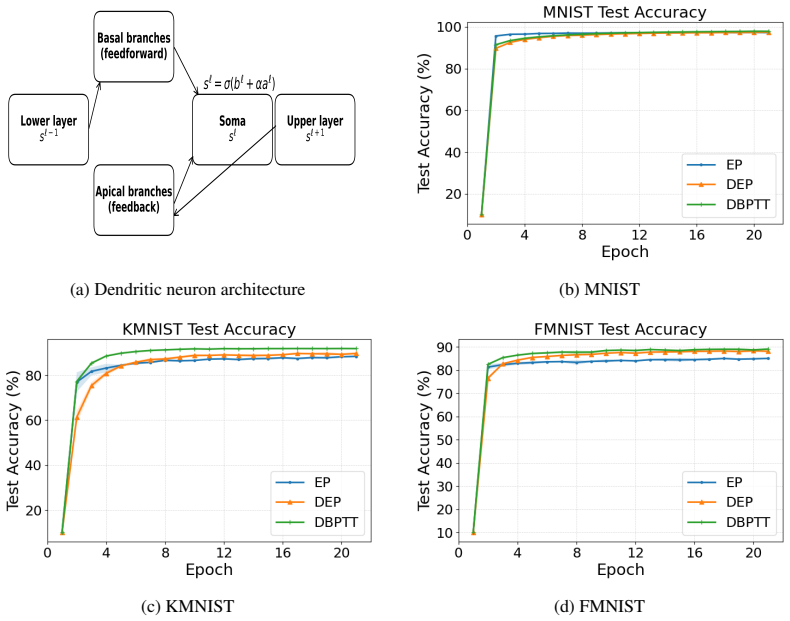
Dendritic EP reaches performance levels comparable to standard EP on simple tasks, delivers significant gains on KMNIST and FMNIST, and approaches the accuracy of dendritic networks trained with backpropagation through time; the improvement coincides with higher-magnitude and more distributed hidden-state trajectories observed during the free phase.
What carries the argument
Dendritic compartments integrated into an advanced equilibrium propagation framework, where each neuron maintains separate dendritic branches that alter activation magnitudes and distribution during the free-phase settling process.
If this is right
- Dendritic EP matches standard EP on MNIST yet outperforms it on KMNIST and FMNIST.
- Dendritic EP approaches the accuracy of the same dendritic architecture trained with backpropagation through time.
- Hidden states under dendritic EP show higher activation magnitudes and broader distribution than under standard EP.
- Architectural additions such as dendritic compartments can strengthen biologically plausible algorithms precisely where standard EP weakens in deeper or harder regimes.
Where Pith is reading between the lines
- The same dendritic modification could be tested on other local learning rules to see whether it improves their scaling behavior.
- The shift toward more distributed hidden activity may offer a concrete mechanism by which biological neurons solve credit-assignment problems.
- Further experiments on deeper networks or non-image modalities would clarify whether the benefit grows with task difficulty.
Load-bearing premise
The observed accuracy differences are caused by the dendritic compartments rather than by any other changes in the EP implementation, hyperparameters, or training procedure.
What would settle it
Run identical EP code on KMNIST and FMNIST with and without the dendritic compartments while freezing every hyperparameter and training detail; the performance gap should disappear if the dendritic structure is not the source of the improvement.
Figures

read the original abstract
Equilibrium propagation (EP) is a biologically plausible alternative to backpropagation (BP), but its effectiveness can degrade in deeper and more challenging learning settings. In parallel, dendritic neural networks have demonstrated improved performance and generalization when trained with BP, suggesting that structured, biologically inspired architectures may enhance learning. In this work, we investigate the integration of dendritic neural networks with equilibrium propagation using an advanced EP framework. We evaluate the proposed dendritic EP model on MNIST, Kuzushiji-MNIST (KMNIST), and Fashion-MNIST (FMNIST), considering both shallow and deeper architectures. Our results show that dendritic EP achieves performance comparable to standard EP on simple tasks, while providing consistent improvements on more challenging datasets and deeper models. In particular, dendritic EP significantly outperforms standard EP on KMNIST and FMNIST, and approaches the performance of dendritic networks trained with backpropagation through time.To further understand these improvements, we analyze the evolution of hidden states during the free phase. We observe that dendritic EP exhibits higher activation magnitudes and more distributed hidden-state activity compared to standard EP, indicating that dendritic structure alters the internal network dynamics. These findings suggest that incorporating dendritic structure can enhance the effectiveness of biologically plausible learning algorithms, especially in regimes where standard EP struggles. Our work highlights the importance of architectural design for improving biologically inspired training methods.
Editorial analysis
A structured set of objections, weighed in public.
Referee Report
Summary. The paper proposes integrating dendritic neural networks with equilibrium propagation (EP) using an advanced EP framework. It evaluates the resulting dendritic EP model on MNIST, Kuzushiji-MNIST (KMNIST), and Fashion-MNIST (FMNIST) using both shallow and deeper architectures. The central empirical claim is that dendritic EP matches standard EP on simple tasks but yields consistent improvements on more challenging datasets and deeper models, significantly outperforming standard EP on KMNIST and FMNIST while approaching the performance of dendritic networks trained with backpropagation through time. The work further analyzes hidden-state evolution during the free phase, reporting higher activation magnitudes and more distributed activity under dendritic EP.
Significance. If the reported gains are shown to arise specifically from the addition of dendritic compartments rather than from differences in the advanced EP implementation, the result would be significant for biologically plausible learning: it would demonstrate that structured, biologically inspired architectures can extend the reach of EP into regimes (deeper networks, harder datasets) where standard EP degrades, while also providing concrete evidence that dendritic structure alters internal dynamics in ways that support better learning.
major comments (2)
- [Abstract] Abstract (results paragraph): the comparison of 'dendritic EP' (implemented in an 'advanced EP framework') against 'standard EP' does not state whether the advanced framework components (phase lengths, relaxation dynamics, loss terms, or optimization details) are held fixed across both models. Without an explicit control that applies the advanced framework to a non-dendritic baseline, the performance differences on KMNIST/FMNIST and deeper models cannot be attributed to dendritic structure rather than to the framework changes themselves; this directly undermines the central claim that dendritic architecture enhances EP.
- [Results] Results section on hidden-state analysis: the observation of higher activation magnitudes and more distributed activity is presented as evidence that dendritic structure alters dynamics, yet no ablation or matched-pair experiment isolates the dendritic compartments from the advanced EP framework changes. This leaves open the possibility that the observed dynamics are produced by the framework rather than by the dendrites, weakening the mechanistic interpretation offered for the accuracy gains.
minor comments (2)
- The manuscript should report error bars, number of runs, and statistical tests for all accuracy comparisons to allow readers to assess the reliability of the claimed improvements.
- Implementation details for the advanced EP framework (exact phase durations, relaxation criteria, and any additional loss terms) should be provided in the methods section so that the baseline 'standard EP' can be reproduced exactly.
Simulated Author's Rebuttal
We thank the referee for their constructive comments, which highlight important aspects of experimental controls needed to strengthen our claims. We address each major comment point by point below.
read point-by-point responses
-
Referee: [Abstract] Abstract (results paragraph): the comparison of 'dendritic EP' (implemented in an 'advanced EP framework') against 'standard EP' does not state whether the advanced framework components (phase lengths, relaxation dynamics, loss terms, or optimization details) are held fixed across both models. Without an explicit control that applies the advanced framework to a non-dendritic baseline, the performance differences on KMNIST/FMNIST and deeper models cannot be attributed to dendritic structure rather than to the framework changes themselves; this directly undermines the central claim that dendritic architecture enhances EP.
Authors: The referee correctly identifies that the manuscript does not include an explicit control experiment applying the advanced EP framework to a non-dendritic baseline. In the original work, the advanced framework was introduced to facilitate effective training of dendritic networks in more challenging settings, whereas standard EP refers to the baseline implementation from prior literature. We acknowledge that this leaves open the possibility that some gains stem from framework differences. In the revised manuscript, we will add control experiments using the advanced EP framework on standard (point-neuron) networks and compare them directly to both standard EP and dendritic EP. We will also revise the abstract to explicitly describe the setups used for each model. revision: yes
-
Referee: [Results] Results section on hidden-state analysis: the observation of higher activation magnitudes and more distributed activity is presented as evidence that dendritic structure alters dynamics, yet no ablation or matched-pair experiment isolates the dendritic compartments from the advanced EP framework changes. This leaves open the possibility that the observed dynamics are produced by the framework rather than by the dendrites, weakening the mechanistic interpretation offered for the accuracy gains.
Authors: We agree that the hidden-state analysis in the current manuscript does not include an ablation study isolating the effect of dendritic compartments from the advanced EP framework. The analysis was intended to provide insight into why dendritic EP performs better, but without the control, the attribution remains tentative. We will revise this section to include a matched comparison of hidden-state dynamics under the advanced framework for both dendritic and non-dendritic networks. This will strengthen the mechanistic claims regarding the role of dendritic structure in altering network dynamics. revision: yes
Circularity Check
No circularity: claims rest on direct empirical model comparisons
full rationale
The paper advances no derivation chain, first-principles prediction, or uniqueness theorem. Its central claims consist of trained-model accuracy numbers on MNIST-family datasets plus qualitative observations of hidden-state dynamics. These are obtained by running the proposed dendritic-EP architecture against a standard-EP baseline under an 'advanced EP framework'; the differences are measured, not derived. No equation is shown to equal its own input by construction, no fitted parameter is relabeled as a prediction, and no load-bearing premise reduces to a self-citation. The work is therefore self-contained against external benchmarks.
Axiom & Free-Parameter Ledger
Lean theorems connected to this paper
-
IndisputableMonolith/Cost/FunctionalEquation.leanwashburn_uniqueness_aczel unclearWe use the symmetric nudging variant... free phase 60/120, clamped phase 12... 8 basal branches, 2 apical branches, branch sparsity of 0.5
-
IndisputableMonolith/Foundation/ArithmeticFromLogic.leanembed_strictMono_of_one_lt uncleardendritic EP exhibits higher activation magnitudes and more distributed hidden-state activity
Reference graph
Works this paper leans on
-
[1]
Frontiers in computational neuroscience , volume=
Equilibrium propagation: Bridging the gap between energy-based models and backpropagation , author=. Frontiers in computational neuroscience , volume=. 2017 , publisher=
work page 2017
-
[2]
Equivalence of equilibrium propagation and recurrent backpropagation , author=. Neural computation , volume=. 2019 , publisher=
work page 2019
-
[3]
Advances in neural information processing systems , volume=
Updates of equilibrium prop match gradients of backprop through time in an RNN with static input , author=. Advances in neural information processing systems , volume=
-
[4]
Frontiers in neuroscience , volume=
Scaling equilibrium propagation to deep convnets by drastically reducing its gradient estimator bias , author=. Frontiers in neuroscience , volume=. 2021 , publisher=
work page 2021
-
[5]
Advances in neural information processing systems , volume=
Holomorphic equilibrium propagation computes exact gradients through finite size oscillations , author=. Advances in neural information processing systems , volume=
-
[6]
Frontiers in Computational Neuroscience , volume=
Combining backpropagation with equilibrium propagation to improve an actor-critic reinforcement learning framework , author=. Frontiers in Computational Neuroscience , volume=. 2022 , publisher=
work page 2022
-
[7]
arXiv preprint arXiv:2508.14081 , year=
Toward Lifelong Learning in Equilibrium Propagation: Sleep-like and Awake Rehearsal for Enhanced Stability , author=. arXiv preprint arXiv:2508.14081 , year=
-
[8]
Nature communications , volume=
Neural heterogeneity promotes robust learning , author=. Nature communications , volume=. 2021 , publisher=
work page 2021
-
[9]
Nature machine intelligence , volume=
Neurons learn by predicting future activity , author=. Nature machine intelligence , volume=. 2022 , publisher=
work page 2022
-
[10]
Frontiers in Systems Neuroscience , volume=
Predictive neuronal adaptation as a basis for consciousness , author=. Frontiers in Systems Neuroscience , volume=. 2022 , publisher=
work page 2022
-
[11]
Communicative & Integrative Biology , volume=
Biologically-inspired neuronal adaptation improves learning in neural networks , author=. Communicative & Integrative Biology , volume=. 2023 , publisher=
work page 2023
-
[12]
arXiv preprint arXiv:2603.03402 , year=
Heterogeneous Time Constants Improve Stability in Equilibrium Propagation , author=. arXiv preprint arXiv:2603.03402 , year=
- [13]
-
[14]
Deep Learning for Classical Japanese Literature
Deep learning for classical japanese literature , author=. arXiv preprint arXiv:1812.01718 , year=
-
[15]
Fashion-MNIST: a Novel Image Dataset for Benchmarking Machine Learning Algorithms
Fashion-mnist: a novel image dataset for benchmarking machine learning algorithms , author=. arXiv preprint arXiv:1708.07747 , year=
work page internal anchor Pith review Pith/arXiv arXiv
-
[16]
Going beyond the point neuron: Active dendrites and sparse representations for continual learning , author=. bioRxiv , pages=. 2021 , publisher=
work page 2021
-
[17]
Nature communications , volume=
Dendrites endow artificial neural networks with accurate, robust and parameter-efficient learning , author=. Nature communications , volume=. 2025 , publisher=
work page 2025
-
[18]
Parameter efficient dendritic-tree neurons outperform perceptrons , author=. 2022 , eprint=
work page 2022
-
[19]
Adam: A Method for Stochastic Optimization
Adam: A method for stochastic optimization , author=. arXiv preprint arXiv:1412.6980 , year=
work page internal anchor Pith review Pith/arXiv arXiv
-
[20]
Training a Spiking Neural Network with Equilibrium Propagation , author =. Proceedings of the Twenty-Second International Conference on Artificial Intelligence and Statistics , pages =. 2019 , editor =
work page 2019
-
[21]
Scaling SNNs Trained Using Equilibrium Propagation to Convolutional Architectures , author=. 2024 , eprint=
work page 2024
-
[22]
Eqspike: spike-driven equilibrium propagation for neuromorphic implementations , author=. Iscience , volume=. 2021 , publisher=
work page 2021
discussion (0)
Sign in with ORCID, Apple, or X to comment. Anyone can read and Pith papers without signing in.