Recognition: 2 theorem links
· Lean TheoremModeling Λ polarization in Au+Au collisions at sqrt{s_{rm NN}}=200 GeV using relativistic spin hydrodynamics
Pith reviewed 2026-05-12 01:06 UTC · model grok-4.3
The pith
Longitudinal spin acceleration combined with transverse expansion produces a quadrupole pattern in Lambda polarization that matches Au+Au collision data.
A machine-rendered reading of the paper's core claim, the machinery that carries it, and where it could break.
Core claim
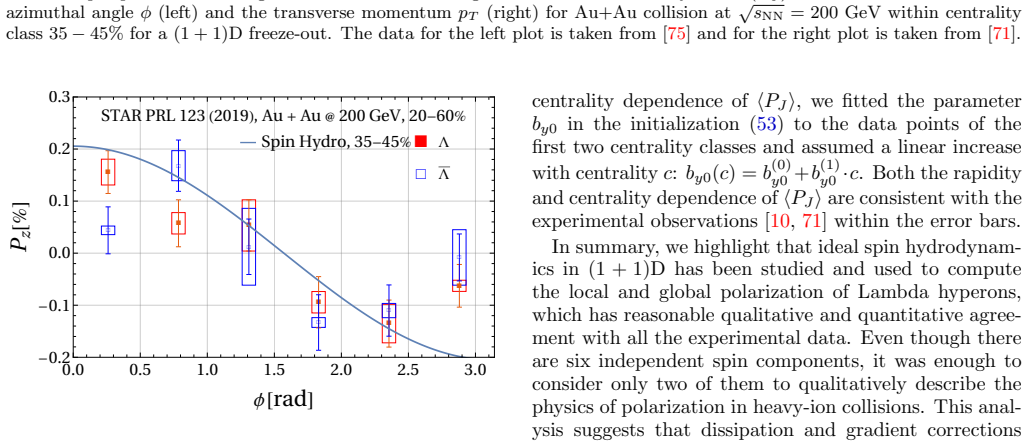
Operating in the small-polarization regime where spin evolves perturbatively atop the bulk expansion, symmetry-constrained initial conditions in a non-boost-invariant hydrodynamic background produce both local and global Lambda polarization. Extending the model to incorporate transverse flow and spatial anisotropy at freeze-out shows that the longitudinal spin acceleration component, coupled with transverse expansion, generates a quadrupole pattern in the longitudinal polarization. The resulting momentum-dependent and integrated observables exhibit qualitative and reasonably good quantitative agreement with experimental data for Au+Au collisions at 200 GeV.
What carries the argument
The longitudinal component of the spin acceleration vector within the extended (1+1+2)D spin hydrodynamic evolution, which interacts with transverse expansion to induce azimuthal anisotropy in the polarization.
If this is right
- The model reproduces the experimentally observed quadrupole structure in longitudinal Lambda polarization.
- Both differential and integrated polarization observables agree qualitatively and to a reasonable quantitative level with data from 200 GeV Au+Au collisions.
- The framework supplies concrete predictions for the in-plane transverse spin polarization component, which has not yet been measured.
Where Pith is reading between the lines
- The same longitudinal acceleration mechanism could be tested at other collision energies to check whether the quadrupole pattern persists or changes with initial conditions.
- If the transverse polarization predictions hold, polarization data could constrain the early-time spin potential beyond what integrated yields alone provide.
- The perturbative small-polarization treatment suggests a path to include higher-order spin effects once the leading quadrupole is confirmed.
Load-bearing premise
The system stays in the small-polarization regime where spin evolves perturbatively on top of the bulk flow, and that transverse flow plus spatial anisotropy can be added at freeze-out in an ad hoc way while preserving longitudinal dynamics.
What would settle it
A measurement of Lambda longitudinal polarization that lacks the predicted quadrupole azimuthal dependence, or that shows transverse polarization values substantially different from the model's predictions, would falsify the central mechanism.
Figures




read the original abstract
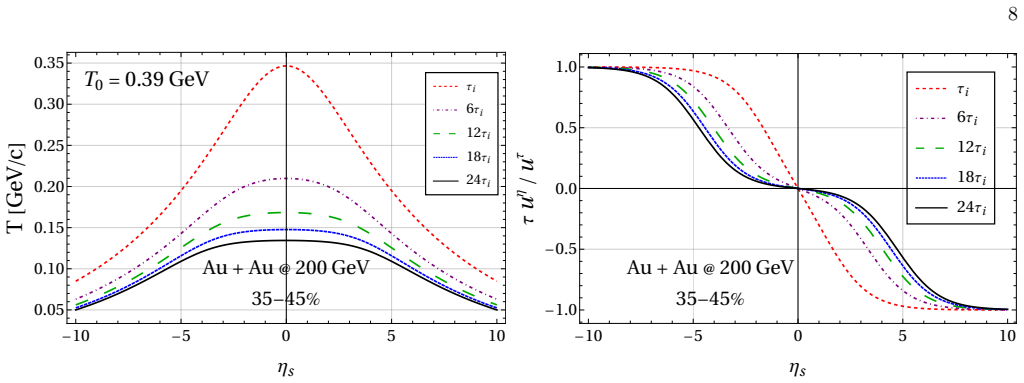
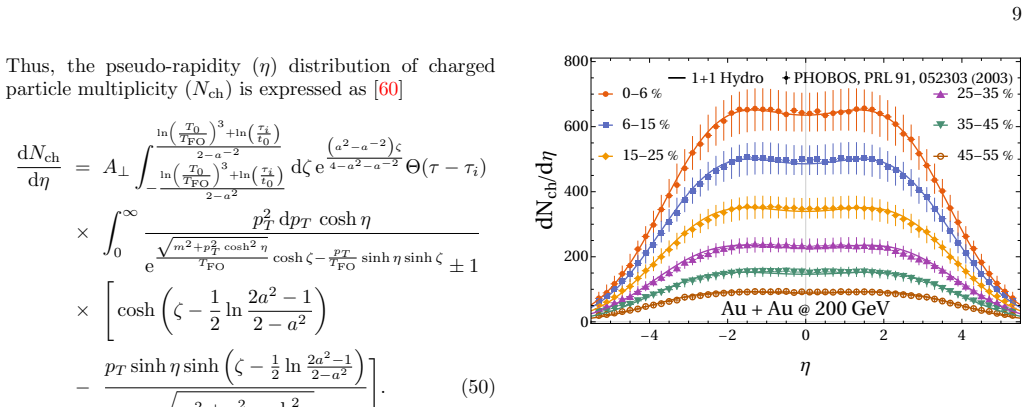
We investigate spin polarization dynamics in relativistic heavy-ion collisions using ideal relativistic spin hydrodynamics, employing non-boost-invariant longitudinal solutions as the hydrodynamic background. Operating in the small-polarization regime, where spin evolves perturbatively on top of the bulk expansion, we first analyze a $(1+1)$D setup with transverse homogeneity. In this framework, symmetry-constrained initial conditions for the spin potential lead to non-trivial evolution and generate both local and global $\Lambda$ hyperon polarization consistent with qualitative experimental trends, though they fail to reproduce observed azimuthal structures. To address this limitation, we extend the framework by incorporating transverse flow and spatial anisotropy at freeze-out, constructing a $novel$ $(1+1+2)$D model that preserves the longitudinal dynamics. We demonstrate that the inclusion of a longitudinal spin acceleration component, coupled with transverse expansion, results in the emergence of a quadrupole pattern in the longitudinal polarization. The resulting momentum-dependent and integrated observables exhibit qualitative and reasonably good quantitative agreement with experimental data for Au+Au collisions at $\sqrt{s_{\rm NN}}=200$ GeV. Finally, we provide predictions for the in-plane transverse spin polarization, an observable that, to our knowledge, has not yet been experimentally measured.
Editorial analysis
A structured set of objections, weighed in public.
Referee Report
Summary. The manuscript presents a study of Λ hyperon polarization in Au+Au collisions at √s_NN = 200 GeV using ideal relativistic spin hydrodynamics. It utilizes non-boost-invariant longitudinal hydrodynamic solutions as the background in the small-polarization regime where spin evolves perturbatively. In a (1+1)D setup with transverse homogeneity, symmetry-constrained initial conditions for the spin potential yield local and global polarization consistent with qualitative experimental trends but fail to capture azimuthal structures. The authors extend this to a novel (1+1+2)D model by incorporating transverse flow and spatial anisotropy at freeze-out while preserving longitudinal dynamics. They find that a longitudinal spin acceleration component, when coupled with transverse expansion, generates a quadrupole pattern in the longitudinal polarization. The momentum-dependent and integrated observables show qualitative and reasonably good quantitative agreement with experimental data, and predictions are made for the in-plane transverse spin polarization.
Significance. If the central results hold after clarification, the work is significant for advancing spin hydrodynamics modeling in heavy-ion collisions. It demonstrates how spin evolution on a longitudinal background can produce observed polarization patterns, including a quadrupole structure, and offers testable predictions for an unmeasured observable (in-plane transverse polarization). The approach builds on standard ideal hydrodynamics with perturbative spin terms and provides a concrete framework linking dynamics to data at RHIC energies.
major comments (1)
- [Abstract and model extension] Abstract (model extension paragraph): the central claim that 'the inclusion of a longitudinal spin acceleration component, coupled with transverse expansion, results in the emergence of a quadrupole pattern' is presented only after extending the (1+1)D background to a (1+1+2)D construction via ad hoc incorporation of transverse flow and spatial anisotropy at freeze-out. It is unclear whether this pattern is generated dynamically by the spin-hydro equations or imposed by the symmetry-breaking choices at the matching surface; this distinction is load-bearing for the claim that the quadrupole and subsequent data agreement arise from the spin-hydro coupling rather than from the added transverse elements.
minor comments (2)
- The abstract states 'qualitative and reasonably good quantitative agreement' with data but provides no details on error bars, specific quantitative metrics (e.g., χ² values), data selection, or how the perturbative small-polarization assumption is validated numerically.
- More explicit discussion of the freeze-out hypersurface construction and how the added transverse flow parameters are chosen (beyond symmetry constraints) would improve reproducibility and clarify the scope of the (1+1+2)D extension.
Simulated Author's Rebuttal
We thank the referee for the careful reading of our manuscript and the constructive feedback. The main concern is the clarity of whether the quadrupole pattern arises dynamically from the spin-hydrodynamic equations or is imposed by the approximate transverse elements at freeze-out. We address this point below and have revised the abstract and relevant sections for improved precision.
read point-by-point responses
-
Referee: [Abstract and model extension] Abstract (model extension paragraph): the central claim that 'the inclusion of a longitudinal spin acceleration component, coupled with transverse expansion, results in the emergence of a quadrupole pattern' is presented only after extending the (1+1)D background to a (1+1+2)D construction via ad hoc incorporation of transverse flow and spatial anisotropy at freeze-out. It is unclear whether this pattern is generated dynamically by the spin-hydro equations or imposed by the symmetry-breaking choices at the matching surface; this distinction is load-bearing for the claim that the quadrupole and subsequent data agreement arise from the spin-hydro coupling rather than from the added transverse elements.
Authors: We acknowledge that the transverse flow and spatial anisotropy are incorporated at the freeze-out hypersurface in an approximate way, rather than being evolved dynamically from an initial state in a full (3+1)D hydrodynamic simulation. This is an explicit modeling choice to isolate the effects of longitudinal spin dynamics while capturing essential transverse features. However, the longitudinal polarization pattern is not directly imposed by these choices. The spin evolution is governed by the perturbative spin-hydrodynamic equations on the given background; the quadrupole structure (with its characteristic azimuthal sign changes) emerges specifically from the coupling of the longitudinal spin acceleration term to the transverse velocity gradients at freeze-out. This is evidenced by the fact that the pure (1+1)D case, which lacks transverse expansion, produces no azimuthal quadrupole. We have revised the abstract and the model-extension paragraph to explicitly distinguish the approximate background from the dynamical spin evolution, and we have added a brief discussion clarifying the origin of the pattern and the limitations of the approximation. revision: yes
Circularity Check
No significant circularity detected in derivation chain
full rationale
The paper starts from standard ideal relativistic hydrodynamics equations, augments them with spin terms in the small-polarization perturbative regime, and evolves symmetry-constrained initial conditions for the spin potential in a (1+1)D longitudinal background. The subsequent (1+1+2)D extension adds transverse flow and spatial anisotropy explicitly at freeze-out to restore azimuthal dependence absent from the purely longitudinal setup; the quadrupole pattern in longitudinal polarization is then shown to arise from the coupling of the longitudinal spin acceleration to this added transverse expansion. Because the transverse elements are introduced as an explicit model extension rather than fitted parameters whose values are tuned to the polarization observables themselves, and because the central polarization expressions remain independent of the target data, no step reduces by construction to its own inputs. The reported agreement with data is therefore an external check rather than a tautology.
Axiom & Free-Parameter Ledger
free parameters (2)
- Initial conditions for spin potential
- Transverse flow and spatial anisotropy parameters at freeze-out
axioms (2)
- domain assumption Ideal relativistic spin hydrodynamics in the small-polarization regime
- domain assumption Non-boost-invariant longitudinal solutions as hydrodynamic background
Lean theorems connected to this paper
-
IndisputableMonolith/Cost/FunctionalEquation.leanwashburn_uniqueness_aczel unclear?
unclearRelation between the paper passage and the cited Recognition theorem.
We investigate spin polarization dynamics... using ideal relativistic spin hydrodynamics, employing non-boost-invariant longitudinal solutions... small-polarization regime... (1+1+2)D model... longitudinal spin acceleration component, coupled with transverse expansion, results in the emergence of a quadrupole pattern
-
IndisputableMonolith/Foundation/DimensionForcing.leanalexander_duality_circle_linking unclear?
unclearRelation between the paper passage and the cited Recognition theorem.
The inclusion of a longitudinal spin acceleration component... quadrupole pattern in the longitudinal polarization... reasonably good quantitative agreement with experimental data
What do these tags mean?
- matches
- The paper's claim is directly supported by a theorem in the formal canon.
- supports
- The theorem supports part of the paper's argument, but the paper may add assumptions or extra steps.
- extends
- The paper goes beyond the formal theorem; the theorem is a base layer rather than the whole result.
- uses
- The paper appears to rely on the theorem as machinery.
- contradicts
- The paper's claim conflicts with a theorem or certificate in the canon.
- unclear
- Pith found a possible connection, but the passage is too broad, indirect, or ambiguous to say the theorem truly supports the claim.
Reference graph
Works this paper leans on
-
[1]
Collective flow and viscosity in relativistic heavy-ion collisions
U. Heinz and R. Snellings, “Collective flow and viscosity in relativistic heavy-ion collisions,” Ann. Rev. Nucl. Part. Sci.63(2013) 123–151,arXiv:1301.2826 [nucl-th]
work page Pith review arXiv 2013
-
[2]
Hydrodynamic Modeling of Heavy-Ion Collisions
C. Gale, S. Jeon, and B. Schenke, “Hydrodynamic Modeling of Heavy-Ion Collisions,” Int. J. Mod. Phys. A 28(2013) 1340011,arXiv:1301.5893 [nucl-th]
work page Pith review arXiv 2013
-
[3]
Properties of hot and dense matter from relativistic heavy ion collisions,
P. Braun-Munzinger, V. Koch, T. Sch¨ afer, and J. Stachel, “Properties of hot and dense matter from relativistic heavy ion collisions,” Phys. Rept.621 (2016) 76–126,arXiv:1510.00442 [nucl-th]
-
[4]
Arslandoket al., Hot QCD White Paper, (2023), arXiv:2303.17254 [nucl-ex]
M. Arslandok et al., “Hot QCD White Paper,” pre-print (3, 2023) 1–190,arXiv:2303.17254 [nucl-ex]
-
[5]
Viscous Hydrodynamics and the Quark Gluon Plasma,
D. A. Teaney, “Viscous Hydrodynamics and the Quark Gluon Plasma,” in Quark-gluon plasma 4, R. C. Hwa and X.-N. Wang, eds., pp. 207–266. World Scientific, 2010.arXiv:0905.2433 [nucl-th]
-
[6]
Nearly Perfect Fluidity: From Cold Atomic Gases to Hot Quark Gluon Plasmas,
T. Sch¨ afer and D. Teaney, “Nearly Perfect Fluidity: From Cold Atomic Gases to Hot Quark Gluon Plasmas,” Rept. Prog. Phys.72(2009) 126001, arXiv:0904.3107 [hep-ph]
-
[7]
P. Romatschke and U. Romatschke, Relativistic Fluid Dynamics In and Out of Equilibrium. Cambridge Monographs on Mathematical Physics. Cambridge University Press, 5, 2019. arXiv:1712.05815 [nucl-th]
work page Pith review arXiv 2019
-
[8]
Angular momentum conservation in heavy ion collisions at very high energy
F. Becattini, F. Piccinini, and J. Rizzo, “Angular momentum conservation in heavy ion collisions at very high energy,” Phys. Rev. C77(2008) 024906, arXiv:0711.1253 [nucl-th]
work page Pith review arXiv 2008
-
[9]
Spin polarization in relativistic heavy-ion collisions,
F. Becattini, M. Buzzegoli, T. Niida, S. Pu, A.-H. Tang, and Q. Wang, “Spin polarization in relativistic heavy-ion collisions,” Int. J. Mod. Phys. E33no. 06, (2024) 2430006,arXiv:2402.04540 [nucl-th]
-
[10]
Polarization phenomenon in heavy-ion collisions,
T. Niida and S. A. Voloshin, “Polarization phenomenon in heavy-ion collisions,” Int. J. Mod. Phys. E33no. 09, (2024) 2430010,arXiv:2404.11042 [nucl-ex]. [11]STARCollaboration, L. Adamczyk et al., “Global Λ hyperon polarization in nuclear collisions: evidence for the most vortical fluid,” Nature548(2017) 62–65, arXiv:1701.06657 [nucl-ex]
-
[11]
Globally Polarized Quark-gluon Plasma in Non-central A+A Collisions
Z.-T. Liang and X.-N. Wang, “Globally polarized quark-gluon plasma in non-central A+A collisions,” Phys. Rev. Lett.94(2005) 102301, arXiv:nucl-th/0410079. [Erratum: Phys.Rev.Lett. 96, 039901 (2006)]. [13]STARCollaboration, J. Adam et al., “Polarization of Λ ( ¯Λ) hyperons along the beam direction in Au+Au collisions at √sN N = 200 GeV,” Phys. Rev. Lett.12...
work page Pith review arXiv 2005
-
[12]
Hydrodynamics of fluids with spin,
F. Becattini, “Hydrodynamics of fluids with spin,” Phys. Part. Nucl. Lett.8(2011) 801–804
work page 2011
-
[13]
Relativistic fluid dynamics with spin
W. Florkowski, B. Friman, A. Jaiswal, and E. Speranza, “Relativistic fluid dynamics with spin,” Phys. Rev.C97 no. 4, (2018) 041901,arXiv:1705.00587 [nucl-th]
work page Pith review arXiv 2018
-
[14]
Relativistic hydrodynamics for spin-polarized fluids,
W. Florkowski, R. Ryblewski, and A. Kumar, “Relativistic hydrodynamics for spin-polarized fluids,” Prog. Part. Nucl. Phys.108(2019) 103709, arXiv:1811.04409 [nucl-th]
-
[15]
The ideal relativistic fluid limit for a medium with polarization
D. Montenegro, L. Tinti, and G. Torrieri, “The ideal relativistic fluid limit for a medium with polarization,” Phys. Rev.D96no. 5, (2017) 056012, arXiv:1701.08263 [hep-th]
work page Pith review arXiv 2017
-
[16]
Fate of spin polarization in a relativistic fluid: An entropy-current analysis
K. Hattori, M. Hongo, X.-G. Huang, M. Matsuo, and H. Taya, “Fate of spin polarization in a relativistic fluid: An entropy-current analysis,” Phys. Lett. B795(2019) 100–106,arXiv:1901.06615 [hep-th]
work page Pith review arXiv 2019
-
[17]
Relativistic spin hydrodynamics with torsion and linear response theory for spin relaxation,
M. Hongo, X.-G. Huang, M. Kaminski, M. Stephanov, and H.-U. Yee, “Relativistic spin hydrodynamics with torsion and linear response theory for spin relaxation,” JHEP11(2021) 150,arXiv:2107.14231 [hep-th]
-
[18]
Hydrodynamics, spin currents and torsion,
A. D. Gallegos, U. Gursoy, and A. Yarom, “Hydrodynamics, spin currents and torsion,” JHEP05 (2023) 139,arXiv:2203.05044 [hep-th]
-
[19]
Semi-classical Kinetic Theory for Massive Spin-half Fermions with Leading-order Spin Effects,
A. Das, W. Florkowski, A. Kumar, R. Ryblewski, and R. Singh, “Semi-classical Kinetic Theory for Massive Spin-half Fermions with Leading-order Spin Effects,” Acta Phys. Polon. B54no. 8, (2023) 8–A4, arXiv:2203.15562 [hep-th]
-
[20]
Guiding center hydrodynamics with spin,
R. Singh, “Guiding center hydrodynamics with spin,” J. Subatomic Part. Cosmol.4(2025) 100255, arXiv:2503.23061 [nucl-th]
-
[21]
Gyrohydrodynamics: Relativistic spinful fluid with strong vorticity,
Z. Cao, K. Hattori, M. Hongo, X.-G. Huang, and H. Taya, “Gyrohydrodynamics: Relativistic spinful fluid with strong vorticity,” PTEP2022no. 7, (2022) 071D01,arXiv:2205.08051 [hep-th]
-
[22]
Relativistic second-order dissipative spin hydrodynamics from the method of moments,
N. Weickgenannt, D. Wagner, E. Speranza, and D. H. Rischke, “Relativistic second-order dissipative spin hydrodynamics from the method of moments,” Phys. Rev. D106no. 9, (2022) 096014,arXiv:2203.04766 [nucl-th]
-
[23]
Relativistic dissipative spin hydrodynamics from kinetic theory with a nonlocal collision term,
N. Weickgenannt, D. Wagner, E. Speranza, and D. H. Rischke, “Relativistic dissipative spin hydrodynamics from kinetic theory with a nonlocal collision term,” Phys. Rev. D106no. 9, (2022) L091901, arXiv:2208.01955 [nucl-th]
-
[24]
Entropy current and entropy production in relativistic spin hydrodynamics,
F. Becattini, A. Daher, and X.-L. Sheng, “Entropy current and entropy production in relativistic spin hydrodynamics,” Phys. Lett. B850(2024) 138533, arXiv:2309.05789 [nucl-th]
-
[25]
Hybrid approach to perfect and dissipative spin hydrodynamics,
Z. Drogosz, W. Florkowski, and M. Hontarenko, “Hybrid approach to perfect and dissipative spin hydrodynamics,” Phys. Rev. D110no. 9, (2024) 096018,arXiv:2408.03106 [hep-ph]
-
[26]
Dissipative currents and transport coefficients in relativistic spin hydrodynamics,
A. Daher, X.-L. Sheng, D. Wagner, and F. Becattini, “Dissipative currents and transport coefficients in relativistic spin hydrodynamics,” Phys. Rev. D112 no. 9, (2025) 094020,arXiv:2503.03713 [nucl-th]. 25
-
[27]
Perfect spinfluid: A divergence-type approach,
N. Abboud, L. Gavassino, R. Singh, and E. Speranza, “Perfect spinfluid: A divergence-type approach,” Phys. Rev. D112no. 9, (2025) 094043,arXiv:2506.19786 [nucl-th]
-
[28]
Nonlinear causality and stability of perfect spin hydrodynamics and its nonperturbative character,
S. Bhadury, Z. Drogosz, W. Florkowski, S. K. Kar, and V. Mykhaylova, “Nonlinear causality and stability of perfect spin hydrodynamics and its nonperturbative character,” Phys. Rev. D113no. 3, (2026) 036017, arXiv:2511.19295 [hep-ph]
-
[29]
On the Energy Tensor of Spinning Massive Matter in Classical Field Theory and General Relativity,
F. W. Hehl, “On the Energy Tensor of Spinning Massive Matter in Classical Field Theory and General Relativity,” Rept. Math. Phys.9(1976) 55–82
work page 1976
-
[30]
Emergent Canonical Spin Tensor in the Chiral-Symmetric Hot QCD,
M. Buzzegoli and A. Palermo, “Emergent Canonical Spin Tensor in the Chiral-Symmetric Hot QCD,” Phys. Rev. Lett.133no. 26, (2024) 262301, arXiv:2407.14345 [hep-ph]
-
[31]
On the local thermodynamic relations in relativistic spin hydrodynamics,
F. Becattini and R. Singh, “On the local thermodynamic relations in relativistic spin hydrodynamics,” Eur. Phys. J. C85no. 11, (2025) 1338,arXiv:2506.20681 [nucl-th]
-
[32]
S. De Groot, W. Van Leeuwen, and C. Van Weert, Relativistic Kinetic Theory. Principles and Applications. North Holland, Amsterdam, 1, 1980
work page 1980
-
[33]
Thermodynamic versus kinetic approach to polarization-vorticity coupling
W. Florkowski, A. Kumar, and R. Ryblewski, “Thermodynamic versus kinetic approach to polarization-vorticity coupling,” Phys. Rev.C98no. 4, (2018) 044906,arXiv:1806.02616 [hep-ph]
work page Pith review arXiv 2018
-
[34]
Pseudogauge dependence of the spin polarization and of the axial vortical effect,
M. Buzzegoli, “Pseudogauge dependence of the spin polarization and of the axial vortical effect,” Phys. Rev. C105no. 4, (2022) 044907,arXiv:2109.12084 [nucl-th]
-
[35]
Spin polarization evolution in a boost invariant hydrodynamical background
W. Florkowski, A. Kumar, R. Ryblewski, and R. Singh, “Spin polarization evolution in a boost invariant hydrodynamical background,” Phys. Rev. C99no. 4, (2019) 044910,arXiv:1901.09655 [hep-ph]
work page Pith review arXiv 2019
-
[36]
Spin polarization dynamics in the non-boost-invariant background,
W. Florkowski, R. Ryblewski, R. Singh, and G. Sophys, “Spin polarization dynamics in the non-boost-invariant background,” Phys. Rev. D105no. 5, (2022) 054007, arXiv:2112.01856 [hep-ph]
-
[37]
Spin dynamics with realistic hydrodynamic background for relativistic heavy-ion collisions,
S. K. Singh, R. Ryblewski, and W. Florkowski, “Spin dynamics with realistic hydrodynamic background for relativistic heavy-ion collisions,” Phys. Rev. C111 no. 2, (2025) 024907,arXiv:2411.08223 [hep-ph]
-
[38]
Spin polarization dynamics in the Gubser-expanding background,
R. Singh, G. Sophys, and R. Ryblewski, “Spin polarization dynamics in the Gubser-expanding background,” Phys. Rev. D103no. 7, (2021) 074024, arXiv:2011.14907 [hep-ph]
-
[39]
Spin hydrodynamics on a hyperbolic expanding background,
R. Singh and A. Soloviev, “Spin hydrodynamics on a hyperbolic expanding background,”arXiv:2603.02296 [nucl-th]
-
[40]
Study of Lambda polarization in relativistic nuclear collisions at sqrt{s}_NN = 7.7-200 GeV
I. Karpenko and F. Becattini, “Study of Λ polarization in relativistic nuclear collisions at √sNN = 7.7 –200 GeV,” Eur. Phys. J. C77no. 4, (2017) 213, arXiv:1610.04717 [nucl-th]
work page Pith review arXiv 2017
-
[41]
Global Λ polarization in high energy collisions,
Y. Xie, D. Wang, and L. P. Csernai, “Global Λ polarization in high energy collisions,” Phys. Rev. C95 no. 3, (2017) 031901,arXiv:1703.03770 [nucl-th]
-
[42]
Local spin polarization in high energy heavy ion collisions,
H.-Z. Wu, L.-G. Pang, X.-G. Huang, and Q. Wang, “Local spin polarization in high energy heavy ion collisions,” Phys. Rev. Research.1(2019) 033058, arXiv:1906.09385 [nucl-th]
-
[43]
Global Λ polarization in moderately relativistic nuclear collisions,
Y. B. Ivanov, “Global Λ polarization in moderately relativistic nuclear collisions,” Phys. Rev. C103no. 3, (2021) L031903,arXiv:2012.07597 [nucl-th]
-
[44]
Hydrodynamic study of hyperon spin polarization in relativistic heavy ion collisions,
B. Fu, K. Xu, X.-G. Huang, and H. Song, “Hydrodynamic study of hyperon spin polarization in relativistic heavy ion collisions,” Phys. Rev. C103 no. 2, (2021) 024903,arXiv:2011.03740 [nucl-th]
-
[45]
Global $\Lambda$ polarization in heavy-ion collisions from a transport model
H. Li, L.-G. Pang, Q. Wang, and X.-L. Xia, “Global Λ polarization in heavy-ion collisions from a transport model,” Phys. Rev. C96no. 5, (2017) 054908, arXiv:1704.01507 [nucl-th]
work page Pith review arXiv 2017
-
[46]
Thermal vorticity and spin polarization in heavy-ion collisions,
D.-X. Wei, W.-T. Deng, and X.-G. Huang, “Thermal vorticity and spin polarization in heavy-ion collisions,” Phys. Rev. C99no. 1, (2019) 014905, arXiv:1810.00151 [nucl-th]
-
[47]
Spin-thermal shear coupling in a relativistic fluid,
F. Becattini, M. Buzzegoli, and A. Palermo, “Spin-thermal shear coupling in a relativistic fluid,” Phys. Lett. B820(2021) 136519,arXiv:2103.10917 [nucl-th]
-
[48]
Local Polarization and Isothermal Local Equilibrium in Relativistic Heavy Ion Collisions,
F. Becattini, M. Buzzegoli, G. Inghirami, I. Karpenko, and A. Palermo, “Local Polarization and Isothermal Local Equilibrium in Relativistic Heavy Ion Collisions,” Phys. Rev. Lett.127no. 27, (2021) 272302, arXiv:2103.14621 [nucl-th]
-
[49]
Spin polarization induced by the hydrodynamic gradients,
S. Y. F. Liu and Y. Yin, “Spin polarization induced by the hydrodynamic gradients,” JHEP07(2021) 188, arXiv:2103.09200 [hep-ph]
-
[50]
Shear-Induced Spin Polarization in Heavy-Ion Collisions,
B. Fu, S. Y. F. Liu, L. Pang, H. Song, and Y. Yin, “Shear-Induced Spin Polarization in Heavy-Ion Collisions,” Phys. Rev. Lett.127no. 14, (2021) 142301, arXiv:2103.10403 [hep-ph]
-
[51]
C. Yi, S. Pu, and D.-L. Yang, “Reexamination of local spin polarization beyond global equilibrium in relativistic heavy ion collisions,” Phys. Rev. C104 no. 6, (2021) 064901,arXiv:2106.00238 [hep-ph]
-
[52]
A. Palermo, E. Grossi, I. Karpenko, and F. Becattini, “Λ polarization in very high energy heavy ion collisions as a probe of the quark–gluon plasma formation and properties,” Eur. Phys. J. C84no. 9, (2024) 920, arXiv:2404.14295 [nucl-th]
-
[53]
In-plane transverse polarization in heavy-ion collisions,
A. Arslan, W.-B. Dong, C. Gale, S. Jeon, Q. Wang, and X.-Y. Wu, “In-plane transverse polarization in heavy-ion collisions,” Phys. Rev. C113no. 3, (2026) 034920,arXiv:2509.00796 [nucl-th]
-
[54]
Collective dynamics of polarized spin-half fermions in relativistic heavy-ion collisions,
R. Singh, “Collective dynamics of polarized spin-half fermions in relativistic heavy-ion collisions,” Int. J. Mod. Phys. A38no. 20, (2023) 2330011, arXiv:2212.06569 [hep-ph]
-
[55]
Family of new exact solutions for longitudinally expanding ideal fluids,
S. Shi, S. Jeon, and C. Gale, “Family of new exact solutions for longitudinally expanding ideal fluids,” Phys. Rev. C105no. 2, (2022) L021902, arXiv:2201.06670 [hep-ph]
-
[56]
Exact solution of Boltzmann equation in a longitudinal expanding system,
S. Chen and S. Shi, “Exact solution of Boltzmann equation in a longitudinal expanding system,” Phys. Rev. C109no. 5, (2024) L051901,arXiv:2311.09575 [nucl-th]
-
[57]
Attractor for (1+1)D viscous hydrodynamics with general rapidity distribution,
S. Chen and S. Shi, “Attractor for (1+1)D viscous hydrodynamics with general rapidity distribution,” Phys. Rev. C111no. 2, (2025) L021902, arXiv:2407.15209 [hep-ph]
-
[58]
Anisotropic hydrodynamics with a boost-noninvariant expansion,
S. Chen and S. Shi, “Anisotropic hydrodynamics with a boost-noninvariant expansion,” Phys. Rev. D111no. 1, (2025) 014001,arXiv:2409.19897 [nucl-th]
-
[59]
Onset of Bjorken Flow in Quantum Evolution of the Massive Schwinger Model,
H. Shao, S. Chen, and S. Shi, “Onset of Bjorken Flow in Quantum Evolution of the Massive Schwinger Model,”arXiv:2509.10855 [hep-ph]
-
[60]
Projection method 26 for boost-invariant and cylindrically symmetric dissipative hydrodynamics,
W. Florkowski and R. Ryblewski, “Projection method 26 for boost-invariant and cylindrically symmetric dissipative hydrodynamics,” Phys. Rev. C85(2012) 044902,arXiv:1111.5997 [nucl-th]. [66]Particle Data GroupCollaboration, P. A. Zyla et al., “Review of Particle Physics,” PTEP2020no. 8, (2020) 083C01
-
[61]
Collective longitudinal polarization in relativistic heavy-ion collisions at very high energy
F. Becattini and I. Karpenko, “Collective Longitudinal Polarization in Relativistic Heavy-Ion Collisions at Very High Energy,” Phys. Rev. Lett.120no. 1, (2018) 012302,arXiv:1707.07984 [nucl-th]
work page Pith review arXiv 2018
-
[62]
The Significance of the fragmentation region in ultrarelativistic heavy ion collisions,
B. B. Back et al., “The Significance of the fragmentation region in ultrarelativistic heavy ion collisions,” Phys. Rev. Lett.91(2003) 052303,arXiv:nucl-ex/0210015. [69]STARCollaboration, J. Adam et al., “Global polarization of Λ hyperons in Au+Au collisions at√sN N = 200 GeV,” Phys. Rev. C98(2018) 014910, arXiv:1805.04400 [nucl-ex]. [70]STARCollaboration,...
-
[63]
Vorticity and particle polarization in heavy ion collisions (experimental perspective),
S. A. Voloshin, “Vorticity and particle polarization in heavy ion collisions (experimental perspective),” EPJ Web Conf.171(2018) 07002,arXiv:1710.08934 [nucl-ex]. [73]STARCollaboration, T. Niida, “Global and local polarization of Λ hyperons in Au+Au collisions at 200 GeV from STAR,” Nucl. Phys. A982(2019) 511–514, arXiv:1808.10482 [nucl-ex]. [74]HADESColl...
-
[64]
H. Heiselberg and A.-M. Levy, “Elliptic flow and HBT in noncentral nuclear collisions,” Phys. Rev. C59 (1999) 2716–2727,arXiv:nucl-th/9812034. [77]STARCollaboration, J. Adams et al., “Azimuthal anisotropy in Au+Au collisions at s(NN)**(1/2) = 200-GeV,” Phys. Rev. C72(2005) 014904, arXiv:nucl-ex/0409033. [78]STARCollaboration, J. Adams et al., “Transverse ...
-
[65]
Probing vorticity structure in heavy-ion collisions by local Λ polarization,
X.-L. Xia, H. Li, Z.-B. Tang, and Q. Wang, “Probing vorticity structure in heavy-ion collisions by local Λ polarization,” Phys. Rev. C98(2018) 024905, arXiv:1803.00867 [nucl-th]
-
[66]
Evolution of Λ polarization in the hadronic phase of heavy-ion collisions,
Y. Sun, Z. Zhang, C. M. Ko, and W. Zhao, “Evolution of Λ polarization in the hadronic phase of heavy-ion collisions,” Phys. Rev. C105no. 3, (2022) 034911, arXiv:2112.14410 [nucl-th]
-
[67]
Progress and challenges in small systems,
J. Noronha, B. Schenke, C. Shen, and W. Zhao, “Progress and challenges in small systems,” Int. J. Mod. Phys. E33no. 06, (2024) 2430005,arXiv:2401.09208 [nucl-th]
-
[68]
A Decade of Collectivity in Small Systems,
J. F. Grosse-Oetringhaus and U. A. Wiedemann, “A Decade of Collectivity in Small Systems,” arXiv:2407.07484 [hep-ex]
-
[69]
M. Buzzegoli, “Kubo formulas for spin polarization in dissipative relativistic spin hydrodynamics: a first-order gradient expansion approach,” JHEP07(2025) 255, arXiv:2502.15520 [nucl-th]
-
[70]
Local Lambda polarization in light-ion with ALICE at LHC
C. Jauch, “Local Lambda polarization in light-ion with ALICE at LHC.” Strangness in Quark Matter 2026
work page 2026
-
[71]
Stochastic relativistic advection diffusion equation from the Metropolis algorithm,
G. Ba¸ sar, J. Bhambure, R. Singh, and D. Teaney, “Stochastic relativistic advection diffusion equation from the Metropolis algorithm,” Phys. Rev. C 110no. 4, (2024) 044903,arXiv:2403.04185 [nucl-th]
-
[72]
Relativistic viscous hydrodynamics in the density frame: Numerical tests and comparisons,
J. Bhambure, A. Mazeliauskas, J.-F. Paquet, R. Singh, M. Singh, D. Teaney, and F. Zhou, “Relativistic viscous hydrodynamics in the density frame: Numerical tests and comparisons,” Phys. Rev. C111no. 6, (2025) 064910,arXiv:2412.10303 [nucl-th]
-
[73]
J. Bhambure, R. Singh, and D. Teaney, “Stochastic relativistic viscous hydrodynamics from the Metropolis algorithm,” Phys. Rev. C111no. 6, (2025) 064909, arXiv:2412.10306 [nucl-th]
-
[74]
Modeling Lambda polarization in Au+Au collisions at 200 GeV using relativistic spin hydrodynamics
M. Buzzegoli, A. Geci´ c, and R. Singh, “Modeling Lambda polarization in Au+Au collisions at 200 GeV using relativistic spin hydrodynamics.” https://github.com/rs240291/rs-HYDRO.git, 2026
work page 2026
discussion (0)
Sign in with ORCID, Apple, or X to comment. Anyone can read and Pith papers without signing in.