Recognition: 2 theorem links
· Lean TheoremDynamically Characterizing the Structures of Dirac Points via Wave Packets
Pith reviewed 2026-05-12 01:33 UTC · model grok-4.3
The pith
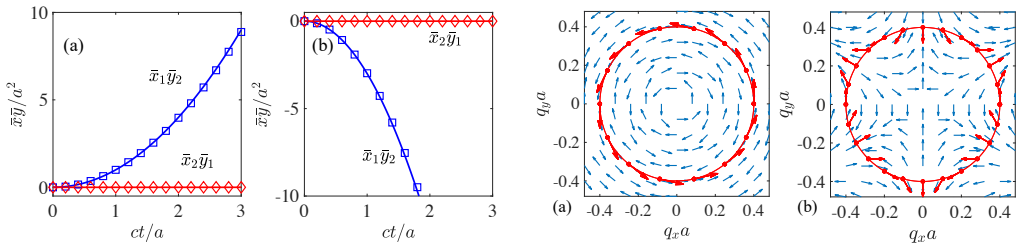
Wave packets' center-of-mass motion and spin texture determine the winding numbers of Dirac and parabolic points.
A machine-rendered reading of the paper's core claim, the machinery that carries it, and where it could break.
Core claim
In the tight-binding model for graphene augmented with third-nearest-neighbor hoppings, Dirac points appear in pairs that can merge into hybrid or parabolic points. The time evolution of an initial wave packet shows that its center-of-mass displacement directly reflects the winding number of a nearby Dirac point, and its spin polarization texture reflects the winding number of a parabolic point. Gapped hybrid points induce purely one-dimensional oscillatory motion known as Zitterbewegung.
What carries the argument
The center-of-mass motion and spin texture arising from the semiclassical or exact dynamics of wave packets in the extended tight-binding Hamiltonian.
If this is right
- The winding number around each Dirac point fixes the direction and magnitude of the long-time center-of-mass drift of a wave packet prepared with appropriate momentum.
- Parabolic points produce a characteristic precession or texture in the spin degree of freedom of the wave packet that reveals their topological charge.
- A gapped hybrid point confines the wave-packet oscillation to a single spatial direction, producing a distinctive Zitterbewegung signature.
- Tracking these dynamical signatures allows identification of the points at which Dirac pairs are created or annihilated during parameter tuning.
Where Pith is reading between the lines
- If realized in cold-atom or photonic lattices, this method could map topological transitions in real time by watching packet trajectories.
- The approach might extend to three-dimensional Weyl points by generalizing the wave-packet observables.
- Disorder or interactions would likely blur the clean signatures, implying the need for sufficiently coherent samples.
Load-bearing premise
The ideal tight-binding Hamiltonian with third-nearest-neighbor terms together with semiclassical or exact wave-packet evolution faithfully reproduces the topological winding numbers without disorder, interactions, or finite-size effects changing the observed dynamics.
What would settle it
Launching a wave packet near a Dirac point whose winding number is independently known and finding that its center-of-mass motion does not match the predicted drift would falsify the claimed correspondence.
Figures


read the original abstract
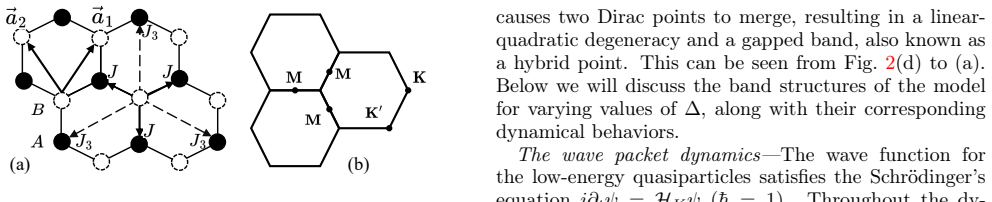
Topological non-trivial band structures are the core problem in the field of topological materials. In this paper, we investigate the topological band structure in a system with controllable Dirac points from the perspective of wave packet dynamics. By adding a third-nearest-neighboring coupling to the graphene model, additional pairs of Dirac points emerge. The emergence and annihilation of Dirac points result in hybrid and parabolic points, and we show that these band structures can be revealed by the dynamical behaviors of wave packets. Particularly, for the gapped hybrid point, the motion of the wave packet shows a one-dimensional \emph{Zitterbewegung} motion. Furthermore, we also show that the winding number associated with the Dirac point and parabolic point can be determined via the center-of-mass and spin texture of wave packets, respectively. The results of this work could motivate new experimental methods to characterize the system's topological signatures through wave packet dynamics, which may also find application in systems of other exotic topological materials.
Editorial analysis
A structured set of objections, weighed in public.
Referee Report
Summary. The manuscript studies wave-packet dynamics in a tight-binding graphene model augmented by third-nearest-neighbor hopping. Adding this term produces additional Dirac points whose pairwise emergence and annihilation create hybrid and parabolic points. The authors report that these structures are visible in the time evolution of wave packets, with gapped hybrid points exhibiting one-dimensional Zitterbewegung, and claim that the winding numbers of Dirac points and parabolic points are quantitatively recoverable from the center-of-mass trajectory and the spin texture, respectively.
Significance. If an explicit, invertible mapping from the cited observables to the integer winding numbers can be established and shown to be robust, the work would supply a dynamical route to extracting topological invariants that complements static probes such as ARPES or transport. The approach could be relevant to both real materials and engineered lattices where wave-packet control is feasible.
major comments (2)
- [Abstract] Abstract: the assertion that 'the winding number associated with the Dirac point and parabolic point can be determined via the center-of-mass and spin texture of wave packets' is not accompanied by any explicit formula, derivation, or numerical protocol that converts the observable (e.g., COM oscillation amplitude, frequency, or spin-texture winding) into the integer winding number. Without this mapping the claim reduces to a qualitative observation rather than a quantitative determination, which is load-bearing for the central result.
- [Model and Results] Model definition and results sections: the third-nearest-neighbor hopping strength appears as a free parameter that controls the creation of hybrid/parabolic points, yet no systematic scan or error analysis is provided showing that the reported COM or spin-texture signatures remain one-to-one with the winding number when this parameter, initial-state choice, or weak disorder is varied. This leaves the robustness of the extraction unverified.
minor comments (2)
- [Introduction] Notation for the winding number and for the spin texture is introduced without a clear reference to the standard definition used in the tight-binding literature; a brief equation or citation would improve clarity.
- [Figures] Figure captions and axis labels for the wave-packet trajectories should explicitly state the initial conditions and the value of the third-nearest-neighbor parameter used in each panel.
Simulated Author's Rebuttal
We thank the referee for the detailed and constructive report. The comments highlight important points regarding the quantitative nature of our claims and the need to demonstrate robustness. We address each major comment below and have prepared revisions to strengthen the manuscript.
read point-by-point responses
-
Referee: [Abstract] Abstract: the assertion that 'the winding number associated with the Dirac point and parabolic point can be determined via the center-of-mass and spin texture of wave packets' is not accompanied by any explicit formula, derivation, or numerical protocol that converts the observable (e.g., COM oscillation amplitude, frequency, or spin-texture winding) into the integer winding number. Without this mapping the claim reduces to a qualitative observation rather than a quantitative determination, which is load-bearing for the central result.
Authors: We agree that the abstract claim would benefit from greater precision. The manuscript presents numerical results in which the COM oscillation amplitude for Dirac points and the winding of the spin texture for parabolic points match the known integer winding numbers in the chosen parameter regimes. However, we did not supply an explicit analytic mapping or a reproducible numerical protocol that converts the raw observables into the integer. In the revised version we will add a dedicated subsection deriving the relation from the semiclassical wave-packet equations of motion (using the effective low-energy Hamiltonian around each point) and will include a clear step-by-step protocol for extracting the winding number from simulated or measured COM trajectories and spin textures. revision: yes
-
Referee: [Model and Results] Model definition and results sections: the third-nearest-neighbor hopping strength appears as a free parameter that controls the creation of hybrid/parabolic points, yet no systematic scan or error analysis is provided showing that the reported COM or spin-texture signatures remain one-to-one with the winding number when this parameter, initial-state choice, or weak disorder is varied. This leaves the robustness of the extraction unverified.
Authors: We acknowledge that the present manuscript illustrates the signatures only for representative values of the third-nearest-neighbor hopping and for a limited set of initial wave-packet parameters. To verify robustness we will add supplementary material containing (i) a systematic scan of the hopping strength across the emergence and annihilation points, (ii) results for several initial-state widths and momenta, and (iii) simulations with weak on-site disorder. These additions will demonstrate that the extracted winding numbers remain stable within the reported precision. revision: yes
Circularity Check
Wave-packet dynamics derivation is self-contained; no reduction to inputs by construction
full rationale
The paper starts from an explicit tight-binding Hamiltonian (graphene plus third-nearest-neighbor terms), evolves wave packets either semiclassically or exactly, and extracts center-of-mass trajectories and spin textures as observables. These observables are shown to encode the winding numbers of Dirac and parabolic points. No step equates a fitted parameter to a prediction, renames a known result, or relies on a self-citation chain whose uniqueness theorem is unverified outside the present work. The mapping from dynamics to winding number is derived from the equations of motion rather than presupposed in the Hamiltonian definition, satisfying the requirement that the central claim retain independent content.
Axiom & Free-Parameter Ledger
free parameters (1)
- third-nearest-neighbor hopping strength
axioms (2)
- domain assumption Electrons in the lattice are described by a non-interacting tight-binding Hamiltonian on a honeycomb lattice.
- domain assumption Wave-packet dynamics can be obtained from the time-dependent Schrödinger equation on the lattice without decoherence or many-body effects.
Lean theorems connected to this paper
-
IndisputableMonolith/Foundation/AlexanderDuality.leanalexander_duality_circle_linking unclearthe winding number associated with the Dirac point and parabolic point can be determined via the center-of-mass and spin texture of wave packets, respectively
-
IndisputableMonolith/Cost/FunctionalEquation.leanwashburn_uniqueness_aczel unclearBy adding a third-nearest-neighboring coupling to the graphene model, additional pairs of Dirac points emerge
Reference graph
Works this paper leans on
-
[1]
N. W. Ashcroft and N. D. Mermin,Solid State Physics (Saunders College Publishing, 1976)
work page 1976
- [2]
- [3]
-
[4]
M. Z. Hasan and C. L. Kane, Rev. Mod. Phys.82, 3045 (2010)
work page 2010
- [5]
-
[6]
S. M. Young, S. Zaheer, J. C. Y. Teo, C. L. Kane, E. J. Mele, and A. M. Rappe, Phys. Rev. Lett.108, 140405 (2012)
work page 2012
-
[7]
S. M. Young and C. L. Kane, Phys. Rev. Lett.115, 126803 (2015)
work page 2015
-
[8]
X. Wan, A. M. Turner, A. Vishwanath, and S. Y. Savrasov, Phys. Rev. B83, 205101 (2011)
work page 2011
- [9]
-
[10]
Z. Yang, F. Gao, X. Shi, X. Lin, Z. Gao, Y. Chong, and B. Zhang, Phys. Rev. Lett.114, 114301 (2015)
work page 2015
-
[11]
V. Peri, Z.-D. Song, M. Serra-Garcia, P. Engeler, R. Queiroz, X. Huang, W. Deng, Z. Liu, B. A. Bernevig, and S. D. Huber, Science367, 797 (2020)
work page 2020
- [12]
-
[13]
D.-W. Zhang, Y.-Q. Zhu, Y. X. Zhao, H. Yan, and S.-L. Zhu, Adv. Phys.67, 253 (2018)
work page 2018
- [14]
- [15]
- [16]
- [17]
-
[18]
C.-K. Chiu, J. C. Y. Teo, A. P. Schnyder, and S. Ryu, Rev. Mod. Phys.88, 035005 (2016)
work page 2016
-
[19]
L. Tarruell, D. Greif, T. Uehlinger, G. Jotzu, and T. Esslinger, Nature483, 302 (2012)
work page 2012
-
[20]
L. Duca, T. Li, M. Reitter, I. Bloch, M. Schleier-Smith, and U. Schneider, Science347, 288 (2015)
work page 2015
- [21]
- [22]
- [23]
-
[24]
G. Montambaux, L.-K. Lim, J.-N. Fuchs, and F. Pié- chon, Phys. Rev. Lett.121, 256402 (2018)
work page 2018
-
[25]
E. Schrödinger, Sitzungsber. Preuss. Akad. Wiss. Phys. Math. Kl.24, 418 (1930)
work page 1930
-
[26]
N. R. Cooper, J. Dalibard, and I. B. Spielman, Rev. Mod. Phys.91, 015005 (2019)
work page 2019
- [27]
-
[28]
D.-L. Deng, S.-T. Wang, K. Sun, and L.-M. Duan, Chin. Phys. Lett.35, 013701 (2017)
work page 2017
- [29]
-
[30]
Z. Li, H. Cao, and L.-B. Fu, Phys. Rev. A91, 023623 (2015)
work page 2015
- [31]
-
[32]
X. Shen, D.-W. Zhang, H. Yan, Z. Li, and S.-L. Zhu, Phys. Rev. Res.2, 013037 (2020)
work page 2020
- [33]
-
[34]
W. Zawadzki and T. M. Rusin, J. Phys.: Condens. Mat- ter23, 143201 (2011)
work page 2011
-
[35]
Z. Meng, L. Wang, W. Han, F. Liu, K. Wen, C. Gao, P.Wang, C.Chin, andJ.Zhang,Nature615,231(2023)
work page 2023
-
[36]
L. Fallani, L. D. Sarlo, J. E. Lye, M. Modugno, R. Saers, C. Fort, and M. Inguscio, Phys. Rev. Lett.93, 140406 (2004)
work page 2004
- [37]
-
[38]
L. J. LeBlanc, M. C. Beeler, K. Jiménez-Garcĺa, A. R. Perry, S. Sugawa, R. A. Williams, and I. B. Spielman, New J. Phys.15, 073011 (2013)
work page 2013
-
[39]
E. Alba, X. Fernandez-Gonzalvo, J. Mur-Petit, J. K. Pa- chos, and J. J. Garcia-Ripoll, Phys. Rev. Lett.107, 235301 (2011)
work page 2011
-
[40]
Z. Wu, L. Zhang, W. Sun, X.-T. Xu, B.-Z. Wang, S.-C. Ji, Y. Deng, S. Chen, X.-J. Liu, and J.-W. Pan, Science 354, 83 (2016)
work page 2016
- [41]
-
[42]
X. Shen, F. Wang, Z. Li, and Z. Wu, Phys. Rev. A100, 062514 (2019)
work page 2019
-
[43]
N. Fläschner, B. S. Rem, M. Tarnowski, D. Vogel, D.- S. Lühmann, K. Sengstock, and C. Weitenberg, Science 352, 1091 (2016)
work page 2016
-
[44]
T. Li, L. Duca, M. Reitter, F. Grusdt, E. Demler, M. En- dres, M. Schleier-Smith, I. Bloch, and U. Schneider, Sci- ence352, 1094 (2016)
work page 2016
- [45]
-
[46]
H. C. Po, H. Watanabe, and A. Vishwanath, Phys. Rev. Lett.121, 126402 (2018)
work page 2018
- [47]
-
[48]
M. A. J. Herrera and D. Bercioux, Commun. Phys.6, 42 (2023)
work page 2023
- [49]
-
[50]
C. Wang, P. Zhang, X. Chen, J. Yu, and H. Zhai, Phys. Rev. Lett.118, 185701 (2017). 6
work page 2017
discussion (0)
Sign in with ORCID, Apple, or X to comment. Anyone can read and Pith papers without signing in.