Recognition: no theorem link
CrackMorph-XAI-Net: A Topology-Preserving and Explainable Framework for Automated Crack Morphology
Pith reviewed 2026-05-12 01:03 UTC · model grok-4.3
The pith
CrackMorph-XAI-Net converts crack images into measurable morphological features like centerlines, junctions, and topology via a four-stage pipeline.
A machine-rendered reading of the paper's core claim, the machinery that carries it, and where it could break.
Core claim
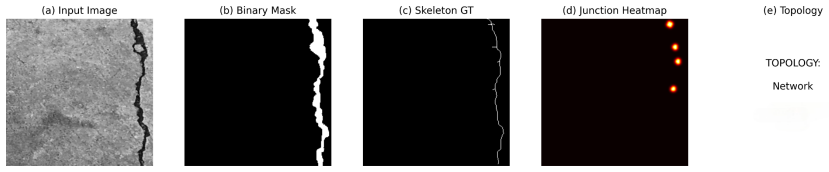
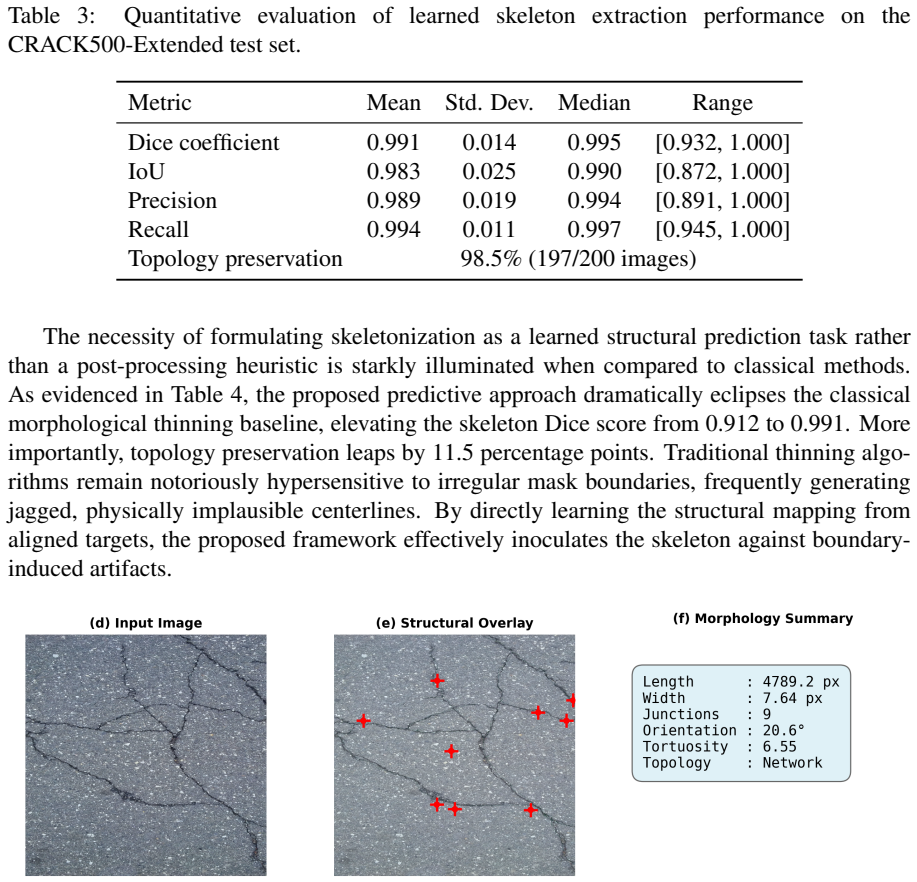
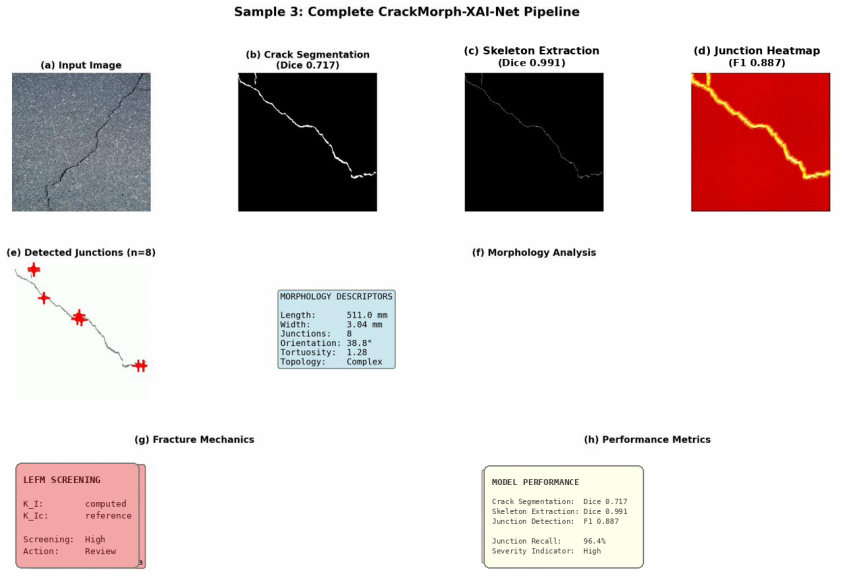
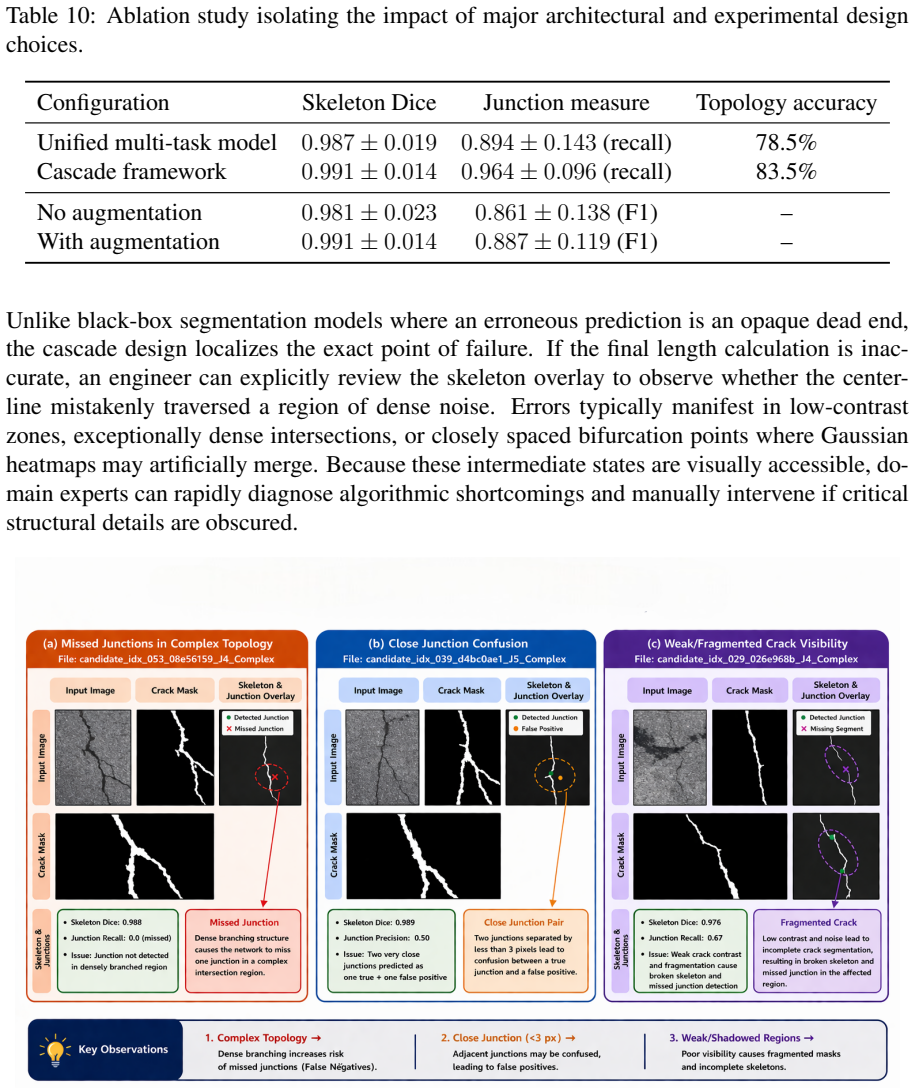
CrackMorph-XAI-Net is an explainable morphology-aware framework that converts crack image and region-mask data into interpretable structural outputs through four stages: topology-preserving skeleton extraction, junction detection via Gaussian heatmap regression, morphology descriptor computation, and severity-oriented screening. On the extended CRACK500 benchmark the learned skeleton stage reaches a mean Dice coefficient of 0.991 with topology preserved in 98.5 percent of test images, junction detection attains 0.964 recall and 0.887 F1-score, and predicted morphology values correlate above 0.95 with reference values for length, width, orientation, junction count, and tortuosity.
What carries the argument
Four-stage pipeline that first learns a topology-preserving skeleton from the input mask, then regresses junction locations as Gaussian heatmaps, computes scalar descriptors, and applies severity screening.
Load-bearing premise
The manually created skeleton, junction, and topology annotations added to CRACK500 accurately represent real-world crack variability and the four trained stages generalize without major domain shift.
What would settle it
Running the model on a fresh crack image collection from different materials, lighting, or cameras and observing skeleton Dice below 0.95 or topology preservation below 90 percent would falsify the generalization claim.
Figures


read the original abstract
Automated crack inspection is increasingly recognized as a critical component of infrastructure monitoring; however, cracks continue to be reported primarily as binary segmentation masks by many current vision-based systems. While localization is facilitated by such masks, limited structural information is provided for robust engineering interpretation. For practical crack assessment, measurable morphological features -- including centerline geometry, branching behavior, junction locations, topology, and severity-related indicators -- are required. In this work, \textit{CrackMorph-XAI-Net}, an explainable morphology-aware framework for image-based crack analysis, is presented. Crack image and region-mask data are converted into a sequence of interpretable structural outputs through four distinct stages: topology-preserving skeleton extraction, junction detection via Gaussian heatmap regression, morphology descriptor computation, and severity-oriented screening. To support rigorous stage-wise evaluation, the standard \textit{CRACK500} benchmark is extended with aligned skeleton maps, junction heatmaps, and topology labels. Experimental validation demonstrates that a mean Dice coefficient of 0.991 is achieved by the learned skeleton extraction stage, with topology preserved in 98.5\% of test images. Furthermore, a recall of 0.964 and an F1-score of 0.887 are obtained in the junction detection stage, highlighting the efficacy of heatmap regression for sparse structural targets. Strong agreement between predicted and reference morphology values is revealed by descriptor-level evaluation, with correlations exceeding 0.95 for length, width, orientation, junction count, and tortuosity.
Editorial analysis
A structured set of objections, weighed in public.
Referee Report
Summary. The manuscript presents CrackMorph-XAI-Net, a four-stage explainable framework for automated crack morphology analysis from images. It converts crack images and region masks into interpretable outputs via topology-preserving skeleton extraction, junction detection through Gaussian heatmap regression, morphology descriptor computation (length, width, orientation, junction count, tortuosity), and severity-oriented screening. The CRACK500 benchmark is extended with aligned skeleton maps, junction heatmaps, and topology labels to support stage-wise evaluation. Reported results include a mean Dice coefficient of 0.991 for skeleton extraction (with topology preserved in 98.5% of test images), recall of 0.964 and F1-score of 0.887 for junction detection, and correlations exceeding 0.95 between predicted and reference morphology descriptors.
Significance. If the results hold under rigorous validation, the work could meaningfully advance infrastructure monitoring by moving beyond binary crack segmentation to provide measurable, topology-aware structural features useful for engineering severity assessment. The emphasis on topology preservation and the multi-stage pipeline for interpretable outputs addresses a practical gap in current vision systems. The high descriptor correlations suggest potential utility if annotation quality and generalization are confirmed.
major comments (3)
- [Abstract / Experimental validation] Abstract / Experimental validation: The central performance claims (Dice 0.991 for skeleton extraction, 98.5% topology preservation, junction recall 0.964 / F1 0.887, descriptor correlations >0.95) are evaluated exclusively against manually extended CRACK500 annotations for skeletons, junctions, and topology. No inter-annotator agreement metrics, annotation protocol details, or consistency checks are referenced, which is load-bearing because skeleton and junction tasks are sparse and boundary-sensitive; small labeling variations can inflate metrics when models are trained and tested on the same annotation style.
- [Dataset extension and evaluation] Dataset extension and evaluation: The extension of CRACK500 is used to create the reference skeleton maps, junction heatmaps, and topology labels that underpin all quantitative results, yet no details on generation process, potential biases, or validation against real-world crack variability are provided. This directly affects the reliability of the reported stage-wise metrics and the assumption that the four-stage models will generalize without major domain shift.
- [Results / Descriptor-level evaluation] Results / Descriptor-level evaluation: Strong agreement (correlations >0.95) is claimed for morphology descriptors, but the manuscript summary provides no baseline comparisons to existing crack skeletonization or junction detection methods, no ablation studies on the pipeline stages, and no error analysis or standard deviations. This makes it difficult to determine whether the framework's contributions are incremental or if results are tied to the custom annotation process.
minor comments (2)
- [Title / Abstract] The title references 'XAI-Net' and the abstract describes an 'explainable' framework, but specific mechanisms for explainability (e.g., attention maps, feature attribution) are not detailed in the provided summary; expand this in the methods or discussion for clarity.
- [Experimental validation] Ensure all reported metrics (e.g., Dice, F1, correlations) are accompanied by measures of variability such as standard deviation across test images or folds to better indicate robustness.
Simulated Author's Rebuttal
We thank the referee for the constructive and detailed comments on our manuscript. We address each major point below and will incorporate revisions to enhance the clarity, transparency, and rigor of the evaluation.
read point-by-point responses
-
Referee: [Abstract / Experimental validation] Abstract / Experimental validation: The central performance claims (Dice 0.991 for skeleton extraction, 98.5% topology preservation, junction recall 0.964 / F1 0.887, descriptor correlations >0.95) are evaluated exclusively against manually extended CRACK500 annotations for skeletons, junctions, and topology. No inter-annotator agreement metrics, annotation protocol details, or consistency checks are referenced, which is load-bearing because skeleton and junction tasks are sparse and boundary-sensitive; small labeling variations can inflate metrics when models are trained and tested on the same annotation style.
Authors: We agree that inter-annotator agreement and annotation protocol details are essential for validating sparse, boundary-sensitive tasks such as skeleton extraction and junction detection. The revised manuscript will include a dedicated subsection detailing the annotation protocol for extending CRACK500 (including tools, guidelines, and verification steps). Where multiple annotators contributed to subsets of the data, we will report inter-annotator agreement metrics (e.g., Dice overlap for skeletons and F1 for junctions); for portions annotated by a single expert, we will explicitly note this limitation and discuss its implications for metric interpretation. revision: yes
-
Referee: [Dataset extension and evaluation] Dataset extension and evaluation: The extension of CRACK500 is used to create the reference skeleton maps, junction heatmaps, and topology labels that underpin all quantitative results, yet no details on generation process, potential biases, or validation against real-world crack variability are provided. This directly affects the reliability of the reported stage-wise metrics and the assumption that the four-stage models will generalize without major domain shift.
Authors: We acknowledge the need for full transparency on the dataset extension. The revision will expand the methods section with a step-by-step description of the generation process for skeleton maps, junction heatmaps, and topology labels, including any semi-automated procedures followed by manual correction. Potential sources of bias (e.g., annotation style or image selection) will be discussed, along with a qualitative comparison to real-world crack variability drawn from the original CRACK500 images and additional external samples. We will also add a brief analysis of domain-shift risks and note plans for future cross-dataset testing. revision: yes
-
Referee: [Results / Descriptor-level evaluation] Results / Descriptor-level evaluation: Strong agreement (correlations >0.95) is claimed for morphology descriptors, but the manuscript summary provides no baseline comparisons to existing crack skeletonization or junction detection methods, no ablation studies on the pipeline stages, and no error analysis or standard deviations. This makes it difficult to determine whether the framework's contributions are incremental or if results are tied to the custom annotation process.
Authors: We agree that comparative baselines, ablations, and error analysis strengthen the evaluation. In the revised manuscript we will add (i) baseline results using established skeletonization methods (e.g., morphological thinning, Zhang-Suen) and junction detectors on the same extended annotations, (ii) ablation studies isolating each pipeline stage, and (iii) error analysis including standard deviations for all reported metrics and correlations. These additions will clarify the incremental value of the proposed framework relative to prior approaches. revision: yes
Circularity Check
No circularity: standard supervised evaluation on manually extended benchmark
full rationale
The paper describes a four-stage pipeline (skeleton extraction, junction detection via heatmap regression, descriptor computation, severity screening) trained and evaluated on a manually extended version of the public CRACK500 dataset. Reported metrics (Dice 0.991, topology preservation 98.5%, correlations >0.95) are conventional test-set performance figures measured against the human-provided skeleton maps, heatmaps, and topology labels. No equations, self-referential definitions, fitted-parameter-as-prediction steps, or load-bearing self-citations appear in the abstract or described chain; the morphology outputs are computed from the learned stages rather than presupposed by them. The derivation therefore remains independent of its own outputs.
Axiom & Free-Parameter Ledger
free parameters (1)
- Neural network weights and hyperparameters
axioms (1)
- domain assumption Supervised learning on annotated crack images can produce accurate topology-preserving skeletons and junction detections
Reference graph
Works this paper leans on
-
[1]
I. Abdel-Qader, O. Abudayyeh, and M. E. Kelly. Analysis of edge-detection techniques for crack identification in bridges.Journal of Computing in Civil Engineering, 17(4):255– 263, 2003
work page 2003
-
[2]
A. Cord and S. Chambon. Automatic road defect detection by textural pattern recognition based on AdaBoost.Computer-Aided Civil and Infrastructure Engineering, 27(4):244– 259, 2012
work page 2012
-
[3]
H. Oliveira and P. L. Correia. Automatic road crack detection and characterization.IEEE Transactions on Intelligent Transportation Systems, 14(1):155–168, 2013
work page 2013
-
[4]
Y . Shi, L. Cui, Z. Qi, F. Meng, and Z. Chen. Automatic road crack detection using random structured forests.IEEE Transactions on Intelligent Transportation Systems, 17(12):3434–3445, 2016
work page 2016
-
[5]
Q. Zou, Y . Cao, Q. Li, Q. Mao, and S. Wang. CrackTree: Automatic crack detection from pavement images.Pattern Recognition Letters, 33(3):227–238, 2012
work page 2012
-
[6]
J. Long, E. Shelhamer, and T. Darrell. Fully convolutional networks for semantic segmen- tation. InProceedings of the IEEE Conference on Computer Vision and Pattern Recogni- tion, pages 3431–3440, 2015
work page 2015
-
[7]
O. Ronneberger, P. Fischer, and T. Brox. U-Net: Convolutional networks for biomedical image segmentation. InMedical Image Computing and Computer-Assisted Intervention, pages 234–241, 2015
work page 2015
-
[8]
Y . Liu, J. Yao, X. Lu, R. Xie, and L. Li. DeepCrack: A deep hierarchical feature learning architecture for crack segmentation.Neurocomputing, 338:139–153, 2019
work page 2019
- [9]
-
[10]
Z. Liu, W. Li, Q. Wang, H. Lu, and W. Wang. CrackFormer: Transformer network for fine-grained crack detection.IEEE Transactions on Geoscience and Remote Sensing, 60:1–13, 2022. 19
work page 2022
-
[11]
Y . Yang, P. Xu, and Y . Yan. Pavement crack detection method based on multi-scale dilated spatial attention.International Journal of Transportation Science and Technology, 2025. doi:10.1016/j.ijtst.2025.06.004
-
[12]
F. Yang, L. Zhang, S. Yu, D. Prokhorov, X. Mei, and H. Ling. Feature pyramid and hierar- chical boosting network for pavement crack detection.IEEE Transactions on Intelligent Transportation Systems, 21(4):1525–1535, 2020
work page 2020
-
[13]
A. Mosinska, P. Marquez-Neila, M. Kozinski, and P. Fua. Beyond the pixel-wise loss for topology-aware delineation. InProceedings of the IEEE Conference on Computer Vision and Pattern Recognition, pages 3136–3145, 2018
work page 2018
-
[14]
R. R. Selvaraju, M. Cogswell, A. Das, R. Vedantam, D. Parikh, and D. Batra. Grad-CAM: Visual explanations from deep networks via gradient-based localization.International Journal of Computer Vision, 128(2):336–359, 2020
work page 2020
-
[15]
A. Barredo Arrieta, N. Diaz-Rodriguez, J. Del Ser, A. Bennetot, S. Tabik, A. Barbado, and F. Herrera. Explainable artificial intelligence (XAI): Concepts, taxonomies, opportunities and challenges toward responsible AI.Information Fusion, 58:82–115, 2020
work page 2020
-
[16]
D. Melching, T. Strohmann, G. Requena, and E. Breitbarth. Explainable machine learning for precise fatigue crack tip detection.Scientific Reports, 12:9513, 2022. doi:10.1038/s41598-022-13275-1
-
[17]
Y .-J. Cha, W. Choi, and O. Buyukozturk. Deep learning-based crack damage detection using convolutional neural networks.Computer-Aided Civil and Infrastructure Engineer- ing, 32(5):361–378, 2017
work page 2017
-
[18]
A. Kirillov, E. Mintun, N. Ravi, H. Mao, C. Rolland, L. Gustafson, and others. Segment anything.arXiv preprint arXiv:2304.02643, 2023
work page internal anchor Pith review Pith/arXiv arXiv 2023
- [19]
-
[20]
C. H. Sudre, W. Li, T. Vercauteren, S. Ourselin, and M. J. Cardoso. Generalised Dice overlap as a deep learning loss function for highly unbalanced segmentations. InDeep Learning in Medical Image Analysis and Multimodal Learning for Clinical Decision Sup- port, pages 240–248, 2017
work page 2017
-
[21]
T.-Y . Lin, P. Goyal, R. Girshick, K. He, and P. Dollar. Focal loss for dense object detection. InProceedings of the IEEE International Conference on Computer Vision, pages 2980– 2988, 2017
work page 2017
-
[22]
D. P. Kingma and J. Ba. Adam: A method for stochastic optimization. InInternational Conference on Learning Representations, 2015
work page 2015
-
[23]
J. Zhao, Y . Sang, and F. Duan. The state of the art of two-dimensional digital image correlation computational method.Engineering Reports, 1:e12038, 2019
work page 2019
-
[24]
S. Roux, J. Rethore, and F. Hild. Digital image correlation and fracture: An advanced technique for estimating stress intensity factors of 2D and 3D cracks.Journal of Physics D: Applied Physics, 42:214004, 2009. 20
work page 2009
-
[25]
J. Rethore. Automatic crack tip detection and stress intensity factors estimation of curved cracks from digital images.International Journal for Numerical Methods in Engineering, 103:516–534, 2015
work page 2015
-
[26]
M. L. Williams. On the stress distribution at the base of a stationary crack.Journal of Applied Mechanics, 24:109–114, 1957
work page 1957
-
[27]
T. L. Anderson.Fracture Mechanics: Fundamentals and Applications. CRC Press, 4th edition, 2017
work page 2017
- [28]
-
[29]
Mallikarjunaiah, S.M., and P. Venkatachalapthy.hp-adaptive finite element simulation of a static anti-plane shear crack in a nonlinear strain-limiting elastic solid.Finite Elements in Analysis and Design, 255:104520, 2026
work page 2026
-
[30]
Gou, K., Mallikarjuna, M., Rajagopal, K.R., and Walton, J. Modeling fracture in the context of a strain-limiting theory of elasticity: a single plane-strain crack.International Journal of Engineering Science, 88:73–82, 2015. 21
work page 2015
discussion (0)
Sign in with ORCID, Apple, or X to comment. Anyone can read and Pith papers without signing in.