Recognition: no theorem link
Completely asymptotically free chiral theories with scalars
Pith reviewed 2026-05-12 01:44 UTC · model grok-4.3
The pith
Chiral gauge theories with scalars achieve complete asymptotic freedom for specific numbers of colors and fermion families.
A machine-rendered reading of the paper's core claim, the machinery that carries it, and where it could break.
Core claim
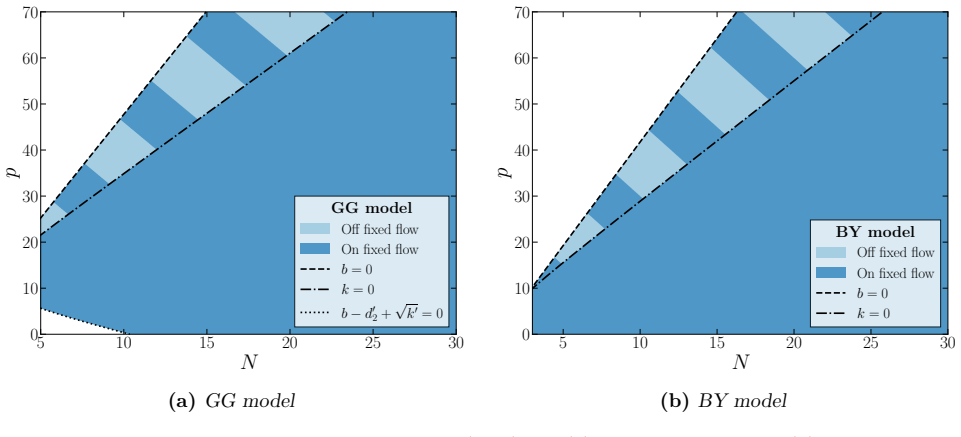
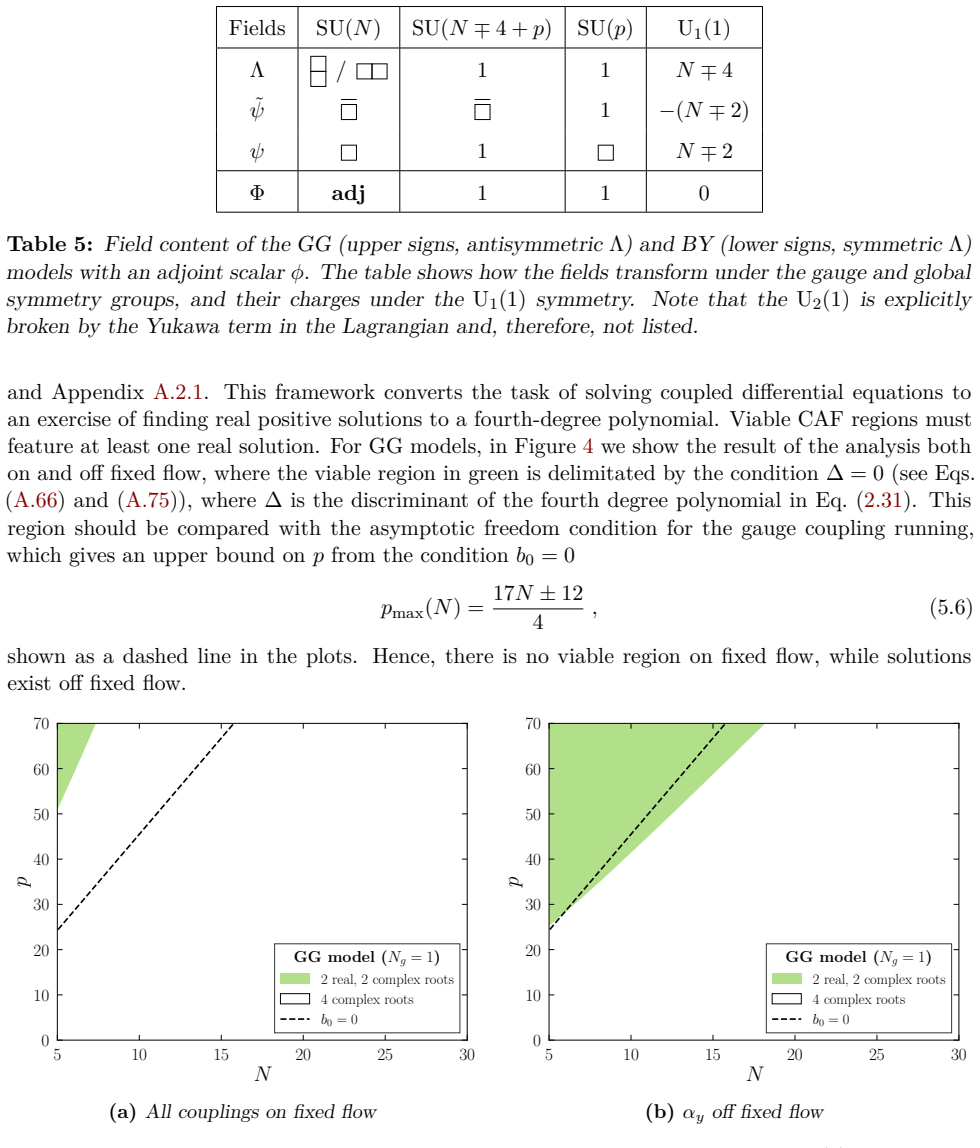
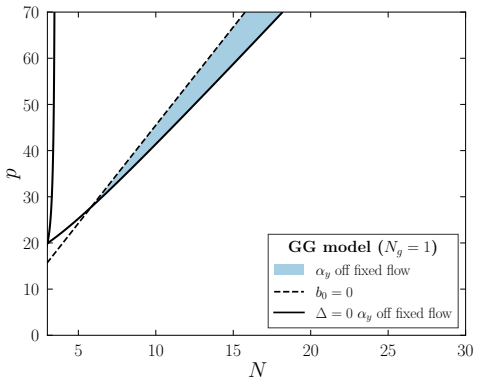
In generalised Georgi-Glashow and Bars-Yankielowicz chiral gauge theories augmented by a scalar in the fundamental or adjoint representation and multiple chiral fermion families, the gauge, Yukawa and quartic couplings can all be made asymptotically free when the number of colours and the multiplicities of vector-like and chiral families are chosen appropriately; the one-loop beta functions for all three types of interaction then remain negative.
What carries the argument
One-loop beta functions for the gauge coupling, Yukawa couplings between the scalars and fermions, and the scalar quartic self-coupling, whose simultaneous negativity ensures every coupling flows to zero in the ultraviolet.
If this is right
- Both the fundamental and adjoint scalar representations admit complete asymptotic freedom for suitable discrete choices of colour number and family multiplicities.
- All three classes of coupling—gauge, Yukawa and quartic—flow to zero at high energies when the conditions are met.
- The models remain perturbative up to arbitrarily high scales, providing ultraviolet-complete chiral gauge theories.
- The constructions generalize earlier chiral models by incorporating scalars while preserving ultraviolet freedom.
Where Pith is reading between the lines
- These discrete parameter sets could serve as starting points for constructing larger grand-unified theories that remain asymptotically free after additional fields are added.
- Higher-loop or non-perturbative checks, such as lattice simulations, could confirm whether the identified points survive beyond one-loop order.
- The same beta-function balancing technique might be applied to other gauge groups or representations to enlarge the list of viable chiral models.
Load-bearing premise
The one-loop perturbative beta-function analysis remains valid and sufficient to guarantee ultraviolet freedom without non-perturbative effects or additional consistency conditions altering the flow for the chosen representations.
What would settle it
A two-loop computation of the beta functions at the specific values of colour number and family multiplicities that satisfy the one-loop conditions, if it reveals a positive beta function for any coupling, would show that complete asymptotic freedom fails.
Figures




read the original abstract
We provide the conditions for complete asymptotic freedom for chiral gauge theories including scalars, as motivated by grand unified models. These are generalised Georgi-Glashow and Bars-Yankielowicz theories that feature a scalar field transforming either in the fundamental or in the adjoint of the gauge group. In both scenarios, we consider the addition of multiple chiral fermion families. We systematically analyse the interplay between gauge, Yukawa, and quartic couplings required for all interactions to remain asymptotically free at short distances. We find that for both scalar representations, complete asymptotic free models can be obtained for a specific number of colours and multiplicity of vector-like and chiral families.
Editorial analysis
A structured set of objections, weighed in public.
Referee Report
Summary. The paper analyzes renormalization-group beta functions for gauge, Yukawa, and scalar quartic couplings in chiral SU(N_c) gauge theories with scalars transforming in the fundamental or adjoint representation (generalized Georgi-Glashow and Bars-Yankielowicz models). It adds multiple chiral fermion families plus vector-like pairs and identifies specific discrete values of N_c together with the multiplicities of vector-like and chiral families for which all three classes of couplings remain asymptotically free.
Significance. If the reported parameter sets are both anomaly-free and correctly yield negative beta-function coefficients at one loop (and remain stable under higher-order corrections), the work supplies concrete, fully perturbative UV-complete chiral gauge theories. Such examples are useful for GUT model building because they eliminate Landau poles while preserving chirality. The systematic treatment of the coupled gauge-Yukawa-quartic system is a positive feature.
major comments (3)
- The manuscript does not verify that the reported (N_c, family-multiplicity) combinations satisfy gauge-anomaly cancellation. For chiral SU(N_c) theories the cubic anomaly coefficient A_3 must vanish independently of the sign of the gauge beta function; non-zero A_3 renders the quantum theory inconsistent regardless of perturbative asymptotic freedom. This check is load-bearing for the central claim that the listed models are viable.
- Explicit one-loop beta-function expressions for the gauge, Yukawa, and quartic couplings are not displayed, nor are the numerical values of the beta-function coefficients that lead to the quoted (N_c, family) solutions. Without these, the specific numbers cannot be reproduced or checked for algebraic or numerical errors.
- The analysis is performed at one-loop order. For complete asymptotic freedom to be robust, the paper should at least comment on the stability of the negative beta-function signs under two-loop corrections, especially for the quartic and Yukawa sectors where higher-order terms can be sizable.
minor comments (1)
- A compact table listing the allowed (N_c, n_vector-like, n_chiral) triples for each scalar representation would improve readability and allow immediate comparison with anomaly-cancellation conditions.
Simulated Author's Rebuttal
We thank the referee for the careful reading and constructive comments on our manuscript. We address each major comment point by point below, indicating the revisions we plan to implement.
read point-by-point responses
-
Referee: The manuscript does not verify that the reported (N_c, family-multiplicity) combinations satisfy gauge-anomaly cancellation. For chiral SU(N_c) theories the cubic anomaly coefficient A_3 must vanish independently of the sign of the gauge beta function; non-zero A_3 renders the quantum theory inconsistent regardless of perturbative asymptotic freedom. This check is load-bearing for the central claim that the listed models are viable.
Authors: We appreciate the referee for emphasizing this crucial consistency requirement. The parameter sets we report were chosen to be anomaly-free, but we did not explicitly display the A_3 calculations. We will add a dedicated paragraph (or short subsection) that recalls the standard formula for the cubic anomaly coefficient in SU(N_c) and verifies its vanishing for each of the listed (N_c, vector-like, chiral-family) combinations. revision: yes
-
Referee: Explicit one-loop beta-function expressions for the gauge, Yukawa, and quartic couplings are not displayed, nor are the numerical values of the beta-function coefficients that lead to the quoted (N_c, family) solutions. Without these, the specific numbers cannot be reproduced or checked for algebraic or numerical errors.
Authors: We agree that full transparency requires the explicit expressions. Although the beta functions were derived from the standard one-loop formulas, the manuscript presented only the resulting conditions rather than the intermediate coefficients. We will insert the complete one-loop beta-function expressions for the gauge, Yukawa, and scalar quartic couplings, together with the numerical coefficient values that yield the reported solutions, either in the main text or in a new appendix. revision: yes
-
Referee: The analysis is performed at one-loop order. For complete asymptotic freedom to be robust, the paper should at least comment on the stability of the negative beta-function signs under two-loop corrections, especially for the quartic and Yukawa sectors where higher-order terms can be sizable.
Authors: We acknowledge that one-loop results constitute a necessary but not automatically sufficient condition. We will add a brief discussion paragraph noting the possible size of two-loop corrections in the Yukawa and quartic sectors and stating that a dedicated two-loop analysis lies outside the scope of the present work. The one-loop search nevertheless identifies the candidate models that can be examined at higher order in future studies. revision: partial
Circularity Check
No circularity: conditions obtained by direct solution of beta-function equations
full rationale
The paper derives the reported values of N_c and family multiplicities by solving the coupled perturbative beta-function equations for the gauge, Yukawa, and quartic couplings in the chosen scalar representations. These outputs are not defined in terms of themselves, not obtained by fitting a subset of data and relabeling the fit as a prediction, and do not rely on load-bearing self-citations or imported uniqueness theorems. The derivation remains self-contained against the standard one-loop beta-function formulae and the explicit representation content; anomaly cancellation is an independent consistency requirement outside the scope of the circularity analysis.
Axiom & Free-Parameter Ledger
axioms (2)
- domain assumption Perturbative beta functions accurately capture the ultraviolet behavior of the theory.
- domain assumption The chosen fermion and scalar representations yield anomaly-free theories.
Reference graph
Works this paper leans on
-
[1]
Partial Symmetries of Weak Interactions
S. L. Glashow. “Partial Symmetries of Weak Interactions” . In: Nucl. Phys. 22 (1961), pp. 579–
work page 1961
-
[2]
doi: 10.1016/0029-5582(61)90469-2
-
[3]
Steven Weinberg. “A Model of Leptons” . In: Phys. Rev. Lett. 19 (1967), pp. 1264–1266. doi: 10.1103/PhysRevLett.19.1264
-
[4]
Broken symmetries, massless particles and gauge fields
Peter W. Higgs. “Broken symmetries, massless particles and gauge fields” . In: Phys. Lett. 12 (1964), pp. 132–133. doi: 10.1016/0031-9163(64)91136-9
-
[5]
Spontaneous Symmetry Breakdown without Massless Bosons
Peter W. Higgs. “Spontaneous Symmetry Breakdown without Massless Bosons” . In: Phys. Rev. 145 (1966), pp. 1156–1163. doi: 10.1103/PhysRev.145.1156
-
[6]
Georges Aad et al. “Observation of a new particle in the search for the Standard Model Higgs boson with the ATLAS detector at the LHC” . In: Phys. Lett. B 716 (2012), pp. 1–29. doi: 10.1016/j.physletb.2012.08.020. arXiv: 1207.7214 [hep-ex]
work page internal anchor Pith review doi:10.1016/j.physletb.2012.08.020 2012
-
[7]
Higgs mass and vacuum stability in the Standard Model at NNLO
Giuseppe Degrassi, Stefano Di Vita, Joan Elias-Miro, Jose R. Espinosa, Gian F. Giudice, Gino Isidori, and Alessandro Strumia. “Higgs mass and vacuum stability in the Standard Model at NNLO” . In: JHEP 08 (2012), p. 098. doi: 10 . 1007 / JHEP08(2012 ) 098. arXiv: 1205 . 6497 [hep-ph]
work page 2012
-
[8]
Standard Model Vacuum Stability and Weyl Consistency Conditions
Oleg Antipin, Marc Gillioz, Jens Krog, Esben Mølgaard, and Francesco Sannino. “Standard Model Vacuum Stability and Weyl Consistency Conditions” . In: JHEP 08 (2013), p. 034. doi: 10.1007/JHEP08(2013)034. arXiv: 1306.3234 [hep-ph]
-
[9]
Unity of All Elementary Particle Forces
H. Georgi and S. L. Glashow. “Unity of All Elementary Particle Forces” . In: Phys. Rev. Lett. 32 (1974), pp. 438–441. doi: 10.1103/PhysRevLett.32.438
-
[10]
Hierarchy of Interactions in Unified Gauge Theories
H. Georgi, Helen R. Quinn, and Steven Weinberg. “Hierarchy of Interactions in Unified Gauge Theories” . In: Phys. Rev. Lett. 33 (1974), pp. 451–454. doi: 10.1103/PhysRevLett.33.451
-
[11]
Unified Interactions of Leptons and Hadrons
H. Fritzsch and Peter Minkowski. “Unified Interactions of Leptons and Hadrons” . In: Annals Phys. 93 (1975), pp. 193–266. doi: 10.1016/0003-4916(75)90211-0
-
[12]
Lepton Number as the Fourth Color
Jogesh C. Pati and Abdus Salam. “Lepton Number as the Fourth Color” . In: Phys. Rev. D 10 (1974). [Erratum: Phys.Rev.D 11, 703–703 (1975)], pp. 275–289. doi: 10.1103/PhysRevD.10. 275
-
[13]
Grand Unified Theories and Proton Decay
Paul Langacker. “Grand Unified Theories and Proton Decay” . In: Phys. Rept. 72 (1981), p. 185. doi: 10.1016/0370-1573(81)90059-4
-
[14]
Asymptotically Safe Grand Unification
Borut Bajc and Francesco Sannino. “Asymptotically Safe Grand Unification” . In: JHEP 12 (2016), p. 141. doi: 10.1007/JHEP12(2016)141. arXiv: 1610.09681 [hep-th]
-
[16]
Higgs Phenomena in Asymptotically Free Gauge Theories
T. P. Cheng, E. Eichten, and Ling-Fong Li. “Higgs Phenomena in Asymptotically Free Gauge Theories” . In: Phys. Rev. D 9 (1974), p. 2259. doi: 10.1103/PhysRevD.9.2259
-
[17]
Asymptotically Free Gauge Theories - I
D. J. Gross and Frank Wilczek. “Asymptotically Free Gauge Theories - I” . In: Phys. Rev. D 8 (1973), pp. 3633–3652. doi: 10.1103/PhysRevD.8.3633
-
[18]
Stable Asymptotically Free Extensions (SAFEs) of the Standard Model
Bob Holdom, Jing Ren, and Chen Zhang. “Stable Asymptotically Free Extensions (SAFEs) of the Standard Model” . In: Journal of High Energy Physics 2015.3 (Mar. 2015). issn: 1029-8479. doi: 10.1007/jhep03(2015)028. url: http://dx.doi.org/10.1007/JHEP03(2015)028. 25
-
[19]
Softened Gravity and the Extension of the Standard Model up to Infinite Energy
Gian F. Giudice, Gino Isidori, Alberto Salvio, and Alessandro Strumia. “Softened Gravity and the Extension of the Standard Model up to Infinite Energy” . In: JHEP 02 (2015), p. 137. doi: 10.1007/JHEP02(2015)137. arXiv: 1412.2769 [hep-ph]
-
[20]
Conformal Phase Diagram of Com- plete Asymptotically Free Theories
Claudio Pica, Thomas A. Ryttov, and Francesco Sannino. “Conformal Phase Diagram of Com- plete Asymptotically Free Theories” . In: Phys. Rev. D 96.7 (2017), p. 074015. doi: 10.1103/ PhysRevD.96.074015. arXiv: 1605.04712 [hep-th]
-
[21]
Triviality Pursuit: Can Elementary Scalar Particles Exist?
David J. E. Callaway. “Triviality Pursuit: Can Elementary Scalar Particles Exist?” In: Phys. Rept. 167 (1988), p. 241. doi: 10.1016/0370-1573(88)90008-7
-
[22]
Phase structure of complete asymptotically free SU( Nc) theories with quarks and scalar quarks
Frederik F. Hansen, Tadeusz Janowski, Kasper Langæble, Robert B. Mann, Francesco Sannino, Tom G. Steele, and Zhi-Wei Wang. “Phase structure of complete asymptotically free SU( Nc) theories with quarks and scalar quarks” . In: Phys. Rev. D 97.6 (2018), p. 065014. doi: 10.1103/ PhysRevD.97.065014. arXiv: 1706.06402 [hep-ph]
-
[23]
Selection toolkit for standard and non-standard GUTs
Giacomo Cacciapaglia, Aldo Deandrea, Konstantinos Kollias, and Francesco Sannino. “Selection toolkit for standard and non-standard GUTs” . In: Phys. Rev. D 113 (Apr. 2026), p. 075043. doi: doi.org/10.1103/395g-tl4h. arXiv: 2507.06368 [hep-ph]
-
[24]
New constraints on chiral gauge theories
Thomas Appelquist, Andrew G. Cohen, Martin Schmaltz, and Robert Shrock. “New constraints on chiral gauge theories” . In: Phys. Lett. B 459 (1999), pp. 235–241. doi: 10 . 1016 / S0370 - 2693(99)00616-4. arXiv: hep-th/9904172
-
[25]
Phases of chiral gauge theories
Thomas Appelquist, Zhi-yong Duan, and Francesco Sannino. “Phases of chiral gauge theories” . In: Phys. Rev. D 61 (2000), p. 125009. doi: 10 . 1103 / PhysRevD . 61 . 125009. arXiv: hep - ph/0001043
-
[26]
Is There a c Theorem in Four-Dimensions?
John L. Cardy. “Is There a c Theorem in Four-Dimensions?” In: Phys. Lett. B 215 (1988), pp. 749–752. doi: 10.1016/0370-2693(88)90054-8
-
[27]
H., Jedamzik, K., & Pogosian, L
Nicola Andrea Dondi, Vladimir Prochazka, and Francesco Sannino. “Conformal Data of Funda- mental Gauge-Yukawa Theories” . In:Phys. Rev. D 98 (2018), p. 045002. doi: 10.1103/PhysRevD. 98.045002. arXiv: 1712.05388 [hep-th]
-
[28]
Composite Quarks and Leptons as Solutions of Anomaly Constraints
Itzhak Bars and Shimon Yankielowicz. “Composite Quarks and Leptons as Solutions of Anomaly Constraints” . In:Phys. Lett. B 101 (1981), pp. 159–165. doi: 10.1016/0370-2693(81)90664-X
-
[29]
Dynamics from symmetries in chiral SU (N ) gauge theories
Stefano Bolognesi, Kenichi Konishi, and Andrea Luzio. “Dynamics from symmetries in chiral SU (N ) gauge theories” . In: JHEP 09 (2020), p. 001. doi: 10.1007/JHEP09(2020)001 . arXiv: 2004.06639 [hep-th]
-
[30]
Some exact results in chiral gauge theories
Csaba Csáki, Hitoshi Murayama, and Ofri Telem. “Some exact results in chiral gauge theories” . In: Phys. Rev. D 104.6 (2021), p. 065018. doi: 10.1103/PhysRevD.104.065018 . arXiv: 2104. 10171 [hep-th]
-
[31]
Probing the dynamics of chiralSU(N) gauge theories via generalized anomalies
Stefano Bolognesi, Kenichi Konishi, and Andrea Luzio. “Probing the dynamics of chiral SU (N ) gauge theories via generalized anomalies” . In: Phys. Rev. D 103.9 (2021), p. 094016. doi: 10. 1103/PhysRevD.103.094016. arXiv: 2101.02601 [hep-th]
-
[32]
Strong anomaly and phases of chiral gauge theories
Stefano Bolognesi, Kenichi Konishi, and Andrea Luzio. “Strong anomaly and phases of chiral gauge theories” . In: JHEP 08 (2021), p. 028. doi: 10 . 1007 / JHEP08(2021 ) 028. arXiv: 2105 . 03921 [hep-th]
work page 2021
-
[33]
Phases of confining SU(5) chiral gauge theory with three gen- erations
Yang Bai and Daniel Stolarski. “Phases of confining SU(5) chiral gauge theory with three gen- erations” . In: JHEP 03 (2022), p. 113. doi: 10.1007/JHEP03(2022)113 . arXiv: 2111.11214 [hep-th]. 26
-
[34]
The Z2 anomaly in some chiral gauge theories
Stefano Bolognesi, Kenichi Konishi, and Andrea Luzio. “The Z2 anomaly in some chiral gauge theories” . In: JHEP 08 (2023), p. 125. doi: 10.1007/JHEP08(2023)125 . arXiv: 2307.03822 [hep-th]
-
[35]
Dynamical symmetry breaking in Georgi-Glashow chiral-gauge theories
Hao-Lin Li, Álvaro Pastor-Gutiérrez, Shahram Vatani, and Ling-Xiao Xu. “Dynamical symmetry breaking in Georgi-Glashow chiral-gauge theories” . In: JHEP 12 (2025), p. 020. doi: 10.1007/ JHEP12(2025)020. arXiv: 2507.21208 [hep-th]
-
[36]
Confinement without symmetry breaking in chiral gauge theories
Haolin Li, Álvaro Pastor-Gutiérrez, and Shahram Vatani. “Confinement without symmetry breaking in chiral gauge theories” . In: (Mar. 2026). arXiv: 2603.19355 [hep-th]
-
[37]
Asymptotically safe and free chiral theories with and without scalars
Esben Mølgaard and Francesco Sannino. “Asymptotically safe and free chiral theories with and without scalars” . In: Phys. Rev. D 96.5 (2017), p. 056004. doi: 10.1103/PhysRevD.96.056004 . arXiv: 1610.03130 [hep-ph]
-
[38]
Group Theory of the Spontaneously Broken Gauge Symmetries
Ling-Fong Li. “Group Theory of the Spontaneously Broken Gauge Symmetries” . In: Phys. Rev. D 9 (1974), pp. 1723–1739. doi: 10.1103/PhysRevD.9.1723
-
[39]
Asymptotic Freedom: An Approach to Strong Interactions
H. David Politzer. “Asymptotic Freedom: An Approach to Strong Interactions” . In: Phys. Rept. 14 (1974), pp. 129–180. doi: 10.1016/0370-1573(74)90014-3
-
[40]
Mass and Mixing Angle Predictions from Infrared Fixed Points
B. Pendleton and Graham G. Ross. “Mass and Mixing Angle Predictions from Infrared Fixed Points” . In:Phys. Lett. B 98 (1981), pp. 291–294. doi: 10.1016/0370-2693(81)90017-4
-
[41]
Reduction in the Number of Coupling Parameters
W. Zimmermann. “Reduction in the Number of Coupling Parameters” . In: Commun. Math. Phys. 97 (1985), p. 211. doi: 10.1007/BF01206187
-
[43]
A Simple Proof of Descartes’s Rule of Signs
Xiaoshen Wang. “A Simple Proof of Descartes’s Rule of Signs” . In: The American Mathematical Monthly 111.6 (2004), pp. 525–526. doi: 10.2307/2972804
-
[44]
Introducing RGBeta: a Mathematica package for the evaluation of renormalization group β-functions
Anders Eller Thomsen. “Introducing RGBeta: a Mathematica package for the evaluation of renormalization group β-functions” . In: Eur. Phys. J. C 81.5 (2021), p. 408. doi: 10 . 1140 / epjc/s10052-021-09142-4 . arXiv: 2101.08265 [hep-ph]
-
[45]
Dual of QCD with One Adjoint Fermion
Matin Mojaza, Marco Nardecchia, Claudio Pica, and Francesco Sannino. “Dual of QCD with One Adjoint Fermion” . In: Phys. Rev. D 83 (2011), p. 065022. doi: 10.1103/PhysRevD.83.065022 . arXiv: 1101.1522 [hep-th]
-
[46]
The Standard Model is Natural as Magnetic Gauge Theory
Francesco Sannino. “The Standard Model is Natural as Magnetic Gauge Theory” . In: Mod. Phys. Lett. A 26 (2011), pp. 1763–1769. doi: 10.1142/S0217732311036279. arXiv: 1102.5100 [hep-ph]
-
[47]
Charting standard model duality and its signa- tures
Giacomo Cacciapaglia and Francesco Sannino. “Charting standard model duality and its signa- tures” . In: Phys. Rev. D 111.3 (2025), p. 035013. doi: 10.1103/PhysRevD.111.035013 . arXiv: 2407.17281 [hep-ph]
-
[48]
Orientifold theory dynamics and symmetry break- ing
Francesco Sannino and Kimmo Tuominen. “Orientifold theory dynamics and symmetry break- ing” . In: Phys. Rev. D 71 (2005), p. 051901. doi: 10.1103/PhysRevD.71.051901 . arXiv: hep- ph/0405209
-
[49]
Conformal window of SU(N) gauge theories with fermions in higher dimensional representations
Dennis D. Dietrich and Francesco Sannino. “Conformal window of SU(N) gauge theories with fermions in higher dimensional representations” . In: Phys. Rev. D 75 (2007), p. 085018. doi: 10.1103/PhysRevD.75.085018. arXiv: hep-ph/0611341
-
[50]
W. Gellert, ed. The VNR concise encyclopedia of mathematics . New York: Van Nostrand Rein- hold, 1977. isbn: 0442226462. 27 A Detailed CAF analysis A.1 CAF Analysis from Solving ODE’s This approach considers coupled ODE’s governing the beta functions, which admit analytic solutions. A.1.1 Y ukawa Coupling The RG equation, which governs the Yukawa coupling...
work page 1977
discussion (0)
Sign in with ORCID, Apple, or X to comment. Anyone can read and Pith papers without signing in.