Recognition: 2 theorem links
· Lean TheoremPhysical derivation of the coarea formula and an elementary proof via gradient flow
Pith reviewed 2026-05-12 00:47 UTC · model grok-4.3
The pith
The coarea formula arises when the mass of a body with density g(x) is rewritten using a gradient flow diffeomorphism and the change-of-variables theorem.
A machine-rendered reading of the paper's core claim, the machinery that carries it, and where it could break.
Core claim
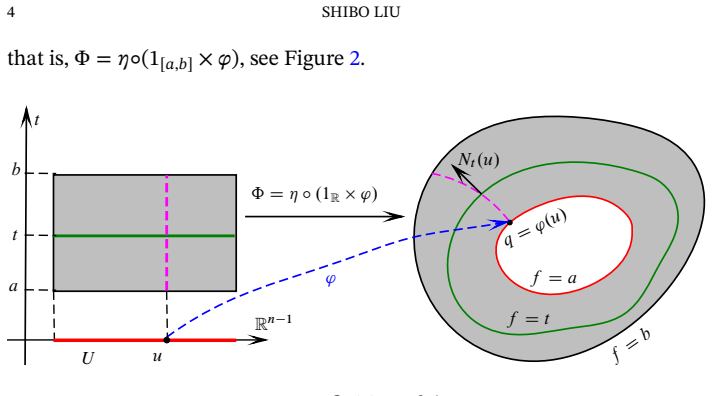
By interpreting the integral of g(x) over a domain as the mass of a body with density g, the authors construct a diffeomorphism Φ via the gradient flow of a suitable function. The change-of-variables theorem applied to this Φ, whose Jacobian determinant is obtained geometrically from the flow, directly produces the elementary coarea formula relating the volume integral to an integral over level sets.
What carries the argument
The diffeomorphism Φ built from the gradient flow, together with its geometrically computed Jacobian determinant that converts the volume element into a product of the level-set surface element and the gradient magnitude.
Load-bearing premise
The gradient flow must produce a global diffeomorphism without singularities or caustics throughout the domain of interest.
What would settle it
A smooth density g on a bounded domain for which direct numerical integration of the mass differs from the value obtained by integrating the proposed level-set formula after the flow is computed.
Figures
read the original abstract
In this note, we derive an elementary version of the coarea formula by considering the mass of a solid body with density $g (x)$. Then we present an rigorous proof using the changing variable formula. To this end we construct the diffeomorphism $\Phi$ via the gradient flow and compute its Jacobian determinant via geometric method.
Editorial analysis
A structured set of objections, weighed in public.
Referee Report
Summary. The manuscript presents a physical derivation of an elementary version of the coarea formula by interpreting the integral of g(x) as the mass of a solid body with density g(x). It then gives a rigorous proof via the change-of-variables theorem, constructing a diffeomorphism Φ from the gradient flow of g and computing det DΦ by a geometric argument.
Significance. If the proof is valid under clearly stated regularity assumptions, the physical mass interpretation supplies useful intuition and the gradient-flow approach could serve as an accessible alternative to standard proofs in geometric measure theory. The result would be of modest pedagogical interest but does not claim new theorems or applications beyond the coarea identity itself.
major comments (2)
- The construction of the diffeomorphism Φ via the gradient flow (described in the rigorous proof) assumes that the flow is complete and yields a global diffeomorphism on the relevant domain without caustics or trajectory crossings. For a general C^1 function g this fails; local existence is guaranteed by standard ODE theory, but global extension requires extra hypotheses (e.g., g convex or the domain star-shaped with respect to the flow) that are not stated. This assumption is load-bearing for the subsequent application of the change-of-variables formula.
- The geometric computation of the Jacobian determinant of Φ is claimed to be elementary, yet the manuscript does not derive it from the variational equation along the flow (Liouville formula or divergence of the generating vector field). Without this explicit link, the argument risks presupposing the volume distortion that the coarea formula encodes.
minor comments (3)
- The abstract uses the phrase 'changing variable formula'; replace with the standard term 'change of variables formula'.
- The precise statement of the coarea formula being proved (including the class of functions g and the precise integral identity) should be displayed as a numbered theorem before the proof begins.
- A brief comparison with the classical coarea formula (e.g., Federer or Evans-Gariepy) would clarify what is elementary versus what is assumed from prior results.
Simulated Author's Rebuttal
We thank the referee for the careful reading and constructive comments on our manuscript. The points raised highlight important issues of rigor and clarity that we have addressed in revision. We respond to each major comment below.
read point-by-point responses
-
Referee: The construction of the diffeomorphism Φ via the gradient flow (described in the rigorous proof) assumes that the flow is complete and yields a global diffeomorphism on the relevant domain without caustics or trajectory crossings. For a general C^1 function g this fails; local existence is guaranteed by standard ODE theory, but global extension requires extra hypotheses (e.g., g convex or the domain star-shaped with respect to the flow) that are not stated. This assumption is load-bearing for the subsequent application of the change-of-variables formula.
Authors: We agree that the global existence of the gradient flow as a diffeomorphism requires additional hypotheses that were not explicitly stated. In the revised manuscript we now specify that g is C^1 with compact support in a bounded convex domain Ω and that the flow lines remain non-intersecting on the time interval of interest (which holds automatically when g is convex, or more generally when the vector field ∇g is Lipschitz and the domain is star-shaped with respect to the flow). A new remark has been inserted before the change-of-variables step to record these standing assumptions, so that the application of the theorem is justified. revision: yes
-
Referee: The geometric computation of the Jacobian determinant of Φ is claimed to be elementary, yet the manuscript does not derive it from the variational equation along the flow (Liouville formula or divergence of the generating vector field). Without this explicit link, the argument risks presupposing the volume distortion that the coarea formula encodes.
Authors: The geometric argument proceeds from the definition of the flow map and the infinitesimal stretching of volume elements orthogonal to the level sets of g; it does not invoke the coarea formula itself. Nevertheless, to make the connection transparent we have added a brief paragraph showing that the same Jacobian satisfies the Liouville ODE d/dt log|det DΦ_t| = div(∇g) along trajectories. This confirms the geometric computation without circularity while preserving its elementary character. revision: partial
Circularity Check
No circularity: derivation relies on external change-of-variables theorem and standard gradient-flow existence
full rationale
The paper motivates the coarea formula via a physical mass argument with density g(x) and then proves it by constructing a diffeomorphism Φ from the gradient flow of g and applying the standard change-of-variables formula, with the Jacobian computed geometrically. Both the change-of-variables theorem and the local existence of gradient flows for smooth vector fields are external, well-established results not derived or fitted inside the paper. No self-citation chain, no redefinition of the target coarea identity in terms of itself, and no parameter fitted to a subset of data that is then relabeled as a prediction. The derivation chain is therefore self-contained against external benchmarks.
Axiom & Free-Parameter Ledger
axioms (1)
- domain assumption g is sufficiently smooth for the gradient flow to define a diffeomorphism on the domain of interest.
Lean theorems connected to this paper
-
IndisputableMonolith/Foundation/AlexanderDuality.leanalexander_duality_circle_linking unclearTheorem 0.1 (Coarea formula)... f C², Ω compact free of critical points
Reference graph
Works this paper leans on
-
[1]
P.Ding,Certainmetricpropertiesoflevelhypersurfaces,JPJournalofGeometryandTopol- ogy21(2018)75–83
work page 2018
-
[2]
Ding, A natural geometric proof of the length-curvature identity, Math
P. Ding, A natural geometric proof of the length-curvature identity, Math. Mag. 97 (2024) 503–507
work page 2024
-
[3]
H. Federer, Geometric measure theory, Die Grundlehren der mathematischen Wis- senschaften,Band153,Springer-VerlagNewYork,Inc.,NewYork,1969
work page 1969
-
[4]
S. Liu, Y. Zhang, On the change of variables formula for multiple integrals, J. Math. Study 50(2017)268–276
work page 2017
-
[5]
M. Willem, Minimax theorems,Progress in Nonlinear Differential Equations and their Ap- plications,vol.24,BirkhäuserBoston,Inc.,Boston,MA,1996
work page 1996
discussion (0)
Sign in with ORCID, Apple, or X to comment. Anyone can read and Pith papers without signing in.