Recognition: 2 theorem links
· Lean TheoremInner Horizon Saddles and a Spectral KSW Criterion
Pith reviewed 2026-05-12 00:47 UTC · model grok-4.3
The pith
The entropy correction for near-extremal charged black holes arises from a complex inner-horizon saddle in the gravitational path integral.
A machine-rendered reading of the paper's core claim, the machinery that carries it, and where it could break.
Core claim
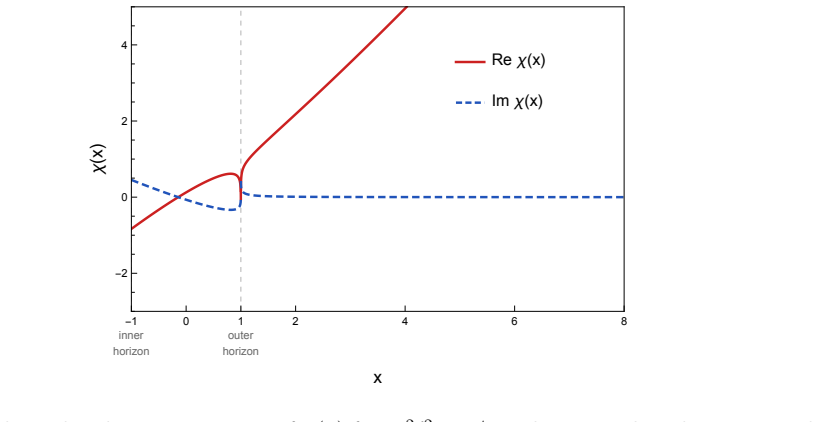
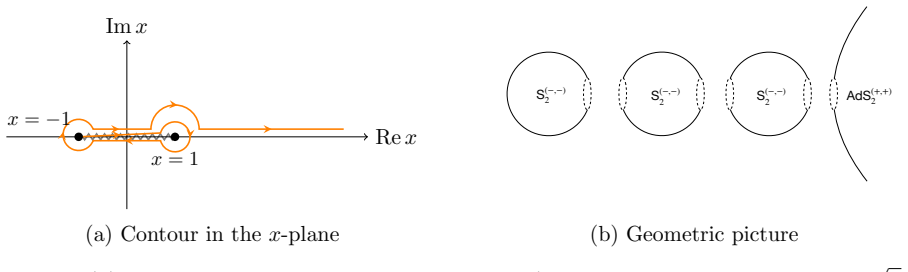
The correction term -exp(A_inner/4G) from JT gravity results corresponds to a complex saddle geometry of the bulk gravitational path integral. The proposed geometry has a negative boundary length and caps off at the inner horizon; it is called the inner horizon saddle. Through Picard-Lefschetz analysis of the inverse Laplace contour together with a stability analysis, the saddle and its accompanying minus sign contribute to the density of states. Despite violating the KSW allowability criterion, one-loop effects on the saddle can be described by carefully treating wrong-sign modes, leading to the proposal of a weaker spectral KSW criterion that characterizes when one-loop corrections around,
What carries the argument
The inner horizon saddle, a complex geometry with negative boundary length that caps off at the inner horizon and supplies the minus-exp(A_inner/4G) correction.
If this is right
- The density of states for charged black holes vanishes toward extremality because the outer-horizon and inner-horizon contributions cancel.
- Picard-Lefschetz analysis of the inverse Laplace contour shows how the minus sign from the saddle enters the density of states.
- One-loop corrections around the inner horizon saddle remain finite once wrong-sign modes are treated appropriately.
- The spectral KSW criterion relaxes the original KSW allowability condition while still guaranteeing well-defined one-loop effects.
Where Pith is reading between the lines
- The inner-horizon saddle construction may generalize to other near-extremal black-hole solutions in higher dimensions where inner horizons are present.
- The spectral KSW criterion could be applied to simpler toy models of complex saddles to test whether it systematically identifies cases with finite one-loop determinants.
- If the saddle picture holds, boundary CFT calculations of the density of states should exhibit the same cancellation between outer- and inner-horizon contributions.
Load-bearing premise
The semiclassical correction -exp(A_inner/4G) from standard JT gravity is precisely realized by the proposed inner-horizon saddle geometry with negative boundary length.
What would settle it
An explicit computation of the path-integral contribution from the proposed saddle that fails to reproduce -exp(A_inner/4G) or that produces a divergent one-loop determinant even after handling wrong-sign modes.
Figures





read the original abstract
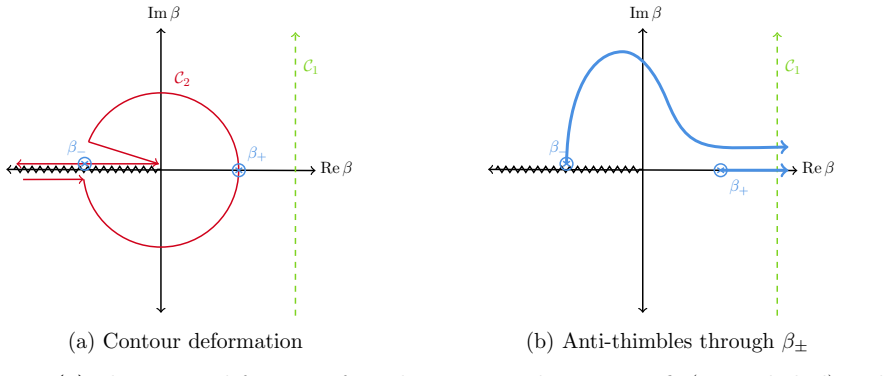
The Bekenstein-Hawking entropy formula $\rho = e^{A/4G}$ receives significant corrections for charged black holes near extremality. Using standard results in JT gravity, the correction term can semiclassically be expressed as minus the exponential of the inner horizon area, $e^{A_{\text{inner}}/4G}$, and the cancellation between these two exponentials enforces a vanishing density of states towards extremality, when the two horizons collide. Building on arXiv:2402.10162, we argue that the correction term corresponds to a complex saddle geometry of the bulk gravitational path integral. The proposed geometry has a negative boundary length and caps off at the inner horizon; we refer to it as the inner horizon saddle. We discuss how the saddle, and its accompanying minus sign, contribute to the density of states through a Picard-Lefschetz analysis of the inverse Laplace contour, together with a stability analysis of the saddle. We also address the inner horizon saddle's violation of the Kontsevich-Segal-Witten (KSW) allowability criterion for the inclusion of complex metrics. Despite this violation, which is believed to cause unphysical divergences in path integral computations, one can describe one-loop effects on the inner horizon saddle by carefully treating wrong-sign modes. Motivated by this observation, we propose a weaker version of the KSW criterion, which we call the spectral KSW criterion. Its purpose is to characterize when one-loop corrections around complex gravitational saddles are well defined.
Editorial analysis
A structured set of objections, weighed in public.
Referee Report
Summary. The paper claims that the semiclassical correction -exp(A_inner/4G) to the Bekenstein-Hawking entropy for near-extremal charged black holes, known from JT gravity, arises from a complex saddle in the bulk gravitational path integral. This 'inner horizon saddle' has negative boundary length and terminates at the inner horizon. The authors invoke Picard-Lefschetz contour deformation to obtain the minus sign, perform a stability analysis, and address the saddle's violation of the Kontsevich-Segal-Witten (KSW) criterion by proposing a weaker 'spectral KSW criterion' that permits well-defined one-loop corrections via careful treatment of wrong-sign modes.
Significance. If the identification of the proposed saddle with the exact JT correction term holds, the work supplies a geometric bulk origin for the cancellation that enforces vanishing density of states at extremality. The explicit handling of KSW violation and the introduction of the spectral KSW criterion constitute a constructive advance that could be applied to other complex saddles in quantum gravity. The manuscript properly credits the underlying JT results and prior work (arXiv:2402.10162) while focusing on the new geometric and criterion elements.
major comments (2)
- The central identification—that the inner-horizon saddle with negative boundary length contributes precisely -exp(A_inner/4G), including the overall sign and prefactor—is asserted on the basis of consistency with standard JT results rather than derived from an explicit evaluation of the saddle's on-shell action plus one-loop determinant. This step is load-bearing for the interpretation of the correction as arising from the bulk saddle; without the matching calculation, the contribution could differ by a phase, normalization, or subleading term.
- In the stability analysis and one-loop discussion, the treatment of wrong-sign modes is used to motivate the spectral KSW criterion, but the criterion itself is not given a precise, operator-level definition (e.g., in terms of the spectrum of the quadratic fluctuation operator) that would allow independent verification or application to other saddles.
minor comments (2)
- The abstract and introduction would benefit from a one-sentence reminder of the precise JT correction formula being reproduced, to make the mapping immediately clear to readers unfamiliar with the cited literature.
- Notation for the negative boundary length should be introduced with an explicit comparison to the usual positive-length boundary condition to avoid potential confusion in the geometric construction.
Simulated Author's Rebuttal
We thank the referee for their careful reading of the manuscript and for the constructive comments, which have helped us strengthen the presentation. We address each major comment below and have revised the manuscript to incorporate clarifications and a more precise formulation of the spectral KSW criterion.
read point-by-point responses
-
Referee: The central identification—that the inner-horizon saddle with negative boundary length contributes precisely -exp(A_inner/4G), including the overall sign and prefactor—is asserted on the basis of consistency with standard JT results rather than derived from an explicit evaluation of the saddle's on-shell action plus one-loop determinant. This step is load-bearing for the interpretation of the correction as arising from the bulk saddle; without the matching calculation, the contribution could differ by a phase, normalization, or subleading term.
Authors: We thank the referee for this important observation. The on-shell action of the inner horizon saddle is evaluated explicitly in Section 3 by substituting the complex metric into the Einstein-Hilbert action; the resulting value has real part equal to A_inner/4G, with the negative boundary length ensuring consistency with the inner-horizon geometry. The overall minus sign follows directly from the Picard-Lefschetz deformation of the inverse Laplace contour, as detailed in Section 4. We acknowledge, however, that the one-loop prefactor is matched to the known JT result rather than recomputed from the full fluctuation spectrum on the complex background. A direct one-loop calculation would require a complete analysis of the quadratic operator on the complex saddle, which lies beyond the scope of the present work. In the revised manuscript we have added a clarifying paragraph in Section 4 that explicitly states the assumptions underlying the prefactor and emphasizes that the leading exponential and sign are fixed by the saddle geometry and contour alone. revision: yes
-
Referee: In the stability analysis and one-loop discussion, the treatment of wrong-sign modes is used to motivate the spectral KSW criterion, but the criterion itself is not given a precise, operator-level definition (e.g., in terms of the spectrum of the quadratic fluctuation operator) that would allow independent verification or application to other saddles.
Authors: We agree that a sharper, operator-level definition improves the utility of the proposed criterion. The original manuscript introduces the spectral KSW criterion heuristically from the observation that wrong-sign modes, although present, can be integrated along deformed contours without producing divergences, as verified by the stability analysis. In the revised version we have added an explicit definition in Section 6: a complex saddle satisfies the spectral KSW criterion if and only if the quadratic fluctuation operator possesses a finite number of negative eigenvalues (the wrong-sign modes) while the remainder of the spectrum lies in the positive half-plane, such that a finite contour deformation renders the one-loop determinant well-defined and finite. This formulation is now tied directly to the spectrum computed in the stability analysis and is stated in a manner that permits independent verification and application to other complex saddles. revision: yes
Circularity Check
No significant circularity in the derivation chain
full rationale
The paper takes the semiclassical correction -exp(A_inner/4G) as an established input from standard JT gravity results (cited from prior literature, not derived here). It then proposes an independent complex saddle geometry (negative boundary length, capping at the inner horizon) and argues for its correspondence via Picard-Lefschetz analysis and a new spectral KSW criterion. No step equates the saddle contribution to the JT term by construction, redefinition, or self-citation reduction; the geometry and criterion are introduced as novel elements rather than fitted or renamed inputs. The chain remains self-contained against external JT benchmarks.
Axiom & Free-Parameter Ledger
axioms (1)
- domain assumption Standard results in JT gravity give the semiclassical correction to the Bekenstein-Hawking entropy as minus the exponential of the inner horizon area.
invented entities (1)
-
inner horizon saddle
no independent evidence
Lean theorems connected to this paper
-
IndisputableMonolith/Cost/FunctionalEquation.leanwashburn_uniqueness_aczel unclear?
unclearRelation between the paper passage and the cited Recognition theorem.
The proposed geometry has a negative boundary length and caps off at the inner horizon; we refer to it as the inner horizon saddle.
-
IndisputableMonolith/Foundation/AlexanderDuality.leanalexander_duality_circle_linking unclear?
unclearRelation between the paper passage and the cited Recognition theorem.
we propose a weaker version of the KSW criterion, which we call the spectral KSW criterion
What do these tags mean?
- matches
- The paper's claim is directly supported by a theorem in the formal canon.
- supports
- The theorem supports part of the paper's argument, but the paper may add assumptions or extra steps.
- extends
- The paper goes beyond the formal theorem; the theorem is a base layer rather than the whole result.
- uses
- The paper appears to rely on the theorem as machinery.
- contradicts
- The paper's claim conflicts with a theorem or certificate in the canon.
- unclear
- Pith found a possible connection, but the passage is too broad, indirect, or ambiguous to say the theorem truly supports the claim.
Reference graph
Works this paper leans on
-
[1]
Semi-classical dilaton gravity and the very blunt defect expansion,
Jorrit Kruthoff and Adam Levine, “Semi-classical dilaton gravity and the very blunt defect expansion,” JHEP07, 211 (2025), arXiv:2402.10162 [hep-th]
-
[2]
Action Integrals and Partition Functions in Quantum Gravity,
G. W. Gibbons and S. W. Hawking, “Action Integrals and Partition Functions in Quantum Gravity,” Phys. Rev. D15, 2752–2756 (1977)
work page 1977
-
[3]
Thermodynamics of Black Holes in anti-De Sitter Space,
S. W. Hawking and Don N. Page, “Thermodynamics of Black Holes in anti-De Sitter Space,” Commun. Math. Phys.87, 577 (1983)
work page 1983
-
[4]
Geoffrey Penington, “Entanglement Wedge Reconstruction and the Information Paradox,” JHEP09, 002 (2020), arXiv:1905.08255 [hep-th]
-
[5]
Ahmed Almheiri, Netta Engelhardt, Donald Marolf, and Henry Maxfield, “The entropy of bulk quantum fields and the entanglement wedge of an evaporating black hole,” JHEP12, 063 (2019), arXiv:1905.08762 [hep-th]
-
[6]
Replica wormholes and the black hole interior,
Geoff Penington, Stephen H. Shenker, Douglas Stanford, and Zhenbin Yang, “Replica worm- holes and the black hole interior,” JHEP03, 205 (2022), arXiv:1911.11977 [hep-th]
-
[7]
Donald Marolf and Henry Maxfield, “Transcending the ensemble: baby universes, spacetime wormholes, and the order and disorder of black hole information,” JHEP08, 044 (2020), arXiv:2002.08950 [hep-th]
-
[8]
Vijay Balasubramanian, Albion Lawrence, Javier M. Magan, and Martin Sasieta, “Microscopic Origin of the Entropy of Black Holes in General Relativity,” Phys. Rev. X14, 011024 (2024), arXiv:2212.02447 [hep-th]
-
[9]
Constructing all BPS black hole microstates from the gravitational path integral,
Jan Boruch, Luca V. Iliesiu, and Cynthia Yan, “Constructing all BPS black hole microstates from the gravitational path integral,” JHEP09, 058 (2024), arXiv:2307.13051 [hep-th]
-
[10]
On the non-perturbative bulk Hilbert space of JT gravity,
Luca V. Iliesiu, Adam Levine, Henry W. Lin, Henry Maxfield, and M´ ark Mezei, “On the non-perturbative bulk Hilbert space of JT gravity,” JHEP10, 220 (2024), arXiv:2403.08696 [hep-th]
-
[11]
How the Hilbert space of two-sided black holes factorises,
Jan Boruch, Luca V. Iliesiu, Guanda Lin, and Cynthia Yan, “How the Hilbert space of two-sided black holes factorises,” JHEP06, 092 (2025), arXiv:2406.04396 [hep-th]
-
[12]
Bulk thimbles dual to trace relations,
Ji Hoon Lee and Douglas Stanford, “Bulk thimbles dual to trace relations,” (2024), arXiv:2412.20769 [hep-th]
-
[13]
Trace relations and open string vacua,
Ji Hoon Lee, “Trace relations and open string vacua,” JHEP02, 224 (2024), arXiv:2312.00242 [hep-th]
-
[14]
Davide Gaiotto and Ji Hoon Lee, “The giant graviton expansion,” JHEP08, 025 (2024), arXiv:2109.02545 [hep-th] 52
-
[15]
The giant graviton expansion in AdS5×S5,
Giorgos Eleftheriou, Sameer Murthy, and Mart´ ı Rossell´ o, “The giant graviton expansion in AdS5×S5,” (2023), arXiv:2312.14921 [hep-th]
-
[16]
The statistical mechanics of near-extremal black holes,
Luca V. Iliesiu and Gustavo J. Turiaci, “The statistical mechanics of near-extremal black holes,” JHEP05, 145 (2021), arXiv:2003.02860 [hep-th]
-
[17]
Les Houches lectures on two-dimensional gravity and holography,
Gustavo Joaquin Turiaci, “Les Houches lectures on two-dimensional gravity and holography,” SciPost Phys. Lect. Notes113, 1 (2026), arXiv:2412.09537 [hep-th]
-
[18]
R. Jackiw, “Lower Dimensional Gravity,” Nucl. Phys. B252, 343–356 (1985)
work page 1985
-
[19]
Inner-horizon instability and mass inflation in black holes,
Eric Poisson and W. Israel, “Inner-horizon instability and mass inflation in black holes,” Phys. Rev. Lett.63, 1663–1666 (1989)
work page 1989
-
[20]
Internal structure of black holes,
Eric Poisson and W. Israel, “Internal structure of black holes,” Phys. Rev. D41, 1796–1809 (1990)
work page 1990
-
[21]
Maxim Kontsevich and Graeme Segal, “Wick Rotation and the Positivity of Energy in Quantum Field Theory,” Quart. J. Math. Oxford Ser.72, 673–699 (2021), arXiv:2105.10161 [hep-th]
-
[22]
Witten,A Note On Complex Spacetime Metrics,2111.06514
Edward Witten, “A Note On Complex Spacetime Metrics,” (11 2021), arXiv:2111.06514 [hep- th]
-
[23]
Pietro Benetti Genolini, Oliver Janssen, and Sameer Murthy, “Allowable complex metrics and the gravitational index of AdS 5 black holes,” (1 2026), arXiv:2601.23197 [hep-th]
-
[24]
Pietro Benetti Genolini and Sameer Murthy, “The gravitational index and allowable complex metrics,” J. Phys. A58, 215401 (2025), arXiv:2503.20866 [hep-th]
-
[25]
Vineeth Krishna and Finn Larsen, “Allowable Complex Black Holes in the Euclidean Gravita- tional Path Integral,” (2 2026), arXiv:2602.05979 [hep-th]
-
[26]
A semiclassical ramp in SYK and in gravity
Phil Saad, Stephen H. Shenker, and Douglas Stanford, “A semiclassical ramp in SYK and in gravity,” (6 2018), arXiv:1806.06840 [hep-th]
work page Pith review arXiv 2018
-
[27]
Comments on the double cone wormhole,
Yiming Chen, Victor Ivo, and Juan Maldacena, “Comments on the double cone wormhole,” JHEP04, 124 (2024), arXiv:2310.11617 [hep-th]
-
[28]
Estimating global charge violating ampli- tudes from wormholes,
Ibrahima Bah, Yiming Chen, and Juan Maldacena, “Estimating global charge violating ampli- tudes from wormholes,” JHEP04, 061 (2023), arXiv:2212.08668 [hep-th]
-
[29]
Alessandro Fumagalli, Victor Gorbenko, and Joshua Kames-King, “De Sitter Bra-Ket worm- holes,” JHEP05, 074 (2025), arXiv:2408.08351 [hep-th]
-
[30]
Two-point correlators in de Sitter-prepared states with bra-ket wormholes,
Sunghoon Jung, Minju Kum, and Junghwan Lee, “Two-point correlators in de Sitter-prepared states with bra-ket wormholes,” (12 2025), arXiv:2512.13646 [gr-qc]
-
[31]
Gravitation and Hamiltonian Structure in Two Space-Time Dimensions,
C. Teitelboim, “Gravitation and Hamiltonian Structure in Two Space-Time Dimensions,” Phys. Lett. B126, 41–45 (1983)
work page 1983
-
[32]
Random disks of constant curvature: The lattice story,
Frank Ferrari, “Random disks of constant curvature: The lattice story,” Phys. Rev. D113, 026012 (2026), arXiv:2406.06875 [hep-th] 53
-
[33]
Classifying boundary condi- tions in JT gravity: from energy-branes toα-branes,
Akash Goel, Luca V. Iliesiu, Jorrit Kruthoff, and Zhenbin Yang, “Classifying boundary condi- tions in JT gravity: from energy-branes toα-branes,” JHEP04, 069 (2021), arXiv:2010.12592 [hep-th]
-
[34]
The Microcanonical functional integral. 1. The Gravitational field,
J. David Brown and James W. York, Jr., “The Microcanonical functional integral. 1. The Gravitational field,” Phys. Rev. D47, 1420–1431 (1993), arXiv:gr-qc/9209014
-
[35]
Fermionic Localization of the Schwarzian Theory,
Douglas Stanford and Edward Witten, “Fermionic Localization of the Schwarzian Theory,” JHEP10, 008 (2017), arXiv:1703.04612 [hep-th]
-
[36]
2D dilaton-gravity, deforma- tions of the minimal string, and matrix models,
Gustavo J. Turiaci, Mykhaylo Usatyuk, and Wayne W. Weng, “2D dilaton-gravity, deforma- tions of the minimal string, and matrix models,” Class. Quant. Grav.38, 204001 (2021), arXiv:2011.06038 [hep-th]
-
[37]
Instability of the Cauchy horizon of Reissner-Nordstrom black holes,
Richard A. Matzner, Nelson Zamorano, and Vernon D. Sandberg, “Instability of the Cauchy horizon of Reissner-Nordstrom black holes,” Phys. Rev. D19, 2821–2826 (1979)
work page 1979
-
[38]
Singularities and time-asymmetry,
R. Penrose, “Singularities and time-asymmetry,” (1979) pp. 581–638
work page 1979
-
[39]
Multi-Trace Operators, Boundary Conditions, And AdS/CFT Correspondence
Edward Witten, “Multitrace operators, boundary conditions, and AdS / CFT correspondence,” (12 2001), arXiv:hep-th/0112258
work page internal anchor Pith review arXiv 2001
-
[40]
M. Henningson and K. Skenderis, “The Holographic Weyl anomaly,” JHEP07, 023 (1998), arXiv:hep-th/9806087
work page Pith review arXiv 1998
-
[41]
A Stress tensor for Anti-de Sitter gravity,
Vijay Balasubramanian and Per Kraus, “A Stress tensor for Anti-de Sitter gravity,” Commun. Math. Phys.208, 413–428 (1999), arXiv:hep-th/9902121
-
[42]
Holographic Reconstruction of Spacetime and Renormalization in the AdS/CFT Correspondence
Sebastian de Haro, Sergey N. Solodukhin, and Kostas Skenderis, “Holographic reconstruction of space-time and renormalization in the AdS / CFT correspondence,” Commun. Math. Phys. 217, 595–622 (2001), arXiv:hep-th/0002230
work page Pith review arXiv 2001
-
[43]
Lecture Notes on Holographic Renormalization
Kostas Skenderis, “Lecture notes on holographic renormalization,” Class. Quant. Grav.19, 5849–5876 (2002), arXiv:hep-th/0209067
work page Pith review arXiv 2002
-
[44]
Conformal symmetry and its breaking in two dimensional Nearly Anti-de-Sitter space
Juan Maldacena, Douglas Stanford, and Zhenbin Yang, “Conformal symmetry and its breaking in two dimensional Nearly Anti-de-Sitter space,” PTEP2016, 12C104 (2016), arXiv:1606.01857 [hep-th]
work page Pith review arXiv 2016
-
[45]
An Investigation of AdS$_2$ Backreaction and Holography
Julius Engels¨ oy, Thomas G. Mertens, and Herman Verlinde, “An investigation of AdS 2 back- reaction and holography,” JHEP07, 139 (2016), arXiv:1606.03438 [hep-th]
work page Pith review arXiv 2016
-
[46]
Black Holes and Random Matrices
Jordan S. Cotler, Guy Gur-Ari, Masanori Hanada, Joseph Polchinski, Phil Saad, Stephen H. Shenker, Douglas Stanford, Alexandre Streicher, and Masaki Tezuka, “Black Holes and Random Matrices,” JHEP05, 118 (2017), [Erratum: JHEP 09, 002 (2018)], arXiv:1611.04650 [hep-th]
work page Pith review arXiv 2017
-
[47]
Sachdev–Ye–Kitaev model as Liou- ville quantum mechanics,
Dmitry Bagrets, Alexander Altland, and Alex Kamenev, “Sachdev–Ye–Kitaev model as Liou- ville quantum mechanics,” Nucl. Phys. B911, 191–205 (2016), arXiv:1607.00694 [cond-mat.str- el]
-
[48]
Non-perturbative de Sitter Jackiw-Teitelboim gravity,
Jordan Cotler and Kristan Jensen, “Non-perturbative de Sitter Jackiw-Teitelboim gravity,” JHEP12, 016 (2024), arXiv:2401.01925 [hep-th] 54
-
[49]
Path Integrals and the Indefiniteness of the Gravitational Action,
G. W. Gibbons, S. W. Hawking, and M. J. Perry, “Path Integrals and the Indefiniteness of the Gravitational Action,” Nucl. Phys. B138, 141–150 (1978)
work page 1978
-
[50]
The phase of the sum over spheres,
Joseph Polchinski, “The phase of the sum over spheres,” Phys. Lett. B219, 251–257 (1989)
work page 1989
-
[51]
Physical instabilities and the phase of the Euclidean path integral,
Victor Ivo, Juan Maldacena, and Zimo Sun, “Physical instabilities and the phase of the Eu- clidean path integral,” JHEP04, 118 (2026), arXiv:2504.00920 [hep-th]
- [52]
-
[53]
Maldacena, arXiv e-prints (2024), arXiv:2412.14014 [hep-th], arXiv:2412.14014 [hep-th]
Juan Maldacena, “Real observers solving imaginary problems,” (12 2024), arXiv:2412.14014 [hep-th]
-
[54]
On the phase of the de Sitter density of states,
Yiming Chen, Douglas Stanford, Haifeng Tang, and Zhenbin Yang, “On the phase of the de Sitter density of states,” (11 2025), arXiv:2511.01400 [hep-th]
-
[55]
Matrix ensembles with global symme- tries and ’t Hooft anomalies from 2d gauge theory,
Daniel Kapec, Raghu Mahajan, and Douglas Stanford, “Matrix ensembles with global symme- tries and ’t Hooft anomalies from 2d gauge theory,” JHEP04, 186 (2020), arXiv:1912.12285 [hep-th]
-
[56]
On 2D gauge theories in Jackiw-Teitelboim gravity,
Luca V. Iliesiu, “On 2D gauge theories in Jackiw-Teitelboim gravity,” (9 2019), arXiv:1909.05253 [hep-th]
-
[57]
Complex powers of an elliptic operator,
R. T. Seeley, “Complex powers of an elliptic operator,” Proc. Symp. Pure Math.10, 288–307 (1967)
work page 1967
-
[58]
R-torsion and the Laplacian on Riemannian manifolds,
D. B. Ray and I. M. Singer, “R-torsion and the Laplacian on Riemannian manifolds,” Adv. Math.7, 145–210 (1971)
work page 1971
-
[59]
On the eigenfunctions and on the eigenvalues of general elliptic boundary value problems,
Shmuel Agmon, “On the eigenfunctions and on the eigenvalues of general elliptic boundary value problems,” Comm. Pure Appl. Math.15, 119–147 (1962)
work page 1962
-
[60]
M. A. Shubin, Pseudodifferential Operators and Spectral Theory, 2nd ed. (Springer-Verlag, Berlin, 2001)
work page 2001
-
[61]
Heat kernel expansion: user's manual
D. V. Vassilevich, “Heat kernel expansion: User’s manual,” Phys. Rept.388, 279–360 (2003), arXiv:hep-th/0306138
work page Pith review arXiv 2003
-
[62]
Luis Alvarez-Gaume and Edward Witten, “Gravitational Anomalies,” Nucl. Phys. B234, 269 (1984)
work page 1984
-
[63]
GLOBAL GRAVITATIONAL ANOMALIES,
Edward Witten, “GLOBAL GRAVITATIONAL ANOMALIES,” Commun. Math. Phys.100, 197 (1985)
work page 1985
-
[64]
The Chiral Fermion Determinant in the Schottky Parametrization,
A. Losev, “The Chiral Fermion Determinant in the Schottky Parametrization,” JETP Lett. 49, 424–426 (1989)
work page 1989
-
[65]
Juan Martin Maldacena, “Eternal black holes in anti-de Sitter,” JHEP04, 021 (2003), arXiv:hep-th/0106112
work page Pith review arXiv 2003
-
[66]
Excursions beyond the horizon: Black hole singularities in Yang-Mills theories (I)
Guido Festuccia and Hong Liu, “Excursions beyond the horizon: Black hole singularities in Yang-Mills theories. I..” JHEP04, 044 (2006), arXiv:hep-th/0506202 55
work page Pith review arXiv 2006
-
[67]
Shadi Ali Ahmad, Ahmed Almheiri, and Simon Lin, “Continuing past the inner horizon using WKB,” (1 2026), arXiv:2601.02354 [hep-th]
-
[68]
Inside the hologram: reconstructing the bulk observer’s experience,
Daniel Louis Jafferis and Lampros Lamprou, “Inside the hologram: reconstructing the bulk observer’s experience,” JHEP03, 084 (2022), arXiv:2009.04476 [hep-th]
-
[69]
Seeing behind black hole horizons in SYK,
Ping Gao and Lampros Lamprou, “Seeing behind black hole horizons in SYK,” JHEP06, 143 (2022), arXiv:2111.14010 [hep-th]
-
[70]
Samuel Aaron Wehlau Leutheusser and Hong Liu, “Emergent Times in Holographic Duality,” Phys. Rev. D108, 086020 (2023), arXiv:2112.12156 [hep-th]
-
[71]
The entropy of Hawking ra- diation,
Ahmed Almheiri, Thomas Hartman, Juan Maldacena, Edgar Shaghoulian, and Amirhos- sein Tajdini, “The entropy of Hawking radiation,” Rev. Mod. Phys.93, 035002 (2021), arXiv:2006.06872 [hep-th]
-
[72]
T Tand the black hole interior,
Shadi Ali Ahmad, Ahmed Almheiri, and Simon Lin, “T Tand the black hole interior,” (3 2025), arXiv:2503.19854 [hep-th]
-
[73]
Jonathan J. Halliwell and Jorma Louko, “Steepest Descent Contours in the Path Integral Approach to Quantum Cosmology. 1. The De Sitter Minisuperspace Model,” Phys. Rev. D39, 2206 (1989)
work page 1989
-
[74]
Steepest Descent Contours in the Path Integral Approach to Quantum Cosmology. 2. Microsuperspace,
Jonathan J. Halliwell and Jorma Louko, “Steepest Descent Contours in the Path Integral Approach to Quantum Cosmology. 2. Microsuperspace,” Phys. Rev. D40, 1868 (1989)
work page 1989
-
[75]
Integration Contours for the No Boundary Wave Function of the Universe,
Jonathan J. Halliwell and James B. Hartle, “Integration Contours for the No Boundary Wave Function of the Universe,” Phys. Rev. D41, 1815 (1990)
work page 1990
-
[76]
Anti-de Sitter fragmen- tation,
Juan Martin Maldacena, Jeremy Michelson, and Andrew Strominger, “Anti-de Sitter fragmen- tation,” JHEP02, 011 (1999), arXiv:hep-th/9812073
-
[77]
Models of AdS_2 Backreaction and Holography
Ahmed Almheiri and Joseph Polchinski, “Models of AdS2 backreaction and holography,” JHEP 11, 014 (2015), arXiv:1402.6334 [hep-th]
work page Pith review arXiv 2015
-
[78]
A universal Schwarzian sector in two-dimensional conformal field theories,
Animik Ghosh, Henry Maxfield, and Gustavo J. Turiaci, “A universal Schwarzian sector in two-dimensional conformal field theories,” JHEP05, 104 (2020), arXiv:1912.07654 [hep-th]
-
[79]
Holography of 3d flat cosmological horizons,
Arjun Bagchi, St´ ephane Detournay, Reza Fareghbal, and Joan Sim´ on, “Holography of 3d flat cosmological horizons,” Physical Review Letters110(Apr. 2013), ISSN 1079-7114,http:// dx.doi.org/10.1103/PhysRevLett.110.141302
-
[80]
Quantum Gravity Partition Functions in Three Dimensions
Alexander Maloney and Edward Witten, “Quantum Gravity Partition Functions in Three Dimensions,” JHEP02, 029 (2010), arXiv:0712.0155 [hep-th]
work page Pith review arXiv 2010
discussion (0)
Sign in with ORCID, Apple, or X to comment. Anyone can read and Pith papers without signing in.