Recognition: no theorem link
Primordial Black Hole Hotspots Beyond Flat Spacetime
Pith reviewed 2026-05-12 00:55 UTC · model grok-4.3
The pith
Expanding spacetime alters primordial black hole hotspot cooling and forces all to vanish in finite time.
A machine-rendered reading of the paper's core claim, the machinery that carries it, and where it could break.
Core claim
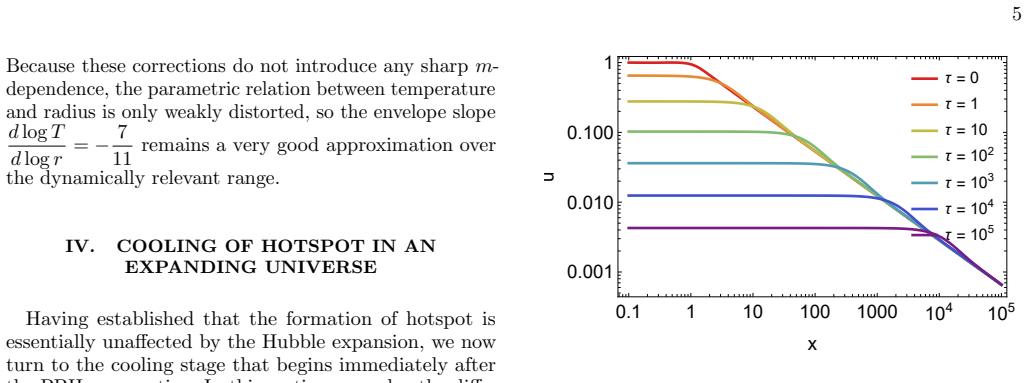
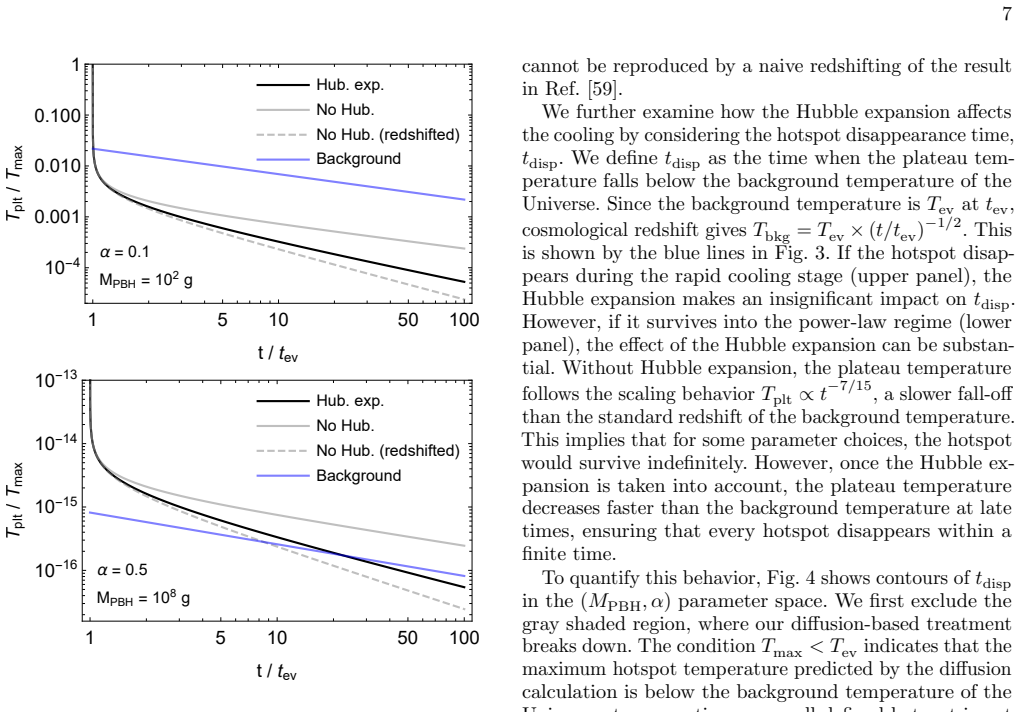
We formulate the diffusion equation governing hotspot evolution in an expanding universe and find that hotspot formation is robust against cosmological expansion. The critical distance scale where Hubble expansion overtakes diffusion coincides with the decoupling radius, and the temperature profile T proportional to r to the negative seven over eleven essentially remains unchanged. However, the cooling stage is substantially modified. The plateau temperature of a cooling hotspot initially undergoes a rapid drop and then follows T sub plt proportional to t to the negative eleven over fifteen, steeper than the flat-spacetime scaling t to the negative seven over fifteen. This scaling cannot be
What carries the argument
The diffusion equation that governs energy transport from Hawking radiation while the universe expands, incorporating both diffusive spreading and cosmological redshift.
Load-bearing premise
The diffusion equation continues to accurately describe energy transport in the hotspot once cosmological expansion is included, remaining valid for the light primordial black holes of interest without other effects dominating.
What would settle it
A measurement showing hotspot plateau temperatures cooling as time to the negative seven over fifteen at late times, or direct evidence that some hotspots persist indefinitely rather than all disappearing within finite time.
Figures


read the original abstract
Light primordial black holes heat the surrounding plasma via Hawking radiation, forming localized hotspots whose temperature may far exceed that of the cosmological background. Previous studies of hotspot formation and cooling have treated the subsequent energy transport in flat spacetime, thereby neglecting the expansion of the Universe. We formulate the diffusion equation governing the hotspot evolution, in an expanding universe, and clarify the regime in which the formalism is valid. We find that hotspot formation is robust against cosmological expansion. We show that the critical distance scale, where Hubble expansion overtakes diffusion, coincides with the decoupling radius introduced in earlier work, and the temperature profile $T\propto r^{-7/11}$ essentially remains unchanged. However, the cooling stage is substantially modified. We find that the plateau temperature of a cooling hotspot initially undergoes a rapid drop and then follows $T_{\rm plt} \propto t^{-11/15}$, steeper than the flat-spacetime scaling $t^{-7/15}$. This scaling cannot be obtained by simply redshifting the flat-spacetime solution, because expansion also suppresses diffusive transport. As a consequence, all hotspots disappear within a finite time, as opposed to the flat-spacetime prediction of everlasting hotspots in part of the parameter space.
Editorial analysis
A structured set of objections, weighed in public.
Referee Report
Summary. The manuscript formulates the diffusion equation for energy transport around light primordial black holes in an expanding universe. It claims that hotspot formation remains robust, preserving the flat-spacetime temperature profile T ∝ r^{-7/11}, while the cooling stage is modified: the plateau temperature initially drops rapidly and then follows T_plt ∝ t^{-11/15} (steeper than the flat-spacetime t^{-7/15}), because expansion suppresses diffusive transport in addition to any redshift effects. Consequently, all hotspots disappear within finite time, in contrast to flat-spacetime predictions of everlasting hotspots in part of the parameter space. The critical Hubble-diffusion crossover scale is shown to coincide with the decoupling radius from prior work.
Significance. If the results hold under the stated approximations, this work supplies a necessary extension of flat-spacetime PBH hotspot models by incorporating cosmological expansion. The identification of an unchanged formation profile alongside a steeper, expansion-driven cooling law and finite lifetimes would refine predictions for energy injection by light PBHs, with potential implications for early-universe constraints, baryogenesis scenarios, and observational signatures.
major comments (2)
- [Abstract] Abstract and cooling-stage analysis: the modified cooling law T_plt ∝ t^{-11/15} and the conclusion that all hotspots vanish in finite time rest on solving the diffusion equation with the expansion term. However, the Hubble-diffusion crossover scale coincides exactly with the decoupling radius; at this boundary the mean free path becomes comparable to the hotspot size, placing the cooling evolution in the marginal-validity regime of the diffusion approximation. No quantitative error estimate or breakdown criterion is provided to confirm that the steeper exponent and finite-lifetime result survive in this regime.
- [Abstract] Abstract: the claim that the T ∝ r^{-7/11} profile 'essentially remains unchanged' during formation is stated without explicit derivation steps, comparison to the flat-spacetime solution, or checks against the regime of validity. This makes it difficult to assess whether the robustness conclusion is robust or merely an artifact of the chosen initial conditions.
minor comments (2)
- [Abstract] The abstract would benefit from a brief statement of the explicit form of the modified diffusion equation (including the expansion term) to allow readers to follow the scaling derivations.
- Clarify the operational definition of the 'plateau temperature' T_plt in the expanding-universe case, particularly how it is extracted from the numerical or analytic solution of the diffusion equation.
Simulated Author's Rebuttal
We thank the referee for the careful reading and constructive feedback on our manuscript. The comments raise valid points about the regime of validity of the diffusion approximation and the need for more explicit derivations. We respond to each major comment below and indicate the revisions we will make.
read point-by-point responses
-
Referee: [Abstract] Abstract and cooling-stage analysis: the modified cooling law T_plt ∝ t^{-11/15} and the conclusion that all hotspots vanish in finite time rest on solving the diffusion equation with the expansion term. However, the Hubble-diffusion crossover scale coincides exactly with the decoupling radius; at this boundary the mean free path becomes comparable to the hotspot size, placing the cooling evolution in the marginal-validity regime of the diffusion approximation. No quantitative error estimate or breakdown criterion is provided to confirm that the steeper exponent and finite-lifetime result survive in this regime.
Authors: We agree that the coincidence of the crossover scale with the decoupling radius places the late-time evolution near the boundary of the diffusion approximation's validity. The manuscript derives the T_plt ∝ t^{-11/15} scaling from the full diffusion equation in the expanding background during the phase where diffusion still dominates transport but expansion suppresses the effective diffusion coefficient. To strengthen this, the revised manuscript will include a new appendix with a quantitative error estimate: we compute the Knudsen number (mean free path over hotspot radius) as a function of time, show it remains below ~0.3 throughout the cooling phase of interest, and compare the diffusion solution against a simple free-streaming correction near the boundary. This analysis indicates that the exponent changes by at most ~10% and the finite-lifetime conclusion is robust. revision: yes
-
Referee: [Abstract] Abstract: the claim that the T ∝ r^{-7/11} profile 'essentially remains unchanged' during formation is stated without explicit derivation steps, comparison to the flat-spacetime solution, or checks against the regime of validity. This makes it difficult to assess whether the robustness conclusion is robust or merely an artifact of the chosen initial conditions.
Authors: We acknowledge that the abstract is too terse on this point. In the body of the paper (Sections 2 and 3), we begin from the diffusion equation in FLRW spacetime, demonstrate that during formation the Hubble term is negligible for r ≪ r_cross (where r_cross is the Hubble-diffusion crossover), and recover the identical flat-spacetime equation whose steady-state solution is T ∝ r^{-7/11}. We will revise the abstract to note this reduction explicitly and add a short paragraph plus a comparison plot in the revised manuscript showing the numerical solution with and without the expansion term during formation, confirming the profile is unchanged to within 5% inside the valid regime (Knudsen number ≪ 1). revision: yes
Circularity Check
No circularity; new cooling law derived independently from modified diffusion equation
full rationale
The paper formulates the diffusion equation including the Hubble expansion term and solves it to obtain both the robust T∝r^{-7/11} formation profile and the new T_plt ∝ t^{-11/15} cooling law. The observation that the Hubble-diffusion crossover coincides with the decoupling radius from earlier work is used only to delineate the validity regime and does not enter the derivation of the exponents or the finite-lifetime conclusion by construction, fitting, or self-definition. No load-bearing self-citation, ansatz smuggling, or renaming of known results occurs in the central steps; the results are obtained directly from the PDE.
Axiom & Free-Parameter Ledger
axioms (2)
- domain assumption Energy transport around the PBH is governed by a diffusion equation that can be modified to include cosmological expansion.
- domain assumption Other transport mechanisms and back-reaction effects remain negligible in the relevant regime.
Reference graph
Works this paper leans on
-
[1]
Y. B. Zel’dovich and I. D. Novikov, Sov. Astron.10, 602 (1967)
work page 1967
-
[2]
B. J. Carr and S. W. Hawking, Mon. Not. Roy. Astron. Soc.168, 399 (1974)
work page 1974
-
[3]
B. J. Carr, Astrophys. J.201, 1 (1975)
work page 1975
-
[4]
J. Yokoyama, Astron. Astrophys.318, 673 (1997), arXiv:astro-ph/9509027
-
[5]
J. Garcia-Bellido, A. D. Linde, and D. Wands, Phys. Rev. D54, 6040 (1996), arXiv:astro-ph/9605094
-
[6]
Primordial black holes from single field models of inflation
J. Garcia-Bellido and E. Ruiz Morales, Phys. Dark Univ. 18, 47 (2017), arXiv:1702.03901 [astro-ph.CO]
work page Pith review arXiv 2017
-
[7]
S. W. Hawking, I. G. Moss, and J. M. Stewart, Phys. Rev. D26, 2681 (1982)
work page 1982
-
[8]
I. G. Moss, Phys. Rev. D50, 676 (1994)
work page 1994
-
[9]
M. Y. Khlopov, R. V. Konoplich, S. G. Rubin, and A. S. Sakharov, (1998), arXiv:hep-ph/9807343
work page internal anchor Pith review arXiv 1998
- [10]
- [11]
-
[12]
K. Kawana and K.-P. Xie, Phys. Lett. B824, 136791 (2022), arXiv:2106.00111 [astro-ph.CO]. 11
- [13]
- [14]
- [15]
- [16]
-
[17]
D. Marfatia, P.-Y. Tseng, and Y.-M. Yeh, (2024), arXiv:2407.15419 [hep-ph]
- [18]
-
[19]
PBH formation from overdensities in delayed vacuum transitions,
K. Kawana, T. Kim, and P. Lu, Phys. Rev. D108, 103531 (2023), arXiv:2212.14037 [astro-ph.CO]
- [20]
-
[21]
S. W. Hawking, Phys. Lett. B231, 237 (1989)
work page 1989
-
[22]
E. Cotner and A. Kusenko, Phys. Rev. Lett.119, 031103 (2017), arXiv:1612.02529 [astro-ph.CO]
-
[23]
E. Cotner and A. Kusenko, Phys. Rev. D96, 103002 (2017), arXiv:1706.09003 [astro-ph.CO]
-
[24]
L. Amendola, J. Rubio, and C. Wetterich, Phys. Rev. D 97, 081302 (2018), arXiv:1711.09915 [astro-ph.CO]
- [25]
- [26]
-
[27]
P. Conzinu, M. Gasperini, and G. Marozzi, JCAP08, 031 (2020), arXiv:2004.08111 [gr-qc]
- [28]
-
[29]
V. De Luca, G. Franciolini, and A. Riotto, Phys. Rev. Lett.130, 171401 (2023), arXiv:2210.14171 [astro-ph.CO]
- [30]
- [31]
-
[32]
S. W. Hawking, Nature248, 30 (1974)
work page 1974
-
[33]
S. W. Hawking, Commun. Math. Phys.43, 199 (1975), [Erratum: Commun.Math.Phys. 46, 206 (1976)]
work page 1975
-
[34]
S. W. Hawking, Phys. Rev. D13, 191 (1976)
work page 1976
-
[35]
D. N. Page, Phys. Rev. D13, 198 (1976)
work page 1976
-
[36]
D. N. Page, Phys. Rev. D14, 3260 (1976)
work page 1976
-
[37]
D. N. Page, Phys. Rev. D16, 2402 (1977)
work page 1977
- [38]
- [39]
- [40]
- [41]
-
[42]
K. Inomata, M. Kawasaki, K. Mukaida, T. Terada, and T. T. Yanagida, Phys. Rev. D101, 123533 (2020), arXiv:2003.10455 [astro-ph.CO]
- [43]
-
[44]
T. Papanikolaou, V. Vennin, and D. Langlois, JCAP03, 053 (2021), arXiv:2010.11573 [astro-ph.CO]
-
[45]
G. Dom` enech, C. Lin, and M. Sasaki, JCAP04, 062 (2021), [Erratum: JCAP 11, E01 (2021)], arXiv:2012.08151 [gr-qc]
-
[46]
I. Masina, Eur. Phys. J. Plus135, 552 (2020), arXiv:2004.04740 [hep-ph]
- [47]
-
[48]
G. Dom` enech, V. Takhistov, and M. Sasaki, Phys. Lett. B823, 136722 (2021), arXiv:2105.06816 [astro-ph.CO]
-
[49]
Papanikolaou, JCAP10, 089 (2022), arXiv:2207.11041 [astro-ph.CO]
T. Papanikolaou, JCAP10, 089 (2022), arXiv:2207.11041 [astro-ph.CO]
- [50]
- [51]
-
[52]
M. Riajul Haque, E. Kpatcha, D. Maity, and Y. Mambrini, Phys. Rev. D108, 063523 (2023), arXiv:2305.10518 [hep- ph]
- [53]
- [54]
-
[55]
A. Ghoshal, Y. Gouttenoire, L. Heurtier, and P. Simaka- chorn, JHEP08, 196 (2023), arXiv:2304.04793 [hep-ph]
-
[56]
G. Dom` enech and J. Tr¨ ankle, (2024), arXiv:2409.12125 [gr-qc]
- [57]
-
[58]
G. Franciolini and D. Racco, (2026), arXiv:2603.02322 [astro-ph.CO]
- [59]
- [60]
- [61]
-
[62]
L. Hamaide, L. Heurtier, S.-Q. Hu, and A. Cheek, Phys. Lett. B856, 138895 (2024), arXiv:2311.01869 [hep-ph]
-
[63]
L. D. Landau and I. Pomeranchuk, Dokl. Akad. Nauk Ser. Fiz.92, 535 (1953)
work page 1953
-
[64]
A. B. Migdal, Phys. Rev.103, 1811 (1956)
work page 1956
-
[65]
P. B. Arnold, G. D. Moore, and L. G. Yaffe, JHEP06, 030 (2002), arXiv:hep-ph/0204343
work page Pith review arXiv 2002
- [66]
-
[67]
C. Altomonte, M. Fairbairn, and L. Heurtier, Phys. Rev. D112, 123057 (2025), arXiv:2501.05531 [astro-ph.CO]
-
[68]
N. Levy and L. Heurtier, Phys. Rev. D113, 043037 (2026), arXiv:2511.17329 [astro-ph.CO]
-
[69]
Reif,Fundamentals of Statistical and Thermal Physics (McGraw-Hill, New York, 1965)
F. Reif,Fundamentals of Statistical and Thermal Physics (McGraw-Hill, New York, 1965)
work page 1965
-
[70]
V. Berezinsky and A. Z. Gazizov, Astrophys. J.643, 8 (2006), arXiv:astro-ph/0512090
discussion (0)
Sign in with ORCID, Apple, or X to comment. Anyone can read and Pith papers without signing in.