Recognition: 1 theorem link
· Lean TheoremCharge radii of Cl isotopes from x-ray spectroscopy of muonic atoms
Pith reviewed 2026-05-12 02:14 UTC · model grok-4.3
The pith
Muonic x-ray measurements determine the charge radii of stable chlorine isotopes to 18 ppm, revising earlier values and resolving a mirror-nuclei discrepancy.
A machine-rendered reading of the paper's core claim, the machinery that carries it, and where it could break.
Core claim
By recording the 2p→1s, 3p→1s, and 4p→1s x-ray energies in muonic 35,37Cl with a large germanium detector array and enriched samples of only tens of milligrams, the experiment reaches 18 ppm precision. When these energies are inserted into calculations that include higher-order QED, nuclear polarization, and finite-size effects, the nuclear charge radii are found to be R(35Cl) = 3.3333(23) fm and R(37Cl) = 3.3444(23) fm. The extracted difference δ⟨r²⟩(37Cl − 35Cl) = −0.0776(64) fm² is twenty-five times more precise than earlier results and eliminates a discrepancy with the overall trend for mirror nuclei.
What carries the argument
The energies of muonic-atom x-ray transitions (2p, 3p, 4p → 1s), whose large sensitivity to the nuclear charge distribution is calibrated by state-of-the-art QED and nuclear-polarization corrections.
If this is right
- The new radii agree with the global trend for mirror nuclei and remove the prior discrepancy.
- The 25-fold improvement in the radius difference supplies reliable reference values for laser spectroscopy of radioactive chlorine isotopes.
- These results tighten the experimental foundation for using nuclear charge radii in determinations of fundamental constants and searches for new physics.
- The technique of extracting high-statistics x-ray spectra from small enriched samples with a large germanium array can be applied to other light nuclei.
Where Pith is reading between the lines
- The method offers a route to anchor optical isotope-shift measurements across the chlorine isotopic chain.
- Similar precision on other mirror pairs could test whether remaining radius anomalies are experimental or structural in origin.
- The revised values may alter the input used in atomic-physics calculations that search for beyond-standard-model effects through parity violation or isotope shifts.
Load-bearing premise
The state-of-the-art atomic and nuclear theory corrections, including higher-order QED and nuclear polarization, are accurate to better than the 18 ppm experimental precision and introduce no significant bias.
What would settle it
An independent measurement of any of the reported muonic x-ray energies in 35Cl or 37Cl that deviates by more than 25 ppm from the values used here, or a revised nuclear-polarization calculation that shifts the extracted radii by more than 0.01 fm.
Figures


read the original abstract
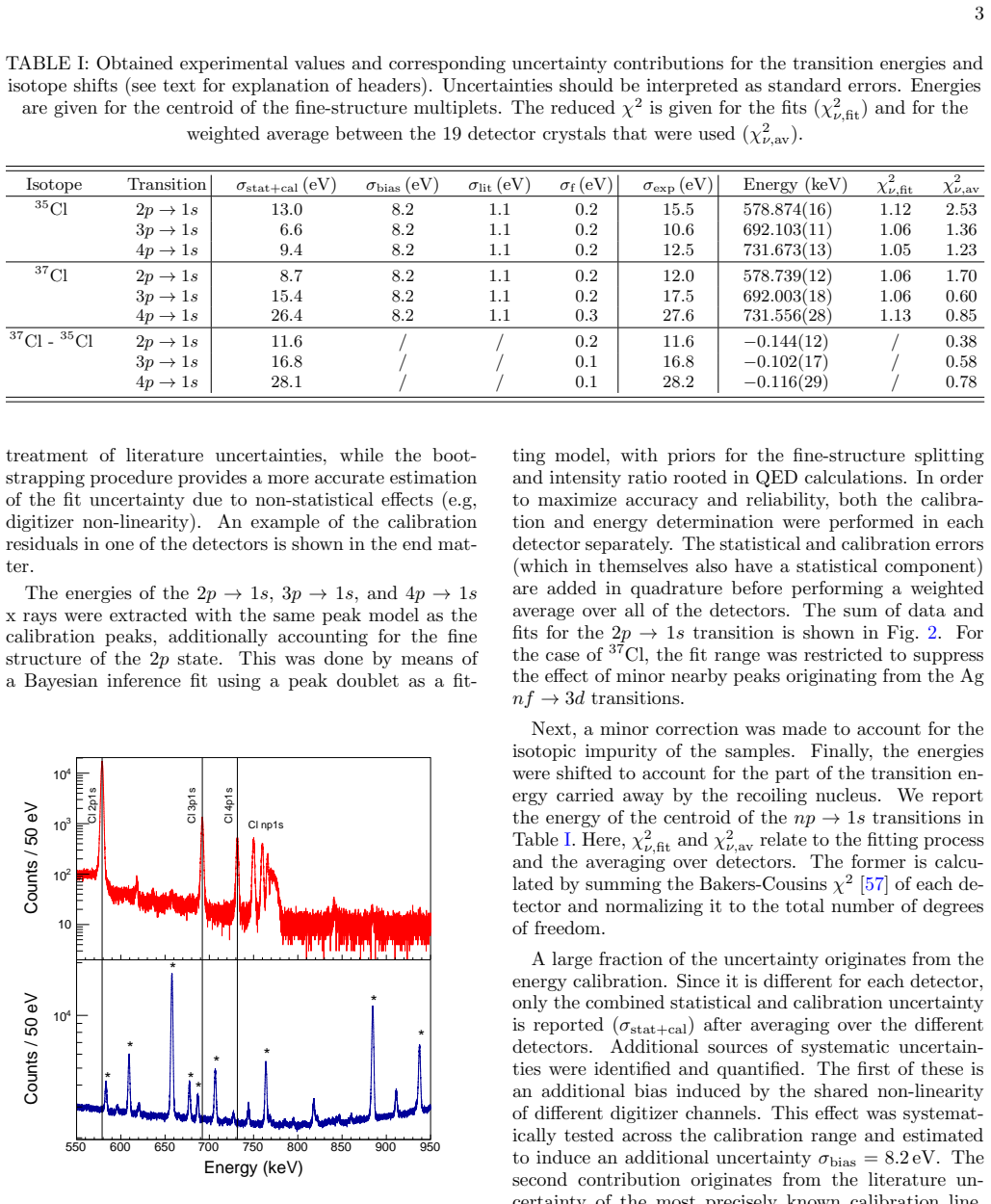
Nuclear charge radii are vital for nuclear and atomic physics, the determination of fundamental constants, and searches for new physics. Muonic atoms, where a single negative muon orbits a nucleus, are sensitive tools for determining nuclear radii due to the large wavefunction overlap of the muon and nucleus. Here we report on a new measurement of the $2, 3, 4p\to1s$ x-ray energies in muonic $^{35,37}$Cl with uncertainties reaching 18 ppm. By employing a large-scale germanium detector array, it was possible to extract these energies from a high statistics dataset using highly enriched samples of only a few tens of milligrams. Combining these results with state-of-the-art atomic and nuclear theory input, the charge radii of the stable chlorine isotopes were determined to be $R(^{35}\text{Cl}) = 3.3333(23)~fm$ and $R(^{37}\text{Cl}) = 3.3444(23)~fm$. This is an order of magnitude more precise and significantly different from previously tabulated values. Our new values solve a discrepancy observed for the charge radius difference in mirror nuclei, agreeing with the overall global trend. The charge radius difference $\delta \langle r^2 \rangle (^{37}\text{Cl} - {^{35}\text{Cl}}) = -0.0776(64)~fm^2$ we extract is 25 times more precise than the previous values. This precision is crucial for establishing reference values for future laser spectroscopy measurements of radioactive isotopes.
Editorial analysis
A structured set of objections, weighed in public.
Referee Report
Summary. The manuscript reports a new measurement of the 2p, 3p, and 4p to 1s x-ray transition energies in muonic atoms of the stable chlorine isotopes 35Cl and 37Cl. Using a large-scale germanium detector array and highly enriched targets of only tens of milligrams, the authors achieve transition-energy uncertainties of 18 ppm from high-statistics data. These energies are combined with external state-of-the-art atomic and nuclear theory corrections to extract the charge radii R(35Cl) = 3.3333(23) fm and R(37Cl) = 3.3444(23) fm, together with the difference δ⟨r²⟩(37Cl − 35Cl) = −0.0776(64) fm², which is stated to be 25 times more precise than previous determinations and to resolve a discrepancy in mirror nuclei.
Significance. If the theoretical corrections can be shown to be accurate at the required level, the work supplies substantially improved reference values for the chlorine charge radii. These are important for nuclear-structure studies, atomic-physics calculations, and as anchors for future laser-spectroscopy measurements on radioactive Cl isotopes. The high-statistics data set obtained with small enriched samples and the resulting precision on the isotope difference constitute clear technical strengths of the measurement.
major comments (2)
- [§5] §5 (Theory corrections and radius extraction): The final radii carry 0.0023 fm uncertainties (0.07 %) that are stated to be dominated by the 18 ppm experimental precision. However, no table or subsection provides the individual magnitudes of the higher-order QED, vacuum-polarization, nuclear-polarization, and finite-size corrections, nor their assigned uncertainties or the propagation into the radius error budget. Without this explicit breakdown it is impossible to verify that theory errors are sub-dominant and isotope-independent, which is load-bearing for the claimed precision and the 25-fold improvement in δ⟨r²⟩.
- [§3–4] §3–4 (Data acquisition and analysis): The pipeline used to extract the transition energies from the germanium spectra—including background modeling, line-shape parametrization, pile-up and dead-time corrections, and the full systematic uncertainty evaluation—is not described in sufficient detail to allow independent assessment of the quoted 18 ppm uncertainties.
minor comments (2)
- [Abstract, §6] The abstract and §6 refer to “state-of-the-art” theory input without citing the specific references or versions of the atomic and nuclear calculations employed.
- [Figures] Figure captions should explicitly state the statistical and systematic contributions to the error bars on the extracted energies.
Simulated Author's Rebuttal
We thank the referee for the careful and constructive review. We address each major comment below and have revised the manuscript to provide the requested details.
read point-by-point responses
-
Referee: [§5] §5 (Theory corrections and radius extraction): The final radii carry 0.0023 fm uncertainties (0.07 %) that are stated to be dominated by the 18 ppm experimental precision. However, no table or subsection provides the individual magnitudes of the higher-order QED, vacuum-polarization, nuclear-polarization, and finite-size corrections, nor their assigned uncertainties or the propagation into the radius error budget. Without this explicit breakdown it is impossible to verify that theory errors are sub-dominant and isotope-independent, which is load-bearing for the claimed precision and the 25-fold improvement in δ⟨r²⟩.
Authors: We agree that an explicit breakdown of the theoretical corrections is necessary to substantiate the error budget. In the revised manuscript we have added a dedicated subsection in §5 together with a new Table 5 that tabulates the individual magnitudes and uncertainties of the higher-order QED, vacuum-polarization, nuclear-polarization, and finite-size corrections for both isotopes. The table also shows the propagation of these contributions into the final radius uncertainties, confirming that theory errors remain sub-dominant to the experimental precision and largely cancel in the isotope difference. revision: yes
-
Referee: [§3–4] §3–4 (Data acquisition and analysis): The pipeline used to extract the transition energies from the germanium spectra—including background modeling, line-shape parametrization, pile-up and dead-time corrections, and the full systematic uncertainty evaluation—is not described in sufficient detail to allow independent assessment of the quoted 18 ppm uncertainties.
Authors: We acknowledge that the description of the analysis pipeline in §§3–4 is not detailed enough for independent verification. In the revised manuscript we have expanded these sections to include a step-by-step account of the background modeling (with explicit functional forms), the line-shape parametrization, the pile-up and dead-time corrections, and the full systematic uncertainty budget with quantitative estimates for each contribution to the 18 ppm uncertainty. revision: yes
Circularity Check
No circularity: measured x-ray energies combined with independent external theory corrections
full rationale
The paper's central result is obtained by measuring 2p,3p,4p→1s x-ray transition energies in muonic 35,37Cl to 18 ppm precision and then subtracting a suite of atomic and nuclear corrections (higher-order QED, vacuum polarization, nuclear polarization, finite-size effects) taken from the existing literature. No equation or step in the provided text defines the extracted radii R(35Cl) or R(37Cl) in terms of a parameter fitted to the same dataset, nor does any load-bearing premise reduce to a self-citation whose validity is established only inside the present work. The theory input is characterized as 'state-of-the-art' external input rather than derived or validated within the paper itself. This is the standard, non-circular workflow for muonic-atom radius extraction.
Axiom & Free-Parameter Ledger
axioms (1)
- domain assumption State-of-the-art atomic and nuclear theory corrections accurately account for all effects beyond the finite nuclear size at the 18 ppm level.
Lean theorems connected to this paper
-
IndisputableMonolith/Foundation/AbsoluteFloorClosure.leanreality_from_one_distinction unclear?
unclearRelation between the paper passage and the cited Recognition theorem.
Combining these results with state-of-the-art atomic and nuclear theory input, the charge radii... R(35Cl)=3.3333(23) fm... δ⟨r²⟩(37Cl−35Cl)=−0.0776(64) fm²
What do these tags mean?
- matches
- The paper's claim is directly supported by a theorem in the formal canon.
- supports
- The theorem supports part of the paper's argument, but the paper may add assumptions or extra steps.
- extends
- The paper goes beyond the formal theorem; the theorem is a base layer rather than the whole result.
- uses
- The paper appears to rely on the theorem as machinery.
- contradicts
- The paper's claim conflicts with a theorem or certificate in the canon.
- unclear
- Pith found a possible connection, but the passage is too broad, indirect, or ambiguous to say the theorem truly supports the claim.
Reference graph
Works this paper leans on
-
[1]
´A. Koszor´ us, X. Yang, W. Jiang, S. Novario, S. Bai, J. Billowes, C. Binnersley, M. Bissell, T. E. Cocolios, 7 B. Cooper,et al., Charge radii of exotic potassium iso- topes challenge nuclear theory and the magic character of N= 32, Nature Physics17, 439 (2021)
work page 2021
-
[2]
F. P. Gustafsson, L. Rodr´ ıguez, R. F. Garcia Ruiz, T. Miyagi, S. W. Bai, D. L. Balabanski, C. L. Binnersley, M. L. Bissell, K. Blaum, B. Cheal,et al., Charge radii measurements of exotic tin isotopes in the proximity of N=50 and N=82, Physical Review Letters135, 222501 (2025)
work page 2025
-
[3]
R. P. de Groote, J. Billowes, C. L. Binnersley, M. L. Bis- sell, T. E. Cocolios, T. Day Goodacre, G. J. Farooq-Smit, D. V. Fedorov, K. T. Flanagan, S. Franchoo,et al., Mea- surement and microscopic description of odd-even stag- gering of charge radii of exotic copper isotopes, Nature Physics16, 620 (2020)
work page 2020
-
[4]
B. A. Marsh, T. Day Goodacre, S. Sels, Y. Tsunoda, B. Andel, A. N. Andreyev, N. A. Althubiti, D. Atanasov, A. E. Barzakh, J. Billowes,et al., Characterization of the shape-staggering effect in mercury nuclei, Nature Physics 14, 1163 (2018)
work page 2018
-
[5]
I. Angeli and K. P. Marinova, Table of experimental nu- clear ground state charge radii: An update, Atomic Data and Nuclear Data Tables99, 69 (2013)
work page 2013
-
[6]
X. Yang, S. Wang, S. Wilkins, and R. G. Ruiz, Laser spectroscopy for the study of exotic nuclei, Progress in Particle and Nuclear Physics129, 104005 (2023)
work page 2023
- [7]
-
[8]
H. De Vries, C. De Jager, and C. De Vries, Nuclear charge-density-distribution parameters from elastic elec- tron scattering, Atomic Data and Nuclear Data Tables 36, 495 (1987)
work page 1987
-
[9]
P. Plattner, E. Wood, L. Al Ayoubi, O. Beliuskina, M. Bissell, K. Blaum, P. Campbell, B. Cheal, R. De Groote, C. Devlin,et al., Nuclear charge radius of 26mAl and its implication for V ud in the quark mixing matrix, Physical Review Letters131, 222502 (2023)
work page 2023
-
[10]
C.-Y. Seng and M. Gorchtein, Data-driven reevaluation off tvalues in superallowedβdecays, Physical Review C109, 045501 (2024)
work page 2024
-
[11]
M. Gorchtein, V. Katyal, B. Ohayon, B. K. Sahoo, and C.-Y. Seng, Cabibbo-kobayashi-maskawa unitarity deficit reduction via finite nuclear size, Phys. Rev. Res. 7, L042002 (2025)
work page 2025
- [12]
-
[13]
M.-Q. Ding, P. Su, D.-Q. Fang, and S.-M. Wang, In- vestigation of the relationship between mirror proton radii and neutron-skin thickness, Chinese Physics C47, 094101 (2023)
work page 2023
-
[14]
S. V. Pineda, K. K¨ onig, D. M. Rossi, B. A. Brown, A. In- corvati, J. Lantis, K. Minamisono, W. N¨ ortersh¨ auser, J. Piekarewicz, R. Powel,et al., Charge radius of neutron- deficient 54ni and symmetry energy constraints using the difference in mirror pair charge radii, Physical Review Letters127, 182503 (2021)
work page 2021
-
[15]
L. Wansbeek, S. Schlesser, B. Sahoo, A. Dieperink, C. Onderwater, and R. Timmermans, Charge radii of ra- dium isotopes, Physical Review C86, 015503 (2012)
work page 2012
-
[16]
V. A. Yerokhin and B. Ohayon, Model-independent de- termination of nuclear charge radii from li-like ions, Phys. Rev. A113, 012804 (2026)
work page 2026
-
[17]
B. Hu, W. Jiang, T. Miyagi, Z. Sun, A. Ekstr¨ om, C. Forss´ en, G. Hagen, J. D. Holt, T. Papenbrock, S. R. Stroberg,et al., Ab initio predictions link the neutron skin of 208Pb to nuclear forces, Nature Physics18, 1196 (2022)
work page 2022
-
[18]
A. Ekstr¨ om, G. Jansen, K. A. Wendt, G. Hagen, T. Pa- penbrock, B. Carlsson, C. Forssen, M. Hjorth-Jensen, P. Navratil, and W. Nazarewicz, Accurate nuclear radii and binding energies from a chiral interaction, Physical Review C91, 051301 (2015)
work page 2015
-
[19]
P. Arthuis, K. Hebeler, and A. Schwenk, Neutron-rich nuclei and neutron skins from chiral low-resolution inter- actions, arXiv:2401.06675 (2024)
-
[20]
E. Chabanat, P. Bonche, P. Haensel, J. Meyer, and R. Schaeffer, A Skyrme parametrization from subnuclear to neutron star densities part II. nuclei far from stabili- ties, Nuclear Physics A635, 231 (1998)
work page 1998
- [21]
-
[22]
P.-G. Reinhard, J. O’Neal, S. M. Wild, and W. Nazarewicz, Extended Fayans energy density functional: optimization and analysis, Journal of Physics G: Nuclear and Particle Physics51, 105101 (2024)
work page 2024
-
[23]
G. Royer and R. Rousseau, On the liquid drop model mass formulae and charge radii, The European Physical Journal A42, 541 (2009)
work page 2009
-
[24]
J. Duflo, Phenomenological calculation for nuclear masses and charge radii, Nuclear Physics A576, 29 (1994)
work page 1994
-
[25]
W. H. King,Isotope shifts in atomic spectra(Springer Science & Business Media, 2013)
work page 2013
-
[26]
B. K. Sahoo, S. A. Blundell, A. Oleynichenko, R. F. Garcia Ruiz, L. V. Skripnikov, and B. Ohayon, Recent advancements in atomic many-body methods for high- precision studies of isotope shifts, Journal of Physics B https://doi.org/10.1088/1361-6455/adacc1 (2024)
- [27]
- [28]
-
[29]
W. Briscoe, H. Crannell, and J. Bergstrom, Elastic elec- tron scattering from the isotopes 35Cl and 37Cl, Nuclear Physics A344, 475 (1980)
work page 1980
-
[30]
Ohayon, Critical evaluation of reference charge radii and applications in mirror nuclei, Atom
B. Ohayon, Critical evaluation of reference charge radii and applications in mirror nuclei, arXiv:2409.08193 (2024)
- [31]
-
[32]
R. F. Garcia Ruiz, M. L. Bissell, K. Blaum, A. Ekstr¨ om, N. Fr¨ ommgen, G. Hagen, M. Hammen, K. Hebeler, J. D. Holt, G. R. Jansen,et al., Unexpectedly large charge radii of neutron-rich calcium isotopes, Nature Physics12, 594 (2016). 8
work page 2016
-
[33]
S. W. Bai, X. Yang, ´A. Koszor´ us, J. C. Berengut, J. Bil- lowes, M. L. Bissell, K. Blaum, A. Borschevsky, P. Camp- bell, B. Cheal,et al., Charge radii of neutron-rich scan- dium isotopes and the seniority symmetry in the 0 f 7/2 shell, Physical Review Letters134, 182501 (2025)
work page 2025
-
[34]
R. Pohl, A. Antognini, F. Nez, F. D. Amaro, F. Biraben, J. M. Cardoso, D. S. Covita, A. Dax, S. Dhawan, L. M. Fernandes,et al., The size of the proton, Nature466, 213 (2010)
work page 2010
-
[35]
R. Pohl, F. Nez, L. M. Fernandes, F. D. Amaro, F. Biraben, J. M. Cardoso, D. S. Covita, A. Dax, S. Dhawan, M. Diepold,et al., Laser spectroscopy of muonic deuterium, Science353, 669 (2016)
work page 2016
-
[36]
J. J. Krauth, K. Schuhmann, M. A. Ahmed, F. D. Amaro, P. Amaro, F. Biraben, T.-L. Chen, D. S. Covita, A. J. Dax, M. Diepold,et al., Measuring theα-particle charge radius with muonic helium-4 ions, Nature589, 527 (2021)
work page 2021
-
[37]
K. Schuhmann, L. M. Fernandes, F. Nez, M. Ab- dou Ahmed, F. D. Amaro, P. Amaro, F. Biraben, T.-L. Chen, D. S. Covita, A. J. Dax,et al., The helion charge radius from laser spectroscopy of muonic helium-3 ions, Science388, 854 (2025)
work page 2025
-
[38]
A. Antognini, N. Berger, T. Cocolios, R. Dressler, R. Eichler, A. Eggenberger, P. Indelicato, K. Jung- mann, C. Keitel, K. Kirch,et al., Measurement of the quadrupole moment of 185Re and 187Re from the hyper- fine structure of muonic x rays, Physical Review C101, 054313 (2020)
work page 2020
-
[39]
S. M. Vogiatzi,Studies of muonic 185, 187 Re, 226Ra, and 248Cm for the extraction of nuclear charge radii, Ph.D. thesis, ETH Zurich (2023)
work page 2023
- [40]
-
[41]
A. Adamczak, A. Antognini, N. Berger, T. E. Cocolios, N. Deokar, C. E. D¨ ullmann, A. Eggenberger, R. Eichler, M. Heines, H. Hess,et al., Muonic atom spectroscopy with microgram target material, The European Physical Journal A59, 15 (2023)
work page 2023
- [42]
-
[43]
Gorchtein, A hitchhiker’s guide to nuclear polariza- tion in muonic atoms, arXiv:2501.15274 (2025)
M. Gorchtein, A hitchhiker’s guide to nuclear polariza- tion in muonic atoms, arXiv:2501.15274 (2025)
- [44]
- [45]
- [46]
-
[47]
J. Grillenberger, C. Baumgarten, and M. Seidel, The high intensity proton accelerator facility, SciPost Physics Pro- ceedings , 002 (2021)
work page 2021
-
[48]
L. Gerchow, S. Biswas, G. Janka, C. Vigo, A. Knecht, S. M. Vogiatzi, N. Ritjoho, T. Prokscha, H. Luetkens, and A. Amato, Germanium array for non-destructive testing (GIANT) setup for muon-induced x-ray emission (MIXE) at the Paul Scherrer Institute, Review of Scientific Instru- ments94, https://doi.org/10.1063/5.0136178 (2023)
-
[49]
H. Scraggs, C. Pearson, G. Hackman, M. Smith, R. Austin, G. Ball, A. Boston, P. Bricault, R. Chakrawarthy, R. Churchman,et al., TIGRESS highly-segmented high-purity germanium clover de- tector, Nuclear Instruments and Methods in Physics Research Section A: Accelerators, Spectrometers, Detectors and Associated Equipment543, 431 (2005)
work page 2005
-
[50]
N. Warr, J. Van de Walle, M. Albers, F. Ames, B. Bastin, C. Bauer, V. Bildstein, A. Blazhev, S. B¨ onig, N. Bree, et al., The miniball spectrometer, The European Physical Journal A49, 1 (2013)
work page 2013
-
[51]
struck.de/sis3316.html(2012), accessed: 26/03/2026
SIS3316 16 channel VME digitizer family,https://www. struck.de/sis3316.html(2012), accessed: 26/03/2026
work page 2012
-
[52]
Skawran,Development of a new method to perform muonic atom spectroscopy with microgram targets, Ph.D
A. Skawran,Development of a new method to perform muonic atom spectroscopy with microgram targets, Ph.D. thesis, ETH Zurich (2021)
work page 2021
-
[53]
J. Campbell and J. Maxwell, A cautionary note on the use of the hypermet tailing function in x-ray spectrom- etry with Si (Li) detectors, Nuclear Instruments and Methods in Physics Research Section B129, 297 (1997)
work page 1997
-
[54]
P. T. Boggs, C. H. Spiegelman, J. R. Donaldson, and R. B. Schnabel, A computational examination of orthog- onal distance regression, Journal of Econometrics38, 169 (1988)
work page 1988
-
[55]
B. Efron and R. J. Tibshirani,An introduction to the bootstrap(Chapman and Hall/CRC, 1994)
work page 1994
-
[56]
B. Efron, Nonparametric estimates of standard error: the jackknife, the bootstrap and other methods, Biometrika 68, 589 (1981)
work page 1981
-
[57]
S. Baker and R. D. Cousins, Clarification of the use of chi-square and likelihood functions in fits to histograms, Nuclear Instruments and Methods in Physics Research 221, 437 (1984)
work page 1984
-
[58]
Heines,Muonic atom spectroscopy of chlorine and potassium isotopes, Ph.D
M. Heines,Muonic atom spectroscopy of chlorine and potassium isotopes, Ph.D. thesis, KU Leuven (2025)
work page 2025
-
[59]
K. Pachucki, V. Lensky, F. Hagelstein, S. Li Muli, S. Bacca, and R. Pohl, Comprehensive theory of the lamb shift in light muonic atoms, Reviews of Modern Physics 96, 015001 (2024)
work page 2024
-
[60]
R. Barrett, Model-independent parameters of the nuclear charge distribution from muonic x-rays, Physics Letters B33, 388 (1970)
work page 1970
- [61]
-
[62]
W. Ryssens, G. Scamps, S. Goriely, and M. Bender, Skyrme-Hartree-Fock-Bogoliubov mass models on a 3D mesh: II. Time-reversal symmetry breaking, The Euro- pean Physical Journal A58, 246 (2022)
work page 2022
- [63]
-
[64]
L. Maisenbacher, V. Wirthl, A. Matveev, A. Grinin, R. Pohl, T. W. H¨ ansch, and T. Udem, Sub-part-per- trillion test of the standard model with atomic hydrogen, 9 Nature , 1 (2026)
work page 2026
-
[65]
S. J. Novario, D. Lonardoni, S. Gandolfi, and G. Hagen, Trends of neutron skins and radii of mirror nuclei from first principles, Phys. Rev. Lett.130, 032501 (2023)
work page 2023
-
[66]
A. J. Miller, K. Minamisono, A. Klose, D. Garand, C. Kujawa, J. Lantis, Y. Liu, B. Maaß, P. Mantica, W. Nazarewicz,et al., Proton superfluidity and charge radii in proton-rich calcium isotopes, Nature Physics15, 432 (2019)
work page 2019
-
[67]
M. Heines, Muonic x ray data for 35,37Cl, 10.5281/zen- odo.15630170 (2025)
-
[68]
G. F. Knoll,Radiation detection and measurement(John & Wiley Sons Inc, 2010)
work page 2010
-
[69]
M.-M. B´ e, V. Chist´ e, C. Dulieu, , E. Browne, V. Chechev, N. Kuzmenko, R. Helmer, A. Nichols, E. Sch¨ onfeld, and R. Dersch,Table of radionuclides (Vol. 1 - A = 1 to 150), Table of Radionuclides, Vol. 1 (Bureau International des Poids et Mesures, 2004). END MA TTER Experimental -The detector array used in this mea- surement consisted of a Miniball clus...
work page 2004
-
[70]
Quoted values are in eV, eV fm −1 and eV fm−2 forα 0, α1 andα 2, respectively
−2.0 ∆E(eVP13) 34.0−3 ∆E(SE) −150.3(40) 29 ∆E(SE−eVP) −2.0(20) ∆E(SErec) 1.3 ∆E(2) rec 6.9 ∆Escreening −0.4 35Cl ∆E(1) rec −1 674.4 144 ∆E(VPrec) 16.8 ∆E(NP) 115.2(250) 37Cl ∆E(1) rec −1 543.9 136 ∆E(VPrec) 15.9 ∆E(NP) 112.0(250) TABLE IV: Parametrization of the calculated QED contributions for the 2p→1stransition in chlorine. Quoted values are in eV, eV ...
discussion (0)
Sign in with ORCID, Apple, or X to comment. Anyone can read and Pith papers without signing in.